There is a fungus known as Armillaria in the Malheur National Forest in eastern Oregon that covers 3.7 square miles of ground.
That number does not fully land until you sit with it. Three point seven square miles. That is bigger than Central Park. Bigger than the entire city of Vatican City. Bigger than most neighborhoods you have ever lived in.
And it is a single organism. One individual. Connected underground through a network of root-like structures called rhizomorphs, living primarily inside the wood of trees it has been slowly killing for somewhere between 2,000 and 8,000 years.
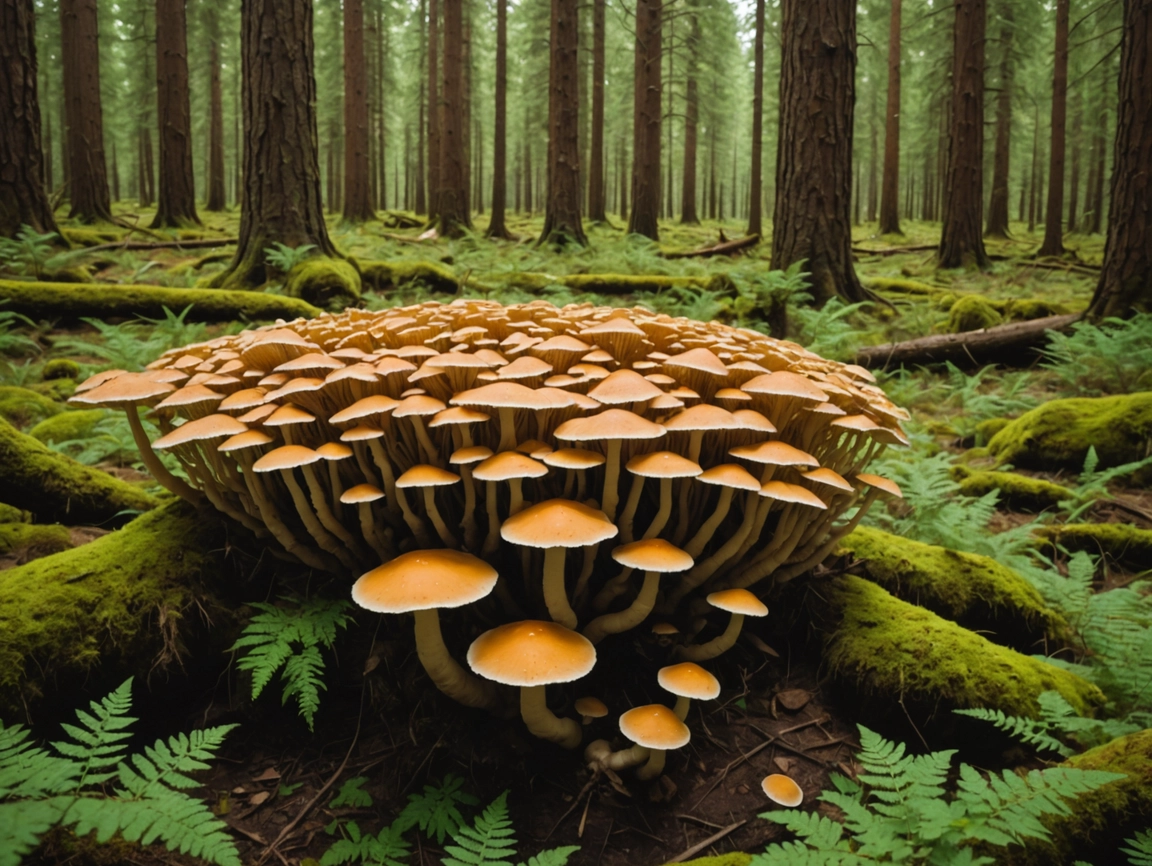
The most remarkable part is what it looks like from the surface. Nothing. A few clusters of small honey-colored mushrooms appear in autumn, scattered across the forest floor like any other woodland fungi. That is it. The largest living thing on earth does not announce itself.
What Armillaria actually is
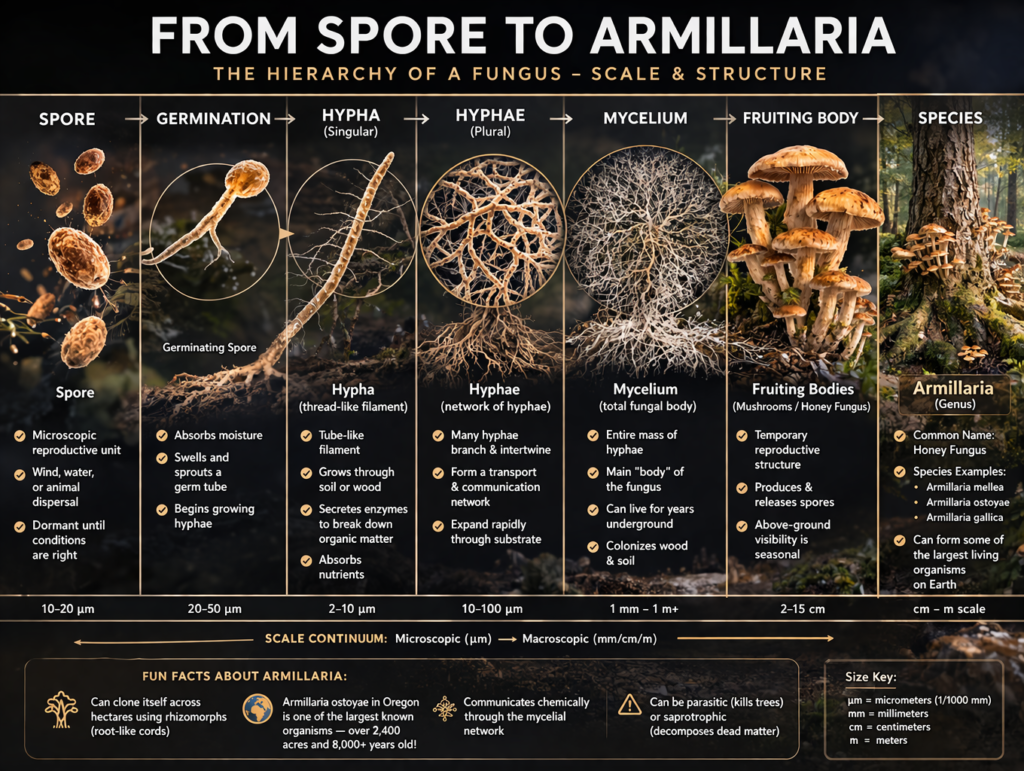
Armillaria is a genus of fungi with around 30 to 40 species found worldwide. Most people who encounter it know it as honey fungus, a name that comes from the warm amber color of the fruiting bodies it occasionally produces above ground. Gardeners in particular know it well, usually because it is killing their trees and there is not much they can do about it.
Below ground, Armillaria lives primarily as mycelium and as rhizomorphs, which are dense cord-like structures that look almost like plant roots but are made entirely of fungal tissue. Rhizomorphs allow Armillaria to travel through soil between trees, extending the organism’s reach far beyond what ordinary mycelium could achieve. They also protect the fungus while it is moving through potentially hostile soil environments.
It feeds by colonizing the root systems and lower trunks of trees, breaking down the wood tissue and extracting nutrients. This makes it a parasite and a decomposer simultaneously. It kills living trees and then continues feeding on their remains after they die. Efficient, if not exactly endearing.
How we know it is one organism
The Oregon Armillaria was identified as a single individual through genetic testing. Researchers collected samples from across the 3.7 square mile area and compared the DNA. Every sample matched. Identical genetic material throughout the entire expanse, which is the definitive confirmation that all of it is one connected organism rather than a collection of genetically similar but separate individuals.
The age estimate is trickier. Dating a fungus is not like counting tree rings. Researchers used a combination of the organism’s size, its known growth rates for the species, and the age of the forest it inhabits to arrive at the 2,000 to 8,000 year estimate. The range is wide because growth rates are difficult to pin down precisely, but even the conservative end of that estimate means this organism was already established before the fall of the Western Roman Empire.
Here is the thing that gets me every time I think about it. The trees this Armillaria is currently living in are not the original trees. This organism has been killing trees, letting them decompose, and then colonising the next generation for thousands of years. The forest around it has changed multiple times over. The organism has not.
Is the Oregon specimen really the largest organism?
It depends on how you define largest and how you define organism, and these are genuinely contested questions in biology.
By area, the Malheur Armillaria is the largest confirmed single fungal organism. There are other large Armillaria individuals on record, including one in Michigan covering about 38 acres and one in Washington State covering around 2,000 acres, but the Oregon specimen exceeds them all.
Other contenders for the title of largest organism include Pando, a clonal colony of quaking aspen in Utah that covers about 106 acres and is made up of some 47,000 individual stems all connected by a single root system. Pando is enormous. But by most biological definitions, a clonal colony of separate stems does not qualify as a single organism in the same way that a genetically continuous fungal network does.
The Armillaria argument is cleaner. One genetic individual. Continuous physical connection. Everything we mean when we say organism.
The honey mushroom: edible and actually good
Here is where Armillaria gets more interesting from a practical standpoint. The fruiting bodies it produces, the honey mushrooms that appear in autumn clusters around the bases of infected trees and on stumps, are edible. Not just edible in a technically-not-poisonous way. Actually good, used in kitchens across Europe and Asia for centuries.
Honey mushrooms have a firm texture that holds up well to cooking, a mild earthy flavor with a slight sweetness that earns the name, and they absorb the flavors of whatever they are cooked with in a way that makes them genuinely versatile. They are widely eaten across Russia, Eastern Europe, and Japan where they are considered a seasonal delicacy rather than just a foraged curiosity.
There is an important caveat though. Honey mushrooms must be thoroughly cooked before eating. Raw or undercooked honey mushrooms cause gastrointestinal distress in most people, and some individuals react even to cooked specimens. The toxins responsible are heat-labile, meaning they break down with sufficient cooking, but lightly sauteed is not sufficient. These need to be properly cooked through.
There is also an identification issue. Honey mushrooms are one of the wild-foraged species most often confused with toxic lookalikes, particularly with the deadly Galerina marginata which shares the same habitat (dead and dying wood), the same season (autumn), and a broadly similar appearance. This is not a beginner foraging target. If you want to eat honey mushrooms, go with an experienced local guide or foraging group the first several times.
The forest’s complicated relationship with Armillaria
Armillaria has a reputation problem. Gardeners and foresters mostly encounter it as a destructive parasite that is nearly impossible to eradicate once established. It kills commercially valuable timber. It destroys ornamental trees. Trying to remove it from a garden or woodland typically involves removing every infected root, which is exhausting and often incomplete.
But the ecological picture is more complicated than that framing suggests. Armillaria primarily targets trees that are already stressed, weakened by drought, disease, overcrowding, or age. In a forest functioning normally, it acts more as a selective pruning mechanism than a random destroyer, removing trees that are already struggling and returning their nutrients to the system.
The gaps it creates by killing trees allow light to reach the forest floor, triggering the regeneration of understory plants and young trees. The decaying wood it feeds on becomes habitat for insects, birds, and other fungi. Armillaria is part of the forest’s cycling process, even when it is acting as a pathogen.
This is a pattern that keeps showing up in mycology. The fungi that look most destructive from one angle are often doing essential work when you zoom out far enough to see the whole system.
What 8,000 years actually means
I keep coming back to the age question because it does something to your sense of scale that is hard to shake.
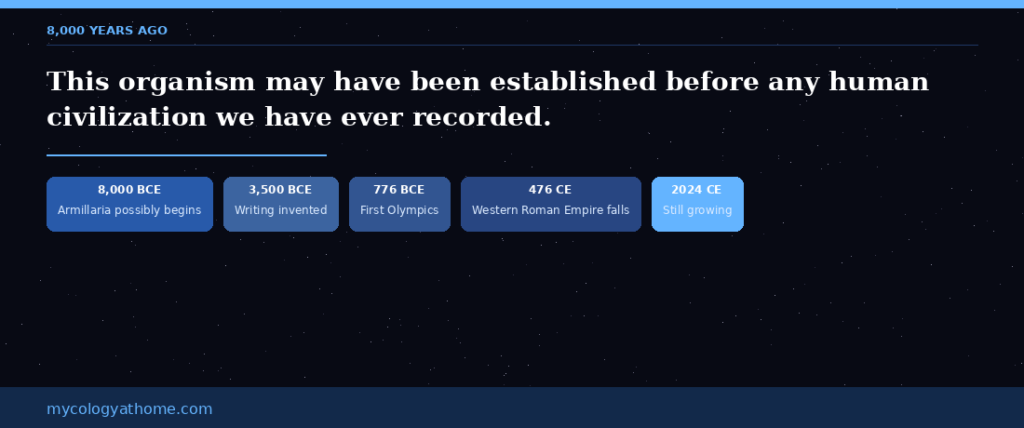
Eight thousand years ago, the Neolithic period was underway. The first permanent human settlements were being built in the Middle East. Stonehenge would not be started for another 3,000 years. Writing had not been invented. Agriculture was new.
The Oregon Armillaria may have already been established before any of that. It has been continuously alive, continuously feeding, continuously expanding through the same patch of eastern Oregon soil while every human civilization we have ever recorded rose and fell around it.
And if you walked through that forest right now, on a day when the honey mushrooms had not yet fruited, you would see nothing unusual. A forest. Some trees. The ground. The largest and possibly oldest living thing on earth, entirely invisible, doing what it has always done.
Why this matters beyond the wow factor
The Armillaria story is genuinely extraordinary on its own terms, but it also illustrates something important about fungi more broadly. The scale at which these organisms operate does not match any mental model most of us start with.
We think of mushrooms as small things that appear briefly on logs and forest floors. The actual organism producing those mushrooms might be older than recorded history and larger than a city neighborhood. The mushroom is just the fruit. What we are not seeing is the point.
Once you understand that, everything about fungi gets more interesting. The lion’s mane fruiting body you might be growing on your kitchen shelf is a temporary reproductive structure produced by an organism that, in the wild, might have been living inside a hardwood tree for decades. The reishi you dry and powder is the annual fruiting of a mycelial network that could be far older than the tree it grows on.
Fungi operate on timescales and at scales that are genuinely alien to the way humans experience the world. Armillaria is just the example dramatic enough to make that undeniable.