A few years ago, if you’d told me I’d eventually spend my weekends pressure cooking grain jars, reading mycology research papers for fun, and genuinely caring about the difference between mycelium on grain and fruiting body extract, I would have looked at you the way you look at someone who has said something mildly concerning at a dinner party. Politely, but with concern.
And yet here we are.
The way it started was completely ordinary. I bought a mushroom grow kit on a whim, mostly out of curiosity and partly because I’d seen someone post a photo of their oyster mushroom harvest online and thought it looked like a fun weekend project. It arrived in a cardboard box. It was a block of substrate in a plastic bag with some instructions printed on a card. Nothing about it suggested it was about to become a gateway to one of the more genuinely fascinating topics I’ve ever stumbled into.
I followed the instructions, put it on my kitchen counter near the window, misted it twice a day, and waited.
About a week later, small white pins started appearing at the cut opening in the bag. Tiny, pale, otherworldly looking things. Within four days they had turned into a full cluster of oyster mushrooms the size of my hand. I genuinely did not expect it to work that well or that fast, and I remember standing in my kitchen at seven in the morning looking at this thing I had apparently grown, feeling disproportionately pleased about it.
The question that started everything
The harvest was good. But what actually got me was the question I couldn’t stop thinking about afterward: what was happening in there?
The block of substrate had been a block of substrate. Then it was covered in white threads. Then it produced mushrooms. The whole thing happened in my kitchen in less than two weeks, and I had no real mental model for any of it. I knew plants grew. I understood, in a vague way, how seeds worked. But this felt different. There was no seed. There was just substrate, and then mycelium, and then mushrooms, and the transition between each stage happened with a speed and efficiency that seemed almost impatient.
I started reading. And this is where things got interesting in a way I didn’t anticipate.
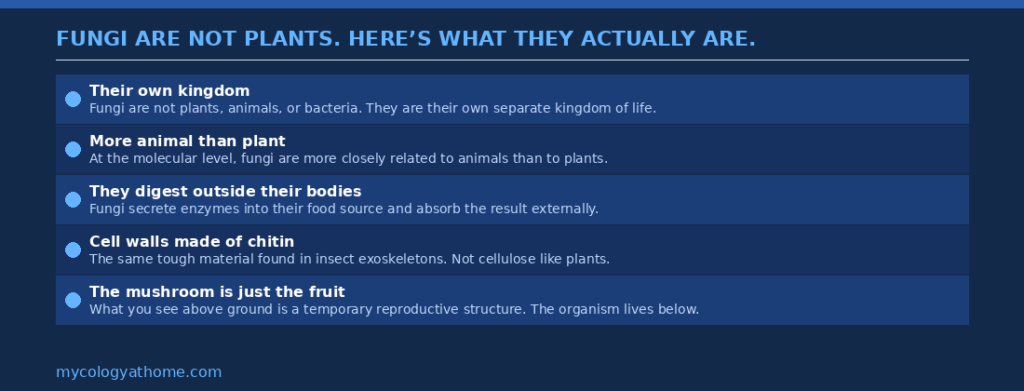
The more I read about what fungi actually are, the more I realized how comprehensively I had misunderstood them. I’d thought of mushrooms as a food, obviously, and vaguely as a category of organism that sat somewhere between plants and the soil. What I found instead was that fungi are their own kingdom entirely, more closely related to animals than to plants at the molecular level, operating through biological mechanisms that have no real analog in anything else alive.
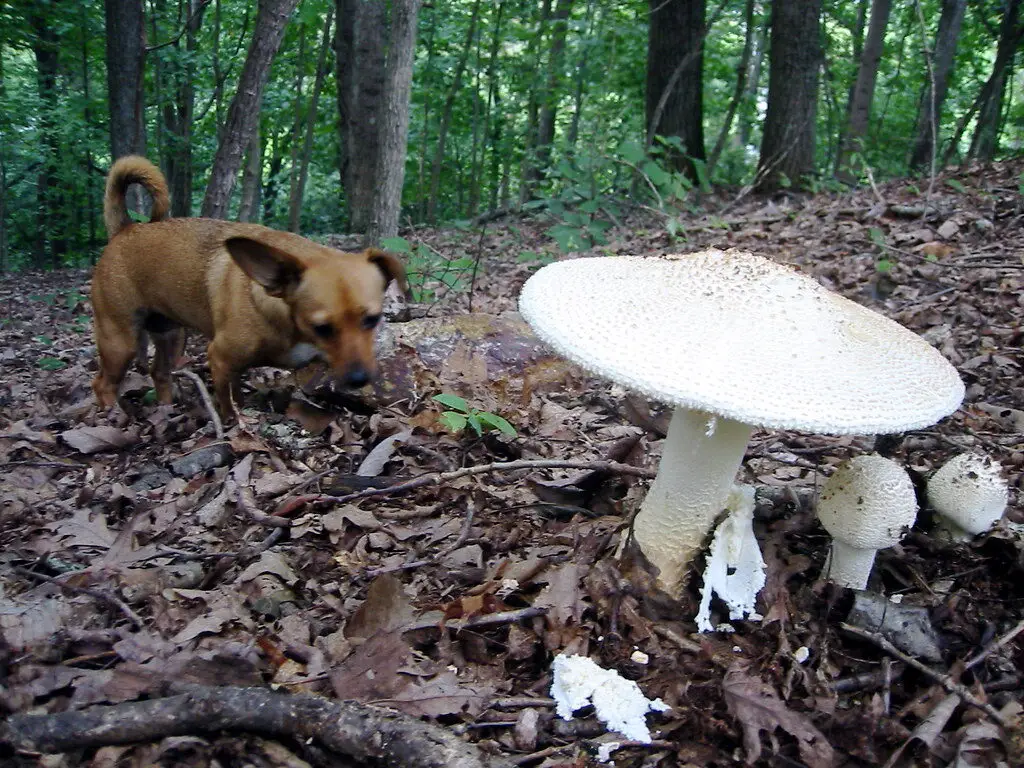
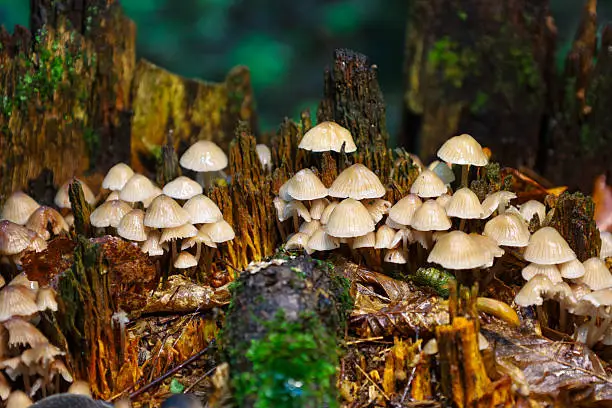
They digest food outside their bodies, secreting enzymes into whatever they’re growing through and absorbing the result. Their cell walls are made of chitin, the same material in insect exoskeletons. The thing you see above ground, the mushroom itself, is just the fruiting body, the temporary reproductive structure sent up by an organism that might be decades old and stretch across an area the size of a parking lot underground.
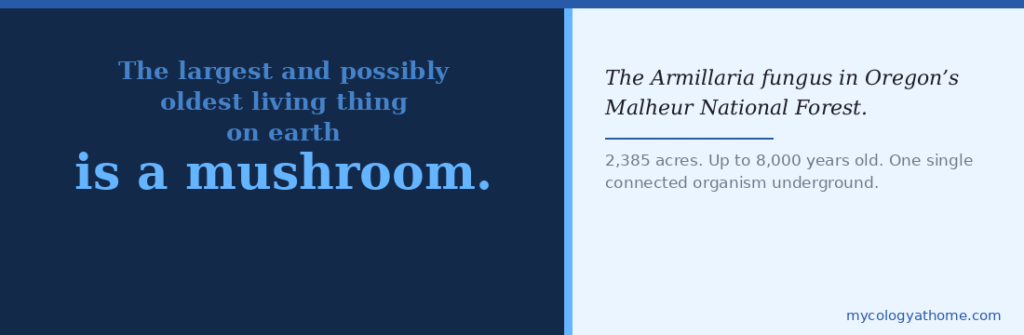
I remember reading about the Armillaria fungus in Oregon’s Malheur National Forest, a single organism that covers about 2,385 acres and is estimated to be somewhere between 2,000 and 8,000 years old, and feeling genuinely unsettled in the best possible way. The largest and possibly oldest living thing on earth is a mushroom. It just doesn’t look like anything.
Medicinal Mushrooms
Growing led to reading about growing, which led to reading about fungi generally, which eventually led to the medicinal mushroom literature. This happened gradually and then all at once, the way these things usually do.
I’d heard of lion’s mane in passing, seen it mentioned in health adjacent content online, and assumed it was probably another supplement with more marketing than evidence behind it. I already felt fairly skeptical of the wellness industry, a skepticism that came from watching too many things get hyped and then quietly disappear.
But when I actually looked at the research rather than the marketing, something different showed up. Not miracle cure research. Researchers shouldn’t present preliminary studies with 12 participants as if they’ve solved aging.Actual, peer-reviewed, replicated work on specific mechanisms. Lion’s mane stimulating nerve growth factor production. Turkey tail’s PSK has been used as an approved cancer treatment adjunct in Japan for decades. Reishi modulates the HPA axis in ways that affect cortisol and sleep architecture. These weren’t vague claims about antioxidants and wellbeing. They were specific mechanisms with specific evidence.
That specificity was what convinced me. I’m not someone who is easily persuaded by general health claims. But I find it genuinely hard to be dismissive of a compound that has been through randomized controlled trials and used clinically in a major country’s healthcare system. The evidence for turkey tail in particular is more robust than most pharmaceutical supplements I’ve looked at, and most people in Western countries have never heard of it.
I started taking lion’s mane and reishi daily. I noticed real things, not dramatic things, but real ones. The mental clarity I’d been hoping for showed up around week three. The sleep improvement from reishi was noticeable within two weeks. Neither effect was enormous. Both were consistent enough to make me keep going.
Growing became something else entirely
Meanwhile, the growing side of things had escalated.
The grow kit had led to buying grain spawn and growing from scratch, which led to learning about substrate preparation and sterilization, which led to my first pressure cooker purchase, which led to the genuinely humbling experience of a completely contaminated first batch. Green mold on everything. A small, sour-smelling disaster on my counter.
But even the failure was interesting. I wanted to understand what went wrong. Why did some bags contaminate while others didn’t? What was the green stuff, and why did it win against my mycelium? Figuring out that the substrate had been too wet and that I’d rushed the inoculation felt like actual problem-solving in a way that a lot of daily life doesn’t. There was a clear cause, a clear effect, and a clear path to doing it differently next time.
Next time went better. The time after that, better still. I grew oyster mushrooms, then lion’s mane, then eventually shiitake on logs in the backyard. Growing lion’s mane was particularly satisfying because I was also taking it as a supplement and there was something pleasing about producing my own. Drying the excess harvest and turning it into powder felt like a small but genuine kind of self-sufficiency.
The growing hobby and the health interest were always separate in my mind initially, but they became harder to separate over time. Understanding how mycelium colonizes substrates made the biology of how beta-glucans form more concrete. Watching reishi develop its distinctive antler growth in high CO2 conditions made the environmental sensitivity of medicinal compound production feel real rather than abstract. The two threads were always the same thread, just approached from different ends.
The thing that surprised me most
I expected to learn about mushrooms. I didn’t expect to have my understanding of ecosystems fundamentally rearranged.
The mycorrhizal network research did that. The idea that forests are connected underground through fungal threads, that trees transfer carbon and nutrients between each other, that chemical warning signals travel through the network when a tree is under attack, is the kind of information that you can’t unhear. Every time I walk through a forest now, which I do more than I used to, I’m aware that the ground underneath is doing something extraordinary and that the trees I’m looking at are not as separate as they appear.
There’s a researcher named Suzanne Simard whose work documented a lot of this! She describes old growth forests as having a social structure, a distribution network with what she calls mother trees at the center. Whether or not you want to use that kind of language, the underlying biology is real, and it changes what a forest is. It goes from being a collection of individual organisms competing for resources to being something more like a community sharing them.
That reframing, from competition to cooperation, from isolated individuals to interconnected systems, runs through a lot of what makes fungi so compelling to think about. They decompose dead wood and return the nutrients to the soil. Connect living plants and enable resource transfer that wouldn’t otherwise be possible. They produce compounds that have given us penicillin and cyclosporin and some of the most interesting natural health substances known. Fungi exist at scales from microscopic hyphae to the largest organism on earth. They are doing more ecological work than almost anything else alive, and they do it largely invisibly.
Why this site exists
Mycology at Home exists because I kept running into the same problem. When I was learning about this stuff: the information available was either too basic, too credulous, or too academic. Health content about medicinal mushrooms tended to either repeat marketing claims without scrutiny or dismiss everything as unproven. Cultivation content tended to assume either beginner status or a level of equipment that most home growers don’t have. The science was scattered across journals and papers that are hard to read if you didn’t study biology.
What I wanted was a resource that would tell me what the evidence actually says, not what the supplement companies want me to believe and not a blanket dismissal of things that have real research behind them. A resource that would walk me through growing without assuming I had a laboratory setup. A resource that treated the science of fungi as something genuinely worth understanding rather than just a backdrop for health claims.
So I built it, or I’m in the process of building it, which is a more honest description of something that keeps growing.
If you’re new here because you bought a grow kit and now have questions, or because you’ve been reading about lion’s mane and want to know if it’s actually worth trying, or because someone sent you a link about the wood wide web and you fell down the same rabbit hole I did, you’re in the right place. The obsession is real, the information is as accurate as I can make it, and there’s a lot more to cover.
Fungi are strange and extraordinary and have been quietly running the world’s biological systems for hundreds of millions of years while we mostly walked past them without a second glance. Paying attention to them feels, to me at least, like one of the more interesting things you can do with your time.