How Long Does Lion’s Mane Take to Work?
Most people notice subtle subjective effects after 2 to 4 weeks of consistent daily use. The cognitive benefits measured in clinical trials emerge at 8 to 16 weeks as nerve growth factor production gradually increases. Some notice acute focus effects within hours of a single dose, but this is different from the cumulative benefit that builds over weeks.
Effects reverse when you stop, which confirms the mechanism is active rather than placebo.
Lion’s mane is not a supplement you take and feel the next morning. The mechanism involves stimulating nerve growth factor production, which is a gradual neurological process, not an acute response. Understanding the timeline sets realistic expectations and stops people from quitting too early.
The clinical evidence on timing comes from four human trials that have measured specific outcomes at specific time points. I cover the dose side of this in my new Lion’s Mane Dosage Guide, which walks through the four trials in detail. This post is about what happens week by week.
Mushroom Supplements: What Works, What’s Misleading, and How to Buy Safely
What happens and when, based on the clinical trials
Five milestones drawn from the four human studies on lion’s mane cognitive outcomes.
Week one and two: probably nothing noticeable
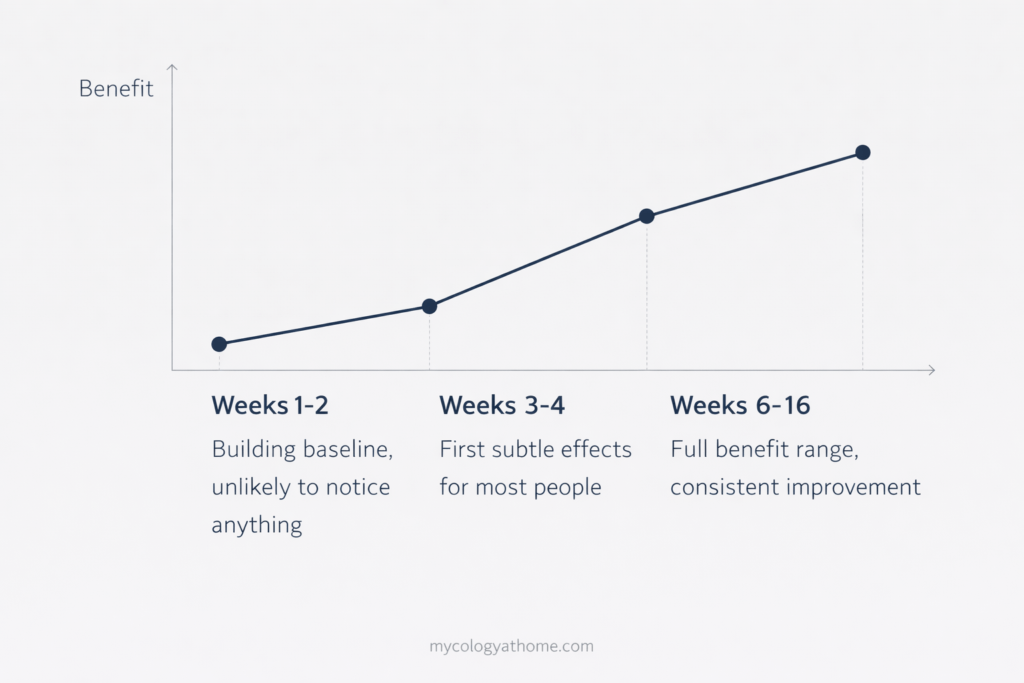
The first two weeks are mostly the supplement establishing a baseline. Some people report a subtle shift in mental clarity toward the end of week two, particularly with higher doses of quality extract. Most people notice nothing, and that is normal.
There is one exception worth knowing about. Docherty et al. 2023 demonstrated acute effects on attention tasks at 60 minutes post-dose in healthy young adults given a single 1.8g dose of fruiting body [3]. So an acute cognitive signal can exist within hours, especially on focus-specific tasks like the Stroop test. But this is different from the cumulative cognitive benefit that takes weeks to build. If you notice something quickly, great. If you do not, that means nothing about whether the supplement will work for you over the full timeline.
The temptation to give up here is real. Resist it. Two weeks is not enough data.
Weeks three and four: first effects for most people
This is typically when people start noticing something. The effects are usually subtle rather than dramatic: a bit less mental fatigue, slightly easier to focus for extended periods, occasionally a noticeable improvement in mood. Do not expect a dramatic cognitive shift.
If you reach four weeks with a quality fruiting body extract at a clinically relevant dose (1,500 mg per day or higher of verified fruiting body material) and notice nothing at all, either the product is underdelivering or lion’s mane simply is not going to produce a noticeable subjective effect for you. Individual variation is real. Before concluding either way, verify you are actually taking a fruiting body product (not mycelium-on-grain) and that the dose matches what the research supports.
I Tried Lion’s Mane Every Day for 30 Days. Here’s What Happened
Six weeks and beyond: the full picture
The landmark clinical trial on cognitive outcomes ran for 16 weeks. Mori et al. 2009 gave 30 adults aged 50 to 80 with mild cognitive impairment either 3,000 mg per day of dried fruiting body powder or a placebo for 16 weeks, then tracked them through a four-week washout period after stopping. The treatment group showed significantly improved scores on the Revised Hasegawa Dementia Scale at weeks 8, 12, and 16. Scores declined measurably after discontinuation [1]. The reversal is important: it confirms the mechanism was genuinely driving the improvement, not placebo.
Saitsu et al. 2019 replicated a similar pattern in healthy older adults (n=31, age 55-65) at 3,200 mg per day for 12 weeks [2]. And Li et al. 2020 extended the window to 49 weeks with an erinacine A-enriched mycelium product in mild Alzheimer’s patients, showing continued cognitive support at this much longer duration [4].
For long-term use, most people find the benefits plateau at a certain point and remain stable as long as supplementation continues. Lion’s mane is a maintenance supplement as much as it is an improvement one.
What affects the timeline
Four variables determine how fast you notice something, and all four matter.
Product quality. A quality fruiting body extract works faster and more noticeably than a mycelium-on-grain product. Mycelium-on-grain does not contain hericenones (the NGF-stimulating compounds from the fruiting body), so the timeline measured in clinical trials may not apply to that form at all. If you are taking a mycelium-on-grain product and wondering why nothing is happening at week four, that may be the entire answer. My breakdown of mycelium on grain covers why this matters.
Dose. The clinical trials used 1,050 to 3,200 mg per day of actual fruiting body material. A reasonable starting dose for most people is 1,500 to 2,000 mg per day of verified-quality fruiting body. Below 1,000 mg per day, you are under the clinical floor and effects may never emerge regardless of how long you wait. The Lion’s Mane Dosage Guide walks through what each trial actually used and what that means for a starting dose.
Consistency. Missing doses significantly slows the timeline. Daily use is not optional if you want the research-supported outcomes. The cumulative NGF signaling that drives the cognitive effects depends on steady intake, not intermittent high doses.
Individual variation. Some people are more responsive than others. Age, baseline cognitive function, and general neurological health all play a role. People aged 50 and older with mild cognitive impairment showed the largest and most measurable effects in the trials. Healthy younger adults tend to show more modest subjective changes.
Why two people on the same dose get different timelines
All four of these matter. Ignoring any of them can turn what should be a 4-week effect into a “lion’s mane does not work for me” conclusion that is not actually supported.
Product Quality
Fruiting body extract works. Mycelium-on-grain lacks hericenones entirely.
Dose
1,000 mg/day clinical floor. 1,500-2,000 mg/day is a reasonable start.
Consistency
Daily use required. NGF signaling is cumulative, not intermittent.
Individual Variation
Age, baseline cognitive function, and neurological health all affect responsiveness.
What Are Beta-Glucans? The Compound Behind Mushroom Supplements
Mycelium on Grain Explained for Supplement Users
When to give up
After eight weeks at a 1,500-2,000 mg daily dose of a third-party-tested fruiting body product, if you still notice nothing, lion’s mane may not be the right supplement for your physiology. That is a legitimate conclusion. It does not mean the research is wrong. It does not mean you are doing something wrong. It means the signal-to-noise ratio for you personally is too low to be worth continuing.
If you have not addressed the four variables above, addressing them first is the cheaper move than quitting. A lot of people write off lion’s mane after running 500 mg per day of a mycelium product for two weeks. That is not a fair test. Eight weeks at 1,500 mg per day of a quality fruiting body extract is a fair test.
The bottom line
Two to four weeks for first subjective effects. Eight to 16 weeks for the cumulative cognitive benefit the clinical trials measured. If you are not there yet, keep going. If you have given it a fair run (eight weeks, 1,500+ mg per day, verified-quality fruiting body) and still noticed nothing, lion’s mane is unlikely to work well for you.
If you are still figuring out what dose and product to try, start with the Lion’s Mane Dosage Guide, which walks through what the research actually supports.
Is Lion’s Mane Good for You? Benefits & Side Effects
Now that you know the timeline, check your dose
Most of the “lion’s mane did not work for me” stories trace back to dosing too low or using a mycelium-on-grain product that lacks the active compounds. The Dosage Guide walks through what the research actually supports.
References
[1] Mori K, Inatomi S, Ouchi K, Azumi Y, Tuchida T. Improving effects of the mushroom Yamabushitake (Hericium erinaceus) on mild cognitive impairment: a double-blind placebo-controlled clinical trial. Phytotherapy Research. 2009;23(3):367-372. PubMed
[2] Saitsu Y, Nishide A, Kikushima K, Shimizu K, Ohnuki K. Improvement of cognitive functions by oral intake of Hericium erinaceus. Biomedical Research. 2019;40(4):125-131. PubMed
[3] Docherty S, Doughty FL, Smith EF. The acute and chronic effects of Lion’s mane mushroom supplementation on cognitive function, stress and mood in young adults: a double-blind, parallel groups, pilot study. Nutrients. 2023;15(22):4842. PMC
[4] Li IC, Chang HH, Lin CH, et al. Prevention of Early Alzheimer’s Disease by Erinacine A-Enriched Hericium erinaceus Mycelia Pilot Double-Blind Placebo-Controlled Study. Frontiers in Aging Neuroscience. 2020;12:155. Frontiers
Not medical advice. For informational purposes only. See Medical Disclaimer.