How Much Lion’s Mane Should You Take? A Dosage Guide
How Much Lion’s Mane Should You Take?
Dosage is the question people ask when they have already decided to try it. The honest answer starts with the clinical trials, not the supplement labels.
across 4 clinical trials
Dosage is the question people ask when they have already decided to try lion’s mane. Most of what comes up when you search it is either unhelpfully vague (“take as directed”) or confidently precise in a way that is not supported by the evidence. The honest answer is in between, and it requires understanding one key variable that the supplement industry tends to hide: dose is meaningless without knowing the form of the product.
A gram of whole dried fruiting body powder is not the same as a gram of 10:1 fruiting body extract, which is not the same as a gram of mycelium-on-grain powder, which is not the same as a gram of erinacine-enriched mycelium extract. The clinical trials use these forms at very different doses, and the effects at those doses are not interchangeable.
So here is the honest dosage guide, anchored to the four human clinical trials that actually exist for lion’s mane, not to marketing language.
The evidence-based dose range
Four human trials, four dose points
Every dose range in this guide traces back to these four published trials. Nothing invented, nothing extrapolated beyond what the data supports.
MCI in older adults (16 weeks)
30 adults aged 50-80 with mild cognitive impairment. 96% dried fruiting body powder. Significant HDS-R improvement at weeks 8, 12, and 16.
Healthy older adults (12 weeks)
31 healthy adults aged 55-65. Fruiting body in capsule form. Significant MMSE improvement vs placebo.
Healthy young adults (28 days + acute)
41 adults aged 18-45. Fruiting body, three 600 mg capsules. Faster Stroop task at 60 minutes; trend toward reduced stress at 28 days.
Mild Alzheimer’s (49 weeks)
Erinacine A-enriched mycelium, three 350 mg capsules. MMSE and IADL improvements at 49 weeks.
Four randomized controlled trials in humans have used lion’s mane at doses in the range of 1,000 to 3,200 mg per day. Every trial that produced a positive cognitive or mood result fell inside this range. The specific doses, populations, and forms used were:
Mori et al. 2009 (Phytotherapy Research): 3,000 mg per day of 96% dried fruiting body powder, taken as four 250 mg tablets three times daily, for 16 weeks. Population: 30 adults aged 50 to 80 with mild cognitive impairment. Result: significantly improved scores on the Revised Hasegawa Dementia Scale at weeks 8, 12, and 16 [1].
Saitsu et al. 2019 (Biomedical Research): 3,200 mg per day of fruiting body powder in capsule form, for 12 weeks. Population: 31 healthy older adults aged 55 to 65. Result: significant improvement on the Mini-Mental State Examination compared to placebo [2].
Docherty et al. 2023 (Nutrients): 1,800 mg per day of fruiting body (three 600 mg capsules), for 28 days plus an acute single-dose protocol. Population: 41 healthy adults aged 18 to 45. Result: faster performance on the Stroop task at 60 minutes post-dose, and a trend toward reduced subjective stress after 28 days [3].
Li et al. 2020 (Frontiers in Aging Neuroscience): 1,050 mg per day (three 350 mg capsules) of erinacine A-enriched mycelium, for 49 weeks. Population: patients with mild Alzheimer’s disease. Result: improvements on the Mini-Mental State Examination and Instrumental Activities of Daily Living scores [4].
The practical range that emerges from the trials is 1,000 to 3,200 mg per day of actual mushroom material. Most quality fruiting body products settle around 1,000 to 2,000 mg per day as a standard serving. Higher-potency extracts use less weight because the active compounds are concentrated. Erinacine-enriched mycelium products run lower because the bioactive concentration per milligram is higher.
Why the form matters more than the number
The biggest mistake people make reading supplement labels is assuming that “1,000 mg of lion’s mane” means the same thing across products. It does not.
Four forms. Four different doses. Not interchangeable.
A gram of whole dried fruiting body is not the same as a gram of 10:1 extract, which is not the same as a gram of mycelium-on-grain.
Whole Fruiting Body Powder
Dried, milled lion’s mane fruit. What Mori 2009 and Saitsu 2019 used. Essentially dried mushroom in capsule form.
Fruiting Body Extract
Hot water and/or alcohol extraction concentrates active compounds. 8:1 or 10:1 ratios standard. Real extracts at lower doses can reach clinical relevance.
Mycelium-on-Grain
Mycelium grown on oats/rice, dried and ground together. Mostly grain. No hericenones. Not clinically validated for cognitive outcomes.
Erinacine-Enriched Mycelium
Mycelium cultivated to concentrate erinacine A, then extracted. What Li et al. 2020 used. Rarer, higher-priced, lower effective dose per mg.
Whole fruiting body powder. Dried and milled lion’s mane fruit. This is what Mori 2009 and Saitsu 2019 used. Clinical-grade products at this form typically require 3,000 mg or more per day to match the trial doses. You are essentially eating dried mushroom in capsule form, so you need more of it.
Fruiting body extract (concentrated). The fruiting body processed through hot water, alcohol, or both (dual extraction) to concentrate the active compounds. Labeled by extraction ratio like 8:1 or 10:1, meaning eight or ten grams of raw mushroom went into each gram of finished extract. Docherty 2023 used a 10:1 extract at 1.8g per day, which corresponds to roughly 18 grams of raw mushroom equivalent. Products using real concentrated extracts at 1,000 to 1,500 mg per day can reach clinical relevance.
Mycelium-on-grain. A completely different product category. This is mycelium grown on a grain substrate (usually oats or rice), then dried and ground together. It is largely grain with a small amount of mycelium, and it does not contain hericenones (which are only found in the fruiting body). I explain why this matters in detail in my post on mycelium on grain. A product labeled as “1,000 mg of lion’s mane” that is really mycelium-on-grain is not equivalent to 1,000 mg of fruiting body, and no clinical trial has validated this form for cognitive outcomes.
Erinacine A-enriched mycelium extract. A specialized form where mycelium is cultivated under conditions that produce higher concentrations of erinacine A, then extracted. This is what Li et al. 2020 used at 1,050 mg per day. These products are rarer and generally higher-priced, but the active compound concentration can make lower doses clinically meaningful.
If you want to understand the practical differences between these forms in more depth, the difference between mushroom supplement and extract post lays out exactly how each one is produced and why the concentration math matters.
Dosing by goal
The clinical trials have targeted specific outcomes, and the doses that worked for those outcomes differ. Here is what the evidence supports for common reasons people take lion’s mane:
The clinically tested doses for the reasons people actually take lion’s mane
Evidence-anchored targets. If a goal is not listed, the research has not clearly established a dose for it.
Cognitive support in older adults
Strongest evidence from Mori 2009 and Saitsu 2019. 12-16 weeks minimum. Fruiting body powder at clinical doses, or concentrated extract at roughly 1/3 of the equivalent weight.
Focus & performance in healthy adults
Docherty 2023 demonstrated acute effects from a single 1.8g dose and trend toward stress reduction at 28 days of daily 1.8g. Lower doses not formally tested in this population.
Mood & mild anxiety
Vigna 2019 at 1,500 mg/day for 8 weeks. Docherty 2023 stress trend at 1,800 mg/day. Effects more modest than cognitive outcomes but consistent across studies.
Nerve support & NGF effects
Mechanistically plausible from hericenone/erinacine NGF stimulation. No dose-response human trials specifically for peripheral neuropathy. Stay within clinically validated range.
General maintenance
Lowest clinically tested daily dose that produced measurable effects. Below this, research evidence is thin or absent.
Cognitive support in older adults. The strongest evidence here, from Mori 2009 and Saitsu 2019. Effective doses were 3,000 to 3,200 mg per day of fruiting body powder for 12 to 16 weeks. If using a concentrated extract, 1,000 to 2,000 mg per day of an 8:1 or 10:1 extract approximates the same raw-mushroom equivalent.
Focus and performance in healthy young adults. The Docherty 2023 study showed acute effects from a single 1.8g dose of fruiting body and a trend toward stress reduction after 28 days of daily 1.8g. Lower doses have not been formally tested in this population, so 1,500 to 2,000 mg per day is a reasonable starting point with current evidence.
Nerve injury recovery or neuropathy support. Mechanistically, lion’s mane stimulates nerve growth factor synthesis, which is why it is studied in the context of neuropathy. Human evidence here is thinner, but the doses that have shown NGF-related effects in preclinical work are in the same 1,000 to 3,000 mg daily range. There are no dose-response trials specifically for peripheral neuropathy in humans yet. If you are taking lion’s mane for nerve-related reasons, staying within the clinically tested range makes sense.
Mood and anxiety. The Vigna et al. 2019 study used 1,500 mg per day of fruiting body extract for eight weeks in overweight or obese participants and reported improvements in anxiety and depression measures. The Docherty 2023 stress trend was at 1,800 mg per day. For mood purposes, 1,500 to 2,000 mg per day of quality fruiting body is a reasonable target.
General maintenance and antioxidant support. The lowest clinically tested daily dose that produced measurable effects was around 1,000 mg per day. Below that, the evidence is thin or absent. If you are taking lion’s mane for general health rather than a specific outcome, 1,000 to 1,500 mg per day of fruiting body is where the research floor sits.
How long before you notice anything
Dose is one variable. Time is the other. The clinical trials that produced cognitive results ran for 12 to 16 weeks at minimum, and the Li 2020 Alzheimer’s study ran for 49 weeks before measuring outcomes.
Dose is one variable. Time is the other.
Short version: plan on at least 4-8 weeks before judging whether the product is doing something for you.
Some effects are faster than that. Docherty 2023 demonstrated an acute effect on the Stroop task at 60 minutes after a single dose. Subjective reports of energy, focus, or gut comfort often show up within the first one to two weeks. But the documented cognitive benefits (memory, concentration, mental processing speed) take weeks to emerge because they depend on cumulative nerve growth factor signaling.
I wrote a full breakdown of the timeline in my post on how long lion’s mane takes to work. The short version: plan on at least four to eight weeks before making any judgment about whether the product is doing something for you. Stopping after a week because “I do not feel anything yet” is likely to miss the effect that the research supports.
When to take it
The clinical trials split the daily dose across multiple administrations (Mori used three doses per day, Saitsu and Docherty used a single morning dose). There is no strong evidence that one schedule outperforms the other.
Practical considerations that may matter:
- Lion’s mane contains some stimulatory-feeling compounds for some people, particularly when taken in the late afternoon or evening. If you are sensitive, mornings are safer.
- Splitting a high dose (2,000+ mg) into two administrations reduces GI side effects in people who experience them.
- Taking lion’s mane with food slows absorption slightly but improves tolerance for sensitive stomachs.
- Consistency matters more than timing. A dose taken at the same time every day produces more predictable effects than the same total dose taken haphazardly.
Safety and side effects
Lion’s mane is generally well-tolerated in all of the human trials conducted to date. The Mori 2009 study reported mild gastrointestinal symptoms balanced between treatment and placebo groups, meaning they did not appear to be caused by the mushroom itself [1]. The Docherty 2023 study reported no significant adverse events at 1.8g per day over 28 days.
That said, there are real things to be aware of.
What can happen, ranked by how common it is
Lion’s mane is well-tolerated in all clinical trials to date. But “well-tolerated” does not mean “zero side effects.” Here is the honest picture.
Mild GI symptoms
Bloating, soft stool, mild nausea. Usually transient, resolves in 1-2 weeks as the gut adapts. Worse on empty stomach.
Skin contact sensitivity
Rare contact dermatitis reported in people handling raw mushroom or (less commonly) the powder. Discontinue if skin irritation appears.
Allergic reactions
Lion’s mane is a mushroom. People allergic to other mushrooms can be allergic to this one. Try a small first dose and monitor.
Respiratory reactions
One case report of acute respiratory distress in a patient taking H. erinaceus extract (Nakatsugawa 2003). Unclear mechanism, single case in decades of widespread use.
Mild antiplatelet activity
Preclinical work suggests mild anticoagulant potential. Clinical relevance not established, but worth knowing if you take blood thinners.
Gastrointestinal symptoms. The most common side effect is mild GI discomfort: bloating, soft stool, nausea, or cramping. Usually transient, usually resolves within a week as the gut adjusts, and usually milder with food. If GI symptoms persist beyond two weeks, reduce the dose or discontinue.
Skin contact sensitivity. Rare cases of contact dermatitis have been reported in people handling raw lion’s mane or, less commonly, the supplement powder. If you notice skin irritation after handling the product, discontinue.
Respiratory reactions. A case report documented acute respiratory distress in a patient taking Hericium erinaceus extract, though the mechanism was unclear and this was a single case in decades of widespread use [5]. Worth knowing, not worth panicking about.
Anticoagulant effects. Some preclinical work suggests lion’s mane may have mild antiplatelet or anticoagulant activity. The clinical relevance of this is not well established, but it becomes potentially relevant if you take blood thinners (see below).
Allergic reactions. Lion’s mane is a mushroom. People allergic to other mushrooms can be allergic to this one. First-time users should try a small dose and monitor for any reaction.
Drug interactions to know about
This is where honest discussion of mushroom supplements departs from most consumer content. Supplement blogs routinely gloss over interactions. The research literature does not.
Blood thinners. If you take warfarin, apixaban, rivaroxaban, dabigatran, clopidogrel, or aspirin as an anticoagulant, talk to your pharmacist or prescribing physician before starting lion’s mane. The interaction is not clinically confirmed in humans, but the mechanism is plausible enough that caution is warranted.
Diabetes medications. Some mushroom supplements can affect blood sugar modestly. If you take insulin or oral diabetes medications, monitor blood glucose more closely during the first month on lion’s mane to catch any unexpected drops.
Immunosuppressants. Lion’s mane has immunomodulatory effects through its beta-glucan content. If you take immunosuppressive medications after organ transplant or for autoimmune conditions, consult your prescribing physician before adding lion’s mane.
Chemotherapy. Do not combine any mushroom supplement with active cancer treatment without explicit oversight from your oncology team. The interactions with specific chemotherapy regimens are rarely well characterized, and the risk-benefit math is different during cancer treatment.
None of this is a list of absolute contraindications. It is a list of situations where your clinician should know what you are adding to your regimen so they can monitor appropriately.
Tell your clinician what you are taking
Most consumer mushroom content skips this section. The research literature does not. If any of these apply, talk to your pharmacist or prescribing physician before starting.
Anticoagulants
Warfarin, apixaban, rivaroxaban, dabigatran, clopidogrel, aspirin. Preclinical antiplatelet signal; clinical relevance unconfirmed but warrants caution.
Diabetes medications
Insulin and oral glucose-lowering drugs. Monitor blood sugar more closely during the first month to catch any unexpected drops.
Immunosuppressants
Transplant and autoimmune medications. Lion’s mane has immunomodulatory effects via beta-glucans. Consult prescribing physician first.
Active chemotherapy
Do not combine any mushroom supplement with active cancer treatment without explicit oversight from your oncology team.
Pregnancy, nursing, and children
Lion’s mane has not been formally evaluated for safety during pregnancy or breastfeeding. The default clinical position for unvalidated supplements during pregnancy is to avoid them unless a physician specifically recommends otherwise. Do not give lion’s mane to children without guidance from a pediatrician. Childhood dosing does not scale linearly from adult trials.
What affects whether your dose actually works
Two products labeled “1,000 mg lion’s mane” can deliver wildly different amounts of actual bioactive material. The variables that matter:
What separates a good 1,000 mg from a useless 1,000 mg
Two products with identical labels can deliver very different amounts of active compound. These are the four variables that matter.
Beta-glucan content verified
Quality fruiting body typically contains 20-40% beta-glucans by dry weight via proper enzymatic assay. Full breakdown of beta-glucans.
Dual extraction (or clearly documented single method)
Hericenones are alcohol-soluble. Polysaccharides are water-soluble. Dual extraction captures both.
Third-party certificate of analysis available
A published CoA showing beta-glucan content, heavy metals, and contamination testing. What to look for in a CoA.
Fruiting body source, not mycelium-on-grain
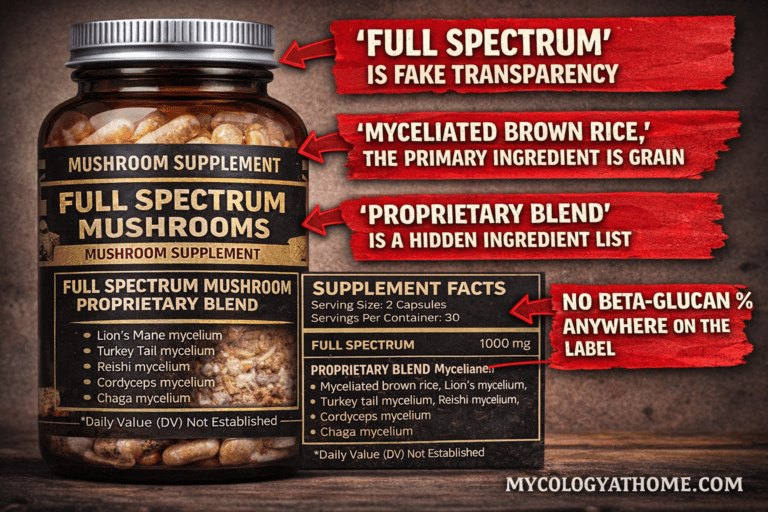
Hericenones only exist in the fruiting body. “Full spectrum” and “whole mushroom complex” often mean mycelium-on-grain. How to spot it.
Beta-glucan content. Beta-glucans are one of the measurable markers of mushroom product quality. Quality lion’s mane fruiting body typically contains 20 to 40 percent beta-glucans by dry weight when measured by proper enzymatic assay. I cover how this works in detail in my post on beta-glucans. Products that cannot document their beta-glucan content, or that use cheaper polysaccharide assays that include the grain starches in mycelium products, are suspect.
Extraction method. Hericenones are fat-soluble and pull into alcohol extractions. Polysaccharides (including beta-glucans) are water-soluble and pull into hot water extractions. Products using dual extraction capture both. Products using only one method miss half the active chemistry.
Third-party testing. A product that publishes a certificate of analysis showing beta-glucan content, heavy metals, and contamination testing is verifying what it claims. A product that does not is asking you to take the label at face value.
Source material. Lion’s mane grown on sawdust fruits differently than lion’s mane grown on supplemented substrates, and the resulting bioactive profiles differ. Most clinical trials have used commercially produced fruiting bodies from controlled cultivation, not wild-harvested material.
These are the quality variables that determine whether your dose matches what was tested in research. I cover product-level evaluation in my upcoming buying guide for best lion’s mane supplements (coming soon), which applies the five-step framework to specific products on the market.
What to do if you are not feeling anything
Not feeling anything? Check these five things before giving up.
Run through these in order. If you have addressed all five and still see nothing at 8 weeks, lion’s mane may not be your supplement.
Has it been at least 4-8 weeks?
Cognitive effects take time. Two weeks in is too early to judge.
Is the product actually fruiting body?
Read carefully. “Full spectrum” / “whole mushroom complex” / “mushroom blend” often mean mycelium-on-grain.
Is the dose too low?
500 mg/day of fruiting body is below the clinical floor. Try 1,500-2,000 mg for 6-8 weeks.
What were you expecting?
Effects are measurable but often subtle. Not caffeine-like stimulation.
Can the brand verify quality?
No CoA, no beta-glucan data, no third-party testing = you might be dosing correctly on a product that does not contain what matters.
A common experience: you start lion’s mane at 1,000 mg per day for a few weeks and notice nothing. Before deciding the product does not work, check these variables in order:
- Has it been at least four to eight weeks? Cognitive effects take time. If you are two weeks in, you may simply not be far enough along.
- Is the product actually fruiting body? Read the label carefully. Words like “full spectrum,” “whole mushroom complex,” or “mushroom blend” often mean mycelium-on-grain without saying so. If you cannot tell from the label, the product likely is not a clinical-grade fruiting body product.
- Is the dose too low? If you are at 500 mg per day of fruiting body powder, that is below the clinical floor. Try 1,500 to 2,000 mg per day of a quality product for six to eight weeks before concluding it does not work.
- What is your expected outcome? “Feeling a difference” is subjective. The effects on memory and cognitive processing are measurable in trials but often subtle in individual experience. If you were expecting caffeine-like stimulation, that is not what lion’s mane produces.
- Is the product quality adequate? If the brand cannot produce a certificate of analysis showing beta-glucan content and contamination testing, you may be dosing correctly on a product that does not contain much of what matters.
If you have addressed all five variables and still see nothing at eight weeks on a 1,500+ mg daily dose of a verified-quality fruiting body product, lion’s mane may simply not be doing much for your specific physiology. Individual variation is real. It does not mean the research is wrong, and it does not mean you are doing something wrong. It means this supplement is not the one for you, and that is a legitimate conclusion.
Now that you know the dose, you need the right product
Dose is one variable. Product quality is another. The buying guide walks through specific products evaluated against the same five-step framework, and the how-long-to-work post covers the timeline in depth.
Frequently asked questions
The longest formal trial ran 49 weeks with no safety signals. Traditional use in East Asian food and medicine goes back centuries. Daily use appears safe for most healthy adults, but because long-term controlled data is limited, some practitioners recommend periodic breaks (a week off every few months). This is a reasonable default but not based on strong evidence either way.
Yes. There is no established interaction. Some products combine them (mushroom coffee drinks), though the lion’s mane dose in those drinks is typically well below the clinical range.
For fruiting body powder, 500 mg per day is below the doses shown to produce effects in clinical trials. For a high-potency concentrated extract, it might be in range. Read the label carefully to know what form you have.
Probably not helpful. The clinical evidence shows dose-response at the ranges tested but does not show that doubling produces proportionally bigger effects. Higher doses also increase the risk of mild GI side effects. Staying within the 1,000 to 3,200 mg per day clinical range is the sensible move.
Either works. Empty stomach may slightly increase absorption speed. Food reduces GI side effects. Choose based on your tolerance.
Usually yes. Stacking lion’s mane with reishi, cordyceps, or turkey tail is common and does not have documented negative interactions. The only caution is that total beta-glucan intake from multiple mushroom supplements becomes meaningful, and people with autoimmune conditions should be especially careful about stacking immunomodulatory mushrooms.
The honest summary
Effective daily doses of lion’s mane based on human clinical trials fall between 1,000 mg and 3,200 mg per day of actual fruiting body material, taken for at least 8 to 16 weeks. Higher doses have not been shown to produce proportionally bigger effects. Lower doses have not been clinically validated. The form of the product (whole fruiting body powder, concentrated extract, mycelium-on-grain, erinacine-enriched mycelium) matters more than the number on the label, because different forms deliver very different amounts of active compounds per milligram.
If you are starting lion’s mane, a reasonable default is 1,500 to 2,000 mg per day of a third-party-tested fruiting body product, taken with food if your stomach is sensitive, for at least eight weeks before evaluating results. If you are not in a hurry and want to see what the research supports, that protocol will tell you whether lion’s mane is going to do something for you.
If you are picking your first product, the quality variables matter at least as much as the dose. My next post in this series walks through specific products and how they evaluate against a consistent framework.
References
[1] Mori K, Inatomi S, Ouchi K, Azumi Y, Tuchida T. Improving effects of the mushroom Yamabushitake (Hericium erinaceus) on mild cognitive impairment: a double-blind placebo-controlled clinical trial. Phytotherapy Research. 2009;23(3):367-372. PubMed
[2] Saitsu Y, Nishide A, Kikushima K, Shimizu K, Ohnuki K. Improvement of cognitive functions by oral intake of Hericium erinaceus. Biomedical Research. 2019;40(4):125-131. PubMed
[3] Docherty S, Doughty FL, Smith EF. The acute and chronic effects of Lion’s mane mushroom supplementation on cognitive function, stress and mood in young adults: a double-blind, parallel groups, pilot study. Nutrients. 2023;15(22):4842. PMC
[4] Li IC, Chang HH, Lin CH, et al. Prevention of Early Alzheimer’s Disease by Erinacine A-Enriched Hericium erinaceus Mycelia Pilot Double-Blind Placebo-Controlled Study. Frontiers in Aging Neuroscience. 2020;12:155. Frontiers
[5] Nakatsugawa M, Takahashi H, Takezawa C, et al. Hericium erinaceum (yamabushitake) extract-induced acute respiratory distress syndrome monitored by serum surfactant proteins. Internal Medicine. 2003;42(12):1219-1222. PubMed
[6] Vigna L, Morelli F, Agnelli GM, et al. Hericium erinaceus Improves Mood and Sleep Disorders in Patients Affected by Overweight or Obesity. Evidence-Based Complementary and Alternative Medicine. 2019;2019:7861297. PMC
Not medical advice. For informational purposes only. Consult your physician or pharmacist before starting any new supplement, especially if you take prescription medications, are pregnant or nursing, or have an underlying medical condition. See Medical Disclaimer.