I get asked this question more than anything else on this site.
After everything I have written about the supplement industry, the misleading labels, the proprietary blends, the withdrawn health claims, what do I actually take?
Here is the answer.
And then I am going to give you two alternatives that might be better for you depending on your budget and how much you want to learn.
My top recommendation: Oriveda
Oriveda is the brand I personally use. I have been taking their products for roughly two years, with a brief break where I switched to RYZE. That break taught me more about supplement quality than anything else I have done. It took about 30 days back on Oriveda to notice the difference again.
That is not a subtle marketing line. It is what happened.
The two products I use are the CCCE HomeoStasis Formula and the ABM Agaricus blazei extract. Here is why.
CCCE HomeoStasis Formula
This is Oriveda’s flagship blend and the product I would recommend if you could only take one mushroom supplement.
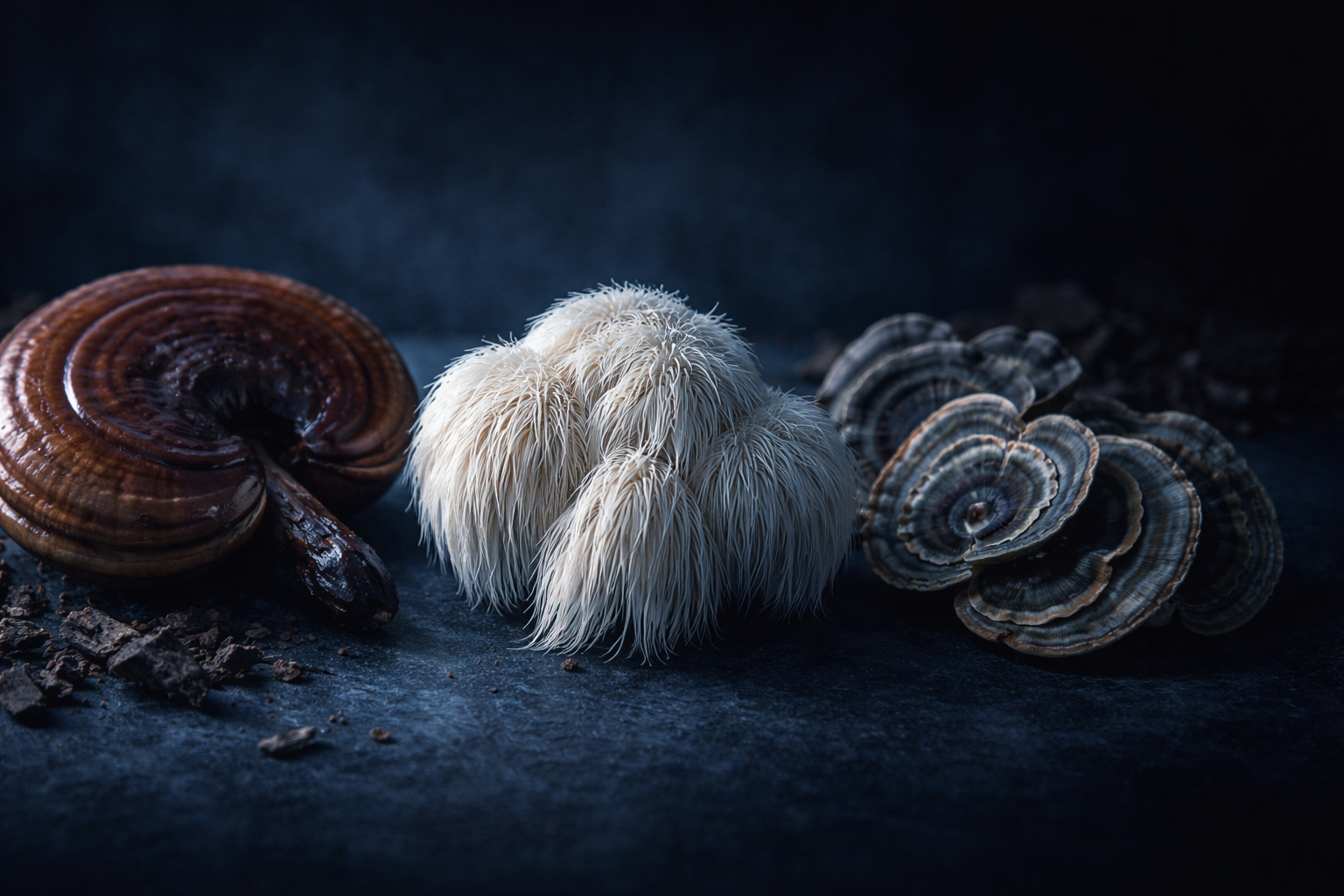
It contains four premium hot water fruiting body extracts: lion’s mane, turkey tail, Cordyceps militaris, and tiger milk (a sclerotium extract). Each species covers 25% of the formula.
What makes this different from every other mushroom blend on the market is that it is not trying to cram ten species into one capsule at meaningless doses. Four species. Four types of beta-glucan (soluble, insoluble, and structural variations). Plus cordycepin from the Cordyceps militaris and the NGF-supporting compounds from lion’s mane and tiger milk.
The formula tests at approximately 50% beta-glucans. That number is not a marketing claim on a retail listing. It is verified by ISO 17025 accredited laboratories (Eurofins and Alkemist US) and published in full CoA reports that anyone can view on Oriveda’s website.
50% beta-glucans. Published lab data. From a company that has been doing this since 2010.
ABM Agaricus blazei Extract
The ABM is a hot water fruiting body extract of Agaricus blazei Murrill, a mushroom with strong research behind its immune-modulating properties. I take this alongside the CCCE for additional immune support. Same testing standard, same published CoA, same level of transparency.
Why Oriveda passes the framework
I am recommending Oriveda for the same reason I built the five-step evaluation framework: because every claim can be verified.
Oriveda introduced the concept of sharing objective lab test reports with customers in 2010. They were doing this before most brands in the space even existed. They use ISO 17025 accredited third-party laboratories, not in-house testing. The distinction matters. In-house testing means a company is grading its own homework. Third-party accredited testing means an independent lab with no financial relationship to the brand is verifying the results.
They are one of the very few supplement companies globally that spend money on quality control instead of marketing. That sentence sounds like an advertisement. It is not. It is the reason their products cost more, and it is the reason they work.
Let me be honest about the price.
Oriveda is expensive.
The CCCE runs roughly $45 to $55 for a two-month supply depending on where you buy it. The ABM is similar. If you take both, you are looking at $45 to $55 per month for supplements.
That is real money. I am not going to pretend it is not.
I think it is justified. The testing is real. The compounds are verified. The products are formulated in line with clinical research rather than marketing trends. When I take Oriveda consistently, I notice the difference. When I switched to a cheaper product, I noticed the absence.
But I understand that not everyone can or wants to spend that much on supplements. Which is why I have two other recommendations.
On the price
Oriveda is expensive. I wish it was cheaper. That is part of why I started growing my own mushrooms.
But the price reflects something most brands skip entirely: every batch independently tested by accredited labs, full documentation published publicly, and formulations built around clinical research rather than marketing trends. You are paying for verified quality. Most brands charge similar prices for unverified promises.
Budget alternative: Real Mushrooms
If Oriveda is outside your budget, Real Mushrooms is my recommendation.
Real Mushrooms passes the five-step framework. They use fruiting body extracts, they publish beta-glucan percentages on the Supplement Facts panel, they state their extraction method, provide third-party testing data, and are transparent about what is in the product.
They are also significantly cheaper than Oriveda. A month’s supply of their lion’s mane or reishi runs roughly $25 to $35.
The trade-off is that Real Mushrooms’ testing documentation is less granular than Oriveda’s. Oriveda publishes full multi-page CoA reports from ISO 17025 accredited labs for every product. Real Mushrooms provides beta-glucan data on the label and makes testing information available but does not publish the same level of detailed lab reporting.
Both are legitimate. Both pass the framework. Oriveda is the premium option with the most documented transparency. Real Mushrooms is the quality option at a more accessible price point.
For the full comparison between these brands and Host Defense, see the brand comparison post.
The third option: grow your own.
This is what I eventually did.
After spending years buying supplements and learning more than I ever expected to about the industry behind them, I started growing mushrooms at home. Lion’s mane on supplemented sawdust. Oyster mushrooms on straw. Reishi on hardwood.
When you grow your own mushrooms, the trust problem disappears entirely.
There is no label to misread. No proprietary blend to decode. No question about whether the product contains what it claims. You are eating the actual mushroom, with all of its compounds, harvested at peak freshness, grown under conditions you controlled.
Is it a replacement for concentrated extracts in every case? No. A dual-extracted reishi supplement delivers triterpenes at concentrations that eating fresh reishi cannot match. But for lion’s mane and oyster mushrooms in particular, growing and eating them fresh is one of the most direct ways to get the benefits the research describes.
And the cost after the initial setup is almost nothing.
I still take Oriveda for the concentrated extract benefits. But I also eat fresh lion’s mane that I grew myself, and I make my own dried mushroom powder from my harvests. The combination of quality supplements and home-grown mushrooms is, in my opinion, the best of both worlds.
What I am not doing in this post.
I am not using affiliate links. I have no commercial relationship with Oriveda, Real Mushrooms, or any brand. Nobody paid me to write this. Nobody asked me to write this.
I am recommending what I personally use because people keep asking. The five-step framework exists so you do not have to take my word for it. Apply it to Oriveda yourself. Apply it to Real Mushrooms, or to whatever brand you are considering. The data is either there or it is not.
This is not an affiliate post. Mycology At Home has no commercial relationship with Oriveda, Real Mushrooms, or any brand mentioned. No one paid for or requested this recommendation. Apply the five-step framework to any brand yourself and verify independently.
Frequently asked questions
Oriveda publishes the most detailed third-party lab documentation of any brand I have found. Full CoA reports from ISO 17025 accredited labs, specifying beta-glucan percentages, cordycepin content, ganoderic acids (for reishi), heavy metals, and more. Real Mushrooms is excellent and passes the framework, but Oriveda’s level of testing transparency is a tier above. The price reflects that.
For me, yes. The products are formulated to match clinical research, every batch is independently verified, and I notice the difference when I take them consistently. Whether it is worth it for you depends on your budget and your priorities. Real Mushrooms at $25-35/month is a quality alternative if the cost is a barrier.
Host Defense uses mycelium on grain for their capsule products. They do not publish beta-glucan data, do not state an extraction method for capsules, and independent testing suggests their products contain significant grain starch. They fail multiple criteria in the framework. I do not recommend them for capsule supplements. The full comparison is here: Real Mushrooms vs Host Defense vs Oriveda.
Grow your own. A lion’s mane grow kit costs $15 to $25 and produces fresh medicinal mushrooms within weeks. Growing from scratch on pasteurized straw (oyster mushrooms) costs under $30 in materials for multiple harvests. You do not need to spend $50 a month on supplements to get the benefits of medicinal mushrooms. You just need to be willing to learn.