RYZE Mushroom Coffee Review
RYZE Mushroom Coffee Review: What the Five-Step Evaluation Reveals
Heavily marketed. Voluntarily withdrew major health claims under regulatory inquiry in 2025. No published beta-glucan data, no extraction method on the label, no public Certificate of Analysis. The marketing is the problem, not the cup of coffee.
criteria passed
RYZE is the most heavily marketed mushroom coffee brand in the United States. When evaluated against the same five-step standard I apply to every product covered on this site, it does not pass the transparency criteria that would let a buyer verify what they are actually getting.
In September 2025, RYZE voluntarily discontinued multiple health claims after an investigation by BBB National Programs’ National Advertising Division [1]. Those claims included statements about energy, focus, immunity, digestion, sleep, and implied appetite suppression similar to GLP-1 medications. They were withdrawn before regulators could rule on whether the claims were truthful or substantiated.
The product appears safe to drink. The ingredients are organic. The marketing is the problem, the lack of verifiable potency data is the problem, and the regulatory record is the problem. The taste of the coffee is not.
This is also not a hit piece. RYZE makes a product that many people enjoy drinking. If you like the taste, the ritual works for your morning, and it has replaced a higher-caffeine coffee habit, that is a perfectly fine reason to keep drinking it.
But RYZE has, until very recently, made significant health claims about energy, focus, immunity, digestion, sleep, and weight management. When the same five criteria I use for any mushroom supplement are applied, the gaps between what the marketing has promised and what the company can actually verify are wide. That is what this post documents.
Who RYZE is and how they got here
The most heavily Instagram-marketed mushroom coffee brand in the US
RYZE built its growth on social media advertising and influencer partnerships. The product is real, the company is legitimate, and the ingredients are organic. The transparency gaps and the 2025 regulatory record are what set this brand apart from the rest of the category.
Launched as a direct-to-consumer functional beverage brand. Headquartered in Boston, Massachusetts.
Mushrooms described as grown in California. Specific farm and facility not publicly disclosed.
Six species combined. Individual species amounts not disclosed. No public CoA available.
Voluntarily discontinued health claims about energy, focus, immunity, sleep, and GLP-1-style appetite suppression.
Worth noting. RYZE’s USDA Organic certification and California growing are real. So is the 2025 NAD inquiry resulting in withdrawn claims. Both pieces of the public record matter for buyers trying to evaluate the brand.
RYZE Superfoods is a Boston-based functional beverage company that built its growth almost entirely through Instagram and influencer marketing. The brand markets itself as a coffee replacement that delivers focus, energy, and immune support through a proprietary blend of six mushroom species. Products are sold direct-to-consumer through their website, on Amazon, at Walmart, and at Target.
The mushrooms in the Super6 blend are described as grown in California [2]. The product line carries USDA Organic certification, which covers the growing practices but not the active compound content of the finished powder.
Beyond what is on the label, RYZE’s public sourcing details are limited. There is no public information on the specific farm or facility, no visibility into any extraction process, and no third-party Certificate of Analysis available for any product batch. This is unusual for a company at RYZE’s marketing scale and stands in clear contrast to brands like Four Sigmatic, which publicly identifies its log-grown Chinese family farm sourcing, or Real Mushrooms, which publishes batch-level beta-glucan reports.
What you can verify, in summary: USDA Organic certification, six mushroom species in some undisclosed ratio, total of 2,000mg of mushroom blend per serving, 48mg of caffeine per serving, and a public regulatory record of withdrawn health claims under a 2025 NAD inquiry [1][2].
The NAD inquiry: the regulatory event that defines this brand right now
In September 2025, BBB National Programs’ National Advertising Division opened an inquiry into RYZE Superfoods as part of its marketplace monitoring program [1].
NAD investigated express claims that RYZE Mushroom Coffee provides “all-day energy, sharper focus, healthier digestion, better immune support,” and “better sleep.” The inquiry also examined whether RYZE’s Mushroom Matcha advertising implied appetite-suppressing benefits comparable to GLP-1 agonist drugs without the side effects [1].
During the inquiry, RYZE voluntarily discontinued all of the challenged claims before NAD could review them on the merits [1]. Because the claims were withdrawn before review, NAD did not make a formal determination on whether they were truthful or adequately substantiated. For compliance purposes, voluntarily discontinued claims are treated as though NAD recommended their discontinuation [1].
In their public response, RYZE stated they are “committed to evidence-based claims and to periodic review and refinement of our messaging” [3].
RYZE voluntarily withdrew its major health claims under NAD inquiry
In September 2025, BBB National Programs’ National Advertising Division opened an inquiry into RYZE Superfoods’ advertising. The investigation examined claims about energy, focus, immunity, digestion, sleep, and whether the Mushroom Matcha advertising implied appetite suppression comparable to GLP-1 medications. RYZE voluntarily discontinued all challenged claims before NAD reviewed them on the merits.
“All-day energy, sharper focus, healthier digestion, better immune support, better sleep” plus implied GLP-1-like appetite suppression in Matcha advertising.
All challenged claims voluntarily discontinued during the inquiry. NAD did not rule on the merits because the claims were withdrawn.
Voluntarily discontinued claims are treated as if NAD recommended discontinuation for compliance tracking purposes.
Stated they are “committed to evidence-based claims and to periodic review and refinement of our messaging.”
Source: BBB National Programs decision page, September 11, 2025. Read the original decision.
That is the regulatory record. The health claims that drove much of RYZE’s marketing were withdrawn under regulatory scrutiny. That does not mean the product is harmful. It means the claims could not be defended when examined by an outside body. A brand that genuinely had evidence supporting its claims would have submitted that evidence to NAD instead of withdrawing the claims to avoid review.
What RYZE actually is
RYZE Mushroom Coffee is an instant coffee product blended with a proprietary six-mushroom blend, organic MCT oil, coconut milk powder, and a prebiotic fiber blend. The mushroom blend, marketed as Super6, contains six species: Cordyceps, Lion’s Mane, Reishi, Shiitake, Turkey Tail, and King Trumpet [2].
Each serving contains approximately 48mg of caffeine, roughly half the caffeine in a standard cup of coffee. The total mushroom content is listed at 2,000mg per serving across all six species [2].
Beyond the original Mushroom Coffee, RYZE sells a Mushroom Matcha, a Mushroom Cocoa, a Superfood Creamer, and various bundles. The transparency issues outlined in this review apply across the product line. None of the RYZE products carry beta-glucan content disclosure on the Supplement Facts panel, and none have public Certificates of Analysis available.
These are reasonable starting ingredients on paper. Six well-known medicinal mushroom species, an organic certification, and lower caffeine than regular coffee. The questions are whether the 2,000mg of mushroom content delivers anything close to the doses used in clinical research, whether the active compounds inside the mushrooms are bioavailable in their current form, and whether any of this can be independently verified.
Sourcing: what RYZE does well and what they leave out
What RYZE genuinely does well — and what they leave out
A balanced look at the brand’s sourcing requires acknowledging both columns. The strengths are real. The gaps are also real, and they are the reason this product cannot be verified against clinical research.
Genuine positives worth crediting
The transparency gaps that matter
A balanced look at the brand’s sourcing position needs to acknowledge what is genuinely good before unpacking what is missing.
What RYZE does well includes USDA Organic certification across the line, mushrooms grown in California rather than imported from undisclosed sources, a stated testing program for heavy metals and mycotoxins [2], lower caffeine than regular coffee at 48mg per serving, and clean organic ingredient choices including MCT oil and prebiotic fibers. None of these are trivial. US-based growing and organic certification put RYZE ahead of the dozens of cheap Amazon mushroom blends with no traceable supply chain.
What RYZE does not disclose is more substantial. The mushroom material in the Super6 blend reads as whole mushroom powder, not extract, which means most of the active compounds remain locked inside chitin cell walls that human digestion cannot effectively break down. There is no public Certificate of Analysis for any product batch. Beta-glucan content (the most important quality marker for any functional mushroom product) is never published. The extraction method is not stated anywhere on the label or website because the product does not appear to be extracted. Individual species amounts within the proprietary 2,000mg blend are not disclosed. Heavy metals testing is claimed but the test results are not publicly available. And the product’s marketed health benefits were voluntarily withdrawn under regulatory inquiry.
The pattern is consistent. The brand documents what is easy to certify (organic growing practices) while staying silent on what would actually let buyers verify the product against the clinical research that the marketing has historically referenced.
The dose problem: 2,000mg sounds bigger than it is
RYZE lists 2,000mg of total mushroom blend per serving. That number gets used heavily in marketing because it sounds substantial. Once you do the math against six species and against the doses that actually appear in clinical research, the picture changes.
Here is what 2,000mg actually represents. It is the entire Super6 blend, spread across Cordyceps, Lion’s Mane, Reishi, Shiitake, Turkey Tail, and King Trumpet. If the species were evenly divided, that would be roughly 333mg per mushroom before considering extraction method, beta-glucan percentage, or whether the cheaper species are weighted more heavily than the expensive ones. Because the blend is proprietary, we do not know the actual split.
2,000mg sounds like a lot until you realize it is the entire mushroom blend, not 2,000mg of Lion’s Mane, Cordyceps, or Reishi individually.
This is where mushroom coffee marketing gets slippery. The benefit claims come from research on individual mushrooms at specific doses, but the cup of coffee you are actually drinking may not contain anything close to the dose used in those studies.
Lion’s Mane is the most-marketed mushroom in RYZE’s blend because its cognitive research has the most consumer appeal. The well-known Lion’s Mane trials used standardized extracts at specific daily doses over weeks or months. Here is how RYZE compares if we generously assume an even 333mg split and treat whole mushroom powder as equivalent to extract (which it is not, since whole powder leaves most of the active compounds locked inside chitin cell walls).
How many cups of RYZE you would need to drink to match Lion’s Mane clinical research
RYZE markets cognitive support based on Lion’s Mane research. The trials behind those claims used standardized extracts at specific daily doses. Here is what it would actually take to drink your way to those doses if we generously assume an even 333mg split of the proprietary blend.
~333mg Lion’s Mane whole powder (1/6 of 2,000mg blend)
Mori 2009 — Cognitive support trial
750mg/day Lion’s Mane extract · 16 weeks · MCI cognitive function
per day
Docherty 2023 — Mood and stress trial
1,800mg/day Lion’s Mane extract · young adults
per day
Saitsu 2019 — Mood and sleep trial
3,200mg/day Lion’s Mane extract · upper clinical range
per day
Why these numbers are still optimistic. The math above assumes Lion’s Mane really is one-sixth of RYZE’s proprietary blend (we cannot verify this), and treats whole mushroom powder as equivalent to a standardized extract (it is not).
Whole mushroom powder leaves most active compounds locked inside chitin cell walls. Roughly 80 percent of people produce insufficient chitinase to access these compounds without extraction. The real cup count to match clinical research is significantly higher than the numbers shown.
These numbers are still optimistic. They assume Lion’s Mane really is one-sixth of RYZE’s proprietary blend, which we cannot verify. They treat whole mushroom powder as equivalent to a standardized extract, which it is not. The compounds in unextracted mushroom material remain largely locked inside chitin cell walls that human digestion cannot efficiently break down. Studies estimate that roughly 80 percent of people produce insufficient chitinase to access these compounds without extraction.
The real cup count to match clinical research, if you adjust for extraction differences and unknown species splits, is significantly higher than the numbers above.
This does not mean RYZE does nothing. It means the evidence the marketing borrows from cannot automatically be applied to this product. The actual question is not whether mushrooms have interesting research behind them. They do. The question is whether this specific product, in the cup you are actually drinking, delivers a studied dose in a verified form.
A lower-caffeine coffee with some mushroom powder is not the same thing as a clinically dosed mushroom extract. With that dose problem in mind, the five-step evaluation becomes much easier to understand
Step 1: Fruiting body or mycelium-on-grain
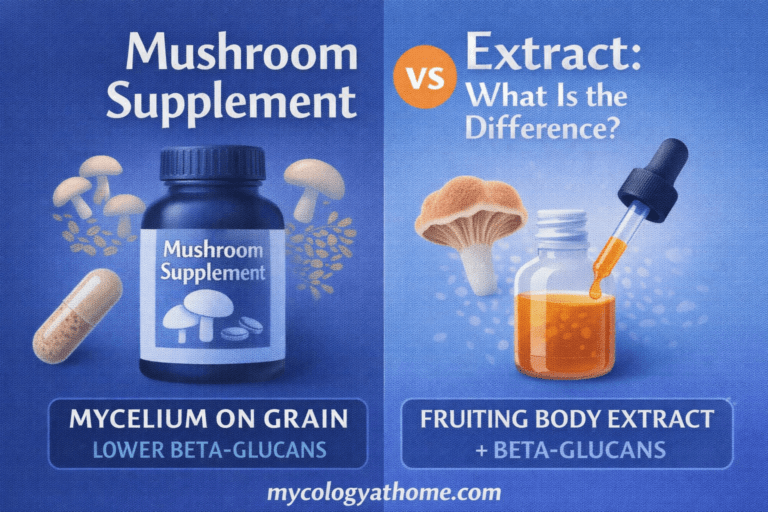
Mushroom supplement quality starts with which part of the mushroom is in the powder. Fruiting body extracts contain higher and more research-aligned concentrations of beta-glucans, the primary active compound class in functional mushrooms. Mycelium grown on grain substrate produces a final material where the fungal compounds and the grain starch cannot be cleanly separated. Whole dried mushroom powder, regardless of source, still leaves the active compounds locked inside chitin cell walls and largely unavailable to human digestion.
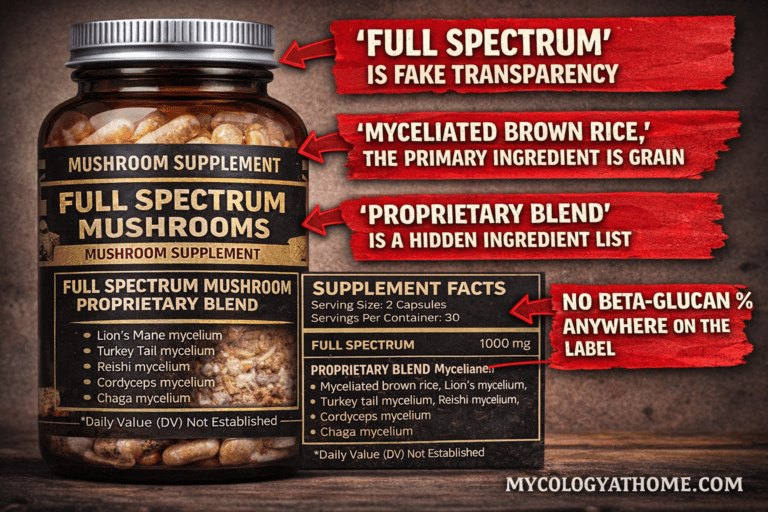
RYZE uses the term “full-spectrum mushrooms” in its marketing. This phrase is not a regulated term in the United States and has no legal definition. It is used inconsistently across the supplement industry to describe products that contain fruiting body, mycelium, or both, sometimes including grain substrate. Some retail listings have described RYZE as fruiting-body-based [4]. The company’s own ingredients page lists species names but does not explicitly state “fruiting body” or “fruiting body extract” anywhere on the Supplement Facts panel [2].
Without an explicit declaration on the Supplement Facts panel itself, a buyer cannot verify which part of the mushroom is in the bag. “Full-spectrum” is marketing language that obscures the question rather than answering it. A brand that genuinely sourced premium fruiting body would say so on the label, because fruiting body is the more expensive and more research-aligned source.
Verdict: Fails. “Full-spectrum mushrooms” is unregulated marketing language. The Supplement Facts panel does not specify fruiting body. A premium brand using premium-source material would disclose it. Independent reviewers including Hamilton’s Mushrooms have noted the same gap [4].
Step 2: Beta-glucan percentage on a third-party CoA
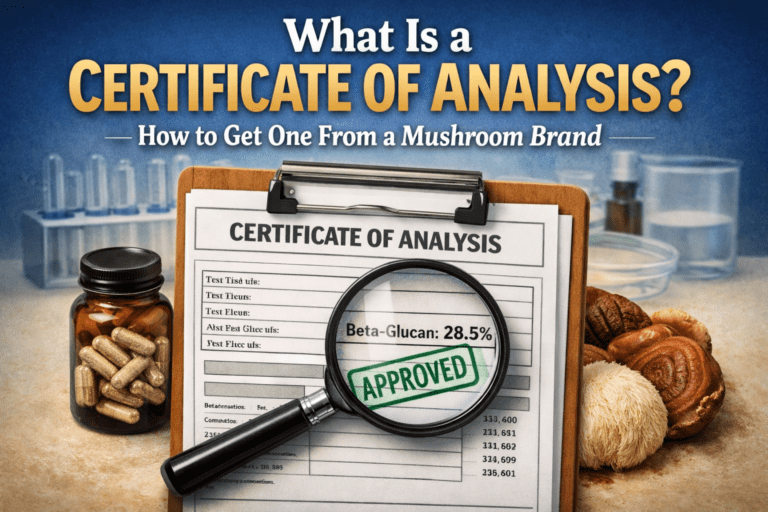
Beta-glucan content is the primary verification metric for mushroom supplement potency. A third-party Certificate of Analysis stating the actual measured beta-glucan percentage by lot is the only way a buyer can confirm what is in the product.
RYZE’s Walmart listing claims their blend contains “beta-glucans at the high amount of 25%+” [5]. That number does not appear on the Supplement Facts panel of the product itself. RYZE does not publish a Certificate of Analysis on their website that a buyer could use to verify the figure independently.
Multiple independent reviewers have flagged this gap. Garage Gym Reviews rated RYZE 1 out of 5 for third-party testing transparency [6]. Innerbody noted that beta-glucan content “is another figure missing from RYZE’s available information” [7]. Hamilton’s Mushrooms documented “no lab testing or beta-glucan data” and “no published results verifying mushroom potency or bioactive content” [4].
The difference between a marketing claim on a retail listing and a verified number on an independently issued Certificate of Analysis is the entire reason this evaluation framework exists.
Verdict: Fails. No public CoA. No beta-glucan percentage on the Supplement Facts panel. A marketing claim on a retail listing does not meet this standard.
Step 3: Extraction method stated
The extraction method determines which compounds end up in the final product. Hot water extraction concentrates beta-glucans. Alcohol extraction is required to capture triterpenes, the fat-soluble compounds responsible for many of Reishi’s traditional uses including sleep and stress regulation. Dual extraction combines both. Whole dried mushroom powder, with no extraction at all, leaves most of the active compounds locked inside indigestible chitin cell walls.
RYZE does not state an extraction method on the product label or website because the product does not appear to be extracted. The mushroom material in the Super6 blend reads as whole dried mushroom powder. Multiple independent reviewers have flagged this absence and the lack of any extraction process documentation [4][6].
This matters most for the Reishi in the blend. Reishi’s cortisol-modulating and sleep-supporting compounds are triterpenes, and triterpenes require alcohol extraction to be present in meaningful amounts. Reishi powder without alcohol extraction does not deliver the triterpene compounds the marketing of Reishi typically references. The same logic applies to most of the other species in the blend.
Verdict: Fails. No extraction method stated because no extraction occurs. Whole mushroom powder is not bioavailable in the way the clinical research on extracted mushroom material is.
Step 4: Third-party testing including heavy metals
RYZE states that their ingredients are “thoroughly tested for mycotoxins and heavy metals” [2]. That is a safety claim. Safety testing covers contamination, the presence of mold byproducts, lead, cadmium, mercury, arsenic, and microbial contaminants.
Safety testing is not the same as potency testing. A product can pass every safety screen and still contain trace amounts of the active compounds it is marketed for. The first kind of testing protects you from a contaminated product. The second tells you whether the product can actually do anything beyond placebo.
No third-party Certificate of Analysis verifying beta-glucan content, triterpene content, or individual mushroom species potency is publicly available from RYZE. The heavy metals testing claim is not paired with public test reports either, only with the statement that testing occurs.
For reference, brands that pass this step typically publish batch-by-batch CoAs from independent ISO-certified laboratories such as Eurofins or Alkemist, listing both contaminant results and active compound percentages. Real Mushrooms publishes lot-specific beta-glucan content. Oriveda publishes ganoderic acid content for Reishi. Nootropics Depot publishes detailed CoAs for every product.
Verdict: Partial. Safety testing appears to be claimed. Potency verification and public CoAs are absent. This is the only step where RYZE earns partial credit.
Step 5: Brand transparency
The Super6 blend is proprietary. Total mushroom content is listed at 2,000mg across six species, but the amount of each individual mushroom is not disclosed [2][6][7].
This means a buyer cannot tell whether the blend is weighted heavily toward the cheapest species (Shiitake and King Trumpet are typically less expensive than Lion’s Mane or Cordyceps) with trace amounts of the more marketed species, or whether each species is included at a meaningful level. Proprietary blends exist specifically to avoid this kind of disclosure.
Combined with the missing extraction method, the absence of beta-glucan disclosure on the Supplement Facts panel, the inconsistent fruiting body claims across platforms, and the lack of a public potency CoA, the transparency picture is consistent across every criterion in the framework.
Verdict: Fails. The transparency gaps are substantial and consistent.
RYZE scored against the same standard I apply to every product
Same criteria. Same evidence threshold. No exceptions for popular brands. Each step requires public, verifiable documentation that a buyer can check against the product itself.
Fruiting body or mycelium-on-grain?
“Full-spectrum mushrooms” is unregulated marketing language. Supplement Facts panel does not specify fruiting body. A premium-source brand would disclose it. Independent reviewers confirm the gap.
Beta-glucan percentage on a third-party CoA?
No public Certificate of Analysis. Walmart listing claims “>25% beta-glucans” but the figure does not appear on the Supplement Facts panel and cannot be independently verified.
Extraction method stated?
No extraction method on the label or website because the mushroom material is whole powder, not extract. Active compounds remain locked in chitin cell walls.
Third-party testing including heavy metals?
Brand claims testing for mycotoxins and heavy metals (safety testing). No public Certificates of Analysis verifying potency for any active compound.
Brand transparency?
Proprietary blend hides per-species amounts. 2,000mg total across 6 species with no individual breakdown. Cheapest mushrooms could dominate the formula without disclosure.
Four fails out of five criteria, with one partial credit on safety testing. A brand can have a clean ingredient list, an organic certification, and a likable origin story, and still fail the verification standards that determine whether the product can deliver on the claims its marketing has made.
How RYZE compares to other mushroom coffee and supplement brands
Brand-to-brand comparison against the quality tier
Every quality-tier mushroom supplement brand publishes Certificates of Analysis with verifiable beta-glucan content. RYZE does not. Here is the comparison side by side.
RYZE
USA · Boston · 2021
Beta-glucan
Not published
Format
Whole powder, not extract
Per serving
$0.85-1.00
Best for
Lower-caffeine ritual only
Four Sigmatic
Finland → Venice CA · 2012
Beta-glucan
~15% (EU data)
Format
Dual-extracted fruiting body
Per serving
$1.00-2.00
Best for
Best mushroom coffee
Real Mushrooms
USA · Chilton family · 1980
Beta-glucan
25-30% verified
Format
Fruiting body extract
Per serving
$0.58-0.88
Best for
Best US value pick
Oriveda
Netherlands · Clinical · 2010
Beta-glucan
30-40% (ISO labs)
Format
Multi-step extracted
Per serving
$0.75-1.50
Best for
Deepest quality proof
A brand evaluation gains useful context from comparison. Here is how RYZE sits relative to four other mushroom coffee or supplement brands most likely to come up if you are researching alternatives.
Versus Four Sigmatic. Four Sigmatic is the original mushroom coffee brand, founded in 2012 in Finland and now based in Venice, California. Their sourcing is publicly attached to log-grown fruiting body extracts, dual-extracted from a Chinese family farm. They do not publish beta-glucan content by lot on the US site, but EU reseller data suggests roughly 15 percent beta-glucan content (mid-tier rather than premium). Their Think Elixir delivers 1,500mg of lion’s mane per serving, which is actually in the clinical trial range. Four Sigmatic’s mushroom coffee dose math is similar to RYZE’s, but their sourcing and extraction documentation is substantially better.
Versus Real Mushrooms. Real Mushrooms is the US-based, Paul Stamets-influenced brand that publishes batch-level beta-glucan content (25 to 30 percent), uses fruiting body extracts, and runs around $0.58 per daily dose for clinical-range Lion’s Mane. They make no coffee products. For lion’s mane supplementation specifically, Real Mushrooms is roughly half the cost of RYZE per serving and delivers a verified clinical dose that RYZE cannot match.
Versus Oriveda. Oriveda is the Dutch clinical-focused brand that publishes ISO-17025 certified Certificates of Analysis, uses pharmaceutical-grade purification, and runs 30 to 40 percent beta-glucan content. They make no coffee products. They are the highest-quality mushroom supplement brand available at retail and the brand I personally take.
Versus Nootropics Depot. Nootropics Depot publishes the most detailed CoAs in the supplement space, runs in-house pharmaceutical-grade testing, and offers an 8:1 lion’s mane extract at competitive pricing. They make no coffee products.
The pattern: every quality-tier mushroom supplement brand publishes Certificates of Analysis with verifiable beta-glucan content. RYZE does not. Among mushroom coffee specifically, even Four Sigmatic (which has its own dose-gap issues) discloses sourcing, extraction method, and species rationale at a level RYZE has not matched.
The marketing problem
The product issues above would matter less if RYZE were marketed honestly as what it functionally is, which is a lower-caffeine coffee alternative with mild mushroom content that may or may not provide measurable supplemental support depending on what is actually in the proprietary blend.
That is not how RYZE has been marketed.
RYZE has relied heavily on social media advertising across Instagram and similar platforms, using influencer partnerships, ambassador programs, and user-generated content to promote claims about energy, focus, immunity, gut health, weight management, and mood improvement [8]. Multiple consumer reports describe seeing ads featuring body transformation imagery, fat loss visualizations, and implications that the product can produce significant physical changes [8].
The NAD inquiry specifically examined whether RYZE’s Matcha advertising implied appetite-suppressing benefits comparable to GLP-1 agonist drugs without their side effects [1]. GLP-1 medications such as semaglutide and tirzepatide are prescription drugs with extensive clinical trial programs and FDA approval. Implying that a mushroom matcha product delivers comparable results is not a creative liberty. It is the kind of claim that exploits people who are struggling with weight and looking for help.
This is where the gap between what the product is and what the marketing has promised becomes a real concern. People who are dealing with chronic fatigue, weight, focus issues, or general health frustrations are not looking for a marginally better cup of coffee. They are looking for relief. Marketing that implies transformative health results from a product with unverified potency and a public record of withdrawn claims is not helping those people. It is taking their money.
A supplement is a supplement. It supplements an existing healthy lifestyle. It does not transform one. No mushroom regardless of brand, dose, or quality is going to produce the kind of results that consistent sleep, nutrition, movement, and stress management produce. Any brand that implies otherwise is selling marketing, not science.
The gap between what RYZE has been sold as and what it actually delivers
The product issues above would matter less if RYZE were marketed honestly as a lower-caffeine coffee alternative. That is not how the brand has been positioned in social media advertising and influencer partnerships, which is why the NAD inquiry happened in the first place.
GLP-1 comparison advertising
The NAD inquiry specifically examined whether RYZE’s Mushroom Matcha advertising implied appetite-suppressing benefits comparable to GLP-1 agonist drugs without the side effects. GLP-1 medications such as semaglutide and tirzepatide are prescription drugs with extensive clinical trial programs. Implying parity with a mushroom matcha is the kind of claim that targets people struggling with weight and looking for help.
Body transformation imagery in social media ads
Multiple consumer reports describe RYZE advertising featuring body transformation imagery, fat loss visualizations, and implied physical changes from drinking the product. There is no published clinical evidence that any mushroom coffee causes meaningful weight loss. The visual marketing implies effects that the product cannot demonstrate.
Health claims withdrawn rather than defended
When NAD opened its 2025 inquiry into express claims about energy, focus, immunity, digestion, and sleep, RYZE voluntarily discontinued all challenged claims rather than defending them on the merits. A brand that genuinely had evidence for its claims would have submitted that evidence to NAD, not withdrawn the claims to avoid review.
What RYZE has marketed itself as vs what the public evidence supports
A side-by-side look at the claims that drove much of RYZE’s marketing reach and what can actually be verified from publicly available information about the product.
What RYZE has promised
What can actually be verified
Who should buy RYZE (the honest version)
Is RYZE the right purchase for your situation?
There is a real audience for RYZE. There is also a much larger audience that the marketing has reached but the product cannot serve.
Who RYZE works for
Caffeine reducers
48mg per serving is half a regular cup. Genuinely lower-caffeine without going decaf. The energy-stability benefit is real and physiologically explainable.
Coffee-alternative seekers
Cleaner ingredient list than chain-store coffee or commercial creamers. USDA Organic, no artificial sweeteners.
Curious beginners
Low-friction entry point into mushroom-adjacent products. No capsules, no powder measuring.
Ritual-driven mornings
If the act of making and drinking the cup is the value, RYZE delivers a pleasant ritual at a coffee-replacement price point.
Who should skip RYZE
Clinical-dose seekers
The cup math does not work. Use Real Mushrooms Lion’s Mane (1,000mg verified at $0.58/day) or Oriveda for therapeutic dosing.
CoA verifiers
RYZE does not publish them. Real Mushrooms, Oriveda, and Nootropics Depot all do.
Extract-format buyers
RYZE is whole powder, not extract. Active compounds remain locked in chitin cell walls and are largely indigestible.
Anyone pulled in by weight loss messaging
No clinical evidence supports RYZE for weight loss. The claims were withdrawn under 2025 NAD inquiry.
There is a real audience for RYZE. The product is not for everyone, but it is also not nothing.
Who RYZE works for: people who want to dramatically reduce caffeine without going decaf and like the chocolaty, mild taste. The 48mg per serving is genuinely lower-caffeine than regular coffee, and many people feel better drinking less caffeine. People who like the cleaner ingredient list compared to chain-store coffee or commercial coffee creamers. Beginners who are curious about functional mushrooms and want a low-friction entry point with no capsules to swallow. Buyers who value USDA Organic certification and US-grown ingredients and are not looking to verify potency through CoAs.
Who RYZE is not the right fit for: anyone targeting the lion’s mane cognitive doses used in clinical trials. The dose math in the cups block above shows why this does not work. People who want to verify what they are buying through public Certificates of Analysis. RYZE does not publish them. Buyers who care whether the mushroom material has been extracted. It has not. Anyone choosing between RYZE and dedicated supplements like Real Mushrooms for therapeutic use. Real Mushrooms wins on dose, cost per dose, and verification. People who got pulled in by RYZE’s social media weight loss messaging or GLP-1 comparison advertising. There is no clinical evidence supporting either claim, and the claims were voluntarily withdrawn under NAD inquiry.
If you want a coffee alternative with a wellness aesthetic, RYZE is a fine choice. If you want a mushroom supplement with verified active compounds, look elsewhere.
Pricing reality check
What RYZE costs vs what the same money buys elsewhere
As a coffee replacement, RYZE is priced in line with specialty coffee. As a functional mushroom supplement, the comparison gets less favorable.
The real comparison: Real Mushrooms Lion’s Mane at $0.58/day delivers 1,000mg of verified extract with published >30% beta-glucan content. Nootropics Depot delivers comparable specs at $0.50-0.65/day. Both are dedicated extracts with public CoAs. RYZE costs more per serving than either while delivering whole powder with no published beta-glucan and proprietary species splits.
The honest framing: If you are buying RYZE because you enjoy the morning ritual and the lower caffeine fits your routine, the price is reasonable for what it is. If you are buying RYZE because the marketing implied therapeutic mushroom benefits, the same money buys significantly more verified mushroom content from a dedicated supplement brand.
RYZE runs about $1.00 per serving at retail for the 30-serving bag of Original Mushroom Coffee, with subscription discounts dropping that to roughly $0.85 to $0.90. The Mushroom Matcha is similarly priced. Bundles and starter kits offer additional savings. The frothing mug bundle pushes the entry price closer to $50 to $60.
For a coffee replacement product, that pricing is in line with specialty coffee. For a functional mushroom product, the comparison gets less favorable.
Real Mushrooms Lion’s Mane Capsules deliver 1,000mg of verified extract at $0.58 per day. Nootropics Depot lion’s mane runs $0.50 to $0.65 per day. Oriveda’s lion’s mane sits at $0.75 to $1.50 per day depending on format. All three are dedicated extracts with published beta-glucan content, all three deliver more clinical-research-aligned dosing, and at least two are less expensive than RYZE per daily dose.
If you are buying RYZE because you enjoy the morning ritual and the lower caffeine fits your routine, the price is reasonable for what it is. If you are buying RYZE because the marketing has implied therapeutic mushroom benefits, the same money buys you significantly more verified mushroom content from a dedicated supplement brand.
Where RYZE is made and what that means
RYZE is headquartered in Boston, Massachusetts. The mushrooms used in the Super6 blend are described as grown in California [2]. The product is USDA Organic certified, which covers the growing practices and the absence of synthetic inputs.
US-based growing is genuinely a positive for any supplement. It indicates a shorter supply chain, better regulatory oversight on the agricultural side, and lower risk of contamination from regions with looser organic standards. RYZE deserves credit for this.
What USDA Organic certification does not do is verify the active compound content of the finished product. Organic certification is a process audit. It confirms growing practices. It says nothing about beta-glucan percentage, extraction method, or whether the mushroom material in the final powder will deliver anything close to a clinical dose.
You can grow mushrooms organically in California, dry them whole, grind them, and put 333mg of each species into a blend, and the product will be USDA Organic certified while still falling well short of the doses used in research. Certification and potency are different categories.
The honest summary
RYZE is a Boston-based functional beverage brand that built its growth on social media marketing and in 2025 voluntarily withdrew major health claims under a regulatory inquiry. The product is safe to drink. The ingredients are organic. The taste is reasonable for an instant coffee. None of those things are in dispute.
The product fails my five-step evaluation on four of five criteria, with one partial credit. There is no public Certificate of Analysis. There is no published beta-glucan content. There is no extraction method on the label because the mushroom material is whole powder, not extract. Individual species amounts within the 2,000mg proprietary blend are not disclosed. Health claims about energy, focus, immunity, digestion, sleep, and weight management were withdrawn under NAD inquiry rather than defended on the merits.
A brand at this scale, with this much social media reach and this level of consumer trust, should be expected to publish more verifiable documentation than RYZE does. The fact that they do not, combined with the regulatory record, is why this review lands at a D rather than the C-tier grade some other low-transparency brands receive.
If you enjoy RYZE as a coffee alternative and the ritual works for your morning, there is nothing wrong with continuing to drink it. But if you are buying RYZE because you believe the marketing about cognitive support, immune benefits, weight management, or therapeutic mushroom dosing, the evidence supporting those beliefs is not publicly available from the company selling you the product.
That is what this evaluation is for. Not to tell you what to buy. To give you the tools to see what is verified and what is marketing.
If you want a mushroom supplement that can actually be verified, start with the evaluation guide
The five-step evaluation works on every brand. The brands that pass it publish their beta-glucan content, state their extraction method, and post third-party CoAs. They are not difficult to find once you know what to look for. And if you want to skip the supplement market entirely, several functional mushroom species can be grown at home with basic equipment.
Frequently asked questions
No. There is no public record of an FDA recall of RYZE Mushroom Coffee as of April 2026. The most significant regulatory event involving RYZE is the September 2025 NAD inquiry into its advertising claims, during which RYZE voluntarily discontinued multiple health claims [1]. An NAD inquiry is an advertising review process, not a product safety recall. The two are different categories of regulatory action.
Dietary supplements are not “FDA approved” as a category. The FDA does not pre-approve dietary supplements before they are sold. The FDA can take post-market action against unsafe products or false advertising, but the term “FDA approved” applies to drugs and certain medical devices, not to supplements. Any supplement brand claiming FDA approval is misrepresenting how the regulatory framework works. RYZE does not claim FDA approval, and neither does any reputable supplement brand.
There is no published clinical evidence that RYZE Mushroom Coffee causes weight loss [8]. Any indirect benefit, such as switching to a lower-caffeine drink reducing caffeine-driven stress eating, would be marginal and unrelated to the mushroom content. The implied weight loss and GLP-1-style appetite suppression marketing that has been associated with RYZE was a major reason for the September 2025 NAD inquiry, after which the relevant claims were voluntarily withdrawn [1].
RYZE is a real, legally operating company selling a real product. The concern is not fraud. The concern is verifiability. The product cannot be independently checked against the quality standards that the clinical research on functional mushrooms is built on. That does not make it a scam. It makes it a product where you are trusting the marketing instead of verifying the science. The 2025 NAD inquiry, which resulted in withdrawn health claims, is also part of the public record that buyers should know about before purchasing.
Are there better mushroom coffee alternatives?
The issue is less about mushroom coffee as a category and more about what specific products can verify. A mushroom coffee that uses extracted fruiting body material, states beta-glucan content on the label, publishes a third-party CoA, and avoids over-claiming health benefits is a better option than one that does not. Four Sigmatic’s Think Elixir, while not a coffee per se, delivers a clinical-trial-range dose of lion’s mane with documented sourcing. The same five criteria can be applied to any product on the market.
What to do instead
If you want a mushroom supplement that can be verified against the doses and extraction methods used in clinical research, start with the evaluation guide and the brand comparison guide. The brands that meet these criteria exist, and they are not difficult to find once you know what to look for.
If you are tired of navigating supplement marketing entirely, several functional mushroom species can be grown at home with basic equipment. Lion’s Mane, Reishi, Turkey Tail, and oyster mushrooms grow well on supplemented sawdust or grain spawn under reasonable home conditions. No labels, no proprietary blends, no marketing budgets to absorb. Just the mushroom.
[Internal link: Grow your own functional mushrooms at home] [Internal link: Mushroom side effects and contraindications]
References
[1] BBB National Programs. Ryze Superfoods Voluntarily Discontinues Health Claims Following NAD Inquiry. September 11, 2025. https://bbbprograms.org/media/newsroom/decisions/ryze-superfoods
[2] RYZE Superfoods. Official website and product pages. Reviewed April 2026. https://www.ryzesuperfoods.com/
[3] NutraIngredients. Ryze Superfoods drops mushroom coffee and matcha health claims after NAD inquiry. September 24, 2025. https://www.nutraingredients.com/Article/2025/09/24/ryze-superfoods-drops-mushroom-coffee-and-matcha-health-claims-after-nad-inquiry/
[4] Hamilton’s Mushrooms. What Is Ryze Mushroom Coffee? Everything You Need to Know. https://hamiltonsmushrooms.com/blogs/the-fungible-content/what-is-ryze-mushroom-coffee-everything-you-need-to-know
[5] Walmart. RYZE Mushroom Coffee product listing. https://www.walmart.com/ip/16298072908
[6] Garage Gym Reviews. Expert-Tested: RYZE Mushroom Coffee Review. https://www.garagegymreviews.com/ryze-mushroom-coffee-review
[7] Innerbody. RYZE Mushroom Coffee Reviews. https://www.innerbody.com/ryze-mushroom-coffee-reviews
[8] Abby Langer Nutrition. Ryze Mushroom Coffee Review: Supercharge Your Health? https://abbylangernutrition.com/ryze-mushroom-coffee-review-supercharge-your-health/