The Fungi Kingdom: How It Differs From Plants and Animals
Fungi are not plants. They are not animals either. They are their own kingdom entirely, and the biology that puts them there is genuinely strange.
Here is the short version: fungi have chitin cell walls instead of cellulose, they digest food outside their bodies, they cannot photosynthesise, and at the molecular level they are more closely related to animals than to plants. That last one surprises most people. The evidence for it is solid.
Fungi were classified as plants until 1969. Here is why that changed, and what the fungi kingdom actually is.
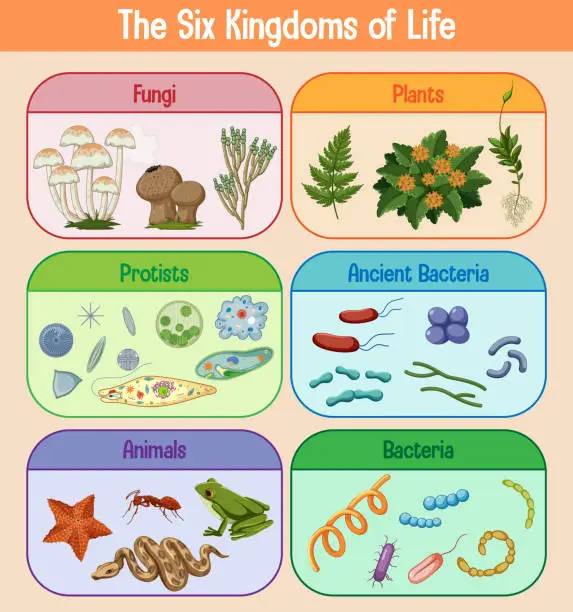
Why fungi needed their own kingdom
Life used to be divided into two kingdoms: plants and animals. If it grew and did not move, it was a plant. That worked until microscopes revealed bacteria, single-celled organisms, and things that did not fit anywhere.
By the 1960s most biologists had moved to a five-kingdom system. Fungi got their own kingdom in 1969. Wherever the classification framework has gone since, fungi always end up in their own distinct group because the biological reasons for separating them are real and significant.
The 1969 reclassification, driven largely by ecologist Robert Whittaker, was not just administrative tidying. It reflected something that had been building in the evidence for decades: fungi are so fundamentally different from plants that putting them in the same kingdom had become scientifically indefensible.
What actually makes fungi different
Four things separate fungi from everything else, right down to the cellular level.
Cell walls made of chitin, not cellulose
Plant cell walls are made of cellulose. Fungal cell walls are made of chitin, the same tough polymer found in insect exoskeletons and crustacean shells. This one difference has enormous downstream consequences for how fungi interact with their environment, how they resist infection, and why they respond differently to environmental stressors than plants do.
It also explains the texture of mushrooms. That slightly firm, rubbery quality of a fresh mushroom cap is chitin at work. It is one of the reasons mushrooms hold up so well in cooking compared to most vegetables.
They digest food outside their bodies
Animals eat food, digest it internally, and absorb the nutrients. Plants make energy from sunlight. Fungi do something genuinely different: they secrete digestive enzymes directly into their food source, break it down externally, and then absorb the resulting nutrients through their cell walls.
This external digestion is why fungi are such effective decomposers. Mycelium threads through dead wood, secreting enzymes that break down lignin and cellulose, then absorbs the released nutrients across an enormous surface area. The digestive surface of a fungus is not a stomach. It is the entire surface of its body.
No chlorophyll, no photosynthesis
Plants are green because of chlorophyll, the pigment that captures light for photosynthesis. Fungi have none. They perform zero photosynthesis and cannot manufacture energy from sunlight under any circumstances. This is why you will never see a genuinely green mushroom. The colours you do see on fungi, from the red cap of fly agaric to the deep amber of honey mushrooms to the blue bruising on some species, come from entirely different pigment compounds with no relationship to photosynthesis.
They grow toward food rather than moving toward it
Animals move to find food. Fungi grow toward it. When mycelium encounters a food source, it extends its network into and through it, maximising contact with nutrients. This growth-as-movement strategy is what allows a single fungal organism to cover acres of forest floor. It is one of the most effective foraging strategies in nature, and it does not require muscles, a nervous system, or locomotion of any kind.
Fungi vs. plants vs. animals at a glance
Why fungi are more related to animals than plants
This is the part most people push back on. Intuition says mushrooms are plant-like. The molecular evidence says the opposite.
When biologists trace evolutionary lineages through DNA sequences, they find that fungi and animals share a common ancestor that existed after plants had already split off. Fungi and animals are sister groups on the tree of life. They diverged from each other more recently than either one diverged from plants.
The supporting evidence is specific. Both fungi and animals store energy as glycogen. Plants store it as starch. Both synthesise the amino acid lysine through the same biochemical pathway, the alpha-aminoadipate pathway, which is distinct from the one plants use. Both have ergosterol or a closely related sterol in their cell membranes rather than the plant sterols found in, well, plants.
And then there is the flagellum detail. Both the sperm of animals and the motile spores of primitive fungi have a single flagellum at the rear of the cell. Plants have a completely different flagellum arrangement. That shared structural feature is a molecular fingerprint pointing back to a shared ancestor that biologists have named Opisthokonta.
None of this makes fungi animals. They are their own kingdom with their own unique biology. But it does mean the intuition that mushrooms belong closer to the plant world than the animal world is genuinely backwards.
How many fungal species are there?
Current estimates put the number somewhere between 2.2 million and 3.8 million species. As of the early 2020s, around 150,000 had been formally described and named.
To put that in context: there are roughly 390,000 known plant species and around 1 million known animal species. The fungi kingdom, even in its tiny described fraction, is comparable in scale to the entire animal kingdom. The undescribed majority represents one of the largest unexplored frontiers in biology.
Most of those species are not mushrooms in any recognisable sense. The majority are microscopic yeasts, mould filaments, and other organisms invisible to the naked eye. The mushrooms most people know, your shiitake, reishi, lion’s mane, oyster, come from a group called Basidiomycota, around 36,000 described species out of potentially millions. We are very early in understanding what is actually in this kingdom.
The major groups within the fungi kingdom
Basidiomycota
The phylum that contains most of what people picture when they hear the word mushroom. Gilled mushrooms, bracket fungi, puffballs, chanterelles, and all the medicinal species including reishi, shiitake, lion’s mane, turkey tail, and oyster mushrooms. Spores are produced on specialised club-shaped cells called basidia, usually on the gills or pores of the fruiting body.
Ascomycota
The largest phylum by described species. Morels, truffles, cup fungi, and yeasts all live here. Most of the contamination molds home growers encounter, Trichoderma, Aspergillus, Penicillium, are Ascomycota. So is Penicillium notatum, the mold that gave us penicillin. Spores are produced in sac-like structures called asci.
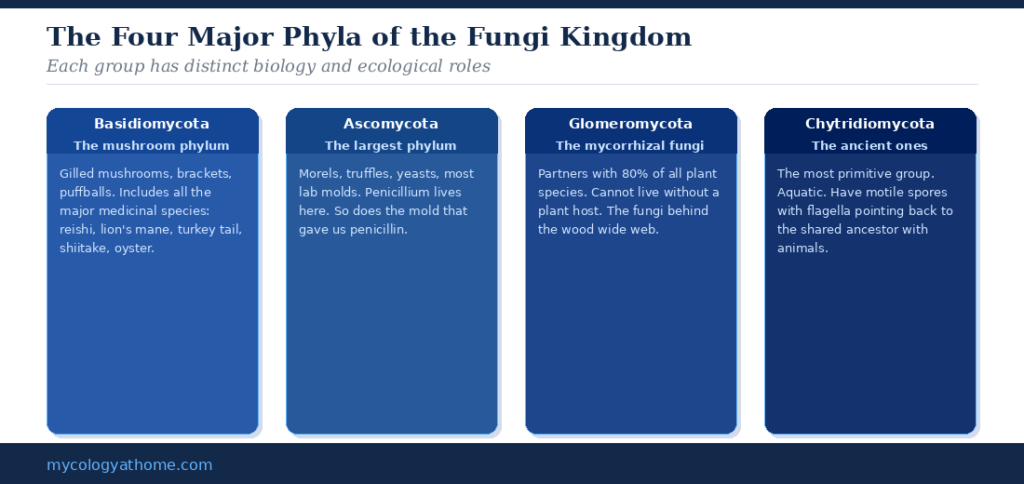
Glomeromycota
A smaller phylum with enormous ecological importance. These are the mycorrhizal fungi that form symbiotic relationships with the roots of around 80 percent of all plant species on earth. They cannot be grown in pure laboratory culture because they cannot complete their life cycle without a plant partner. The wood wide web that connects forest trees runs largely through Glomeromycota.
Chytridiomycota
One of the oldest and most primitive fungal groups, mostly aquatic. These are the fungi with motile spores, the flagellated cells that point back toward the shared ancestry with animals. Some chytrids are catastrophic pathogens: one species has driven the extinction or severe decline of hundreds of amphibian species worldwide and is considered one of the most destructive infectious diseases ever recorded in vertebrates.
What fungi are actually doing on earth
The short version: without fungi, most terrestrial ecosystems collapse. Here is the longer version.
Fungi are the primary decomposers of lignin, the tough polymer that makes wood rigid. No other kingdom can break down lignin efficiently at scale. Without fungal decomposition, dead wood would accumulate indefinitely, carbon would stay locked away from the nutrient cycle, and the recycling system that keeps ecosystems running would grind to a halt.
Mycorrhizal fungi extend the nutrient and water absorption capacity of most plant species far beyond what root systems alone could manage. Most trees in any given forest cannot survive without their fungal partners. The relationship is not optional for them.
And then there is medicine. Penicillin from Penicillium mould transformed infectious disease treatment in the 20th century. Cyclosporin, derived from a soil fungus, made organ transplantation viable by preventing rejection. The first statins for cholesterol management were derived from Aspergillus. The medical debt humanity owes to fungi is difficult to overstate.
Fungi also play a central role in the global carbon cycle, transferring carbon from dead organic matter back into forms that plants and microorganisms can use. Estimates suggest fungal networks globally sequester billions of tonnes of carbon annually. Their role in climate science is one of the areas being most actively researched right now.
Frequently asked questions
Are fungi plants?
No. Fungi were classified as plants until 1969 but the reclassification reflected genuine biological differences that had been accumulating in the evidence for years. Different cell wall material, no photosynthesis, external digestion, and a molecular lineage that places them closer to animals than to plants. They have not been plants in any serious scientific sense for over 50 years.
Are fungi more related to animals or plants?
Animals. Fungi and animals share a common ancestor that plants had already diverged from before fungi and animals split from each other. The molecular evidence for this is solid and has been confirmed across multiple independent lines of research since the 1990s.
How many fungal species exist?
Between 2.2 and 3.8 million is the current scientific estimate. Around 150,000 have been formally described. The rest are largely unknown. For scale, that is more diversity than exists in the entire animal kingdom, and we have described only a small fraction of it.
Why does any of this matter?
Because fungi run processes that make complex life on land possible. Decomposition, plant support, carbon cycling, medicine. Understanding what they are makes you understand what they do, and what they do turns out to be foundational to almost everything.
A kingdom unlike anything else
Fungi sit in their own corner of the tree of life, neither plant nor animal, doing things that nothing else does in quite the same way. More genetically diverse than all plants combined. Present on earth for over a billion years. Found in tropical forests, deep ocean sediments, high-altitude soils, and the cooling pipes of nuclear reactors.
The mushroom you see above the ground is the smallest visible part of a kingdom that runs most of the biological processes that make complex life on land possible.
Once you know what fungi actually are, the world you walk through every day looks different. The soil under any patch of grass is a network. The dead log in the forest is a food source being dismantled by invisible threads. The trees around you are sharing resources through partnerships that predate the existence of most living things you can name.