Slime Molds Are Not Actually Fungi (And Why That Matters)
Slime Molds Are Not Actually Fungi (And Why That Matters)
Single-celled organisms that solve mazes, redesign subway systems, and learn without brains. For 150 years they were classified with fungi. DNA evidence showed they are not even close.
If you have been reading the science articles on this site, you already know that “fungus” is a specific kingdom of life with a specific set of traits. You also know that several organisms look like fungi while not actually being fungi at all. Slime molds are the most famous example, and they are easily the strangest. This is a post I have been looking forward to writing for months.
A slime mold is not a fungus. It grows on decaying wood, forages for bacteria, produces spore-releasing fruiting bodies, and for most of the 20th century it was classified in Kingdom Fungi right alongside the organisms I grow in my kitchen. Then DNA sequencing arrived in the 1990s, and it turned out slime molds were not even in the neighborhood. They belong to a completely different eukaryotic supergroup called Amoebozoa, which is more closely related to animals than to fungi [1][2]. The resemblance to fungi is pure convergent evolution. Two distantly related branches of life figured out similar solutions to the same problem (decompose organic matter, disperse spores) and ended up looking alike despite sharing no recent common ancestor.
I find this genuinely thrilling. A slime mold is, depending on which type you are looking at, either a single giant cell with thousands of nuclei moving across a forest floor as one organism, or a swarm of individual amoebas that can cooperate to form a multicellular body when food runs low. Both options are weirder than anything in Kingdom Fungi. And in the last 25 years, experiments on the plasmodial slime mold Physarum polycephalum have shown it can solve mazes, redesign subway systems, learn to ignore harmless irritants, and transfer what it has learned to another slime mold by touching it.
No brain. No neurons. One cell.
What a slime mold actually is
Looks like a fungus. Is not a fungus.
Three lifestyles. Three cell walls. Three feeding strategies. Slime molds match fungi on a few traits that lie on the surface and differ on the ones that matter at the cellular level.
- Cell WallNone in plasmodial phase. Cellulose in spores.
- FeedingPhagocytosis (engulfs particles)
- Body PlanSingle giant cell or amoeba swarm
- Closest RelativesAmoebas, then animals + fungi
- Cell WallChitin
- FeedingExternal digestion via secreted enzymes
- Body PlanNetwork of hyphae
- Closest RelativesAnimals (opisthokonts)
- Cell WallCellulose
- FeedingPhotosynthesis (makes food from sunlight)
- Body PlanMulticellular with rigid tissues
- Closest RelativesGreen algae
The word “slime mold” covers a handful of distinct organisms that have been lumped together because they all produce similar-looking fruiting bodies on decaying wood. Most of what follows concerns two groups:
Plasmodial slime molds (Myxomycetes). These live most of their lives as a plasmodium, which is a single cell that contains thousands to millions of nuclei. The plasmodium is visible to the naked eye. Some species reach a meter across. It crawls across substrate at up to four centimeters per hour by cytoplasmic streaming, consuming bacteria, fungal spores, and tiny bits of organic matter along the way. When food runs low or conditions change, the plasmodium transforms into spore-producing fruiting bodies that look disconcertingly like tiny mushrooms. The most studied species is Physarum polycephalum, which appears in almost every experiment I describe below.
Cellular slime molds (Dictyostelids). These spend most of their lives as individual single-celled amoebas, each one its own organism, crawling around soil eating bacteria. When food becomes scarce, they release a chemical signal (cyclic AMP) and aggregate. Tens of thousands of individual amoebas converge into a slug-like moving body, migrate to a new location, and then build a multicellular fruiting body in which some of the amoebas die to form a stalk that lifts the others up, where they become spores. The most studied species is Dictyostelium discoideum, which has been a model organism for cell biology for more than fifty years.
Plasmodial Slime Molds
Myxomycetes • e.g. Physarum polycephalumA single giant cell containing thousands to millions of nuclei, all sharing one cytoplasm. Crawls across substrate by cytoplasmic streaming. Can reach a meter across. The star of every famous experiment.
Cellular Slime Molds
Dictyostelids • e.g. Dictyostelium discoideumSingle-celled amoebas that live alone most of the time. When food runs low they release a chemical signal and aggregate into a multicellular slug, which migrates before building a stalked fruiting body together.
A few other groups also get called slime molds (protostelids, labyrinthulids, acrasids), and the latest molecular work has shown that “slime mold” is not even a monophyletic group. Different slime molds evolved their slime-mold-like lifestyles independently from different corners of the eukaryotic tree [1]. The word is a lifestyle description, not a family relationship.
The five traits that define a fungus (chitin cell walls, external digestion, spore reproduction, no photosynthesis, eukaryotic cellular organization) apply partially at best. Slime molds are eukaryotic. They do produce spores. They cannot photosynthesize. But they do not have chitin cell walls. They do not feed by external digestion. They feed by phagocytosis, which is what animals and amoebas do, engulfing food particles and digesting them inside vacuoles. On the two traits that matter most for distinguishing fungi from other eukaryotes, slime molds come out on the animal side.
Why they got lumped with fungi in the first place
The confusion goes back a long way. In the ninth century, a Chinese scholar described a yellow substance resembling Fuligo septica (the organism colloquially called “dog vomit slime mold”) as “demon droppings.” In 1654, the first European illustration of what was almost certainly Lycogala epidendrum appeared in Thomas Panckow’s Herbarium Portabile. For centuries after that, slime molds were classified with fungi because they seemed obviously fungal. They grew on decaying wood. They produced fruiting bodies. They released spores.
A thousand years of mistaken classification
Slime molds were treated as fungi from the first written record until the 1990s. DNA sequencing finally corrected it.
The first scientist to seriously question this was Anton de Bary, who in 1887 noted that slime molds behave like protozoa during their amoeboid phase. He coined the term Mycetozoa, meaning “fungus-animals,” to acknowledge the dual character. This in-between classification persisted for most of the 20th century. Different textbooks placed slime molds in different kingdoms depending on which features the author thought mattered most.
The resolution came from molecular phylogenetics. Starting in the 1990s, researchers began sequencing ribosomal RNA and other conserved genes from every major eukaryotic lineage. When slime molds were included in these analyses, they consistently grouped with amoebas, not with fungi [1][3]. Hibbett and colleagues’ 2007 classification of the fungi kingdom explicitly excludes slime molds [4], and the Adl et al. eukaryotic classification work has placed them in the Amoebozoa, a major eukaryotic supergroup that is genetically closer to animals and fungi together (the Opisthokonts) than to plants, but that branches off the tree before the animal-fungus split [2][3].
In the modern framework, the resemblance to fungi is a striking case of convergent evolution. Decomposing dead plant matter is a good job. Producing tough spores and releasing them at height is a good way to disperse. Multiple unrelated branches of eukaryotic life evolved toward similar solutions because the solutions work.
The plasmodium: one cell the size of a dinner plate
If you have never seen a Physarum plasmodium in person, the scale is hard to grasp from photographs. The yellow network of veins pulsing across a petri dish is one cell. Not one organism made of many cells. One cell, with thousands to millions of nuclei sharing a common cytoplasm.
This design is called a syncytium, and it lets Physarum do something that no multicellular organism can quite manage: coordinate its entire body without any cell-to-cell communication at all. The cytoplasm inside the plasmodium flows rhythmically, pulsing back and forth through the tubular network every minute or so. Areas that encounter food chemicals pulse harder. Areas that encounter repellents pulse weaker. The pattern of pulsation across the whole organism determines where the plasmodium will grow next and where it will retreat.
This is the biology that allows slime molds to do the remarkable things I describe next. The organism has no centralized control. No brain, no nervous system, no command center. The whole thing is a distributed computational process running on oscillating cytoplasm. And the process turns out to be good at solving problems that computer scientists have been working on for decades.
Experiment 1: solving mazes
The most famous slime mold paper appeared in Nature in September 2000, by Toshiyuki Nakagaki and colleagues at RIKEN [5]. The experimental setup was almost embarrassingly simple. Nakagaki cut a maze out of plastic, placed it on an agar surface, and filled every path of the maze with pieces of a Physarum plasmodium. Then he placed oat flakes (Physarum’s preferred food) at the entrance and exit of the maze.
Four landmark experiments that rewrote what “intelligence” means
All four published in major journals. All four performed with Physarum polycephalum. None of them should be possible for an organism without neurons.
Solved a maze
Placed food at the entrance and exit. In 14 of 19 trials, the plasmodium consolidated itself along the shortest path between them, pruning dead ends automatically.
Redesigned the Tokyo rail system
Oat flakes placed at the positions of cities around Tokyo. The resulting network of slime mold tubes matched the JR rail system on efficiency, cost, and fault tolerance.
Habituated to harmless irritants
Over five days of repeated exposure, Physarum stopped avoiding quinine and caffeine bridges. After two days rest, the aversion returned. This is textbook habituation.
Transferred learning by fusing
Habituated slime molds were paired with naive ones. After 3 hours of fusion, the naive cells had acquired the learned behavior. Separated again, they kept it.
Over the following hours, the slime mold initially spread throughout every corridor of the maze, exploring all possible paths. Then it began withdrawing from dead ends. By the end of the experiment, the plasmodium had consolidated itself along the shortest path between the two food sources, leaving the rest of the maze empty. In fourteen of nineteen trials the organism found either the shortest path or one that differed from the shortest by less than two percent.
This was the first experimental demonstration that a single-celled organism without a nervous system could solve a shortest-path problem. The paper earned Nakagaki an Ig Nobel Prize and launched an entire subfield of bio-inspired computing. You can literally find this experiment replicated by high school students today because the protocol is so accessible.
The mechanism is elegant once you know what to look for. The plasmodium’s tubular network adapts in real time to the flow rates within each tube. Tubes carrying more cytoplasm get thicker. Tubes carrying less get thinner and eventually disappear. When food is located at two points, the shortest connection between them ends up carrying the most flow, so it gets reinforced. Longer paths carry less flow, so they get pruned. The maze is solved by a simple rule applied locally to every piece of the organism, with no global knowledge required.
Experiment 2: redesigning the Tokyo rail system
A decade later, Atsushi Tero and colleagues at Hokkaido University took the idea further and published in Science [6]. They built a physical map of the greater Tokyo region: a petri dish with oat flakes placed at locations corresponding to the actual positions of major cities around Tokyo. The central oat flake represented Tokyo itself. The surrounding oat flakes represented Yokohama, Chiba, Saitama, and the other cities connected to Tokyo by the JR rail network.
Then they placed Physarum at the Tokyo location and let it forage.
Slime Mold Network vs. The Actual Tokyo Rail Map
Tero et al. placed oat flakes on a petri dish at the positions of cities around Tokyo. Compare the slime mold’s solution to the human-engineered rail system.
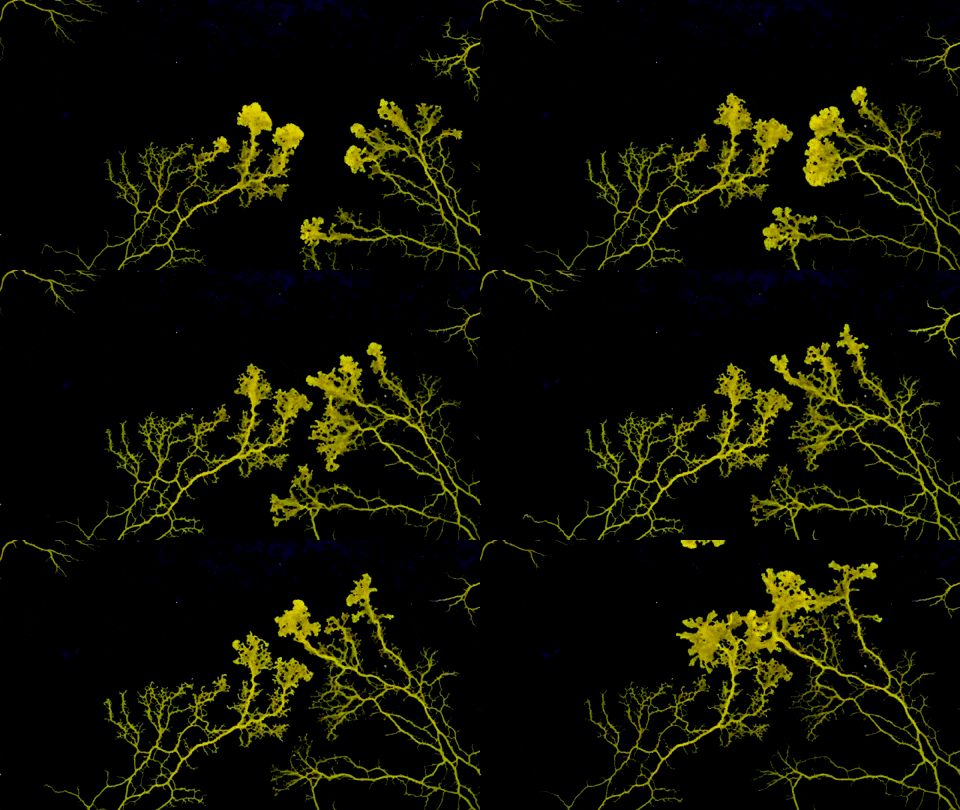
Physarum polycephalum network after ~26 hours of foraging.
Over the next day or so, the slime mold expanded outward to find all of the food sources and then refined its network, strengthening some connections and abandoning others. The resulting network of Physarum tubes bore a striking resemblance to the actual JR rail map. Not identical, but comparable on all the metrics that matter for real transportation networks: overall length, transport efficiency, and fault tolerance (the ability to keep functioning if one connection fails).
This was the punchline the paper landed on. Human engineers had spent decades designing the Tokyo rail system, making deliberate decisions about which cities to connect and how to route the tracks, trading off cost against reliability. A brainless single cell, given only the locations of the cities and about a day, produced a network that performed equivalently well on the same trade-offs.
The researchers developed a mathematical model based on the slime mold’s simple rule (reinforce tubes that carry flow, abandon tubes that do not) and showed that the model could generate optimal-or-near-optimal transportation networks for any arrangement of source points. This work has since inspired algorithms in telecommunications network design, urban planning, and computer science.
Experiment 3: learning without a brain
The third landmark experiment was published by Romain Boisseau, David Vogel, and Audrey Dussutour in Proceedings of the Royal Society B in 2016 [7]. The question was whether a single-celled organism without a nervous system could exhibit learning, specifically habituation. Habituation is the simplest form of learning. It is the decline in response to a stimulus that continues to occur without consequences. When you stop noticing the sound of your refrigerator running, that is habituation.
The experiment was again simple. Boisseau’s team placed Physarum on one side of an agar bridge and food on the other. To reach the food, the slime mold had to cross the bridge. In the control condition, the bridge was plain agar. In the experimental conditions, the bridge was infused with either quinine or caffeine, both of which are harmless to Physarum but taste bad enough that the organism initially hesitates to cross them.
On day one, the slime molds in the quinine and caffeine conditions took much longer to cross the bridge than the controls. By day six, the experimental slime molds were crossing just as fast as the controls. They had habituated. They learned that the quinine and caffeine were not actually dangerous and stopped responding to the unpleasant taste. When the researchers then gave the slime molds two days of rest without any exposure to the bitter substances, the aversion returned. This pattern (response decrement followed by spontaneous recovery) is the textbook definition of habituation.
A single cell had learned. Without neurons. Without a brain. Without any of the structures that biology textbooks treat as prerequisites for learning.
Experiment 4: teaching by touching
The same research group followed up later in 2016 with an even more surprising finding [8]. Slime molds not only learn, they can transfer what they have learned to another slime mold by fusing with it.
Physarum naturally fuses with other Physarum individuals when they meet. Two separate plasmodia that touch each other merge into one larger plasmodium, combining their cytoplasm and all of their nuclei. This is ordinary biology for them. What Vogel and Dussutour wondered was whether learned behavior could travel through the fusion.
They habituated one group of slime molds to tolerate salt on agar bridges, exactly the way Boisseau had habituated them to quinine. Then they paired each habituated slime mold with a naive one that had never encountered salt. The pairs fused into single plasmodia. After three hours of fusion, the researchers separated them again and tested both halves on salt bridges.
The naive slime molds that had fused with habituated ones crossed salt bridges just as quickly as the originally habituated group. The learning had transferred through the fusion contact. Naive controls that had fused with other naive slime molds showed no such effect. At the fusion site between habituated and naive cells, the researchers observed a vein forming in the first three hours that presumably carried the information. The exact molecular mechanism is still unknown. Something (possibly a signaling molecule, possibly a structural change, possibly something else) gets transferred during fusion, and it persists long enough to change the behavior of the recipient.
This is a single-celled organism acquiring a learned behavior from another single-celled organism by merging with it and then splitting apart again. If that does not sound like biology, that is because it is biology nobody had seen before.
What else slime molds do that should not be possible
The learning and network-solving papers get most of the attention, but the weird-biology list goes on.
Things Physarum polycephalum also does
They anticipate periodic events. Saigusa and colleagues showed in 2008 that Physarum exposed to a cold, dry shock every sixty minutes began slowing down in anticipation of the next shock, even when the researchers skipped a dose. The plasmodium had somehow started tracking time.
They make food choices that optimize nutrition. Given a menu of options with different protein-to-carbohydrate ratios, Physarum preferentially moves toward and consumes the blend that maximizes its growth rate, as if balancing a diet.
They have 720 sexes. Physarum polycephalum has three separate genes that determine mating type, each with multiple versions. The combination of all three produces around 720 distinct mating types, and any two compatible types can fuse and reproduce. This is unrelated to the experiments above. It is just one more thing about Physarum that does not fit any intuition most people bring to biology.
They are effectively immortal as long as conditions stay acceptable. A Physarum culture kept alive and fed in a lab can continue indefinitely. When conditions deteriorate, the plasmodium forms a hardened structure called a sclerotium that can survive for years without food or water. Rehydrate the sclerotium and the original plasmodium resumes where it left off.
I grow mushrooms. I have watched mycelium do genuinely impressive things. The slime mold literature is in a different category.
Where you can actually find them
Slime molds are not rare. You have almost certainly walked past them. Most people just do not recognize what they are looking at.
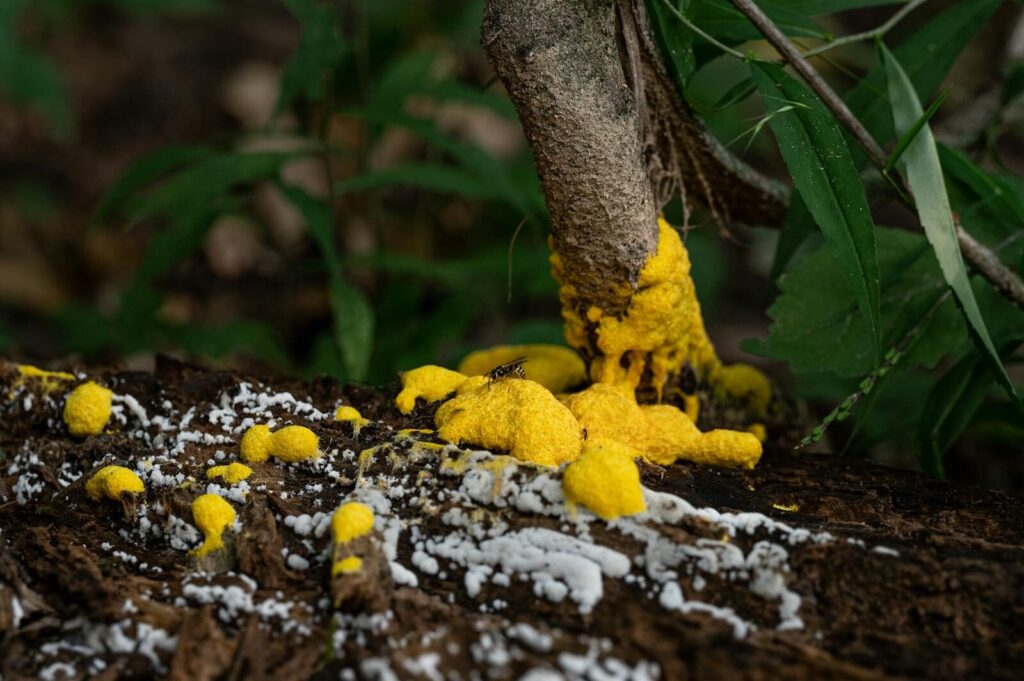
Plasmodial slime molds show up on damp logs, leaf litter, and mulch, especially after periods of rain followed by warm weather. They are often bright yellow, pink, or orange in the active plasmodial phase, which is what people most often notice. Fuligo septica (dog vomit slime mold) is the most commonly encountered species in North America, and it looks exactly like its name suggests. Lycogala epidendrum (wolf’s milk slime mold) produces small pink puffballs on rotting wood that ooze a pink paste if squeezed when young.
Three slime molds you might actually spot
All common across North America. None are dangerous. All will disappear within days as conditions shift.
Fuligo septica
Bright yellow. Appears to ooze overnight in damp mulch beds. The name is accurate about the appearance. Completely harmless.
Lycogala epidendrum
Small pink puffballs on rotting logs. If you squeeze a young one, it oozes a pink paste. Mature ones release spores like a miniature puffball mushroom.
Physarum polycephalum
The star of every experiment on this page. Yellow network of veins on damp substrate. Sold as a culture for home and classroom experiments.
If you have a mulched garden bed and you see something bright yellow or pink that seems to have appeared overnight and kind of looks like it is spreading, that is probably a slime mold. It is harmless. It will not harm your plants. It eats bacteria and decaying organic matter, not living tissue. Give it a few days and it will disappear on its own as conditions change.
Cellular slime molds are much harder to see in the wild because the individual amoebas are microscopic. The aggregated fruiting bodies, once they form, can be visible, but you would have to be looking very closely at soil or decaying leaves to spot them. They are ubiquitous in temperate soil communities nonetheless.
Neither plasmodial nor cellular slime molds are of any concern to home mushroom growers. They are not contamination risks in the way molds and bacteria are. They occupy different ecological niches and would not outcompete a healthy mushroom mycelium even if they somehow got into a grow bag.
Why the reclassification matters
When an organism gets moved from one kingdom to another in the scientific literature, it is not a minor bookkeeping exercise. It changes what questions researchers ask about it, what it gets compared to, and what frameworks get applied to understanding its biology.
Classifying slime molds with fungi made sense for 19th-century mycologists because fungal biology was the closest available framework. But it also meant that researchers studying slime molds brought fungal intuitions to their work. They asked fungal questions: how does the mycelium grow, what is the role of the fruiting body, what chemical signals trigger sporulation. Some of those questions worked for slime molds and some did not.
Reclassifying slime molds as Amoebozoa opened up different questions. How does a single cell coordinate behavior across a plasmodium? How does information propagate through cytoplasmic oscillation? How did learning evolve in organisms that do not have neurons? These are amoebal questions, not fungal ones, and they have turned out to be much more productive.
This is one of the underappreciated benefits of molecular phylogenetics in biology. DNA evidence has forced a lot of reclassifications over the last thirty years. Each one reveals relationships that were invisible to morphological analysis. Slime molds and fungi look alike because they do similar jobs. They are not relatives. Once you accept that, the strangeness of slime mold biology starts making more sense. They are not weird fungi. They are the amoebal path to being a decomposer.
Back to fungi
Everything on this site is about fungi. So why does a post about slime molds, which are not fungi, belong here?
Because understanding what a fungus actually is requires understanding what a fungus is not. The history of mycology is full of organisms that look fungal without being fungal: oomycete water molds (like the organism that caused the Irish potato famine), actinomycete bacteria (which grow as branching filaments like fungi but are prokaryotes), and slime molds. Every one of these looked enough like a fungus that it got classified as one for a significant period. Every one was eventually removed once better evidence became available.
The existence of these look-alike groups is one of the best demonstrations that convergent evolution shapes biology at the deepest level. If decomposition is a niche and spore dispersal is a good strategy for getting to new decomposition sites, evolution finds that solution from multiple starting points. Fungi are one such solution. Slime molds are another. The fact that they look similar is a testament to how good the solution is, not evidence that they are related.
For a deeper look at the boundaries of Kingdom Fungi and the other organisms that live at or just outside it, the pillar post covers the full landscape: What Is a Fungus? The Complete Guide to the Third Kingdom of Life. My post on household mold also touches on this What Is Mold, Really? because the word “mold” is part of this confusion even today. Slime molds are called “molds” despite not being molds in the fungal sense either.
The honest summary
Slime molds are not fungi. They are members of the eukaryotic supergroup Amoebozoa, which is genetically closer to animals and fungi combined than to plants, but which branched off before the animal-fungus split. For most of the 20th century they were incorrectly classified as fungi because they look and act fungal in superficial ways. Molecular phylogenetics corrected the error.
What they actually are is more interesting than fungi. Plasmodial slime molds are single cells that can grow to a meter across and contain millions of nuclei. Cellular slime molds are swarms of individual amoebas that cooperate to form multicellular fruiting bodies. Both groups solve problems that should be impossible for organisms without nervous systems, from finding the shortest path through a maze, to designing efficient transportation networks, to learning to ignore harmless irritants, to transferring that learning to other slime molds through physical contact.
If you see a bright yellow or pink blob on mulch after a rainstorm, that is probably a slime mold. It is harmless. It will disappear within days. And it is doing computation you and I are still trying to figure out.
Now compare slime molds to the actual Kingdom Fungi
The pillar post lays out the five traits that define a fungus, the Opisthokont relationship with animals, and the other look-alikes that are not fungi either.
Frequently asked questions
No. Slime molds are harmless to humans, pets, and plants. They feed on bacteria and decaying organic matter, not living tissue. The bright yellow Fuligo septica that shows up in mulched garden beds looks alarming but poses no health or structural risk.
Yes. Physarum polycephalum is widely used in education and research, and culture kits are available from biological supply companies. The organism is non-pathogenic and easy to maintain on damp filter paper with oat flakes as food. Some high school biology classes grow Physarum specifically to replicate the maze-solving experiment.
Because the name predates the science. The word “mold” in “slime mold” goes back to centuries before anyone understood eukaryotic phylogenetics. By the time molecular evidence showed slime molds were not fungi, the name was too established in scientific literature to change. Similar issue with “water molds” (oomycetes), which are not fungi either but retain the name for historical reasons.
Depends on how you define intelligence. They can solve mazes, optimize transport networks, learn through habituation, and transfer learned information through cell fusion. These are behaviors that in animals would be called cognitive. Whether you want to call them “intelligent” or “behavior driven by simple local rules that produce complex outcomes” is partly a semantic question. The organisms are doing something computationally meaningful regardless of what we label it.
References
[1] Baldauf SL, Doolittle WF. Origin and evolution of the slime molds (Mycetozoa). Proceedings of the National Academy of Sciences USA. 1997;94(22):12007-12012. PubMed
[2] Adl SM, Simpson AGB, Farmer MA, et al. The new higher level classification of eukaryotes with emphasis on the taxonomy of protists. Journal of Eukaryotic Microbiology. 2005;52(5):399-451. PubMed
[3] Shadwick LL, Spiegel FW, Shadwick JD, Brown MW, Silberman JD. Eumycetozoa = Amoebozoa? SSUrDNA Phylogeny of Protosteloid Slime Molds and Its Significance for the Amoebozoan Supergroup. PLOS ONE. 2009;4(8):e6754. PMC
[4] Hibbett DS, Binder M, Bischoff JF, et al. A higher-level phylogenetic classification of the Fungi. Mycological Research. 2007;111(5):509-547. PubMed
[5] Nakagaki T, Yamada H, Tóth Á. Maze-solving by an amoeboid organism. Nature. 2000;407(6803):470. Nature
[6] Tero A, Takagi S, Saigusa T, et al. Rules for biologically inspired adaptive network design. Science. 2010;327(5964):439-442. Science
[7] Boisseau RP, Vogel D, Dussutour A. Habituation in non-neural organisms: evidence from slime moulds. Proceedings of the Royal Society B. 2016;283(1829):20160446. Royal Society
[8] Vogel D, Dussutour A. Direct transfer of learned behaviour via cell fusion in non-neural organisms. Proceedings of the Royal Society B. 2016;283(1845):20162382. Royal Society
[9] Saigusa T, Tero A, Nakagaki T, Kuramoto Y. Amoebae anticipate periodic events. Physical Review Letters. 2008;100(1):018101. PubMed
[10] Dussutour A, Latty T, Beekman M, Simpson SJ. Amoeboid organism solves complex nutritional challenges. Proceedings of the National Academy of Sciences USA. 2010;107(10):4607-4611. PubMed
Not medical or biological advice for hobbyist slime mold work. For informational purposes only.