The FDA and Mushroom Supplements: What Is Actually Regulated
Regulation reality
Mushroom supplements are regulated, but they are not pre-approved.
The FDA does not approve mushroom supplements for safety or effectiveness before they reach the market. The company is responsible for making and labeling the product correctly. The FDA and FTC can act when products are unsafe, mislabeled, or marketed with misleading claims, but that is not the same as a pre-sale quality check.
I used to think a supplement on a store shelf had cleared some basic government review.
Not clinical proof. Not drug-level approval. Just a basic check that the bottle contained what it said, that the dose made sense, and that somebody had looked at the product before it reached customers.
That is not how mushroom supplements work in the United States.
Mushroom supplements are regulated. They are not floating around in a legal vacuum. But they are regulated as dietary supplements, not as drugs. That distinction changes almost everything a buyer needs to know.
The FDA does not approve mushroom supplements for safety or effectiveness before they are sold. In many cases, a company can bring a supplement to market without notifying the FDA first [1].
That does not mean every product is bad. It means the buyer has to understand where the regulatory system stops.
For mushroom supplements, that stopping point matters because the quality problems are not obvious from the bottle. You cannot look at a capsule and know whether it contains fruiting body extract, mycelium grown on grain, meaningful beta-glucans, heavy metal testing, or a realistic dose.
The label can look serious. The claims can sound careful. The product can still be weak.
That is the problem this article is about.
The short version
Mushroom supplements are legal dietary supplements when they meet the rules for supplements.
The FDA can inspect facilities, review labels, monitor adverse event reports, examine imported products, review certain new dietary ingredient notifications, and take action against adulterated or misbranded products after they reach the market [2].
The FTC watches advertising. If a brand makes health claims in ads, on sales pages, or through marketing materials, those claims must be truthful, not misleading, and supported by adequate evidence [7].
The manufacturer is responsible for making sure the product is safe, manufactured properly, and labeled accurately before it is sold [1].
That last sentence is the one to sit with.
The company, not the FDA, is usually the first checkpoint.
0
Pre-sale approval
The FDA does not approve dietary supplements for safety or effectiveness before they are sold.
21 CFR
Manufacturing rules
Supplement makers must establish quality specifications for identity, purity, strength, composition, and contaminants.
FTC
Advertising claims
Health claims in ads need truthful, non-misleading support. Reviews and testimonials do not replace evidence.
Why this matters more for mushroom supplements
Some supplement categories are fairly straightforward. Vitamin C is vitamin C. Magnesium glycinate is still not perfectly simple, but at least the ingredient identity is usually more direct.
Mushrooms are messier.
A mushroom supplement label might say “lion’s mane,” but that can mean several different things:
- Fruiting body powder
- Fruiting body extract
- Mycelium
- Mycelium grown on grain
- A blend of mushroom species
- A blend of extracts and non-extract powders
- A coffee or drink mix with a small mushroom dose hidden inside a proprietary blend
Those are not small differences.
Fruiting body, mycelium, extraction method, beta-glucan content, starch content, and dose can all change what the product actually is. They also change how much confidence you should place in the label.
This is where mushroom supplements become a consumer-protection issue instead of a normal wellness shopping decision.
What the FDA actually does
The FDA regulates dietary supplements under a different framework than prescription or over-the-counter drugs. Drugs generally need FDA approval before marketing. Dietary supplements do not [8].
For supplements, the FDA role is more limited and more reactive.
The agency can inspect facilities to check whether companies are following applicable manufacturing and labeling requirements. It can review labels and other labeling materials, including websites, for claims that may turn the product into an unapproved drug. It can monitor adverse event reports from companies, health care professionals, and consumers. It can act against unsafe, adulterated, or misbranded products after they are on the market [2].
That is real authority.
It is just not the same as pre-market approval.
If a mushroom supplement appears online tomorrow, the FDA has not necessarily checked the beta-glucan level, verified the extraction method, tested the batch for heavy metals, or confirmed that the product contains fruiting body rather than mycelium on grain.
The company is responsible for getting those things right.
Who checks what
The system has oversight. It just leaves gaps consumers need to understand.
01
FDA
Regulates supplement labeling, manufacturing, adulteration, misbranding, facility inspections, and post-market safety actions.
02
FTC
Reviews advertising claims, sales pages, testimonials, and marketing messages for truthful, supported claims.
03
Brand
Responsible for safety, formula quality, label accuracy, manufacturing controls, and keeping records that back up the product.
04
Labs
Can test identity, beta-glucans, contaminants, microbes, and solvents when a brand actually pays for meaningful testing.
05
Buyer
Still has to check the label, dose, extract type, claims, and documentation before trusting the product.
What GMP means and what it does not mean
You will see “GMP” everywhere in supplement marketing.
GMP stands for Good Manufacturing Practice. Dietary supplement manufacturers are subject to current Good Manufacturing Practice regulations under 21 CFR Part 111. These rules require manufacturers to establish specifications and controls for identity, purity, strength, composition, and contaminant limits [4].
That matters. A company should have controls for raw materials, manufacturing steps, packaging, labeling, and finished products.
But “made in a GMP facility” is not the same thing as “this mushroom supplement is clinically proven” or “this bottle contains the beta-glucan level implied by the marketing.”
GMP is about manufacturing quality systems. It is not a shortcut around product-level scrutiny.
A product can be made in a facility that follows GMP rules and still be a poor choice if the formula is weak, the extract is vague, the label hides the dose, or the brand refuses to show meaningful testing.
This is why I do not treat GMP language as a finish line. I treat it as a baseline.
The important difference between labels and ads
Two agencies matter most for consumers: the FDA and the FTC.
The FDA is the main agency for supplement labeling, manufacturing, adulteration, misbranding, and post-market safety actions.
The FTC is the main agency for advertising.
That split matters because a supplement brand does not only communicate through the bottle. It communicates through sales pages, Amazon listings, email funnels, influencer posts, social videos, charts, testimonials, before-and-after language, and “clinically studied” claims.
The FTC looks at the overall message a reasonable consumer takes from the advertising, not just one carefully worded sentence [7].
That is important in mushroom supplements because some brands avoid explicit disease claims on the label, then use fuzzier marketing elsewhere. A page might avoid saying “treats anxiety,” but still surround the product with language about stress, mood, cortisol, calm, sleep, and personal testimonials that create a stronger impression than the label alone.
The FTC guidance is blunt on the core standard: health-related claims need competent and reliable scientific evidence [7].
That does not mean every mushroom claim needs the same level of proof. A claim about normal immune support is different from a claim about treating a disease. But if a brand implies a specific health outcome, the evidence should match the claim.
FDA and FTC do different jobs.
Bottle and product
Label, manufacturing, safety
The FDA focuses on supplement labeling, manufacturing rules, adulteration, misbranding, inspections, and post-market safety issues.
Marketing
Ads, pages, testimonials
The FTC focuses on the claims made in advertising, including sales pages, influencer content, testimonials, and implied health promises.
Buyer filter
Look at the full message
A cautious buyer checks the label and the marketing. Weak brands often stay careful on the bottle and get loose on the sales page.
Structure/function claims are not FDA approval
This is one of the most common points of confusion.
Dietary supplements can make certain structure/function claims. These are claims about supporting normal body structure or function, such as “supports immune function” or “supports cognitive health” [6].
When a supplement label uses this kind of claim, it must carry the familiar disclaimer:
“This statement has not been evaluated by the Food and Drug Administration. This product is not intended to diagnose, treat, cure, or prevent any disease.” [6]
That disclaimer is not decorative legal clutter. It tells you something useful.
It means the FDA has not evaluated that claim before the product reached you.
It also means the product is not supposed to be marketed as a disease treatment. A mushroom supplement that claims to cure depression, treat diabetes, reverse cancer, lower high blood pressure, or replace medication has crossed into dangerous territory.
That does not automatically mean the ingredient has no research behind it. It means the marketing claim is stronger than a supplement should be making.
What “FDA registered” does not prove
Some supplement brands use regulatory-sounding phrases because they know consumers associate them with oversight.
The phrase that bothers me most is “FDA registered facility.”
That can be true and still not tell you what you think it tells you.
Registration is not product approval. A facility registration does not mean the FDA approved the formula, tested the capsules, confirmed the mushroom species, reviewed the beta-glucan content, or endorsed the brand.
The same caution applies to phrases like:
- Made in a GMP facility
- Manufactured in the USA
- Lab tested
- Third-party tested
- Doctor formulated
- Clinically inspired
Some of those phrases can point toward better quality. None of them should be treated as proof by themselves.
If a brand leans on official-sounding language but does not show what was tested, which batch was tested, which lab performed the test, and what the results were, the language is doing more work than the evidence.
Official-sounding is not proof
“FDA registered” does not mean FDA approved.
Registration language can sound reassuring, but it does not prove the FDA reviewed the formula, tested the capsules, verified fruiting body material, or checked the beta-glucan level.
The mushroom-specific gaps consumers still have to check
The regulatory system does not solve the biggest quality questions in mushroom supplements for you.
A good buyer still has to check the things that matter in this category.
Fruiting body vs mycelium on grain
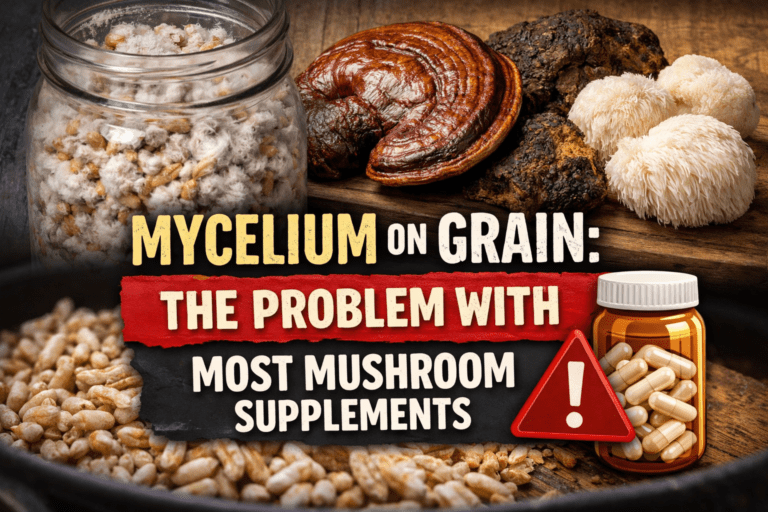
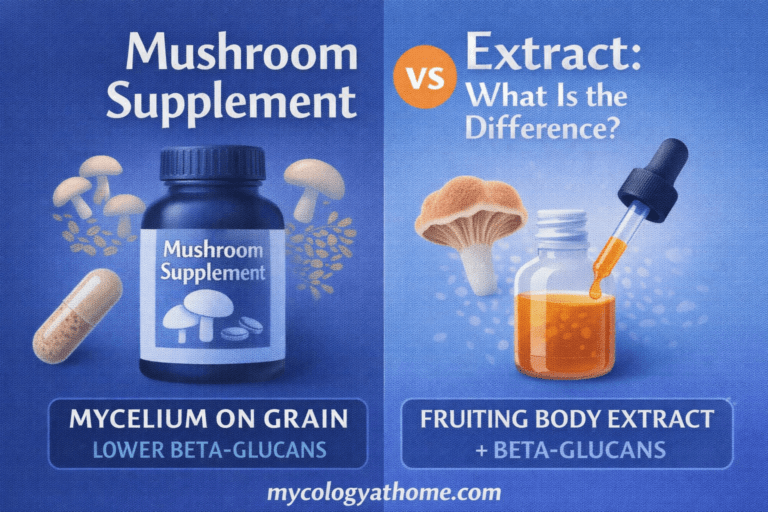
Fruiting body is the above-ground mushroom structure most people recognize. Mycelium is the fungal network. Both can be legitimate biological materials, but the supplement market often uses mycelium grown on grain.
That matters because the finished product may contain a meaningful amount of grain substrate. If the brand is vague about “full spectrum mushroom” or “mycelial biomass,” you need to know whether you are paying for mushroom material or a grain-heavy product.
The FDA is not checking that distinction for you before the product goes live.
Beta-glucans vs polysaccharides
Mushroom brands often advertise polysaccharides. That can sound scientific, but it is weaker than specific beta-glucan data.
Beta-glucans are a major class of mushroom compounds consumers often want to evaluate. Alpha-glucans can reflect starch or glycogen. McCleary and Draga described a method for measuring beta-glucans in mushroom and mycelial products by measuring total glucan and alpha-glucan, then determining beta-glucan by difference [10].
That distinction matters because a high “polysaccharide” number may look impressive while telling you less than you think.
For a mushroom supplement, I want to see beta-glucans listed separately from alpha-glucans. If the product is a reishi extract, I also want to know whether triterpenes are measured. If the product is a lion’s mane extract, I want the brand to be honest about the limits of hericenone, erinacine, and finished-product standardization.
Extraction method
A raw mushroom powder is not the same as an extract.
Some compounds are water-soluble. Some are alcohol-soluble. Some products are hot water extracts. Some are dual extracts. Some labels use ratios like 8:1 or 10:1 without explaining what the ratio means.
The label should tell you what kind of extract you are buying.
If it does not, the brand is asking you to trust the marketing instead of the process.
Dose realism
A mushroom coffee with 200 mg of a proprietary blend is not equivalent to a capsule product providing 1,000 mg of a clearly identified extract.
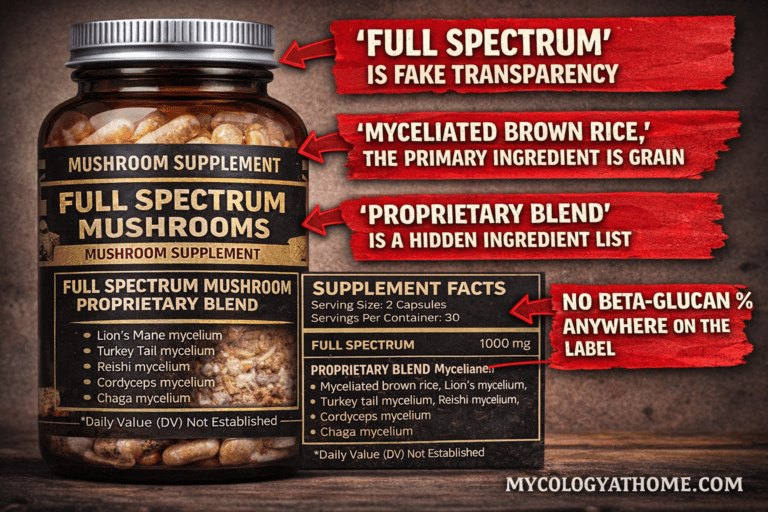
This is one of the easiest ways supplement marketing gets slippery. The front label may feature six mushroom species, but the Supplement Facts panel may reveal a small combined blend that leaves each species underdosed.
The FDA does not standardize mushroom supplement serving sizes for you. FDA’s dietary supplement Q&A says that, apart from a manufacturer’s responsibility to meet safety, labeling, and GMP requirements, there are no regulations limiting the serving size or amount of a dietary ingredient in a serving. That decision is made by the manufacturer and does not require FDA approval [3].
That is why dose realism belongs in every mushroom supplement review.
Lower-risk language
Support claims need evidence, but they can stay within supplement territory.
- Supports normal immune function.
- Helps maintain a normal stress response.
- Supports focus as part of a daily routine.
- Uses the FDA disclaimer when required.
- Connects claims to the actual ingredient, dose, and product form.
Higher-risk language
Disease claims are where supplement marketing gets dangerous fast.
- Treats anxiety, depression, diabetes, cancer, or high blood pressure.
- Promises to reverse brain fog or cure inflammation.
- Uses customer stories as proof of medical outcomes.
- Applies research on one extract to a different gummy, coffee, or capsule.
- Hides the dose behind a proprietary blend.
Contaminants are not a side issue
Mushrooms are not inert powders. They are organisms that interact with their growing substrate.
A 2022 review in Journal of Fungi described how mushrooms can take up minerals, including heavy metals, from substrates and discussed the importance of early contaminant detection for food security [11].
That does not mean mushroom products are automatically unsafe. It means contaminant testing is not optional window dressing.
For mushroom supplements, I want to see testing for:
- Lead
- Cadmium
- Arsenic
- Mercury
- Microbial contamination
- Yeast and mold
- Pesticides when relevant
- Residual solvents when relevant to the extraction process
Lead deserves special caution because the FDA states that no known safe level of lead exposure has been identified [12].
The practical takeaway is not panic. It is documentation.
If a brand sells concentrated mushroom extracts, it should be able to show contaminant testing. If it cannot, I do not think the buyer should fill in the blank with trust.
What a certificate of analysis can and cannot do
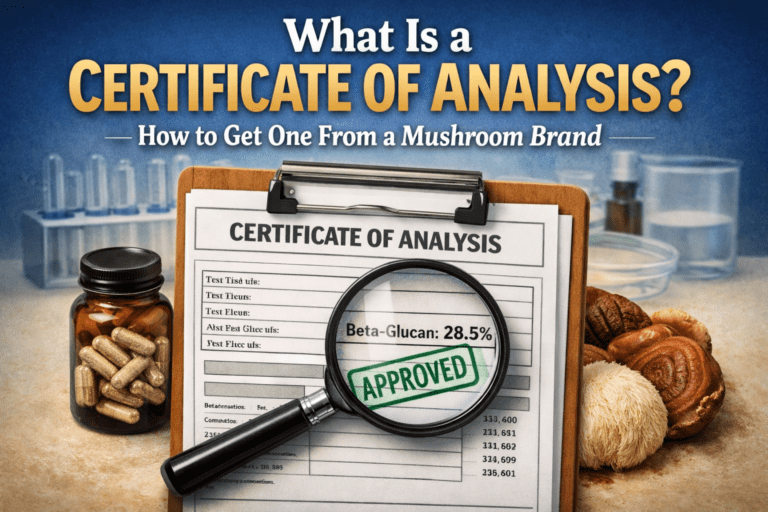
A certificate of analysis can be useful. It can show whether a specific batch met certain specifications for identity, active compounds, contaminants, or microbial limits.
But I do not want this article to become another CoA guide. That is a separate topic.
For regulation, the important point is simpler: a CoA is one of the tools that can fill part of the gap left by the lack of pre-market FDA approval.
Even FDA’s GMP rules allow certain supplier CoA reliance only under conditions. For example, 21 CFR 111.75 says a supplier CoA should include method descriptions, limits, and actual results, and the manufacturer must qualify the supplier and periodically reconfirm the CoA [5].
That is a useful consumer lesson too.
A weak PDF with no batch number, no method, no limits, and no actual results is not strong proof.
If you want the deeper version, read the CoA guide. For this article, the point is that testing only matters when it is specific enough to check.
Regulatory trust signals, ranked from useful to weak.
USP or NSF verified finished product
Independent certification does not prove health benefits, but it is a stronger quality signal than brand-only language.
Batch-specific third-party CoA
Useful when it includes lab name, batch number, methods, limits, and actual results for the product being sold.
Clear beta-glucan and contaminant data
Better than vague polysaccharide claims, especially when alpha-glucans or starch markers are separated.
“Third-party tested” with no report
Potentially true, but not very useful until the brand shows what was tested and what the results were.
“Made in a GMP facility”
A baseline manufacturing signal, not proof that this exact product has meaningful mushroom compounds.
Disease claims with no product-specific proof
If a brand sounds like it is treating a condition, the trust bar should go up immediately.
Third-party certification is stronger than self-policing
Some supplements carry third-party verification from organizations such as USP or NSF.
USP says its dietary supplement verification program includes auditing, product documentation review, laboratory testing for quality standards, and off-the-shelf testing to confirm verified products continue to meet standards [13].
NSF says its supplement certification evaluates composition and includes contaminant assessment for substances such as lead, mercury, arsenic, cadmium, and chromium VI [14].
That kind of certification is not the same as proof that a mushroom supplement will improve your memory, sleep, focus, or immune function.
It is quality verification, not clinical proof.
Still, it is more meaningful than a brand simply saying “lab tested” without showing the lab work.
The problem is that many mushroom supplements do not have USP or NSF verification. When that is the case, you are back to evaluating the brand’s own documentation.
How disease claims should change your trust level
I get more skeptical when a mushroom supplement brand talks like a medical clinic.
There is a difference between:
“Supports normal immune function.”
And:
“Helps fight cancer.”
There is a difference between:
“Supports a calm mood.”
And:
“Treats anxiety.”
There is a difference between:
“Supports healthy glucose metabolism.”
And:
“Lowers blood sugar in diabetics.”
Dietary supplements are not allowed to claim they diagnose, treat, cure, or prevent disease unless the claim is otherwise authorized under the relevant rules. FDA’s structure/function rules draw a line between normal structure/function support and disease claims [6].
The FTC also expects health-related advertising claims to be backed by competent and reliable scientific evidence, and it warns that consumer anecdotes are not enough to substantiate health product claims [7].
This is especially relevant in the mushroom space because the evidence varies by species, compound, preparation, dose, and outcome.
Lion’s mane research is not the same as a random lion’s mane gummy.
Turkey tail PSK research is not the same as a general turkey tail capsule.
Reishi sleep marketing is not the same as a finished product with human clinical evidence at that dose.
That distinction is where a lot of supplement marketing quietly breaks down.
Mushroom-specific proof
The label needs to answer more than “is it regulated?”
Fruiting body or mycelium
The product should clearly state what mushroom material it uses and whether mycelium was grown on grain.
Beta-glucans
Specific beta-glucan data is more useful than vague polysaccharide language.
Alpha-glucans or starch
Alpha-glucan data can help reveal whether grain or starch is inflating the numbers.
Extraction method
A powder, hot water extract, alcohol extract, and dual extract are not the same product.
Dose realism
The dose should be listed clearly enough to know what you are getting per species and per serving.
Contaminants
Heavy metals, microbes, and residual solvents matter more when extracts are concentrated.
The Amazon problem
Amazon reviews can tell you whether a bottle arrived on time, whether capsules smelled strange, whether people liked the product, and whether customers felt something.
They cannot verify the product’s identity, beta-glucan content, extraction method, heavy metal results, or dose realism.
They also cannot replace clinical evidence.
This is why review volume is a weak quality signal for mushroom supplements. A product can have thousands of positive reviews and still provide no useful documentation.
That does not mean every popular product is bad. It means popularity and verification are different things.
For mushroom supplements, I would rather see a boring lab report than a mountain of enthusiastic reviews.
The buyer checklist I actually use
Here is the practical filter I would use before buying a mushroom supplement.
First, I check the Supplement Facts panel. I want to know the exact dose per serving, whether the product uses a proprietary blend, and whether the mushroom species are individually listed.
Second, I check the mushroom material. Fruiting body should be clearly stated if that is what the brand is selling. If the product uses mycelium, I want to know whether it is grown on grain and how the finished material is tested.
Third, I check extraction. A brand should say whether the product is a powder, hot water extract, alcohol extract, or dual extract.
Fourth, I check beta-glucan transparency. A strong label or lab report separates beta-glucans from alpha-glucans. Vague “polysaccharides” language is weaker.
Fifth, I check contaminant testing. Heavy metals and microbes matter in this category.
Sixth, I check the claims. If the brand is promising disease outcomes, I get cautious fast.
Seventh, I check whether the evidence fits the product. A study on a specific extract, dose, and population does not automatically prove a different capsule, coffee blend, gummy, or tincture works the same way.
A 7-point buyer check before you trust the bottle.
01
Read Supplement Facts
Check the dose, serving size, species list, and whether a proprietary blend hides the real amounts.
02
Confirm material
Look for fruiting body or clearly defined mycelium, not vague mushroom biomass language.
03
Check extraction
Powder, hot water extract, alcohol extract, and dual extract should not be treated as interchangeable.
04
Look for beta-glucans
Specific beta-glucan data beats broad polysaccharide claims.
05
Ask about contaminants
Heavy metals, microbes, and residual solvents deserve finished-product testing.
06
Audit the claims
Disease language should make your trust bar go up, not down.
07
Match evidence to product
A study on one extract does not prove a different gummy, coffee, tincture, or capsule works the same way.
Result
Buy only after proof
If the brand cannot answer basic quality questions, the label has not earned your confidence.
What I would ignore
I would not give much weight to these claims by themselves:
- FDA registered facility
- GMP facility
- Doctor formulated
- Ancient wisdom
- Clinically inspired
- Lab tested
- Premium extract
- Full spectrum
- Proprietary blend
- Thousands of five-star reviews
Some of those can be true. Some can even be positive.
They just do not answer the question that matters: what is actually in the bottle, and how do we know?
That is the consumer-protection center of this whole category.
When to talk to a clinician
This site is not here to give medical advice, and mushroom supplements are not risk-free just because they are sold without a prescription.
FDA advises consumers to talk with a doctor, pharmacist, or other health care professional before deciding to purchase or use a dietary supplement, especially because supplements may interact with medicines or other supplements [3]. NCCIH gives similar consumer guidance and points out that natural products can still have risks, side effects, or interactions [9].
That matters more if you are pregnant, nursing, immunocompromised, managing a diagnosed condition, scheduled for surgery, taking blood thinners, taking diabetes medication, taking immune-modulating drugs, or buying a supplement for a child.
If you have a serious reaction or illness that may be connected to a dietary supplement, FDA accepts reports through its safety reporting systems [15].
Bottom line
Mushroom supplements are regulated, but they are not pre-approved.
That is the sentence I wish every buyer understood before reading a sales page.
The FDA can act after products are on the market. The FTC can challenge misleading advertising. GMP rules require manufacturers to establish quality systems and specifications. Structure/function claims have legal boundaries.
All of that matters.
But none of it means the FDA has reviewed your lion’s mane capsules, confirmed the beta-glucan level, checked whether the product is fruiting body or grain-heavy mycelium, or decided that the supplement works for memory, sleep, focus, immunity, or stress.
That work still falls partly on the buyer.
I do not think that should make people cynical. I think it should make them sharper.
If a mushroom supplement is worth buying, the brand should be able to show you what it is, how it was made, how it was tested, and what the evidence actually supports.
If it cannot do that, the safest answer is simple.
Do not let the label borrow trust it has not earned.
Next step
Check mushroom supplements like a skeptic before you pay for them.
The regulation gap does not mean every brand is a scam. It means the good brands should be able to show better proof than the weak ones.
References
[1] FDA. Information for Consumers on Using Dietary Supplements. https://www.fda.gov/food/dietary-supplements/information-consumers-using-dietary-supplements
[2] FDA. FDA 101: Dietary Supplements. https://www.fda.gov/consumers/consumer-updates/fda-101-dietary-supplements
[3] FDA. Questions and Answers on Dietary Supplements. https://www.fda.gov/food/information-consumers-using-dietary-supplements/questions-and-answers-dietary-supplements
[4] eCFR. 21 CFR 111.70. What specifications must you establish? https://www.ecfr.gov/current/title-21/chapter-I/subchapter-B/part-111/subpart-E/section-111.70
[5] eCFR. 21 CFR 111.75. What must you do to determine whether specifications are met? https://www.ecfr.gov/current/title-21/chapter-I/subchapter-B/part-111/subpart-E/section-111.75
[6] eCFR. 21 CFR 101.93. Certain types of statements for dietary supplements. https://www.ecfr.gov/current/title-21/chapter-I/subchapter-B/part-101/subpart-F/section-101.93
[7] Federal Trade Commission. Health Products Compliance Guidance. https://www.ftc.gov/business-guidance/resources/health-products-compliance-guidance
[8] NIH Office of Dietary Supplements. Dietary Supplements: What You Need to Know. https://ods.od.nih.gov/factsheets/WYNTK/
[9] National Center for Complementary and Integrative Health. Using Dietary Supplements Wisely. https://www.nccih.nih.gov/health/using-dietary-supplements-wisely
[10] McCleary BV, Draga A. Measurement of Beta-Glucan in Mushrooms and Mycelial Products. Journal of AOAC International. 2016. https://pubmed.ncbi.nlm.nih.gov/26957216/
[11] Ab Rhaman SMS, Naher L, Siddiquee S. Mushroom Quality Related with Various Substrates’ Bioaccumulation and Translocation of Heavy Metals. Journal of Fungi. 2022. https://pubmed.ncbi.nlm.nih.gov/35049981/
[12] FDA. Lead in Food and Foodwares. https://www.fda.gov/food/environmental-contaminants-food/lead-food-and-foodwares
[13] USP. Dietary Supplements Verification Program. https://www.usp.org/verification-services/dietary-supplements-verification-program
[14] NSF. Product and Ingredient Certification. https://www.nsf.org/nutrition-wellness/product-and-ingredient-certification
[15] FDA. How to Report a Problem with Dietary Supplements. https://www.fda.gov/Food/DietarySupplements/ReportAdverseEvent/default.html