Most mushroom supplement labels are not designed to help you make an informed decision. They are designed to look impressive while hiding the details that would actually tell you whether the product is worth buying.
That is not cynicism. That is how the system works.
Under DSHEA, supplement labels are not required to disclose beta-glucan content, extraction method, or whether the product contains fruiting body or mycelium on grain [1]. A brand can legally omit every piece of information that matters for quality while still appearing to provide full transparency.
Once you know what to look for, though, a label becomes very easy to decode. This guide teaches you the pattern. It takes about 30 seconds per product once you have it down.
What a supplement label actually shows you
A supplement label has two distinct parts.
The Supplement Facts panel is the regulated section. It lists serving size, ingredient amounts, and daily value percentages. This is the part the FDA requires [1].
The rest of the label, the name, the descriptions, the claims on the front, is marketing copy. It is held to a much lower standard. Structure/function claims like “supports immune health” do not require pre-approval and do not need to be supported by clinical evidence specific to that product [2].
Here is the catch: even the Supplement Facts panel does not require brands to disclose the things that actually determine quality. Beta-glucan percentage, extraction method, fruiting body vs mycelium, and third-party test results are all voluntary disclosures.
A brand can legally leave all of that off while still printing a label that looks complete.
The Other Ingredients section is worth checking too. Grain substrates sometimes appear here as “rice flour,” “brown rice powder,” or “myceliated brown rice,” which signals mycelium-on-grain production [3].
The terms designed to mislead
These are not necessarily dishonest. Some brands genuinely believe their products are effective. But from your perspective as a consumer, none of these terms give you anything to verify.
“1000mg Mushroom Complex”
A large milligram number sounds significant. It tells you almost nothing.
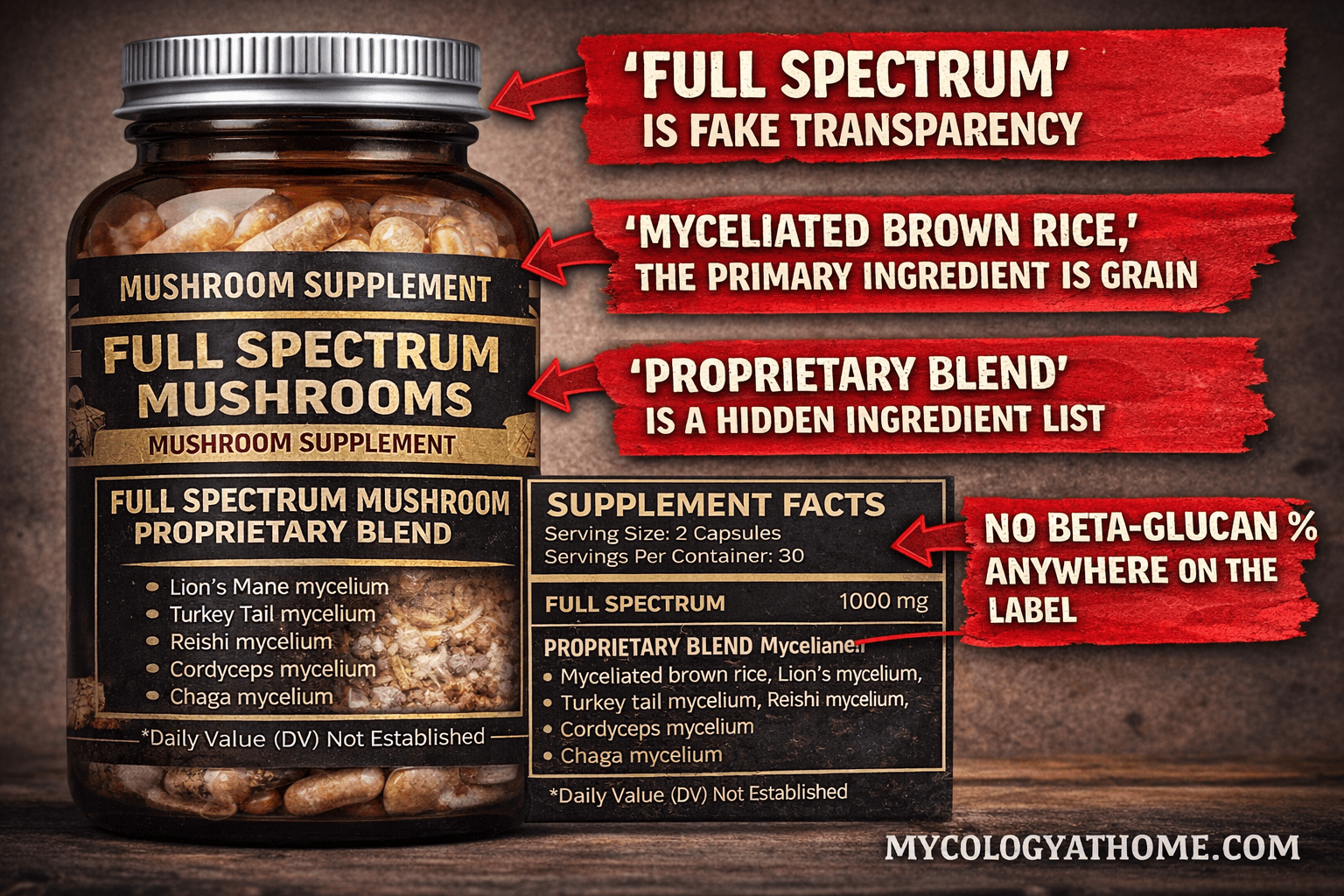
That 1000mg could be a concentrated fruiting body extract with 30% beta-glucans, or it could be mostly grain starch from mycelium grown on rice. Without knowing what is in those milligrams, the number is decoration [3].
Brands use it because consumers have been trained to read higher as better.
“Proprietary Blend”
A proprietary blend means the brand does not have to disclose how much of each ingredient is in the product [4]. They can list ten species and legally include trace amounts of nine of them.
In the supplement industry, “proprietary blend” is frequently a mechanism for hiding underdosing. If a brand is confident in their formulation, they disclose the amounts.
“Full Spectrum”
This is not a regulated term [5]. In mushroom supplement marketing it often means a blend that includes both mycelium and fruiting body, with the mycelium-on-grain component making up a significant proportion.
It sounds premium. It frequently means cheaper material is included while appearing to offer more.
“Standardised Extract”
Any brand can apply this to anything. What matters is what it is standardised to: a specific compound at a verified percentage. “Standardised extract” without specifying the compound and the number is meaningless [6].
“Mycelium” without clarification
Mycelium on its own is not a red flag. The concern is when mycelium is grown on grain, which dilutes active compound content with grain starch. A label that lists mycelium without specifying the substrate or providing beta-glucan data gives you nothing to verify [3].
What actually matters on a label
Five things. Check these and you have a clear picture.
The 30-second label check
You do not need to read every word. Run through these four checks in order and you will know whether to investigate further or move on.
Good label vs bad label
Common red flags: quick reference
The framework evaluates supplements. The growing guide removes the need for them.
Frequently asked questions
No. Milligrams tell you the weight of the capsule contents, not the concentration of active compounds. A 500mg fruiting body extract at 30% beta-glucans delivers far more active compound than a 2000mg mycelium-on-grain powder at 2% [3]. The milligram number without context is meaningless.
Better than nothing, but not the same as an independently verified result. Without a certificate of analysis from a named, accredited lab with a batch number, a self-reported percentage is an unverified claim [7].
Ask for one directly. Any brand confident in their product will send it without hesitation. If they decline, deflect, or send a document without a lab name and batch number, that tells you everything you need to know.
It means the product was made by growing mycelium on brown rice substrate and grinding the entire thing together. The resulting product contains the grain substrate along with the mycelium. Independent testing of such products shows 30-40% starch and 1-5% beta-glucans [3].
Whole mushroom powder without extraction is not automatically bad, but it requires much higher doses to deliver the same amount of active compound as a concentrated extract. The Mori 2009 lion’s mane trial used 3g/day of whole powder [8]. Most capsule products provide 500mg-1g. Without extraction, you need substantially more.
References
[1] U.S. Food and Drug Administration. Dietary Supplement Health and Education Act of 1994 (DSHEA). Public Law 103-417. Full text
[2] U.S. Food and Drug Administration. Structure/Function Claims. 21 CFR 101.93. Guidance on permissible claims for dietary supplements. FDA guidance
[3] McCleary BV, Draga A. Measurement of beta-glucan in mushrooms and mycelial products. Journal of AOAC International. 2016;99(2):364-373. DOI: 10.5740/jaoacint.15-0289
[4] U.S. Food and Drug Administration. Dietary Supplement Labeling Guide: Chapter IV. 21 CFR 101.36. Proprietary blend labeling requirements. FDA labeling guide
[5] There is no FDA regulation defining “full spectrum” for dietary supplements. The term has no standardised meaning in the context of supplement labeling.
[6] USP (United States Pharmacopeia). Dietary Supplement Verification Program. Standardisation in the context of USP refers to verified compound content at specific concentrations. USP verification
[7] ISO/IEC 17025:2017. General requirements for the competence of testing and calibration laboratories. The standard for accredited third-party testing. ISO 17025
[8] Mori K, Inatomi S, Ouchi K, Azumi Y, Tuchida T. Improving effects of the mushroom Yamabushitake (Hericium erinaceus) on mild cognitive impairment: a double-blind placebo-controlled clinical trial. Phytotherapy Research. 2009;23(3):367-372. PubMed: 18844328
Related reading
- Mushroom Supplements: What Works, What’s Misleading, and How to Buy Safely
- What Are Beta-Glucans?
- Mycelium on Grain Explained
- Certificate of Analysis for Mushroom Supplements
- What Is Dual Extraction and Why It Matters
- RYZE Mushroom Coffee: What the Five-Step Framework Reveals
- Real Mushrooms vs Host Defense vs Oriveda