Four Sigmatic Review: Honest Deep Dive
Four Sigmatic Review: Honest Deep Dive on the Mushroom Coffee Brand
The brand that introduced most people to functional mushrooms. Strong sourcing, transparent founder, and a dose-gap problem in their mushroom coffee line that most reviews never mention.
since 2012
Four Sigmatic is the brand that introduced most people to functional mushrooms. If you have ever considered mushroom coffee, you have encountered them. They are at Whole Foods, Target, Sprouts, and roughly every wellness corner of the internet. More than 200 million cups served.
That scale comes with both benefits and trade-offs that most reviews never mention. Four Sigmatic does some things genuinely better than their competitors. They also have transparency gaps that most of their glowing reviews ignore. This deep dive covers both, with specific dose math for each product, a brand-to-brand comparison, and a clear position on who should and should not buy from them.
I will say up front: I have taken Four Sigmatic products. My editorial position is not that Four Sigmatic is bad. It is that their quality varies substantially across the product line, and the dose math does not support most of their mushroom-coffee use cases.
The origin story and what it tells you
A Finnish farmer with a chemistry degree built the biggest US mushroom brand
Most mushroom brands use anonymous manufacturers. Four Sigmatic is publicly attached to a founder with a 13-year track record and two bestselling books.
Originally Four Sigma Foods in Finland. US launch in 2015.
Tero Isokauppila, chemistry and nutrition degrees, two Amazon bestsellers.
Venice CA and Soho NY. Free mushroom coffee. Physical brand presence.
Whole Foods, Target, Sprouts, CVS. Widest distribution in the category.
Key books: Healing Mushrooms (2017) and Healing Adaptogens (2019). Both Amazon bestsellers. The founder’s credibility is real and publicly verifiable, which is unusual in this space.
Four Sigmatic was founded in 2012 in Finland by Tero Isokauppila. He is a 13th-generation Finnish farmer with chemistry and nutrition degrees, and he has written two Amazon bestsellers on functional mushrooms (Healing Mushrooms in 2017, Healing Adaptogens in 2019). The brand launched in the US in 2015, based in Venice, California. They run physical “Shroom Rooms” in Venice and Soho that give out free mushroom coffee.
The name itself is worth explaining. “Four Sigmatic” references a statistical concept: four standard deviations above the mean. The claim is that functional mushrooms are “four sigmas above average food.” Only about 100 foods fall into that category, according to their framing. Whether you find that marketing compelling or silly is a matter of taste. The name is not arbitrary.
The brand has always positioned itself around mushroom coffee as the gateway product. The original insight from Tero was that his Finnish grandparents used chaga as a coffee substitute during World War II when real coffee was unavailable. The modern product takes the opposite approach: real coffee with mushroom extracts added. That is still the core of the brand today.
The founder has credibility. This matters. Most mushroom brands either use anonymous third-party manufacturers or obscure the sourcing chain. Tero is publicly associated with the brand, actively promotes it in interviews and books, and has been doing this for 13+ years. That does not guarantee the products are effective, but it does mean you can trace the decisions to a specific person.
Sourcing: the genuinely strong part
This is where Four Sigmatic’s pitch is most defensible. Their public positions on sourcing:
The sourcing sheet is a mixed picture
Most reviews only cover the strengths. This breakdown shows both sides so you can decide whether the transparency gaps matter for your use case.
What Four Sigmatic genuinely does well
- Log-grown fruiting body extracts only. Public anti-mycelium-on-grain position since day one.
- Dual extraction (hot water + alcohol). Captures full bioactive profile.
- Third-party tested for heavy metals, pesticides, mycotoxins, microbials, radiation.
- USDA Organic, Fair Trade and multiple dietary certifications.
- Publicly transparent about sourcing from a Chinese family farm. No hiding the supply chain.
What they don’t publish
- Beta-glucan content by lot. Not on US product pages. Most important quality marker.
- Certificates of analysis not publicly accessible per batch.
- Individual species doses in some blend products are unclear.
- Extraction ratios (1:1 vs 8:1 vs higher) rarely specified.
- EU reseller data suggests 15% beta-glucan content, which is mid-tier vs 20-30% on premium brands.
Log-grown fruiting body extracts only. Not mycelium-on-grain. This is important because the mycelium-on-grain problem is the most common quality compromise in the medicinal mushroom space. Four Sigmatic has taken an explicit, public anti-mycelium position for years, even when mycelium-on-grain was cheaper and more convenient.
Sourced from an organic family farm in China. They are transparent about this. The public rationale: they could not achieve the same quality of log-grown fruiting bodies at US scale, and they prioritize the growing method over the country of origin. This is a legitimate trade-off. China is where most of the world’s commercial medicinal mushroom cultivation happens, and a well-run Chinese farm with log cultivation produces a better product than a rushed US operation using mycelium-on-grain.
Dual extraction (hot water plus alcohol). Hot water extraction captures polysaccharides and beta-glucans. Alcohol extraction captures triterpenes and other less water-soluble compounds. Dual extraction produces a more complete bioactive profile than single-method extraction. This is covered more fully in my post on dual extraction.
Third-party tested. Every batch is tested for heavy metals, allergens, harmful bacteria, yeasts, molds, mycotoxins, pesticides, and radiation. This is a higher standard than most brands. USDA Organic, Fair Trade, Keto, Gluten-free, and Vegan certified across most products.
Retail availability. Sold at Whole Foods, Target, Sprouts, and thousands of US stores, plus major e-commerce platforms. This is not a small brand trying to build credibility. This is the biggest functional mushroom company in the US.
All of that is real. If the sourcing sheet stopped there, Four Sigmatic would rate as one of the cleanest brands in the space.
The beta-glucan disclosure gap
Here is the thing most reviews skip: Four Sigmatic does not publicly disclose beta-glucan content for their mushroom extracts on their US website.
Beta-glucan percentage is the most important quality marker for a medicinal mushroom product. A quality fruiting body extract should run 20 to 30 percent beta-glucans by weight. Brands like Oriveda publish exact beta-glucan percentages on their certificates of analysis. Real Mushrooms does the same. Nootropics Depot publishes their 8:1 extract ratio and beta-glucan content.
Four Sigmatic does not.
The interesting wrinkle: one EU reseller site I found listed Four Sigmatic lion’s mane at “30% polysaccharides, 15% beta-glucan” and chaga at the same specification. This suggests the beta-glucan content is in the 15 percent range, which is on the lower end of quality fruiting body extracts. 15 percent beta-glucan is not a bad number. It is just not a great one, and it is not the 20 to 30 percent figure you see from the brands that publish their CoAs.
Why this matters: when you pay Four Sigmatic’s prices, you are paying for quality sourcing. If the beta-glucan content is not in the premium range, you are paying a premium for mid-tier bioactive content. The marketing suggests premium quality. The available data suggests mid-tier content with premium packaging and branding.
This is not a scandal. It is a transparency gap. I cover the broader landscape of these transparency issues in how to read a mushroom supplement label.
Full product lineup with dose math
Four Sigmatic has dozens of products. The ones that matter for the honest evaluation are split into three tiers by clinical relevance.
Not all Four Sigmatic products are the same quality bet
The lineup sorts into three tiers based on whether the dose-per-serving actually matches the clinical trial range for the headline species.
Clinically meaningful dose per serving
These actually hit trial range for the featured species
Subclinical but still functional
Good products, dose below trial range for solo use
Primarily taste and routine
Buy for the flavor, not the mushroom content
Tier 1: Clinically meaningful dose per serving
Think Elixir (1,500 mg lion’s mane per serving). This is Four Sigmatic’s standout product. Single-serving packets contain 1,500 mg of log-grown lion’s mane fruiting body extract, which matches the Docherty 2023 trial dose that showed mood and stress improvements in young adults. Not as high as Mori 2009 (3,000 mg/day) or Saitsu 2019 (3,200 mg/day), but genuinely in trial range. No caffeine. Dissolves in hot water, coffee, tea, or smoothies. If you want a Four Sigmatic product with a real dose of lion’s mane, this is the one.
Original Mushroom Coffee (1,500 mg functional mushroom blend per serving). Their flagship product. Contains lion’s mane, turkey tail, chaga, and reishi in a proprietary 1,500 mg blend. The key word is “blend.” At 1,500 mg split across four species, each individual species probably sits in the 200 to 500 mg range. For any single species, that is below clinical trial dose. For general wellness purposes, the total 1,500 mg beta-glucan load is meaningful.
Focus Blend capsules (varies). Lion’s mane plus cordyceps plus rhodiola plus bacopa plus mucuna. Dose transparency is limited on the website. The capsule format suggests it is a more concentrated delivery than the coffee products. Worth checking the label for specific doses before buying.
Tier 2: Subclinical but still functional
Focus Ground Coffee (250 mg lion’s mane + 250 mg chaga per serving). Four tablespoons of ground coffee per 12 oz brew. That is 250 mg of lion’s mane per cup. Three cups per day gets you to 750 mg of lion’s mane, which is about a quarter of the Mori 2009 trial dose (3,000 mg/day). The marketing on their website directly references Mori 2009 but does not mention that the trial used 3 times the amount delivered in a single cup of their coffee.
Focus Instant Coffee packets (250 mg lion’s mane + 250 mg chaga + 100 mg rhodiola + 50 mg caffeine). Same dose math as the ground coffee. Single-serving packets, more convenient for travel.
Various latte mixes, cacao mixes, matcha, and creamers. These typically contain 500 to 1,500 mg of mushroom blend per serving spread across multiple species. Good for taste and convenience. Not reliable delivery systems for trial-matched doses.
Tier 3: Primarily taste and routine
Protein powders. Plant-based protein with functional mushroom extract added. The mushroom content is modest (typically 250 to 500 mg per serving of mushroom blend). You are paying for high-quality plant protein with a functional mushroom accent, not a mushroom product with added protein.
Cold brew, K-pods, espresso capsules, creamers. All good products. None are clinical-dose delivery systems.
The dose-gap math that matters
How many Focus Ground Coffee cups to match each clinical trial?
Four Sigmatic coffee delivers 250 mg of lion’s mane per cup. Here is what that means in cups-per-day if you want to match the trial doses their marketing references.
250 mg lion’s mane per 4 tbsp brew
Mori 2009 (MCI trial)
750 mg/day of extract for cognitive effects
Docherty 2023 (mood & stress)
1,800 mg/day of extract in young adults
Saitsu 2019 (mood & sleep)
3,200 mg/day of extract
This is the single most important thing to understand about Four Sigmatic’s mushroom coffee line. Their website prominently cites the Mori 2009 clinical trial on lion’s mane, which found that “30 men over 50 taking 250 mg lion’s mane fruiting body 3 times a day for 4 months” improved cognitive function markers.
The trial dose was 3 x 250 mg = 750 mg per day.
Wait, that is actually the low end of the modern trial range. Why do the dose guides say 3,000 mg?
The answer: Mori 2009 reported the dose as “250 mg capsules taken three times daily,” but the extract used was concentrated. The effective equivalent of mushroom material was higher. Modern lion’s mane trials (Docherty 2023, Saitsu 2019, Li 2020) establish the functional range at 1,050 to 3,200 mg per day of extract.
So here is the honest dose math on Four Sigmatic’s coffee:
- 1 cup of Focus Ground Coffee = 250 mg lion’s mane extract per serving
- To match Docherty 2023 (1,800 mg/day) = drink 7+ cups per day
- To match Mori 2009 daily dose (750 mg/day) = drink 3 cups per day
- To match Saitsu 2019 (3,200 mg/day) = drink 13 cups per day
Nobody drinks 13 cups of coffee per day. The math simply does not support using Four Sigmatic ground coffee as a clinical-dose lion’s mane delivery system.
That is not a criticism of the product as coffee. It is very good coffee with a functional mushroom accent. It is a criticism of interpreting mushroom coffee products as if they were dose-equivalent to dedicated supplements. They are not.
If you want clinical doses of lion’s mane from Four Sigmatic, buy the Think Elixir, not the coffee.
The five-step framework verdict
My mushroom supplement evaluation framework applies five criteria. Here is how Four Sigmatic scores:
Four Sigmatic scored against my standard criteria
The same framework I apply to every mushroom brand in the Consumer Guide cluster.
Fruiting body vs mycelium-on-grain
Explicitly and publicly fruiting-body-only. No grain starch in extracts. Better than 70% of the retail market.
Species specificity
Names species correctly (Hericium erinaceus, etc). Occasionally uses generic “cordyceps” without full binomial.
Beta-glucan disclosure
Not disclosed on US site. EU reseller data suggests 15% (mid-tier). Biggest miss on the scorecard.
Third-party testing & certifications
Heavy metals, pesticides, mycotoxins, radiation, microbials. USDA Organic, Fair Trade. Better than most.
Dose transparency
Tier 1 products disclose doses clearly. Mushroom coffee marketing implies trial-dose relevance that the dose math does not support.
Fruiting body vs mycelium-on-grain. Pass. Four Sigmatic is explicitly and publicly fruiting-body-only. No grain starch in the extracts. Better than 70 percent of the retail market.
Species specificity. Partial pass. They name species correctly on labels (Hericium erinaceus, Ganoderma lucidum, Cordyceps militaris). Good. They use “cordyceps” generically on some products without full Latin binomial, which is a minor transparency issue.
Beta-glucan disclosure. Fail on the US site. The EU reseller data suggests 15 percent beta-glucan content, which is mid-tier. Without public CoA disclosure by lot, you cannot verify claims. This is the biggest miss.
Third-party testing and certifications. Pass. Heavy metals, pesticides, mycotoxins, radiation, microbials. USDA Organic, Fair Trade, and multiple dietary certifications. Better than most brands.
Dose transparency. Partial pass. Tier 1 products (Think Elixir, Original Mushroom Coffee) disclose doses clearly. Tier 2 products list per-serving doses but the total per-day dose required to match trials is rarely acknowledged in marketing. Tier 3 products can be opaque on individual species content.
Verdict: B+ brand. Strong on sourcing and certifications, weak on beta-glucan verification and dose-gap honesty.
How Four Sigmatic compares to other quality brands
Four Sigmatic sits in a different market position than most brands I would recommend for clinical-dose use. The comparison is worth laying out.
Brand-to-brand comparison with the other three quality tiers
Different brands solve different problems. Four Sigmatic is the best retail mushroom coffee. It is not the best therapeutic supplement.
Four Sigmatic
Finland → Venice CA · 2012
Beta-glucan
~15% (EU data)
Lion’s Mane
250-1,500 mg
Per serving
$1-2
Best for
Mushroom coffee
Oriveda
Netherlands · Clinical focus
Beta-glucan
30-40%
Lion’s Mane
1,000 mg/capsule
Per serving
$0.75-1.50
Best for
Therapeutic use
Real Mushrooms
USA · Stamets-influenced
Beta-glucan
25-30%
Lion’s Mane
500-1,000 mg
Per serving
$0.50-1.00
Best for
Value & quality
Nootropics Depot
USA · Biohacker-focused
Beta-glucan
30%+ (8:1)
Lion’s Mane
500 mg (8:1)
Per serving
$0.50-0.80
Best for
Dose-per-dollar
Versus Oriveda. Oriveda is my personal go-to brand. Dutch, clinical-focused, publishes full CoAs by lot, pharmaceutical-grade purification. Oriveda beta-glucan content runs 30 to 40 percent. No retail presence, no Shroom Rooms, no celebrity endorsements. Pure clinical-grade product at a moderate premium over Four Sigmatic elixirs. If you want the highest quality lion’s mane or reishi extract you can buy for self-supplementation, Oriveda is the answer. If you want mushroom coffee, Oriveda does not make it.
Versus Real Mushrooms. Real Mushrooms is the US-based middle option. Paul Stamets-influenced sourcing standards, fruiting body extracts, published beta-glucan content, aggressive anti-mycelium-on-grain marketing. Comparable or better quality data than Four Sigmatic at comparable prices. No coffee products.
Versus Nootropics Depot. Nootropics Depot publishes the most detailed CoAs in the space. Their 8:1 lion’s mane extract is popular in biohacker circles. Better dose-per-dollar value than Four Sigmatic. No coffee or food products.
Versus Host Defense. Paul Stamets’ brand. Publicly mycelium-on-grain-based, which I specifically do not recommend. I have covered why in the buying guide.
Versus Ryze, Mud/Wtr, and other mushroom coffee brands. Four Sigmatic was the original. Most competitors are pricing differently or using different taste profiles, but the fundamental dose math applies to all of them. If you are choosing between mushroom coffee brands, Four Sigmatic has the longest track record, the cleanest sourcing story, and the widest retail presence. If you are choosing between mushroom coffee and dedicated supplementation, the supplement wins on dose.
Who should buy Four Sigmatic
Is Four Sigmatic the right brand for your situation?
Most reviews treat brand evaluation as universal. It is not. Four Sigmatic is great for some users and wrong for others.
Who should buy Four Sigmatic
Replacing regular coffee with a functional-mushroom accent. Focus Ground is great coffee.
Low-friction entry. Think Elixir is a reasonable intro to lion’s mane without capsules.
In stock at Whole Foods, Target, Sprouts, CVS. Buy in person without waiting for shipping.
USDA Organic, Fair Trade, 13+ year track record. Signals quality even when beta-glucan % is not disclosed.
Who should skip Four Sigmatic
Math does not work. 7-13 cups per day to hit trial range. Buy dedicated supplements.
2-3x the cost of equivalent dose from dedicated brands. Subscribe to improve the math.
No lot-specific CoAs published. Choose Oriveda, Real Mushrooms, or Nootropics Depot.
For diagnosed conditions or trial-matched protocols, dedicated single-species supplements win on dose.
Mushroom coffee drinkers who want to replace their regular coffee. This is the core use case. The Focus Ground Coffee is genuinely great coffee. It tastes better than most regular organic coffee. The functional mushroom accent is a bonus rather than a therapy. If you were going to drink coffee anyway, swapping to Four Sigmatic is a modest upgrade in terms of added benefits.
Beginners who want to try functional mushrooms without committing to supplement capsules. The single-serving packets and the variety of formats make it a low-friction entry. The Think Elixir is a reasonable introduction to lion’s mane for someone who does not want to take capsules.
People who value retail availability. Four Sigmatic is at Whole Foods, Target, Sprouts, and CVS. You can buy it in person without waiting for shipping. Oriveda, Real Mushrooms, and Nootropics Depot are online-only or specialty-store distribution.
People who value brand credibility and organic certifications. USDA Organic, Fair Trade, multiple dietary certifications, 200 million cups served, 13+ year track record. If those signals matter to you, Four Sigmatic checks every box.
Gift-giving or social use. The packaging is attractive, the branding is polished, the product feels premium to use. These matter for non-functional reasons.
Who should skip Four Sigmatic
People targeting clinical-trial-matched doses of any single mushroom species. The math does not work. You will drink 7 to 13 cups of coffee per day to hit trial doses. Buy a dedicated supplement from Oriveda, Real Mushrooms, or Nootropics Depot instead.
People with budget constraints. At $1 to $1.50 per serving, Four Sigmatic is 2 to 3 times the cost of equivalent dose from dedicated supplements. If you are supplementing long-term on a budget, the economics favor single-species capsules or powders from more affordable brands.
People who want beta-glucan percentage verified by lot. Four Sigmatic does not publish lot-specific CoAs. If this level of verification matters to you, choose Oriveda, Real Mushrooms, or Nootropics Depot.
Serious biohackers or therapeutic users. If you are taking lion’s mane for diagnosed mild cognitive impairment, reishi for sleep disorder management, or cordyceps for athletic performance at the trial-matched dose, Four Sigmatic is not the tool for the job. Use dedicated supplements.
Pricing reality check
Per-serving cost breakdown at full retail
The premium is real. Whether it is worth it depends on what you are actually buying.
Four Sigmatic sits at a firm premium price point. Real per-serving costs based on typical retail:
- Focus Instant Coffee packets: $1-1.50 per serving
- Focus Ground Coffee: $0.75-1.00 per cup
- Think Elixir: $1.50-2.00 per serving
- Original Mushroom Coffee: $1-1.25 per serving
- Protein powders: $2-3 per serving
- Latte mixes and cacao: $1.50-2 per serving
Regular organic coffee runs $0.15-0.30 per cup. Dedicated lion’s mane capsules at clinical dose from Oriveda or Real Mushrooms run $0.75-1.50 per daily dose.
The premium over regular coffee is the functional mushroom content. Whether the mushroom content justifies the 4 to 10x price multiple depends on how much you value the mushroom effects and whether the dose is high enough to produce them. For mushroom coffee, the honest answer is that you are paying largely for convenience, brand, and taste rather than clinical efficacy.
Subscription discounts (22 to 34 percent off) improve the math significantly. If you are buying Four Sigmatic regularly, subscribe.
The Think Elixir is the one Four Sigmatic product worth your money at clinical dose
1,500 mg of log-grown lion’s mane fruiting body per serving. Matches the Docherty 2023 trial range. Caffeine-free. The only Four Sigmatic product in trial-matched territory.
Frequently asked questions
Yes. Third-party testing confirms mushroom content. The species on the label are the species in the product. The doses listed on the label are the doses in the product. This is not a fake-mushroom issue like some of the cheap Amazon blends.
No specific concerns have been published, but mushroom supplements during pregnancy have not been formally safety-tested. Default clinical position: avoid during pregnancy and breastfeeding unless your physician approves.
Yes. Most Four Sigmatic coffee products contain about 50 mg of caffeine per serving, which is roughly half of a regular coffee. Good for people who want reduced caffeine without going decaf. Not good if you wanted zero caffeine. The non-coffee products (Think Elixir, latte mixes, cacao, protein powders) are caffeine-free.
Marketing tiers. Focus is the mushroom coffee line with lion’s mane and chaga. Think is the caffeine-free line including the Think Elixir. Think Elixir has a higher lion’s mane dose than the Focus Coffee.
No clinical evidence specifically for ADHD. Anecdotal reports vary widely. If you have ADHD and are looking for supplementation support, talk to your physician first and consider dedicated lion’s mane capsules at clinical dose rather than mushroom coffee.
The honest summary
Four Sigmatic is the most well-known functional mushroom brand in the US and the most publicly available. Their sourcing is genuinely strong: log-grown fruiting body extracts, dual extraction, third-party testing, USDA Organic certification. The founder has real credibility and a 13+ year track record. None of this is marketing spin.
The weaknesses are real too: beta-glucan content is not publicly disclosed by lot, the EU reseller data suggests mid-tier (15 percent) beta-glucan rather than premium (20 to 30 percent), and the mushroom coffee line delivers 250 mg per serving of each species in a way that the marketing implies clinical-trial relevance. For a single cup of coffee, that dose gap is fine. For the trial-matched doses that the marketing implicitly references, it is not.
Best Four Sigmatic products:
- Think Elixir (1,500 mg lion’s mane, matches Docherty 2023)
- Original Mushroom Coffee (1,500 mg blend)
- Focus Blend capsules (higher dose format)
Four Sigmatic products that are fine but not clinically meaningful:
- Focus Ground Coffee (great coffee, 250 mg lion’s mane per cup)
- Focus Instant Coffee packets (convenient, same dose math)
- Latte mixes, cacao, creamers, protein powders
If you are new to functional mushrooms: start with the Think Elixir or Original Mushroom Coffee. Give it 4 to 6 weeks. Evaluate response.
If you are an experienced user or therapeutic target user: skip Four Sigmatic coffee products and use the Think Elixir as an occasional addition to dedicated supplementation from Oriveda, Real Mushrooms, or Nootropics Depot.
If you mainly want better coffee with an accent of functional benefits: Four Sigmatic coffee is legitimately good coffee. The mushroom content is a bonus, not the main event.
The full comparison of brands I do and do not recommend is in Best Lion’s Mane Supplements. Species-specific dosing frameworks are in the Lion’s Mane, Reishi, and Cordyceps dosage guides.
References
[1] Mori K, Inatomi S, Ouchi K, Azumi Y, Tuchida T. Improving effects of the mushroom Yamabushitake (Hericium erinaceus) on mild cognitive impairment: a double-blind placebo-controlled clinical trial. Phytotherapy Research. 2009;23(3):367-372. PubMed
[2] Docherty S, Doughty FL, Smith EF. The acute and chronic effects of Lion’s mane mushroom supplementation on cognitive function, stress and mood in young adults: a double-blind, parallel groups, pilot study. Nutrients. 2023;15(22):4842. PMC
[3] Hirsch KR, Smith-Ryan AE, Roelofs EJ, Trexler ET, Mock MG. Cordyceps militaris Improves Tolerance to High-Intensity Exercise After Acute and Chronic Supplementation. Journal of Dietary Supplements. 2017;14(1):42-53. PubMed
Affiliate disclosure: if you purchase Four Sigmatic through links in this review, I may earn a commission at no additional cost to you. This does not affect my evaluation of the brand or their products. See Affiliate Disclosure and Medical Disclaimer.
Not medical advice. For informational purposes only. Consult your physician or pharmacist before starting any mushroom supplement, particularly if you take prescription medications, are pregnant or nursing, have a scheduled surgery, or have an underlying medical condition.
Similar Posts
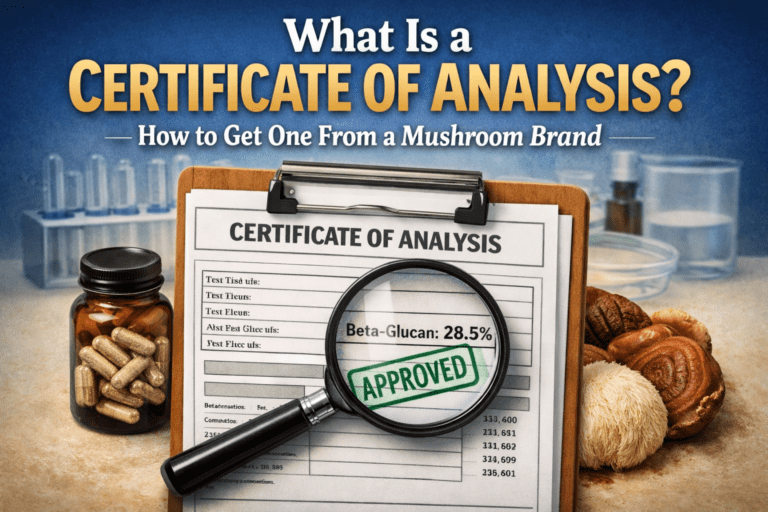
Certificate of Analysis for Mushroom Supplements
Certificate of Analysis for Mushroom Supplements: What It Is, How to Get One A supplement label tells you what a brand wants you to know. A certificate of analysis tells you what is actually in the product. Oriveda Full multi-page lab reports published · Eurofins & Alkemist tested · ISO 17025 CoAs published at oriveda.com/coa.php….
The FDA and Mushroom Supplements: What Is Actually Regulated
Regulation reality Mushroom supplements are regulated, but they are not pre-approved. The FDA does not approve mushroom supplements for safety or effectiveness before they reach the market. The company is responsible for making and labeling the product correctly. The FDA and FTC can act when products are unsafe, mislabeled, or marketed with misleading claims, but…
ORIVeDA Supplement: My Personal Experience
I get asked this question more than anything else on this site. After everything I have written about the supplement industry, the misleading labels, the proprietary blends, the withdrawn health claims, what do I actually take? Here is the answer. And then I am going to give you two alternatives that might be better for…
Best Mushrooms Supplements Ranked (2026): My Honest Top 5
Some of the links in this article are “affiliate links”, a link with a special tracking code. This means if you click on an affiliate link and purchase the item, we will receive an affiliate commission.The price of the item is the same whether it is an affiliate link or not. Regardless, we only recommend…