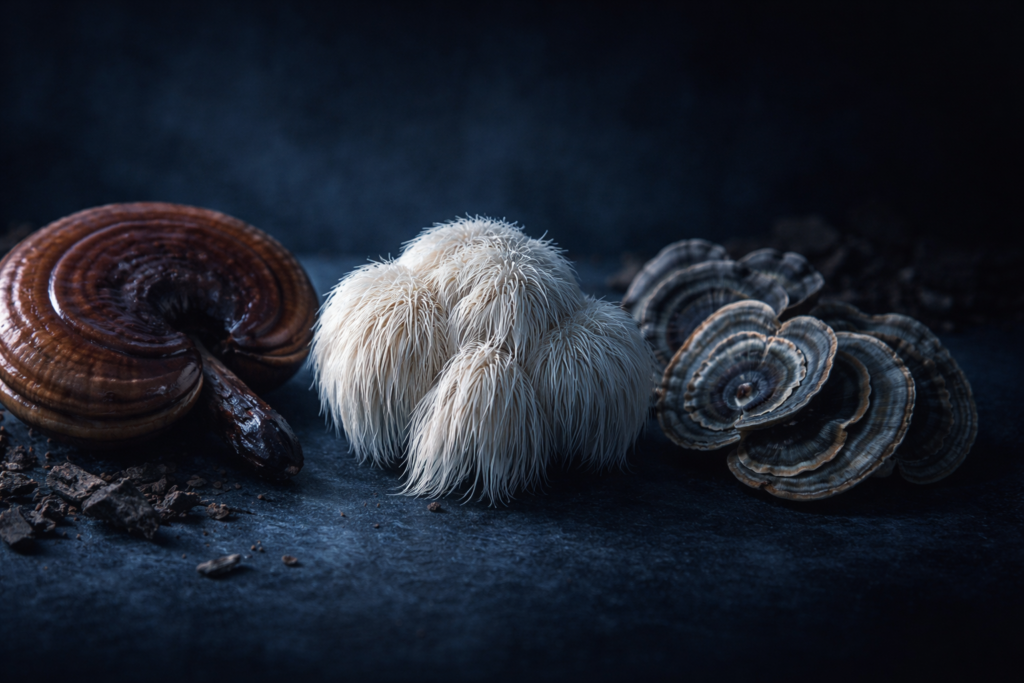
The short answer is yes. Some of them. Under specific conditions. With a lot of caveats that nobody in the industry wants to talk about.
The longer answer is what this entire post is about.
I spent months taking a mushroom supplement that did absolutely nothing. Not a little less than expected. Nothing. And when I eventually figured out why, it changed everything I thought I knew about this industry.
If you are here because you tried a mushroom supplement and felt nothing, or because you are thinking about trying one and want to know if it is worth your money, this post is for you. I am going to be direct about what works, what does not, and why the gap between the two is so much larger than most people realize.
The science is real. I need you to know that first.
Before I tell you why most products fail, I need to be clear about something: the research behind medicinal mushrooms is legitimate.
This is not wellness trend material. These are published, peer-reviewed studies with real methodology.
Lion’s mane has clinical trial data showing cognitive improvements in older adults with mild impairment. The Mori 2009 trial used 3 grams per day of dried fruiting body powder for 16 weeks. Cognitive scores improved progressively at weeks 8, 12, and 16 compared to placebo[1].
Turkey tail’s PSK is an approved adjunctive cancer therapy in Japan. Not a supplement. A prescription pharmaceutical, approved in 1977, with multiple randomized controlled trials behind it[2]
Reishi has documented effects on cortisol and sleep. A 2026 trial showed measurable cortisol reduction over 12 weeks using a mushroom blend[3].
Cordyceps showed significant VO2 max improvements in the Hirsch 2017 trial using 4 grams per day of a concentrated blend over three weeks[4].
The compounds are real. The mechanisms are real. The published data is real.
The problem is what happens between the research lab and the product on your shelf.
The Research Is Peer-Reviewed
Lion’s mane: Cognitive improvements in 50-80 year olds with mild impairment. 3g/day, 16 weeks. Mori et al. 2009 [1]
Turkey tail PSK: Approved adjunctive cancer therapy in Japan since 1977. Pharmaceutical-grade, not a supplement. [2]
Reishi: Measurable cortisol reduction over 12 weeks in a 2026 RCT. Five-mushroom blend, manufacturer funded. [3]
Cordyceps: VO2 max improvement after 3 weeks. 4g/day concentrated blend. Hirsch et al. 2017 [4]
Here is what happened to me.
I bought RYZE Mushroom Coffee. You have probably seen it. Every Instagram ad, every TikTok, every influencer claiming it changed their life.
Their blend lists cordyceps, lion’s mane, reishi, shiitake, turkey tail, and king trumpet. The Amazon listing says it supports “energy, focus, digestion, and immunity.” Six mushroom species promising everything.
I took it every single morning for three months.
I felt exactly the same as before I started.
At the time, I assumed mushroom supplements were just overhyped. Another wellness trend dressed up in scientific language. I filed it away and moved on.
Then I started growing mushrooms at home.
What Happened
I took RYZE Mushroom Coffee every morning for three months. Six mushroom species. Claims about energy, focus, digestion, and immunity.
I felt exactly the same.
No beta-glucan data published. No CoA available. No extraction method stated. Health claims voluntarily withdrawn after NAD investigation in September 2025. Full RYZE case study →
Growing mushrooms taught me what supplements should be.
When I got serious about home cultivation, I had to learn what mycelium actually is. What a fruiting body actually is. How they are structurally different. Why that distinction matters for what ends up in a capsule.
The mushroom you see, the cap, the thing you eat, is the fruiting body. It is the reproductive structure that mycelium produces when conditions are right. The mycelium itself is the root-like network that grows through the substrate.
Fruiting bodies are significantly richer in beta-glucans, the primary immune-active compounds, than mycelium. Especially mycelium grown on grain.
And here is the part that made me angry: a huge portion of the mushroom supplement market uses mycelium grown on grain because it is cheaper and faster to produce. When you grind up mycelium on grain, you are grinding up the grain too. Independent testing shows these products contain 30-40% starch and as little as 1-5% beta-glucans[5].
When I looked back at what I had been taking with RYZE, it started to make sense. I was not supplementing. I was hoping.
The five reasons most mushroom supplements fail.
It is not just one thing. There are five specific ways that commercial products fail to match what clinical trials actually used.
Even the best supplement is still just a supplement.
This is the part nobody in the industry wants to say.
Even if you have a genuinely high-quality product. Fruiting body extract. 30% beta-glucans. Dual extracted. Third-party tested. The real thing.
If you are destroying your health in every other direction, what is the point?
A supplement is a supplement. The word literally means “in addition to.” Not “instead of.”
If you are sleeping four hours a night, eating processed food, not moving your body, and under constant stress, no capsule is going to fix that. The clinical trials that produced positive results were testing whether a specific intervention could produce a measurable effect under controlled conditions. They were not testing whether that intervention could overcome an otherwise unhealthy lifestyle.
I genuinely believe this is one of the most overlooked points in the entire supplement industry. Not just mushrooms. Everything. The supplement is not the solution. It is one small part of a bigger picture.
And the brands that market their products as transformative, as if a capsule will change your body, your energy, your focus, your entire life, are being dishonest with you regardless of whether the product itself is high quality.
What actually makes a difference.
When I started using products I had actually vetted against the five-step framework, things were different.
Not dramatic. Not overnight. But genuinely, measurably different in ways that built over weeks of consistent use.
The difference was not just the product quality. By that point I had also started taking the rest of it seriously. Growing my own mushrooms. Eating fresh lion’s mane I harvested myself. Moving more. Sleeping better. Being intentional about the foundation.
The supplement became part of something. Not the whole thing. Part of it.
That is the context in which mushroom supplements actually work: quality product, consistent use over weeks, and a lifestyle that is not actively working against you.
So what should you actually look for?
I built a five-step evaluation framework that covers this in full detail. But here is the short version.
If a label does not tell you these things, it is usually because the numbers are not worth advertising.
The full framework with detailed explanations, brand comparisons, and case studies is here: Mushroom Supplements: What Works, What’s Misleading, and How to Buy Safely
Or skip the industry entirely.
This is what I eventually did alongside supplementing.
I started growing lion’s mane and oyster mushrooms at home. When you grow your own, the trust problem disappears. There is no label to misread. No proprietary blend to decode. You are eating the actual mushroom with all of its compounds at peak freshness.
A lion’s mane grow kit costs $15-25. Growing oyster mushrooms from scratch costs under $30 in materials. The startup cost is less than a month of most supplement subscriptions.
I still take a quality supplement for the concentrated extract benefits. But I also eat fresh mushrooms I grew myself. The combination is, in my opinion, the best approach.
Frequently asked questions
Some do. Quality fruiting body extracts with verified beta-glucan content, proper extraction, and adequate dosing can deliver genuine supplemental support when taken consistently over weeks as part of a healthy lifestyle. Most products on the market do not meet these criteria.
Most likely because the product did not contain meaningful amounts of the active compounds the research is based on. Mycelium on grain products contain mostly starch. Products without stated beta-glucan content, extraction method, or third-party testing give you no way to verify what is inside. The gap between what was studied and what most people buy is enormous.
The Mori lion’s mane trial showed cognitive improvements starting at week 8. The Hirsch cordyceps trial showed no effect after one week but significant results after three weeks. Most people quit after two weeks and conclude mushroom supplements do not work. That is not enough time even with a quality product.
The science is not a scam. The compounds are real and the research is peer-reviewed. But many products are misleading, underdosed, unverified, or made from materials that do not match what was studied. Some brands are genuinely trying to make good products. Some are prioritizing marketing over quality because the regulatory environment allows it.
I wrote a full recommendation post covering the brand I personally use, a budget alternative, and how to grow your own: The Mushroom Supplement I Recommend to Everyone
For some species, yes. Fresh lion’s mane and oyster mushrooms contain the same active compounds as supplements. You can also dry and powder them. For species like reishi where the most valuable compounds require dual extraction, a quality extract supplement delivers those compounds more efficiently than eating the fresh mushroom.
References
[1] Mori K, Inatomi S, Ouchi K, Azumi Y, Tuchida T. Improving effects of the mushroom Yamabushitake (Hericium erinaceus) on mild cognitive impairment: a double-blind placebo-controlled clinical trial. Phytotherapy Research. 2009;23(3):367-372. PubMed: 18844328. 30 participants aged 50-80, 16-week intervention, 3g/day whole dried fruiting body powder. Funded by Hokuto Corporation. Cognitive improvements reversed after stopping. https://pubmed.ncbi.nlm.nih.gov/18844328/
[2] Tsukagoshi S, Hashimoto Y, Fujii G, et al. Krestin (PSK). Cancer Treatment Reviews. 1984;11(2):131-155. PSK approved as prescription cancer treatment in Japan in 1977. https://www.cancertreatmentreviews.com/article/0305-7372(84)90005-7/abstract
[3] Hisamuddin AS, Ramli F, Leo TK, et al. Adaptogenic Effects of Mushroom Blend Supplementation on Stress, Fatigue, and Sleep. Brain and Behavior. 2026;16(1):e71193. Five-mushroom blend (not reishi alone), 50 participants, funded by NexusWise Sdn Bhd. https://pmc.ncbi.nlm.nih.gov/articles/PMC12808922/
[4] Hirsch KR, Smith-Ryan AE, Roelofs EJ, et al. Cordyceps militaris improves tolerance to high-intensity exercise after acute and chronic supplementation. Journal of Dietary Supplements. 2017;14(1):42-53. 28 participants, PeakO2 mushroom blend, VO2 max improvement after 3 weeks. https://pmc.ncbi.nlm.nih.gov/articles/PMC5236007/
[5] McCleary BV, Draga A. Measurement of beta-glucan in mushrooms and mycelial products. Journal of AOAC International. 2016;99(2):364-373. Methodology for distinguishing beta-glucans from starch in mushroom products. https://pubmed.ncbi.nlm.nih.gov/26957216/
Related reading
- Mushroom Supplements: What Works, What’s Misleading, and How to Buy Safely
- I Took Mushroom Supplements for 3 Months and Felt Nothing
- The Mushroom Supplement I Recommend to Everyone
- What Clinical Trials Actually Used vs What You Are Buying
- RYZE Mushroom Coffee: A Case Study in Supplement Marketing
- What Are Beta-Glucans?
- Mycelium on Grain Explained
- How to Grow Mushrooms at Home