Mycelium on Grain: The Problem With Most Mushroom Supplements
If you have ever taken a mushroom supplement and felt nothing, this is probably why.
Mycelium on grain is the most common and least understood quality problem in the mushroom supplement market. Most consumers have never heard of it. Most labels do not explain it. And it is the single biggest reason people try mushroom supplements, feel no difference, and conclude the whole category is overhyped.
The mushrooms are not the problem. The problem is that a significant portion of what gets sold as a “mushroom supplement” is not really a mushroom product. It is grain starch with a mushroom name on the label.
What mycelium on grain actually is
Fungi have two main structures relevant to supplements.
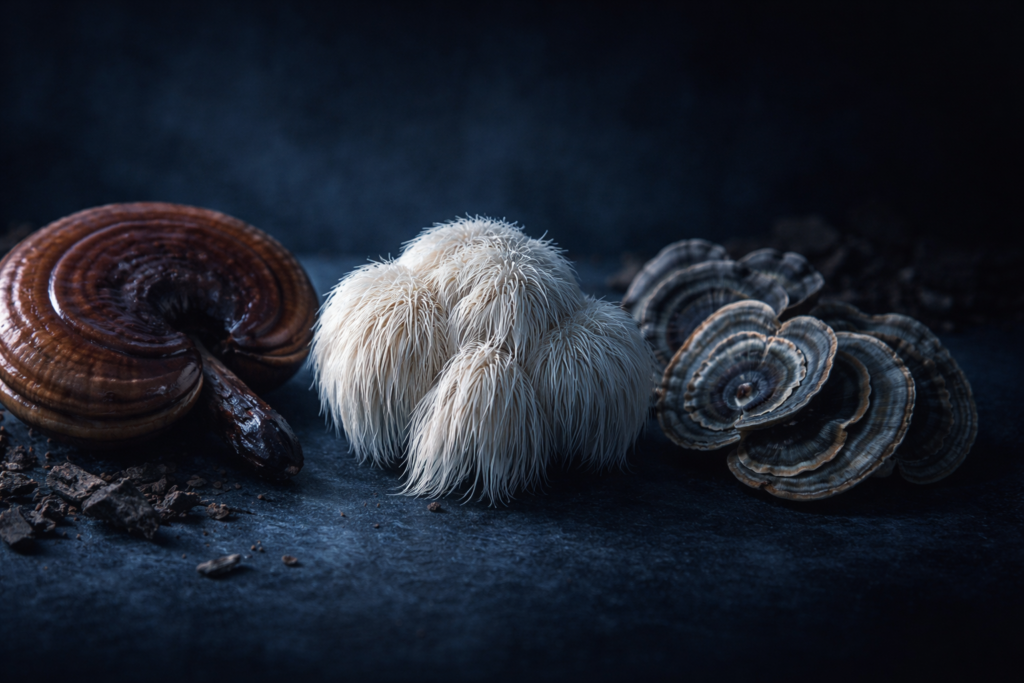
The fruiting body is the actual mushroom, the thing you picture when someone says the word. It is where the highest concentrations of active compounds accumulate: beta-glucans, triterpenes, hericenones, the compounds behind the clinical research[1].
The mycelium is the root-like network that grows through whatever the fungus is feeding on. It does contain bioactive compounds, but at lower concentrations than the fruiting body[2].
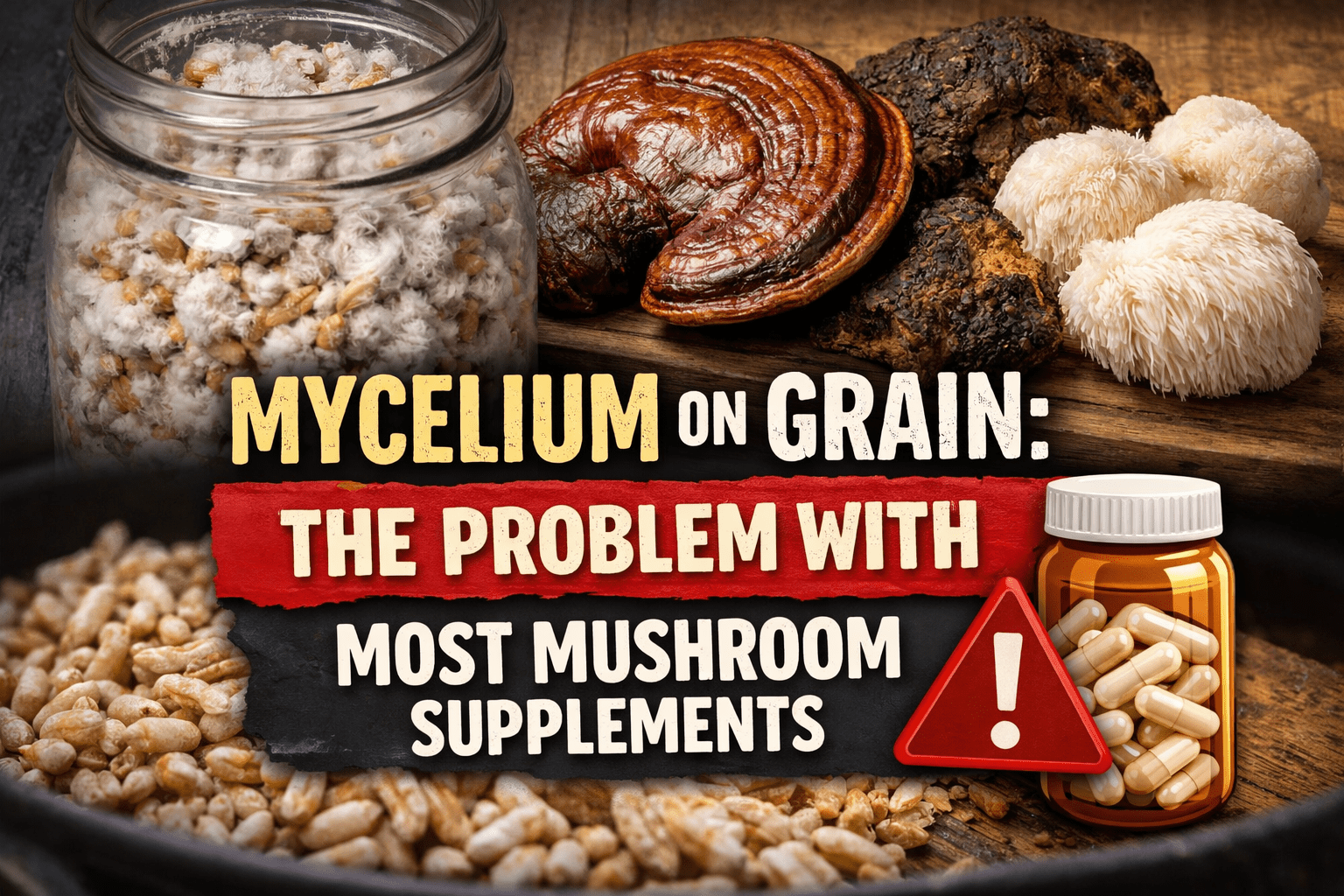
In commercial supplement production, mycelium is typically grown on sterilized grain, usually brown rice or oats. The mycelium colonizes the grain, spreading through it as it grows. When production stops, the whole thing is dried and ground into powder.
Here is the problem: you cannot separate the mycelium from the grain it grew through. When you grind it all up, you get a mixture of fungal material and grain starch. Independent testing has found that grain starch makes up 30-40% of capsule content by weight in popular commercial products.<sup>[3]</sup>
The numbers tell the real story
Quality fruiting body extracts typically test at 25 to 40 percent beta-glucans[3].
Mycelium on grain products often test at 1 to 5 percent[3].
Both can legally be sold as mushroom supplements. Both can list the same milligram dose on the label. Both can sit next to each other on a shelf at similar prices.
The difference is what is inside. And unless you know to check, the label will not tell you.
Why brands use it
The economics are simple.
Growing mycelium on grain is faster, cheaper, and easier to scale than producing fruiting bodies. A brand can list “500mg lion’s mane” on a label without specifying whether that 500mg is concentrated fruiting body extract or grain-diluted mycelium powder. The label looks the same. The product is not[4].
The regulatory framework allows this. Under DSHEA, supplements do not require FDA pre-market approval[5]. A brand is not required to disclose whether it uses fruiting body or mycelium, to publish beta-glucan content, or to provide independent testing data. Everything that would tell you what you are actually buying is voluntary.
Some brands genuinely believe their mycelium products are effective. That argument has legitimate scientific backing in specific cases. But it does not change the reality that most products in this category are underdosed and underdocumented, and that the clinical research the industry references was largely conducted on fruiting body extracts at doses most commercial products do not come close to matching[6].
How to spot it on a label
Labels do not say “this product contains mostly grain starch.” You have to know what to look for.
[HTML COMPONENT: Terms decoder]
Is mycelium itself the problem?
No. Mycelium is a real part of the fungal organism and it does contain bioactive compounds.
Some erinacines in lion’s mane, for example, are actually more concentrated in mycelium than in the fruiting body[7]. Host Defense, founded by mycologist Paul Stamets, produces mycelium-based products and backs them with published research. That is a legitimate scientific position.
The problem is not mycelium categorically. The problem is grain dilution and low transparency. A well-documented mycelium product from a transparent brand that publishes CoA data and specifies beta-glucan content is a fundamentally different product from cheap grain powder in a capsule with a mushroom name on it.
This post is about the latter. And the latter makes up the majority of the market.
What to look for instead
The polysaccharide trick
One more thing worth knowing. Some labels list “total polysaccharides” instead of beta-glucans. This inflates the number because starch is a polysaccharide too[3].
A product claiming “60% polysaccharides” may contain only 5-10% actual beta-glucans. The rest is grain starch from the production process. Always look for “beta-glucans” specifically on the label. Not “polysaccharides.” Not “total carbohydrates.”
When you grow your own mushrooms, there is no label to misread and no grain to dilute the product.
Frequently asked questions
Not harmful. The concern is potency, not safety. A product high in grain starch and low in active compounds is unlikely to do what you expect. You are not being poisoned. You are being undersupplied.
Cost and speed. Growing mycelium on grain is faster and cheaper than producing fruiting bodies at scale[4]. The regulatory environment does not require disclosure of beta-glucan content or mushroom part used[5] In a market where labels look similar, the financial incentive favours lower-cost production.
Check the ingredient list for “myceliated brown rice,” “myceliated oats,” “mycelial biomass,” or “biomass.” If absent but the product lists mycelium without specifying fruiting body, ask the brand for their CoA and check the beta-glucan percentage.
Yes. The issue is grain dilution and transparency, not mycelium as a category. Brands that publish CoAs and document beta-glucan content produce products distinct from cheap grain-diluted powders. The same five-step framework applies regardless of source material.
Some companies, notably Oriveda, use deep-layer cultivation where mycelium is grown in liquid rather than on grain. This produces pure mycelium with no grain substrate contamination. It is a different process from mycelium on grain and does not carry the same starch dilution issue.
References
[1] Zhu F, Du B, Xu B. A critical review on production and industrial applications of beta-glucans. Food Hydrocolloids. 2016;52:275-288. DOI: 10.1016/j.foodhyd.2015.07.003
[2] Lindequist U, Niedermeyer THJ, Jülich WD. The pharmacological potential of mushrooms. Evidence-Based Complementary and Alternative Medicine. 2005;2(3):285-299. PubMed: 16136207
[3] McCleary BV, Draga A. Measurement of beta-glucan in mushrooms and mycelial products. Journal of AOAC International. 2016;99(2):364-373. DOI: 10.5740/jaoacint.15-0289
[4] Chilton J. Redefining medicinal mushrooms. Mushroom Science. 2015. Analysis of production economics and quality differences between fruiting body and mycelium-on-grain supplement production.
[5] U.S. Food and Drug Administration. Dietary Supplement Health and Education Act of 1994 (DSHEA). Public Law 103-417. Full text
[6] Mori K, Inatomi S, Ouchi K, Azumi Y, Tuchida T. Improving effects of the mushroom Yamabushitake (Hericium erinaceus) on mild cognitive impairment. Phytotherapy Research. 2009;23(3):367-372. PubMed: 18844328
[7] Li IC, Lee LY, Tzeng TT, et al. Neurohealth properties of Hericium erinaceus mycelia enriched with erinacines. Behavioural Neurology. 2018;2018:5802634. PubMed: 29951133
[8] Oriveda. Deep layer cultivation methodology. Product documentation at oriveda.com. Deep-layer (liquid) cultivation produces pure mycelium without grain substrate contamination, distinct from solid-state grain cultivation.
Related reading
- Mushroom Supplements: What Works, What’s Misleading, and How to Buy Safely
- What Are Beta-Glucans?
- How to Read a Mushroom Supplement Label
- Certificate of Analysis for Mushroom Supplements
- What Is Dual Extraction and Why It Matters
- Real Mushrooms vs Host Defense vs Oriveda
- Clinical Trial Gap: What Was Studied vs What You’re Buying
- Do Mushroom Supplements Actually Work?