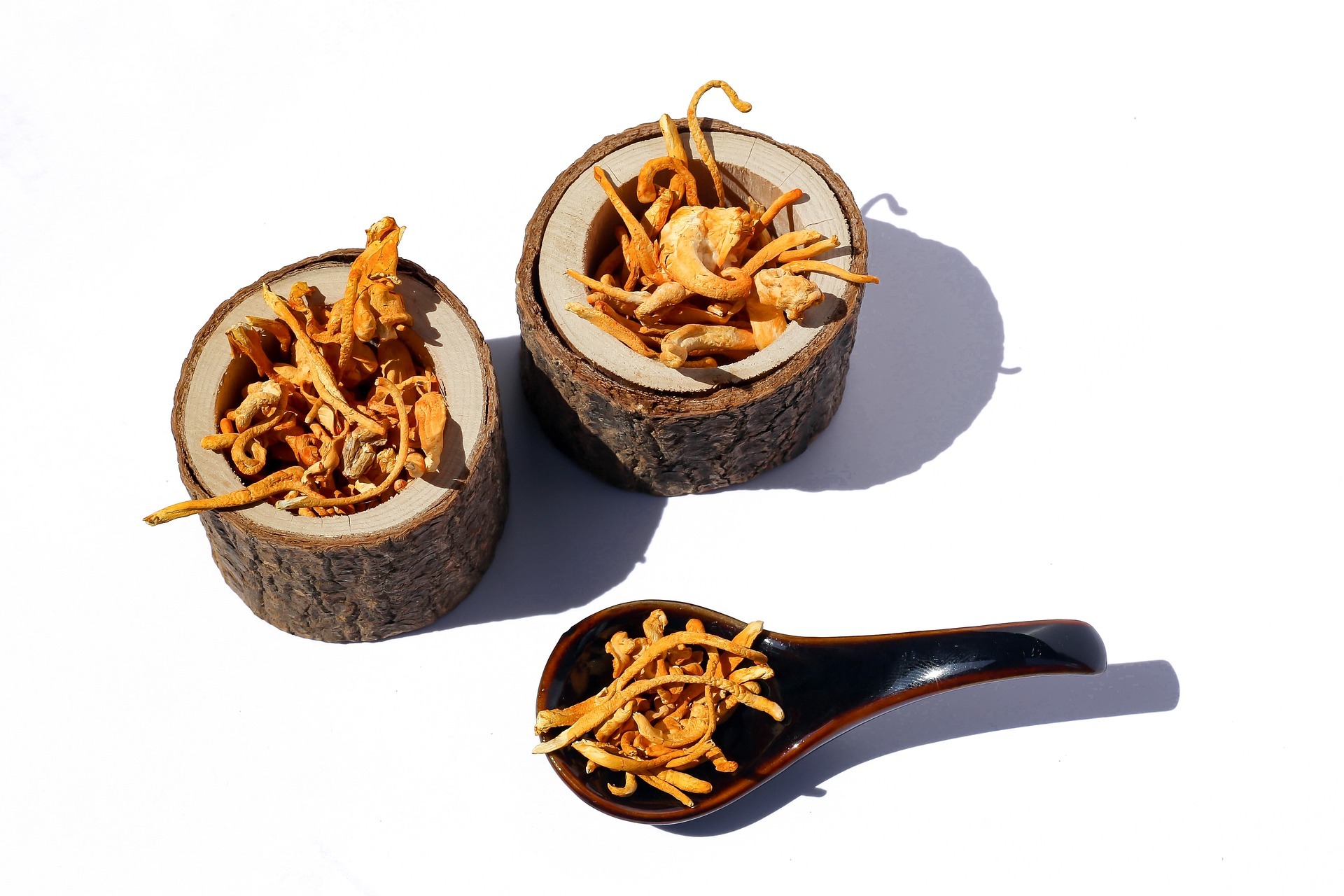
Cordyceps has one of the more unusual origin stories in the fungal world. It is a parasitic fungus that infects insects, mummifies them, and erupts from their bodies to release spores. Tibetan herders noticed centuries ago that yaks grazing on cordyceps-rich pastures were stronger and more energetic than usual. They started using it themselves, and it became a staple of traditional Tibetan and Chinese medicine.
The cordyceps in supplements today is cultivated on plant-based substrates, not insects, so the origin story is mostly just interesting context.
Here is what it actually does and what the research behind it looks like.
The two species worth knowing about
Cordyceps sinensis is the original wild-harvested Himalayan variety. It is extremely rare, genuinely expensive, and the species most referenced in traditional medicine. Cordyceps militaris is its cultivated counterpart and is actually higher in cordycepin, the most studied active compound, than wild C. sinensis. It is also sustainable and affordable.
Most quality supplements use Cordyceps militaris. The research supporting it is solid and for most practical purposes the benefits are comparable or better than the wild variety.
The key active compounds are cordycepin, adenosine, polysaccharides, and beta-glucans. These influence cellular energy production, oxygen utilisation, and endurance at a fundamental biological level.
What the research shows
Athletic performance and endurance
Cordyceps came to international attention in 1993 when Chinese distance runners broke multiple world records at the National Games. Drug tests came back clean. Researchers started paying attention.
The mechanism is fairly specific. Cordyceps appears to enhance the body’s production of adenosine triphosphate, ATP, which is the primary energy currency of every cell. More ATP means muscles have more fuel available during intense exercise.
A randomised controlled trial in the Journal of Dietary Supplements found that older adults supplementing with Cordyceps militaris for twelve weeks showed a significant increase in VO2 max compared to placebo. VO2 max is a measure of how efficiently your body delivers and uses oxygen during exercise. It is one of the better indicators of cardiorespiratory fitness and meaningful gains are not easy to achieve.
Additional studies in trained cyclists showed improved time to exhaustion and ventilatory threshold after supplementation. Athletes could sustain harder efforts for longer before hitting their limits.
Energy and fatigue
The energy benefit of cordyceps is different from caffeine in a way that is worth understanding. Caffeine stimulates the central nervous system. Cordyceps works at the cellular level, specifically through cordycepin’s influence on adenosine pathways, which affects how efficiently cells produce and use energy.
The practical difference is that people tend to describe the energy from cordyceps as sustained rather than sharp. No spike, no crash. It is a different mechanism producing a different result.
A study in the American Journal of Chinese Medicine found that cordyceps supplementation significantly reduced fatigue and improved physical performance in elderly patients after six weeks. The improvements were in exercise tolerance and overall energy levels, not just subjective feeling.
Oxygen utilisation
This is the underlying mechanism behind most of the performance benefits and it makes sense given cordyceps’ origins at high altitude where oxygen is scarce. Cordyceps appears to enhance the activity of key enzymes in the electron transport chain, the cellular process that converts oxygen into usable energy. It also supports red blood cell production and blood flow, improving oxygen delivery to muscles.
For endurance athletes specifically, this efficiency improvement is the most mechanistically interesting aspect of cordyceps. Better oxygen utilisation is a genuine physiological advantage, not just a subjective energy feeling.
Immune support and recovery
Like other medicinal mushrooms, cordyceps contains beta-glucans that modulate immune activity and reduce inflammation. For people training hard, this is relevant both for general immune resilience and for recovery. Intense exercise creates oxidative stress and inflammation. Cordyceps addresses both at the cellular level, which is why it tends to get described as a performance and recovery mushroom rather than just one or the other.
How to take it
Timing matters slightly more with cordyceps than with reishi or lion’s mane.
- Before exercise: 30 to 60 minutes before training is a common approach for performance benefits. Powder in a pre-workout drink or capsules with water both work.
- Morning: for general energy and fatigue reduction, a morning dose with breakfast is reasonable. It works well alongside coffee.
- Dosage: most studies use between 1,000 and 3,000mg daily. Starting at the lower end makes sense and building up from there.
- Form: capsules, powder, and tincture are all effective. Powder is the most flexible and works in smoothies, coffee, or oatmeal.
As with every medicinal mushroom, consistency over weeks produces better results than occasional use. Three to four weeks is a reasonable minimum before forming a view on whether it is doing anything.
Frequently asked questions
Is cordyceps a stimulant?
No. It does not stimulate the central nervous system the way caffeine does. It supports cellular energy production at the mitochondrial level, which produces a different kind of energy lift. Smoother and more sustained, without the jitters or the crash. Some people use it specifically to reduce their caffeine intake while maintaining energy levels.
Does it actually improve athletic performance?
The evidence is genuinely promising, particularly for endurance performance and VO2 max. Results vary depending on baseline fitness, dosage, and supplement quality. People starting from a lower baseline tend to see more noticeable gains than elite athletes who are already highly optimised. But across multiple studies the direction is consistent: cordyceps supports better oxygen utilisation and greater exercise capacity.
Is Cordyceps militaris as good as Cordyceps sinensis?
For most practical purposes, yes, and in some respects better. Cordyceps militaris is actually higher in cordycepin than wild C. sinensis. Wild C. sinensis is critically endangered from overharvesting and costs thousands of dollars per kilogram. Quality cultivated C. militaris is the more effective, more ethical, and considerably more affordable option.
Can you take cordyceps with lion’s mane?
Yes. It is a fairly logical combination. Lion’s mane covers cognitive and neurological support. Cordyceps covers energy and physical performance. They address different systems and work well together. A lot of mushroom blends combine exactly these two for that reason.
How long before you notice anything?
Most people notice something after two to four weeks of consistent daily use. Performance benefits tend to show up during sustained physical effort rather than at rest. If you are not exercising regularly it is harder to assess whether it is doing anything.
Is cordyceps worth taking
For energy, endurance, and physical performance, cordyceps has more clinical support than most natural supplements in that category. The mechanism is specific and well-characterised. The results in human trials are consistent, if modest.
It is not a dramatic supplement and it is not a substitute for training or sleep. But if you are already doing those things and want a natural compound that genuinely supports cellular energy production and oxygen utilisation, cordyceps is one of the more evidence-backed options available.
For a comparison of cordyceps against other medicinal mushrooms and which specific products are worth buying, the ranked list covers that in detail.