How Much Cordyceps Should You Take? A Dosage Guide
How Much Cordyceps Should You Take?
The energy mushroom that works on cellular ATP, not caffeine. Real effects, slow timeline, and a dose that most commercial products do not deliver.
from clinical trial evidence
Cordyceps is the mushroom people buy when they want an energy boost that is not caffeine. That description is technically correct, and it is also where most of the marketing stops being honest.
The honest version: cordyceps does something real, but it is slow. It works on cellular ATP production, not the adenosine receptors that caffeine hits. The effects are measurable in exercise performance trials, but they take weeks to build up. And the dose that actually produces the effects is higher than most mushroom coffee products provide.
This is the dosing guide based on what the clinical trials actually used, split by goal and form, with the relevant caveats for what cordyceps does not do.
The evidence-based dose range
Four human trials define the practical cordyceps dose range, and the pattern they form is useful.
Three trials, one pattern: dose × duration matters
Higher dose, shorter duration. Lower dose, longer duration. Both work. One-week trials of any dose tend not to produce significant results.
Endurance (3 weeks)
28 young adults on PeakO2 blend. Week 1: no significant effects. Week 3: VO2max +4.8 ml/kg/min, TTE +69.8s, VT +0.7 L/min. Timeline matters.
Aerobic capacity (6 weeks)
37 healthy elderly on Cs-4 fermentation product. VO2max 1.88→2.00 L/min (p=0.050), anaerobic threshold 1.15→1.30 L/min (p=0.012).
Thresholds (12 weeks)
20 healthy elderly on Cs-4. Metabolic threshold +10.5%, ventilatory threshold +8.5%. Notably, VO2max did not change at this lower dose.
Hirsch et al. 2017 (Journal of Dietary Supplements): 4 g per day of a Cordyceps militaris-containing mushroom blend (marketed as PeakO2) for 1 week and 3 weeks, in 28 recreationally trained young adults. After 3 weeks, VO2max improved significantly in the treatment group (+4.8 ml/kg/min) but not placebo. Time to exhaustion improved by 28.1 seconds after 1 week and 69.8 seconds after 3 weeks. Ventilatory threshold improved by 0.7 L/min at 3 weeks. Critically, 1 week of supplementation produced no significant effects. The timeline matters [1].
Chen et al. 2010 (Journal of Alternative and Complementary Medicine): 333 mg of Cs-4 (a Cordyceps sinensis mycelial fermentation product) three times daily, for a total of 1 g per day, for 12 weeks. 20 healthy adults aged 50 to 75. Metabolic threshold improved by 10.5%, ventilatory threshold by 8.5%. Notably, VO2max did not change in this trial. A lower dose over a longer duration produces different outcomes than a higher dose over a shorter one [2].
Cs-4 6-week trial (Chinese Journal of Integrative Medicine): 3 g per day of Cs-4 in 37 healthy elderly subjects. VO2max increased from 1.88 to 2.00 L/min (p=0.050) and anaerobic threshold from 1.15 to 1.30 L/min (p=0.012). A middle dose over a middle duration produced the clearest VO2max effect [3].
Dudgeon et al. 2018 (American Journal of Sports Sciences): Low dose 1 to 2 g per day of PeakO2 over 28 days improved endurance in healthy young adults. High dose 12 g per day for just 7 days produced variable effects depending on fitness level [4].
The practical range that emerges is 1 to 4.5 g per day of mushroom material, for 3 to 12 weeks. Extract products concentrate this. A 10:1 hot water extract at 500 to 1,500 mg per day maps to several grams of raw mushroom equivalent.
The pattern is worth naming explicitly: cordyceps has a dose-duration relationship. Lower doses require longer intervention. Higher doses produce results faster but still not instantly. Nothing below 3 weeks of consistent daily use is realistic for the endurance effects the trials measured.
Why the species name on the label actually matters
Read the Latin name on the label
This is one of the few mushroom categories where the species actually tells you what you are buying.
Cultivated Cordyceps militaris
Modern commercial product. Higher in cordycepin than Cs-4. The species used in Hirsch 2017 and most exercise performance research.
Cs-4 Fermentation Product
Standardized substitute for wild sinensis. Grown in bioreactors. Contains adenosine and mannitol. Used in Chen 2010 and other Cs-4 trials.
Wild Cordyceps sinensis
Parasitizes ghost moth larvae at high altitude. Retails $20,000-$40,000/lb when authenticated. Western “wild sinensis” products are almost always mislabeled.
Cordyceps is one of the few mushroom categories where the species on the label tells you something important about what you are buying.
Cordyceps militaris. The species used in most modern commercial supplements. Can be cultivated on grain or insect larvae substrates, contains cordycepin (the most studied bioactive), and produces consistent product. The Hirsch 2017 trial used a militaris-based blend. If you see a cordyceps supplement in a health food store, it is almost certainly militaris.
Cordyceps sinensis. The traditional wild species that grows on ghost moth larvae at high elevations in the Tibetan plateau. Rare, expensive, and increasingly endangered. Actual wild sinensis can retail for $20,000 to $40,000 per pound. Most products labeled “Cordyceps sinensis” are not actually wild sinensis. They are usually the Cs-4 fermentation product described below.
Cs-4 (Paecilomyces hepiali mycelium). A fermented mycelium strain originally isolated from wild C. sinensis, produced in bioreactors as a standardized substitute. This is the species used in the Chen 2010 and the 6-week elderly Cs-4 trial. Cs-4 contains some of the same bioactive compounds as wild sinensis, though the profile is not identical. Labels that say “Cordyceps sinensis” in the supplement aisle are almost always Cs-4.
The practical consequence: the research supports both militaris and Cs-4 for exercise performance. They are not interchangeable at the compound level but they are both evidence-based. Wild sinensis is irrelevant to the supplement conversation because you almost certainly cannot buy it, and if you think you bought it, you probably did not.
The compounds that matter across both species:
- Cordycepin (3′-deoxyadenosine): the most-studied cordyceps bioactive. Higher in militaris than in Cs-4. Activates AMPK (cellular energy sensor), which is the mechanism behind the exercise performance effects.
- Cordycepic acid (d-mannitol): a sugar alcohol with vasodilatory effects. Contributes to the increased blood flow and oxygen utilization.
- Beta-glucans: immune-modulating polysaccharides shared with other medicinal mushrooms.
- Adenosine: present in both forms.
Dosing by goal
This is where cordyceps diverges from lion’s mane and reishi. The goals are different and the evidence strength varies.
Different goals, different evidence bases
Endurance has the strongest evidence. General fatigue has supporting evidence in older populations. Libido claims are traditional, not clinical.
Endurance & VO2max
Strongest evidence. Hirsch 2017 at 4 g/day PeakO2 produced VO2max and TTE improvements at 3 weeks. The most defensible reason to take cordyceps.
Cellular energy & fatigue
Traditional use case. AMPK and ATP production pathways. Lower doses over longer durations work per Chen 2010 data.
High-intensity & altitude
Ventilatory threshold improvements suggest usefulness for sports at aerobic ceiling. Start 3+ weeks before key event.
Libido & vitality
Traditional use strong, modern clinical evidence weaker. Not implausible given the cellular energy mechanism. Longer duration required.
Training recovery
Some evidence for reduced perceived exertion. Overlap with endurance protocols. Continuous daily use during training blocks.
Endurance and VO2max. The strongest evidence. If you are buying cordyceps for exercise performance, the Hirsch 2017 dose of 4 g per day of mushroom blend (or equivalent extract) for 3 weeks is the trial-matched protocol. The Cs-4 3 g per day for 6 weeks is the second-strongest protocol. Do not expect results in 1 week.
Cellular energy and fatigue reduction. The traditional use case. Cordyceps is described in Chinese medicine as a tonic for “invigoration and relief of fatigue,” and modern mechanistic research supports this through the AMPK and ATP production pathways. For non-athletes taking cordyceps for general fatigue or midday energy, 1 to 3 g per day is a reasonable range. This is where the 10:1 extract products make sense as a more concentrated delivery.
Oxygen utilization for altitude or high-intensity sport. The Hirsch 2017 findings on ventilatory threshold and time to exhaustion suggest cordyceps may be useful for sports where you are working near your aerobic ceiling. 4 g per day for at least 3 weeks before the event. This includes cycling, running, hiking at elevation, CrossFit-style workouts, and endurance racing.
Libido and traditional “kidney yang” uses. Cordyceps has traditional use in Chinese medicine for sexual function and vitality. The modern clinical evidence here is weaker than the performance data but not absent. The Chen 2010 and related Cs-4 trials were in older subjects partly because the traditional use was for age-related fatigue. 1 to 3 g per day extract for 8 to 12 weeks is the evidence-based range if this is your use case.
Recovery and reduced training fatigue. Some evidence suggests cordyceps may reduce perceived exertion and speed recovery between training sessions. This is often why athletes stack it with other supplements. Dose overlap with endurance protocols: 2 to 4 g per day of mushroom blend, daily, indefinitely during training cycles.
Cordyceps does not have strong evidence for cognitive enhancement (that is lion’s mane) or sleep (that is reishi). If you see cordyceps marketed for these uses, treat that as a marketing choice rather than evidence-backed positioning.
When to take it
Cordyceps is the morning mushroom. This is the single most practical timing tip in this whole post and the opposite of reishi.
Morning, not evening
The opposite of reishi. Cordyceps supports cellular energy production. Leverage the active-day timing.
The mechanism explains the timing. Cordyceps activates cellular energy pathways, increases oxygen utilization, and contains adenosine-related compounds that support ATP production. Taking it in the morning leverages the active-day timing. Taking it at night does not specifically cause insomnia for most people, but it also does not make biological sense to take an energy-supporting mushroom before sleep.
Practical approach:
- Primary dose: morning, with or without breakfast. Either is fine.
- If training in the afternoon: split dose with half in the morning and half 60 to 90 minutes before training.
- Do not take after 4 PM if you are caffeine-sensitive or notice sleep disruption.
- Stack compatibility: cordyceps and lion’s mane pair well in the morning. Both are activating or neutral. Do not morning-stack cordyceps with reishi because they pull in opposite directions. Reishi at night, cordyceps in the morning.
Consistency matters more than precise timing. Daily is better than occasional. Skipping days resets some of the adaptive response.
How long before you notice anything
Hirsch 2017 established the critical timeline point: one week is not enough. VO2max, TTE, and VT all showed no significant changes at week 1 in the treatment group. By week 3, all three were significantly improved.
Chen 2010 needed 12 weeks at a lower dose to produce threshold improvements.
The pattern:
- First 1 to 2 weeks: nothing measurable. You may perceive a subjective “easier workout” feeling, but trials do not find effects at this duration.
- Weeks 2 to 3: time to exhaustion begins to improve at higher doses.
- Weeks 3 to 6: VO2max effects emerge at 3 to 4 g per day doses.
- Weeks 6 to 12: threshold effects (metabolic, ventilatory, anaerobic) continue to build, especially at lower doses where longer durations compensate.
If you have taken cordyceps at a clinical-range dose for 3 to 4 weeks and noticed nothing in your training, the product is most likely underdelivering on active compounds. Before concluding cordyceps does not work, verify the form (fruiting body extract or Cs-4 mycelium fermentation, not mycelium-on-grain) and check that the dose matches the trial range.
Safety and side effects
Cordyceps has a clean safety profile
Cleaner than reishi. Most side effects are mild, uncommon, and resolve quickly. Worth knowing the few that exist.
Mild GI symptoms
Nausea, stomach upset in the first 1-2 weeks. Usually resolves. Worse on empty stomach for some users.
Slight blood sugar effects
Mild hypoglycemic activity in preclinical studies. Diabetics on medications should monitor glucose more closely during the first month.
Mild antiplatelet effect
Weaker than reishi’s anticoagulant activity but present. Relevant if you take blood thinners or approach surgery.
Immune system activation
Beta-glucan-mediated immune stimulation. People with autoimmune conditions should consult physician before starting.
Allergic reactions
Uncommon but possible, particularly in people with existing mushroom sensitivities. Stop use if skin rash or unusual symptoms appear.
Cordyceps has a clean safety profile relative to other medicinal mushrooms. The documented side effects are mild and uncommon.
Mild GI symptoms. Occasional nausea or stomach upset in the first week. Usually resolves.
Slight blood sugar effects. Cordyceps has mild hypoglycemic activity in some preclinical studies. Diabetics on insulin or oral medications should monitor blood sugar more closely during the first month.
Mild blood thinning. Cordyceps has some documented antiplatelet activity, but the effects are weaker than reishi’s anticoagulant activity. Still worth being aware of if you take blood thinners.
Immune system activation. Cordyceps has beta-glucan-mediated immune-stimulating effects. People with autoimmune conditions should consult their physician before starting because stimulating an already overactive immune response is rarely what you want.
Rare allergic reactions. As with any mushroom product, allergic sensitivity is possible but uncommon.
Drug interactions to know about
Cordyceps has fewer and milder drug interactions than reishi, but a few are worth flagging.
Milder than reishi, still worth knowing
Cordyceps has a shorter interaction list than reishi. But “shorter” is not “none.” If you take any of the following, talk to your physician before starting.
Diabetes medications
Insulin, metformin, sulfonylureas. Cordyceps may produce modest blood-sugar-lowering effects. Monitor glucose during first month.
Anticoagulants & antiplatelets
Warfarin, apixaban, clopidogrel, aspirin. Weaker effect than reishi but still worth discussing with physician.
Immunosuppressants
Transplant and autoimmune medications. Cordyceps stimulates immune response through beta-glucans. Consult prescribing physician.
Corticosteroids
Chronic prednisone or similar. May interact with corticosteroid effects. Discuss with physician if on long-term therapy.
Diabetes medications. Insulin, metformin, sulfonylureas. Cordyceps may produce modest blood-sugar-lowering effects. Monitor glucose during the first month of use.
Anticoagulants and antiplatelets. Milder effect than reishi but still worth discussing with your physician. Warfarin, apixaban, rivaroxaban, clopidogrel, aspirin as anticoagulant.
Immunosuppressants. Transplant medications, autoimmune drugs, biologics. Cordyceps has immune-stimulating effects through polysaccharide content. Consult prescribing physician.
Prednisone and corticosteroids. Cordyceps may interact with corticosteroid effects. If you are on chronic steroid therapy, discuss with your physician.
Surgery. Standard guidance is to stop cordyceps 2 weeks before any scheduled surgery, as with other mushrooms that affect platelet function.
The list is shorter than reishi’s because cordyceps is milder. But that does not mean no interactions exist. If you take multiple prescription medications, your pharmacist should know you are taking cordyceps.
Pregnancy, nursing, and children
Cordyceps has not been formally evaluated for safety during pregnancy or breastfeeding. The default clinical position for unvalidated supplements during pregnancy is to avoid them. Do not give cordyceps to children without pediatric oversight.
What affects whether your dose actually works
What separates clinical-grade cordyceps from expensive filler
Five checks determine whether your dose actually matches what the trials tested.
Species clearly named
Label should say “Cordyceps militaris” or “Cs-4 fermentation product.” Generic “cordyceps” is a transparency problem.
Cordycepin content disclosed Cordyceps-Specific
Cordycepin is the most-studied active compound. Quality C. militaris products disclose cordycepin content in mg per serving. No number means no verification.
Beta-glucan content verified
Quality cordyceps fruiting body extract runs 20-30% beta-glucans by weight. More on beta-glucans.
Fruiting body, not mycelium-on-grain
Same issue as lion’s mane. Grain substrate dilutes active compounds. How to spot it on a label.
Third-party certificate of analysis
Most cordyceps brands do not publish CoAs. Brands that do are verifying their claims. What to look for in a CoA.
The same quality framework applies to cordyceps with a few species-specific considerations.
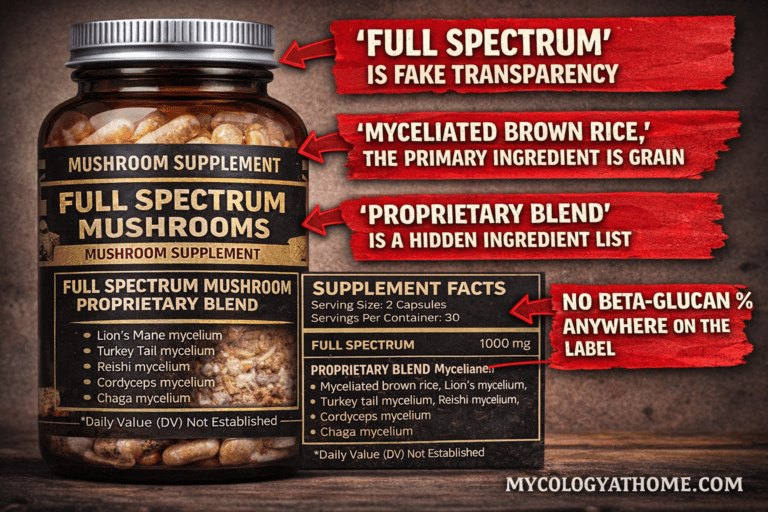
Fruiting body vs mycelium-on-grain. Commercial C. militaris can be cultivated on grain substrates, and many cheap cordyceps products are mycelium-on-grain. The same quality issues as lion’s mane mycelium-on-grain apply here. The rice or grain substrate dilutes active compound content, and label claims about polysaccharide percentage often include the grain starch.
Cordycepin content. This is the species-specific quality marker for cordyceps. Quality C. militaris extract should disclose cordycepin content, typically measured in mg per serving. Products that do not specify cordycepin content may not be capturing the compound in meaningful amounts.
Beta-glucan content. The general mushroom quality marker. 20 to 30 percent beta-glucan content by weight indicates a quality fruiting body extract. Lower figures suggest either mycelium-on-grain or low-yield extraction. My guide to beta-glucans covers this in detail.
Extraction method. Hot water extraction captures the water-soluble beta-glucans and polysaccharides. Dual extraction (water plus alcohol) additionally captures nucleoside compounds. For general use, hot water extraction is fine. For maximum cordycepin extraction, dual extract products concentrate more of the active fraction. My overview of dual extraction explains the difference.
Third-party testing. A product that publishes a certificate of analysis showing beta-glucan percentage, cordycepin content, heavy metal limits, and contamination testing is verifying what it claims. Most cordyceps brands do not do this. The ones that do are paying for lab work that supports their claims.
Species confirmation. A quality product names the species (C. militaris or Cs-4) clearly on the label. Generic “cordyceps” without species specification is a transparency problem. I cover this and other red flags in how to read a mushroom supplement label.
Not noticing anything at 4 weeks? Check these in order.
Cordyceps effects on endurance are measurable but gradual. Before concluding it does not work, verify the basics.
Has it been at least 3 weeks?
Hirsch 2017 found nothing significant at 1 week. Three weeks is the minimum window for the measurable effects.
Is the dose high enough?
The strongest trials used 3-4 g/day of mushroom material. If you are at 500 mg/day, you are well below trial range.
Is it actually the right form?
Fruiting body extract or Cs-4 fermentation mycelium, not mycelium-on-grain. Check the label for “rice” as an ingredient.
Is cordycepin content disclosed?
If not, you may have a low-active product. Quality C. militaris should specify cordycepin content.
Are you testing for the right outcome?
Endurance and VO2max are measurable in structured training. General energy is harder to notice in daily life without a baseline. Use a consistent metric.
Cordyceps is one-third of the mushroom nootropic stack
Cordyceps in the morning for energy. Lion’s mane in the morning for cognition. Reishi at night for sleep and stress. Same evidence-anchored approach applies to all three.
Frequently asked questions
Almost certainly not, because almost nothing sold as “wild sinensis” is actually wild sinensis. Real wild sinensis is one of the most expensive natural products on Earth. Authenticated wild material is only accessible to specialty traditional Chinese medicine practitioners and high-end Asian markets. If you see wild Cordyceps sinensis at a Western supplement retailer at a non-astronomical price, you are looking at either Cs-4 fermentation product or mislabeled militaris. Save your money and buy quality militaris or Cs-4.
The evidence for chronic fatigue syndrome specifically is preliminary. The general fatigue and energy evidence from Chen 2010 was in healthy older adults, not in a CFS population. That said, cordyceps’ AMPK mechanism is biologically plausible for cellular energy support. 1 to 3 g per day for at least 8 weeks is a reasonable trial. Talk to your physician first if you have a diagnosed condition.
Yes, and they work through different mechanisms. Caffeine blocks the adenosine receptors that tell you to feel tired. Cordyceps supports actual cellular energy production. The combination is complementary. Watch for over-stimulation if you are caffeine-sensitive.
No specific interaction is well-documented, but cordyceps does have some preclinical effects on serotonin pathways. If you are on psychiatric medications, let your prescribing physician know before starting.
They will not deliver clinical doses. A typical mushroom coffee product contains 125 mg to 250 mg of cordyceps per serving. At 1 to 3 servings per day, you are getting 125 mg to 750 mg of cordyceps, which is well below the 1 to 4.5 g per day trial range. This is the same dose-gap problem that applies to mushroom coffee generally. I covered the mushroom coffee category and its dose problem in the mushroom coffee hub and cordyceps coffee benefits posts.
The honest summary
Effective daily doses of cordyceps based on human clinical trials fall in the 1 to 4.5 g per day range of mushroom material. For endurance and VO2max specifically, the 3 to 4 g per day doses over 3 to 6 weeks produce the clearest effects. Morning timing is preferred because cordyceps supports cellular energy production. Consistency over 3 weeks minimum is required for the effects the trials measured.
The strongest human evidence is for endurance and oxygen utilization in exercise contexts. General fatigue and energy have supporting evidence mostly in older populations. Traditional uses for libido, vitality, and kidney tonification have weaker modern clinical data but are not implausible given the cellular energy mechanism.
Safety is good. The drug interaction list is shorter than reishi’s, though diabetes medications and anticoagulants still warrant awareness.
If you are picking your first cordyceps product, start with a 1.5 to 3 g per day dose of a C. militaris fruiting body extract (or Cs-4 if you prefer the traditional sinensis substitute) from a brand that publishes a certificate of analysis, take it in the morning, and give it at least 4 weeks before evaluating. If you are using it for endurance performance specifically, push to 3 to 4 g per day and give it 3 weeks minimum before your key training block or event. That is the most evidence-supported approach.
References
[1] Hirsch KR, Smith-Ryan AE, Roelofs EJ, Trexler ET, Mock MG. Cordyceps militaris Improves Tolerance to High-Intensity Exercise After Acute and Chronic Supplementation. Journal of Dietary Supplements. 2017;14(1):42-53. PubMed
[2] Chen S, Li Z, Krochmal R, Abrazado M, Kim W, Cooper CB. Effect of Cs-4 (Cordyceps sinensis) on exercise performance in healthy older subjects: A double-blind, placebo-controlled trial. Journal of Alternative and Complementary Medicine. 2010;16(5):585-590. PMC
[3] Xu YF. Effect of polysaccharide from Cordyceps militaris (Ascomycetes) on physical fatigue induced by forced swimming. Randomized double-blind placebo-controlled clinical trial of Cs-4 on aerobic capacity. Chinese Journal of Integrative Medicine. Cs-4 3 g/day for 6 weeks in healthy elderly. Springer
[4] Dudgeon WD, Thomas DD, Dauch W, Scheett TP, Webster MJ. The Effects of High and Low-Dose Cordyceps Militaris-Containing Mushroom Blend Supplementation After Seven and Twenty-Eight Days. American Journal of Sports Science. 2018;6(1):1-7.
[5] Tuli HS, Sandhu SS, Sharma AK. Pharmacological and therapeutic potential of Cordyceps with special reference to Cordycepin. 3 Biotech. 2014;4(1):1-12.
Not medical advice. For informational purposes only. Consult your physician or pharmacist before starting cordyceps, particularly if you take prescription medications, are pregnant or nursing, have a scheduled surgery, or have an underlying medical condition. See Medical Disclaimer.