How the Supplement Industry Legally Lies to You
How the supplement industry legally lies to you — and why the people most likely to be hurt are the ones with the least defense
The marketing on a supplement bottle was almost certainly never reviewed by anyone in a regulatory position. The system was designed that way. This post is the long version of why, what it actually looks like in practice, and what you can do about it as a buyer.
2024 DNA testing study: percentage of herbal supplements that contained the species the label claimed.
Annual US supplement industry revenue. Most spent by people who genuinely believe what the labels say.
Time it took the FTC to win against Prevagen after suing in 2017. Court order issued December 2024.
The supplement industry generates an estimated $50 billion a year in the United States. Most of that money is spent by people who genuinely believe what they read on the label. The problem is what they read on the label is, in many cases, designed to be technically legal while still misleading them about what the product can actually do.
This post is the long version of something I have written about in pieces across this site, mostly in brand reviews where individual companies have been caught making claims that did not hold up. The point of this post is to step back from any single brand and look at the system itself. The legal structure of supplement labeling in the United States allows companies to say things on a bottle that imply medical benefits without ever having to prove those benefits work. People who are sick, exhausted, struggling with their weight, or watching a parent decline from dementia are the primary audience for this kind of marketing. They are also the people least equipped to read past it.
I am not a regulator. I am not a lawyer. I am someone who got into this category because I have celiac disease and I take mushroom supplements personally, and along the way I learned how this industry actually operates. Once you understand the rules, the marketing patterns become impossible to unsee. That is what this post is about.
The law that made all of this possible
In 1994, Congress passed the Dietary Supplement Health and Education Act, known as DSHEA. Before DSHEA, dietary supplements were regulated more like food additives, and any health claim had to be approved by the FDA before it appeared on a label. After DSHEA, supplements got their own regulatory category, and a new set of rules took effect that completely changed what companies could say on their packaging.
The core change was this. Supplement companies were given the ability to make what are called structure and function claims without prior FDA approval. The FDA does not review these claims before the product hits the shelf. The company is required to have what the law calls “competent and reliable scientific evidence” to support the claim, but they do not have to submit that evidence to the FDA, and the FDA only has voluntary standards for what counts as adequate evidence [1][2].
That is the loophole the entire industry was built around. The FDA cannot stop a supplement claim from going to market. They can only act after the fact, if they happen to investigate the company and find that the claims were unsubstantiated or that the product was making prohibited disease claims. Given the size of the industry and the resources the FDA actually has, this happens to a very small fraction of products.
The 1994 law that made supplement marketing almost impossible to regulate
The Dietary Supplement Health and Education Act (DSHEA) created a regulatory category where the FDA cannot review supplement claims before they hit the shelf. Companies are required to have substantiation. They are not required to submit it to anyone. The FDA can only act after the fact, if they happen to investigate.
Pre-DSHEA framework
Supplements were regulated more like food additives. Health claims required FDA pre-approval before reaching consumers. The bar for substantiation was set by regulators, not manufacturers.
Current framework
“Structure and function” claims need no FDA pre-approval. Manufacturers self-declare evidence is sufficient. The FDA can only react after investigation, which the agency has limited resources to do at the scale of the industry.
A 2012 Office of Inspector General study published by the Department of Health and Human Services analyzed 127 dietary supplements marketed for weight loss or immune support. The findings were not subtle. Substantiation documents that companies provided when asked were “inconsistent with FDA guidance on competent and reliable scientific evidence.” Twenty percent of the supplements included prohibited disease claims on their labels. Seven percent lacked the required FDA disclaimer entirely [1].
That study is now over a decade old. The industry has grown substantially since then. The FDA’s resources have not kept pace.
What a structure and function claim actually is, and why it matters
A structure and function claim describes how a nutrient or ingredient affects the structure or function of the human body without claiming to treat a disease. The classic textbook examples are statements like “calcium builds strong bones” or “fiber maintains bowel regularity” [3]. These are technically permissible because they describe biological function rather than disease prevention.
The problem is what happens at the edges of that definition. A label that says “supports a healthy immune system” is a structure and function claim. A label that says “prevents colds” is a disease claim and is illegal without FDA approval. The first one is allowed. The second one is not. To consumers, they sound like they describe roughly the same thing.
This is not an accident. Manufacturers strategically phrase claims to sit on the legal side of that line while implying the medical benefit on the consumer side of it. The Congressional Research Service noted in 2025 that “a manufacturer may make a strategic choice to phrase a claim so that it is a structure/function claim and not a health claim to avoid the premarket approval requirement and the more rigorous standard associated with health claims” [4]. That is the federal government acknowledging, in a research report, that this is how the system actually works.
How “structure and function” claims sit on the legal side of the line while implying medical benefit
The same product can claim the legal version on its label while the consumer fills in the implied version in their head. The Congressional Research Service has acknowledged this is how manufacturers strategically phrase claims.
“Supports a healthy immune system”
No FDA approval required. The company can put this on the bottle without ever proving the product affects immune function.
“Prevents you from getting sick”
This is a disease claim. Illegal without FDA pre-approval. The company never has to defend that you read it this way.
“Promotes cognitive function”
No FDA approval required. Vague enough that “promotes” can mean almost anything.
“Treats memory loss / dementia”
This is a disease claim. Illegal without FDA pre-approval. Targeted at older adults watching parents decline.
“Supports healthy weight management”
No FDA approval required. Sidesteps the higher evidence standard for weight loss drugs.
“Causes you to lose weight”
This is a disease/efficacy claim. Would require clinical trials. Targeted at people frustrated with weight loss.
The same product can carry phrases like “supports cognitive function” and “promotes mental clarity” without any premarket review of whether the product actually does either of those things. The company is supposed to have evidence somewhere. They are not required to show it to anyone unless they get caught.
The disclaimer that is supposed to protect you
If you look at any supplement bottle, somewhere on the label, usually in small text on the back, you will find a sentence that reads something close to this:
“These statements have not been evaluated by the Food and Drug Administration. This product is not intended to diagnose, treat, cure, or prevent any disease.”
That is the FDA-required disclaimer that has to accompany any structure and function claim [5]. It exists because the law requires the company to tell you, in writing, that the claims on the front of the bottle were not reviewed or approved by anyone.
Almost no consumer reads it. The disclaimer is in 6 to 8 point type, on the back of the bottle, often in gray rather than black, while the claims are in 18 to 24 point bold type on the front. The legal protection is technically there. The practical protection is not.
This is the gap that drives most of the deceptive marketing in the category. Companies put bold, confident, benefit-forward language on the front of the bottle, and they put the disclaimer on the back where almost no one will read it. The structure of the law requires them to disclose. The structure of the design ensures that disclosure does nothing.
Front of bottle vs back of bottle, by visual weight
The FDA-required disclaimer is technically there. The design ensures it does almost nothing. Almost no consumer reads the back-of-bottle 6-point gray text after seeing the front-of-bottle 24-point bold claim.
Promotes mental clarity & brain health
Other Ingredients
Storage Instructions
The headline claim sits in large bold type at eye level on the shelf. This is what you see, what you read, and what drives the purchase decision.
The disclaimer is in 6-8 point gray text on the back of the bottle. It tells you, in writing, that the front of the bottle was never reviewed. Almost no one reads it.
I am not arguing the disclaimer should be on the front of every bottle. I am arguing that, as currently implemented, it does not function as the consumer protection mechanism it was intended to be. People do not read fine print. They read the headline. The headline is the marketing claim. The marketing claim was never reviewed.
The actual deceptive practices, ranked by harm
Not every supplement company is doing the same thing. There is a real spectrum from honest brands that publish their certificates of analysis and stay carefully on the legal side of claim structure, all the way to outright fraud operations using fake celebrity endorsements. The middle of that spectrum is where most of the harm happens, because it is also where most of the volume happens.
Five tiers of supplement marketing deception, ranked by harm
The supplement industry is not uniformly bad. There is a spectrum from honest brands to outright fraud, with most volume and most harm sitting in the middle. Here is the actual ladder.
Implied disease claims that legally qualify as structure/function claims
Where most legal-but-misleading marketing lives. “Supports healthy metabolism” implies weight loss without legally claiming it. The buyer fills in the meaning. The company never had to substantiate it.
Selective citation of preliminary research
A company finds a single in-vitro or animal study, then markets the product as if the effect has been demonstrated in humans at the dose the product delivers. The citation looks impressive. The actual relevance to whether the product works is often zero.
Influencer testimonial marketing without clinical disclosure
Properly disclosing a paid relationship is required by the FTC. It does not protect you from a testimonial implying clinical benefit. “I have so much more energy since I started taking this” is not evidence of anything except that the influencer got paid.
Prescription drug imitator marketing
The category that prompted the 2025 NAD inquiry into RYZE. Imagery, language, or visual styling that implies effects similar to GLP-1 medications or other prescription drugs without explicitly claiming so. Targets people who cannot afford or access the actual medication.
Outright fraud: fake reviews, fake celebrity endorsements, fake media sites
The FTC’s 2018 Tarr Inc. case documented fake media sites mimicking Men’s Health, Good Housekeeping, and Dr. Oz. The April 2026 TruHeight settlement involved thousands of fake five-star reviews written by company employees. This tier is criminal and the rarest.
Tier 1: Implied disease claims that legally qualify as structure and function claims. This is where most legal-but-misleading supplement marketing lives. A weight loss supplement that says “supports healthy metabolism” is implying weight loss without legally claiming it. A cognitive supplement that says “supports memory function” is implying it treats dementia or age-related cognitive decline without legally claiming that. The buyer fills in the meaning. The company never had to substantiate it.
Tier 2: Selective citation of preliminary research. A company finds a single in-vitro or animal study showing some effect of an ingredient, then markets the product as if that effect has been demonstrated in humans at the dose the product delivers. The citation looks impressive. The actual relevance to whether the product does anything in your body is often zero. This is widespread in the cognitive enhancement, immune support, and adaptogen categories.
Tier 3: Influencer-driven testimonial marketing without disclosure. Influencer marketing is supposed to follow FTC endorsement guidelines that require disclosure of paid relationships. Many influencer posts in the supplement space comply technically with #ad disclosures, but the testimonial itself (“I have so much more energy since I started taking this”) implies clinical benefit without any clinical evidence. The disclosure protects the influencer. It does not protect the consumer from a claim that is unsubstantiated.
Tier 4: GLP-1 and prescription drug imitator marketing. This is the category that prompted the National Advertising Division’s 2025 inquiry into RYZE Superfoods. Supplements marketed with imagery, language, or visual styling that imply they deliver effects similar to prescription medications, without ever explicitly claiming so. The implied comparison reaches people who cannot afford or cannot access the actual prescription, and it offers them a non-prescription version that does not actually work the same way.
Tier 5: Fake reviews, fake celebrity endorsements, fake media sites. This is outright fraud territory. The 2018 FTC case against Tarr Inc. documented an “extensive network” of online marketers using fake media websites with domain names that appeared to be authentic news outlets including spoofed Men’s Health, Good Housekeeping, and Dr. Oz sites [6]. The April 2026 settlement with TruHeight involved a children’s height-enhancement supplement where the company allegedly paid for fake five-star reviews and used fake employee-written testimonials. The FTC settlement specifically called out reviews “that were not authentic” and the company offering “free products and discounts in exchange for posting five-star reviews” [7].
Recent enforcement: who got caught and what it took to catch them
The FTC has the authority to act against deceptive supplement advertising, but the agency has limited resources and a high evidence bar. When they do bring cases, the timelines are striking.
Who got caught, what it took, and how long it took
When the FTC does bring cases against deceptive supplement marketing, the timelines are striking. By the time enforcement lands, the product has often been generating revenue for half a decade or longer, and that money is gone.
Quincy Bioscience · Memory supplement
FTC and NY Attorney General sued in 2017 over deceptive cognitive function claims targeted at older Americans. After seven years of litigation including a jury trial, the federal court ordered Quincy Bioscience to cease the deceptive claims in December 2024.
7 years of continued sales during litigation
Rejuvica · Alcohol-craving supplement
FTC found unsupported claims that the product reduced alcohol cravings. Deceptive practices included paid endorsements presented as independent expert opinions and review websites the company itself had drafted. Targeted people struggling with substance use.
$536,000 split among 536,000 consumers
Vanilla Chip LLC · Children’s height supplement
Supplements marketed to parents with claims like “The Only Supplement Clinically Proven to Help Height Growth.” FTC documented thousands of fake five-star reviews written by company employees plus financial incentives offered for positive reviews.
Parents worried about children’s growth
Texas-based · Cardiovascular & diabetic neuropathy claims
Companies and their owner were banned from the supplement industry entirely after the FTC documented unsubstantiated claims that supplements prevented or treated cardiovascular disease and diabetic neuropathy. Targeted people with chronic illness.
Lifetime industry ban after years of violations
Prevagen. This is the memory supplement marketed heavily to older adults with claims about improving cognitive function. The FTC and the New York Attorney General first sued the makers of Prevagen, Quincy Bioscience, in 2017. After seven years of litigation including a jury trial, the U.S. District Court for the Southern District of New York ruled in December 2024 that the company had to cease making the deceptive claims [8]. Seven years. From a federal lawsuit to a court order. During that time, the product continued to sell, the marketing continued to run, and the audience the FTC was trying to protect (older Americans worried about memory loss) continued to be the primary purchasers.
Sobrenix. A supplement marketed as reducing alcohol cravings and helping with problematic drinking. The FTC announced in November 2024 that it would send refunds totaling more than $536,000 to 536,000 consumers who had been deceived by claims that the FTC ultimately determined had no scientific substantiation [9]. The deceptive practices included paid endorsements presented as independent expert opinions and review websites the company itself had drafted. Half a million consumers. One product. The refunds work out to roughly one dollar per affected buyer.
TruHeight. A height-enhancement supplement marketed to parents of children and teenagers with claims like “Help your child grow taller!” and “The Only Supplement Clinically Proven to Help Height Growth.” The April 2026 FTC settlement found the claims were “false or misleading, or were not substantiated.” Beyond the unsubstantiated claims, the FTC documented thousands of fake five-star reviews written by company employees and vendors, plus financial incentives offered to consumers in exchange for positive reviews [7]. The targets here were parents worried about their children’s growth.
Health Research Laboratories. Two Texas-based companies and their owner were banned from the supplement industry entirely in 2022 after the FTC documented unsubstantiated claims that supplements prevented or treated cardiovascular disease and diabetic neuropathy [10]. This was a banning order. They got banned, not fined. The original violations had been ongoing for years before the order took effect.
These are the cases that made it through to enforcement. The FTC’s own data suggests these represent a small fraction of the actual deceptive marketing in the industry. Cases take years. By the time a company is sanctioned, the product has often been generating revenue for half a decade or longer, and that money is gone.
The DNA testing problem: when the product does not even contain what it says it contains
Beyond marketing claims, there is a more fundamental issue with what is actually inside supplement bottles. Independent DNA testing studies have repeatedly found that significant percentages of herbal supplements do not contain the species listed on the label.
A 2024 Chapman University study published in Phytochemical Analysis tested 54 commercial Ayurvedic herbal supplements on the US market for nine targeted herb species. The expected species was detected in only 38.9 percent of products [11]. Undeclared plant species were detected in 19 of the 54 products. That is a roughly 60 percent failure rate for products to contain what their labels claimed they contained.
The DNA testing problem: when the supplement does not contain what the label says
Independent peer-reviewed studies have repeatedly tested commercial supplements and found significant percentages do not contain the species their labels claim. The label is not a reliable indicator of what is in the bottle.
A 2024 Chapman University study tested 54 commercial Ayurvedic supplements. Only 38.9% contained the species their labels claimed.Harris et al., Phytochemical Analysis, 2024
A 2011 NY Botanical Garden study found contamination or substitution in 33% of herbal tea products using DNA barcoding methodology.Stoeckle et al., Scientific Reports, 2011
A 2012 study on black cohosh supplements (marketed for menopausal symptoms) found 25% contained Asian Actaea species instead. Some are toxic.Baker et al., J AOAC International, 2012
A 2011 New York Botanical Garden study found contamination or substitution in herbal tea products at a 33 percent rate using DNA barcoding [12]. A separate study on black cohosh supplements, marketed for menopausal symptoms, found that 25 percent of products contained DNA matching three Asian Actaea species rather than the actual black cohosh species the label claimed [13]. Some of these substitute species are known to be toxic to humans.
The methodological caveat here matters. DNA testing has limitations. Heavy processing of plant extracts can degrade DNA to the point where it cannot be detected, which means a negative DNA test does not always mean the species is absent. Some defenders of the industry have argued that the DNA testing studies overstate the contamination rate because of these methodological issues.
That argument has some merit, but it does not reach the point its defenders need it to reach. Even if you assume the worst-case methodological problems and adjust the failure rates downward, you are still left with a substantial fraction of supplement products that either do not contain the species they claim to contain, or contain undisclosed additional species, or both. For a consumer trying to make an informed purchase, the bottom line is the same: the label is not a reliable indicator of what is in the bottle.
This is the issue the Five-Step Evaluation Framework I use across this site is designed to address for mushroom supplements specifically. Brands that publish third-party Certificates of Analysis with verifiable bioactive content have done the work to confirm what is in their product. Brands that do not publish CoAs are asking you to trust the label. The DNA testing data shows what trusting the label produces.
The targeting problem: who this marketing actually reaches
Deceptive supplement marketing does not target everyone equally. It targets specific populations who are most likely to need help and least equipped to evaluate the claims. This is not an accident either. It is who the marketing is built for.
Who deceptive supplement marketing actually reaches
Deceptive marketing does not target everyone equally. It targets specific populations who are most likely to need help and least equipped to evaluate the claims. The pattern is the same across every category.
Older adults concerned about cognitive decline
Often watching a parent decline from dementia. Looking for anything that might help. Frequently first targeted via TV ads, mailers, and social media.
Textbook case: Prevagen marketing to Americans 50+
People struggling with weight
Cannot access or cannot afford GLP-1 prescription medications. Marketing implies similar effects without the cost or prescription requirement.
Textbook case: 2025 NAD inquiry into RYZE Matcha
Parents worried about their children
Children expressing insecurity about height. Parents worried about growth. Marketing aimed at the parent as the purchaser.
Textbook case: TruHeight settlement, April 2026
People with chronic illness
Diagnosed with serious conditions. Looking for alternatives or adjuncts to prescription medication. Targeted with claims about prevention or treatment.
Textbook case: Health Research Labs cardiovascular claims
People with substance use disorders
Trying to quit drinking or other substances. Searching for help with what is, for many, a life-or-death struggle.
Textbook case: Sobrenix, 536,000 deceived buyers
The financial incentive is strongest where buyers are most vulnerable
Healthy, skeptical, well-informed buyers are not the target audience. Desperate buyers are. The marketing pattern is the same across every category because the economics demand it.
Older adults concerned about cognitive decline. Prevagen is the textbook case. The marketing specifically targeted Americans over 50 who were worried about memory loss, often watching a parent decline from dementia, and looking for anything that might help. The FTC ultimately won its case after seven years of litigation. During those seven years, an estimated several million bottles of Prevagen were sold to that audience.
People struggling with weight. The 2025 NAD inquiry into RYZE Superfoods specifically examined whether the company’s Mushroom Matcha advertising implied appetite-suppressing benefits comparable to GLP-1 medications such as semaglutide and tirzepatide. GLP-1 drugs are prescription medications with extensive clinical trial programs and significant cost barriers. A mushroom matcha that implies similar effects without the prescription, the cost, or the side effect profile is targeted directly at people who cannot access the actual medication or cannot afford it.
Parents worried about their children. TruHeight marketed height-enhancement supplements to parents of children and teenagers. The targets were not the children. They were the parents who had heard their child express insecurity about their height, or who were worried about whether their child was growing normally, and were looking for an intervention. The FTC ultimately found the claims were not substantiated and the company had been generating fake reviews to amplify the deception [7].
People with chronic illness. Health Research Laboratories marketed supplements claiming to prevent or treat cardiovascular disease, diabetic neuropathy, and other serious conditions [10]. The audience was not curious wellness shoppers. The audience was people who had been diagnosed with these conditions and were looking for something other than prescription medication.
People with substance use disorders. Sobrenix marketed itself as helping reduce alcohol cravings and consumption, language that maps directly onto the experience of people trying to quit drinking. The 536,000 affected consumers who received refunds were people who had been searching for help with what is, for many of them, a life-or-death struggle [9].
The pattern across all of these is the same. The deceptive marketing is most profitable when it reaches people who are already searching for solutions to genuine problems. That makes the financial incentive for the marketing especially strong. Healthy, skeptical, well-informed buyers are not the target audience. Desperate buyers are.
Why “supplements work for some people” is not a counter-argument
A common defense of the supplement industry is that supplements do work for some people, and that I am being too harsh on a category that delivers genuine benefits. I want to address this directly, because it is half right and half misleading in itself.
It is true that some supplements do produce measurable benefits for some people in some conditions. Vitamin D supplementation in deficient individuals has well-documented effects. B12 supplementation in vegans and people with absorption issues works. Magnesium for sleep in people who are deficient has reasonable support. There are real ingredients that do real things in well-defined contexts.
“Some supplements work for some people” — half right, half misleading
It is true. Some supplements do produce measurable benefits in well-defined contexts. But that fact is often used as a defense for products and marketing that have no relationship to it.
Real supplements that produce real effects
The leap that doesn’t actually hold
Where the argument breaks down is in the leap from “some supplements work for some people” to “the marketing of any specific product is therefore trustworthy.” Those are not the same statement. The marketing of an individual product is making a specific claim about that specific product at the dose it delivers in the form it delivers it. Whether the broader category of supplements has any legitimate uses says nothing about whether the bottle in front of you is one of those legitimate uses.
The Five-Step Evaluation Framework on this site exists precisely to bridge this gap. It is not a framework for deciding whether mushroom supplements work in general. It is a framework for evaluating whether a specific brand’s specific product can be verified against the clinical research the marketing is borrowing from. A brand can sell a real species at a real dose with verified beta-glucan content and a published Certificate of Analysis. That brand has done the work to substantiate its claims. Most brands have not.
The honest version of the supplement category is this. There is a real top tier of brands publishing detailed quality documentation. There is a much larger middle tier making structure and function claims that are technically legal but leave the buyer unable to verify whether the product matches the marketing. There is a bottom tier engaging in outright fraud. Most consumers, most of the time, are buying from the middle tier without knowing the difference.
What you can actually do about it
You cannot fix the supplement industry as a single consumer. The legal structure that allows deceptive marketing is set by Congress, not the supplement aisle at Whole Foods. What you can do is develop the basic literacy to read past the marketing on the products you actually consider buying.
Five things you can actually do as a buyer
You cannot fix the supplement industry as a single consumer. What you can do is develop the basic literacy to read past the marketing on the products you actually consider buying.
Read the back-of-bottle disclaimer
Almost everything on the front is marketing copy that was never reviewed. The disclaimer tells you this in plain language. Read it. Internalize it. Apply it to every label.
Ask what the product publishes about its content
A real Certificate of Analysis from an independent lab is a different category than a marketing claim. “Lab tested” without showing the results is doing nothing. Look for batch-level CoAs with active compound content.
Read structure/function claims literally
“Supports a healthy immune system” is not “prevents illness.” “Promotes cognitive function” is not “improves memory.” These distinctions are deliberate. Stop filling in the gap.
Treat testimonials as paid content
Even properly disclosed influencer endorsements don’t mean the product works. Surprisingly uniform 5-star reviews are a red flag. Before-and-after imagery in paid social ads is marketing, not evidence.
Marketing is not evidence. Documentation is.
The price, the celebrity, the social media presence, the influencer partnerships, the testimonials — none substitute for verified content documentation. Verified content documentation is what separates the brands that have done the work.
The starting point is recognizing that almost everything on the front of a supplement bottle is marketing copy that was never reviewed by anyone in a regulatory position. The disclaimer on the back tells you this in plain language. Read it.
The second step is asking what specifically the product publishes about its content. A real Certificate of Analysis from an independent laboratory is a different category of document than a marketing claim. If a brand publishes batch-level CoAs with active compound content, they have done the work. If a brand says “lab tested” without showing you the test results, the words are doing nothing.
The third step is reading the structure and function claims for what they actually say rather than what they imply. “Supports a healthy immune system” is not “prevents illness.” “Promotes cognitive function” is not “improves memory.” These distinctions are deliberate and they matter. The marketing is built so that you fill in the gap between what the words say and what the implied benefit is. If you stop filling in the gap, the claim becomes much smaller.
The fourth step is being suspicious of testimonials, especially before-and-after imagery, especially when the testimonial reaches you through paid social media advertising. The Sobrenix case included paid endorsements presented as independent expert opinions and review websites the company itself had drafted [9]. The TruHeight case included thousands of fake five-star reviews from employees [7]. If a testimonial is in a paid ad, treat it as paid content. If reviews are surprisingly uniformly positive, ask who paid for them.
The fifth step is the simplest and the most important. The marketing of any single product is not evidence that the product works. The clinical research on an ingredient is not evidence that the specific product you are looking at delivers that ingredient at the studied dose. The presence of a celebrity endorsement is not evidence of anything except that the celebrity got paid. The price of the product is not evidence of quality. None of those things substitute for verified content documentation, and verified content documentation is what separates the brands that have done the work from the brands that have not.
The point of writing this
I run a small site about mushroom supplements and home cultivation. The reason I keep writing posts like this one is that the people who land on my brand reviews are usually people who have already bought the product and are now wondering if they got taken. Or they are about to buy it and they want to know if it is legit. They are not industry insiders. They are not researchers. They are people who got marketed to and are trying to figure out whether the marketing was real.
The supplement industry is not going to stop marketing this way. There is no version of this story where the laws change, the FTC gets the resources it needs, or the deceptive brands voluntarily clean up their messaging. The financial incentive is too strong, the legal structure is too permissive, and the audience that buys based on marketing claims keeps being there for the next round of products.
What can change is your ability to read the bottle.
The supplement industry isn’t going to fix itself. What can change is your ability to read the bottle.
Most of this site exists to apply the same documentation-first standard to specific brands and specific products. The five-step evaluation framework, the brand reviews, the label-reading guides — all of it is built so you can verify the product instead of trusting the marketing.
Frequently asked questions
No. There are real brands publishing real third-party Certificates of Analysis with verified active compound content, made under clean manufacturing practices, with responsible structure and function claims that reflect what the product can actually do. The category is not uniformly bad. The category is poorly regulated, which means the bad actors and the good actors are sitting on the same shelf at the same store, and the consumer has to do the work to tell them apart.
Class action lawsuits against supplement companies have happened, including high-profile cases against Prevagen, Sobrenix, and others. The FTC handles most enforcement actions for deceptive advertising. Individual consumers have sometimes received refunds through these enforcement actions, as in the Sobrenix case where 536,000 consumers received refunds totaling $536,000 [9]. The path to recovery for most consumers is slow, often takes years, and typically results in modest per-person refunds. The realistic protection is buying from brands that publish verifiable documentation rather than relying on enforcement after the fact.
The Dietary Supplement Health and Education Act of 1994 explicitly removed pre-approval authority from the FDA for structure and function claims. Manufacturers are required to have substantiation that claims are truthful and not misleading, but they are not required to submit that substantiation to the FDA before marketing. The FDA can only act after the fact, and only if they investigate and find violations [1][2].
Some are. The FTC requires influencers to disclose paid relationships, and many do follow these rules. The disclosure protects against the legal violation of undisclosed advertising. It does not, however, ensure the supplement actually does what the influencer says it does. An influencer can fully disclose a paid partnership and still describe an effect that the product cannot demonstrate clinically. Treat influencer testimonials as paid content even when they are properly disclosed.
References
[1] Department of Health and Human Services Office of Inspector General. Dietary Supplements: Structure/Function Claims Fail To Meet Federal Requirements. 2012. https://oig.hhs.gov/reports/all/2012/dietary-supplements-structurefunction-claims-fail-to-meet-federal-requirements/
[2] Food and Drug Administration. Notifications for Structure/Function and Related Claims in Dietary Supplement Labeling. https://www.fda.gov/food/information-industry-dietary-supplements/notifications-structurefunction-and-related-claims-dietary-supplement-labeling
[3] Food and Drug Administration. Structure/Function Claims. https://www.fda.gov/food/nutrition-food-labeling-and-critical-foods/structurefunction-claims
[4] Congressional Research Service. Food and Dietary Supplement Labeling Claims: FDA Regulation and Select Legal Issues. August 2025. https://www.congress.gov/crs-product/R48623
[5] Food and Drug Administration. Small Entity Compliance Guide on Structure/Function Claims. https://www.fda.gov/regulatory-information/search-fda-guidance-documents/small-entity-compliance-guide-structurefunction-claims
[6] Federal Trade Commission. FTC Cracks Down on Supplement Marketers Touting Bogus Celebrity Endorsements. 2018. Coverage: SupplySide Supplement Journal.
[7] Federal Trade Commission. FTC TruHeight Settlement Announcement. April 2026. Coverage: NutraIngredients-USA. https://www.nutraingredients.com/Article/2026/04/23/ftc-truheight-settlement-spotlights-clinical-substantiation-and-testimonial-oversight/
[8] Federal Trade Commission. Statement on FTC’s Win in Lawsuit Against the Makers of Dietary Supplement Prevagen. December 10, 2024. https://www.ftc.gov/news-events/news/press-releases/2024/12/statement-ftcs-win-lawsuit-against-makers-dietary-supplement-prevagen
[9] Federal Trade Commission. Refunds to consumers deceived by Sobrenix marketing. November 2024. Coverage: Global Compliance News. https://www.globalcompliancenews.com/2024/11/26/
[10] Federal Trade Commission. FTC Proposed Order Stops Marketers from Continuing to Promote Supplements Using Baseless Health Claims. March 2022. https://www.ftc.gov/news-events/news/press-releases/2022/03/ftc-proposed-order-stops-marketers-continuing-promote-supplements-using-baseless-health-claims
[11] Harris CM, Kim DY, Jordan CR, et al. DNA barcoding of herbal supplements on the US commercial market associated with the purported treatment of COVID-19. Phytochemical Analysis. 2024;35(4):664-677. https://pubmed.ncbi.nlm.nih.gov/38225696/
[12] Stoeckle MY, Gamble CC, Kirpekar R, Young G, Ahmed S, Little DP. Commercial teas highlight plant DNA barcode identification successes and obstacles. Scientific Reports. 2011;1:42.
[13] Baker DA, Stevenson DW, Little DP. DNA barcode identification of black cohosh herbal dietary supplements. Journal of AOAC International. 2012;95(4):1023-1034.
Similar Posts
Can You Trust Mushroom Supplement Reviews on Amazon?
A product with 4.8 stars and 30,000 reviews looks safe. It feels validated. You would be making a reasonable decision to buy it. Except you would not. Not with supplements. Amazon reviews work well for books, electronics, and kitchen gadgets. For mushroom supplements, the review model breaks down in ways that are worth understanding before…
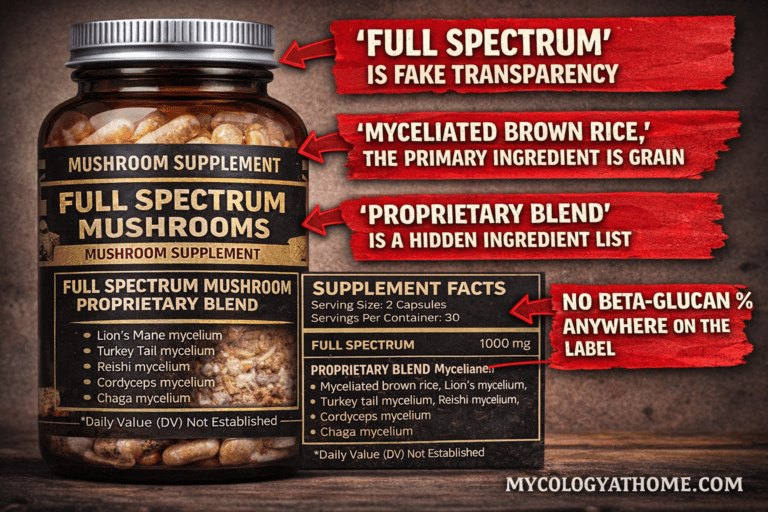
How to Read a Mushroom Supplement Label: Spot Red Flags Fast
Most mushroom supplement labels are not designed to help you make an informed decision. They are designed to look impressive while hiding the details that would actually tell you whether the product is worth buying. That is not cynicism. That is how the system works. Under DSHEA, supplement labels are not required to disclose beta-glucan…
ORIVeDA Supplement: My Personal Experience
I get asked this question more than anything else on this site. After everything I have written about the supplement industry, the misleading labels, the proprietary blends, the withdrawn health claims, what do I actually take? Here is the answer. And then I am going to give you two alternatives that might be better for…
Mushrooms and Celiac Disease: Are They Safe?
Quick answer Are mushrooms safe for people with celiac disease? Mushrooms themselves appear low risk. Fungi digest their substrate externally, breaking down proteins (including gluten) before absorbing them. The fruiting body is synthesized tissue, not undigested substrate. The National Celiac Association considers mushrooms safe. Limited testing supports this. The real risks are environmental: grain dust…
Do Mushroom Supplements Actually Work? Here’s Why Not.
The short answer is yes. Some of them. Under specific conditions. With a lot of caveats that nobody in the industry wants to talk about. The Honest Answer The science is real. Most products are not.Here is how to tell the difference. Fact-checked. Referenced. No affiliate links. The longer answer is what this entire post…