QUICK ANSWER
Real Mushrooms is the strongest option for most people: 100% fruiting body, published beta-glucan percentages, third-party CoAs, and mid-range pricing.
Host Defense uses mycelium on grain with no published beta-glucan data, though their liquid extracts are a materially different and better product than their capsules.
Oriveda offers the most rigorously documented products on the market, particularly for reishi, at a premium price.
The full comparison below applies the five-step evaluation framework from our consumer guide.
This comparison is not an affiliate post. None of the brands discussed paid for inclusion, and there are no affiliate links on this page. The evaluation is based entirely on publicly available information: product labels, certificates of analysis, and brand documentation.
If you have read my guide on how to evaluate mushroom supplements, you know the framework: fruiting body or mycelium, beta-glucan percentage, extraction method, third-party testing, and brand transparency. Those five criteria are how you separate a product that will actually do something from one that will not.
This post takes that framework and applies it to three brands you will encounter constantly if you spend any time researching mushroom supplements: Real Mushrooms, Host Defense, and Oriveda. They represent three genuinely different approaches to making mushroom products, and comparing them side by side is the clearest way to show how the evaluation system works in practice.
I am not going to tell you which one to buy. I am going to show you exactly what each brand does and does not do, measured against the same criteria, so you can decide for yourself based on what matters to you.
📖 Before you buy anything, read: Mushroom Supplements: What Works, What’s Misleading, and How to Buy Safely
The Framework
Five Criteria. Every Brand. No Exceptions.
This is what we are measuring each brand against and why it matters.
| 🍄 |
Step 1: Fruiting Body Specified The fruiting body is where active compounds concentrate. Mycelium on grain dilutes the product with starch. If the label does not say fruiting body, that is the first red flag. |
| 🔬 |
Step 2: Beta-Glucan % on a CoA Beta-glucans are the primary immune-active compounds. A quality extract tests at 25% or higher. If the brand does not publish this number from a third-party lab, you cannot verify what you are buying. |
| ⚗️ |
Step 3: Extraction Method Stated Extraction breaks down chitin cell walls so your body can absorb the active compounds. Hot water extraction is the minimum. Reishi and chaga need dual extraction to capture fat-soluble triterpenes. |
| 📋 |
Step 4: Third-Party Testing A certificate of analysis from an independent lab verifies that the product contains what the label says. Self-reported numbers are not the same thing. If a brand will not share their CoA, that tells you something. |
| 🔍 |
Step 5: Brand Transparency Does the brand explain their process? Specify the mushroom part? Acknowledge industry problems? Brands confident in their product lead with specifics. Brands with something to hide lead with marketing. |
The three approaches in brief
Before getting into the criteria, it helps to understand that these three brands are not just different products. They represent fundamentally different philosophies about how mushroom supplements should be made.
Real Mushrooms uses 100 percent fruiting body extracts with no mycelium and no grain. They publish beta-glucan percentages on every product label and provide third-party certificates of analysis. Their position is straightforward: the fruiting body is where the active compounds are concentrated, and everything else is a compromise.
Host Defense was founded by Paul Stamets, one of the most recognised mycologists in the world. Their capsule products use mycelium grown on organic brown rice, and they intentionally include the rice substrate as part of the product. Their position is that the whole organism, mycelium plus the substrate it grows on, provides a broader range of beneficial compounds than an isolated fruiting body extract.
Oriveda is a smaller, Netherlands-based company that focuses on highly documented extraction processes. Their reishi product uses a multi-step extraction (hot water, alcohol, and alcohol precipitation) and they specify individual ganoderic acids rather than just listing triterpenes as a group. Their position is that precision in extraction and documentation is what separates a therapeutic product from a marketing exercise.
Three philosophies. Three very different products. One framework to evaluate them.
Real Mushrooms
The Fruiting Body Standard
The mushroom is where the compounds are. Everything else is a compromise. 100% fruiting body, verified beta-glucans, no grain, no filler.
Host Defense
The Whole Organism Approach
The mycelium and its growing substrate contain compounds the fruiting body does not. The whole organism is greater than the sum of its parts.
Oriveda
Precision Extraction
If you cannot measure it, you cannot trust it. Multi-step extraction, compound-specific testing, and the most detailed documentation in the category.
Criterion 1: Fruiting body or mycelium
This is the first and most consequential distinction.
Real Mushrooms: 100 percent fruiting body. Every product states this explicitly on the label. No mycelium, no grain substrate, no fillers. The ingredient list on their lion’s mane, for example, reads: Hericium erinaceus (lion’s mane) mushroom extract (fruiting body). That is it.
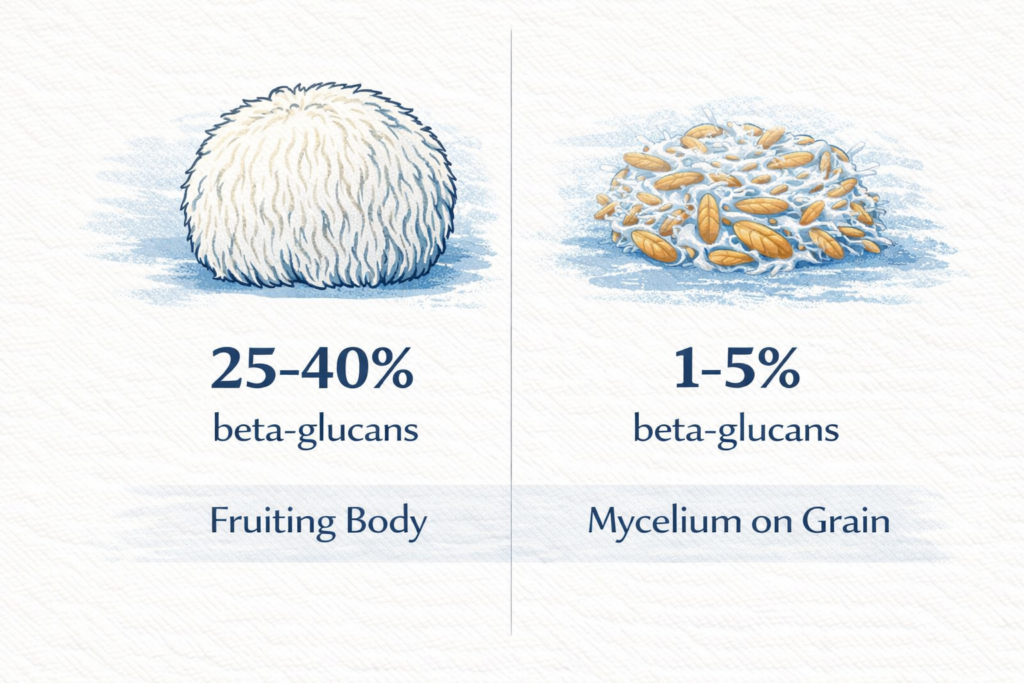
Host Defense: Their capsule products are made from mycelium grown on organic brown rice. The mycelium is not separated from the rice substrate before processing. The final product is a combination of mycelium and the grain it grew on, which Host Defense describes as “myceliated brown rice” or “myceliated biomass.” They argue that this biomass is a functional part of the formula, not a filler.
This is the core of the debate. Independent testing has consistently shown that mycelium grown on grain products contain significantly higher starch content and lower beta-glucan content than fruiting body extracts. The grain substrate dilutes the active compounds. Host Defense’s own FAQ states that they guarantee their capsules contain greater than 55 percent polysaccharides, but polysaccharides include starch, and starch from rice is a polysaccharide with no immune-modulating activity. That number does not tell you how much beta-glucan is present.
Oriveda: Fruiting body for most products, including their flagship reishi. Their cordyceps uses deep-layer cultivated mycelium grown in liquid rather than on grain, which means no grain substrate ends up in the final product. For lion’s mane, they offer both a fruiting body extract and a separate mycelium-based product, clearly labelled as different products for different purposes.
Verdict on this criterion: Real Mushrooms and Oriveda meet the fruiting body standard clearly. Host Defense does not for their capsule products.
Mycelium on Grain: The Problem With Most Mushroom Supplements
Criterion 2: Beta-glucan percentage
This is where the comparison gets most revealing.
Real Mushrooms: Lists beta-glucan content on every product’s Supplement Facts panel. Their lion’s mane guarantees greater than 25 percent beta-glucans. Their 5 Defenders blend guarantees greater than 20 percent. These are verified by third-party testing using the Megazyme method, which is the industry standard for distinguishing beta-glucans from non-active starch polysaccharides.
Host Defense: Does not list beta-glucan content on their labels. Their official position, stated publicly by Paul Stamets, is that current beta-glucan testing methods are unreliable and that listing a specific percentage would be inaccurate. They list polysaccharide content (greater than 55 percent) but as explained above, polysaccharides include grain starch, which inflates the number without contributing immune-modulating activity.
Independent analyses of Host Defense products have found beta-glucan content significantly lower than fruiting body extracts, with high alpha-glucan (starch) content consistent with the grain substrate making up a substantial portion of the product.
Oriveda: Lists beta-glucan content and goes further than most brands. Their reishi specifies both beta-glucan and individual ganoderic acids, which are the triterpene compounds specific to reishi. Their turkey tail specifies beta-glucan content at over 50 percent. All numbers are verified by third-party testing at Eurofins using the Megazyme K-YBGL method, with certificates of analysis published on their website.
Verdict on this criterion: Real Mushrooms and Oriveda both publish verified beta-glucan percentages. Host Defense does not, and their stated reason, while intellectually interesting, leaves the consumer unable to verify what they are getting.
What Are Beta-Glucans? The Compound Behind Mushroom Supplements
Beta-Glucan Transparency
What Each Brand Actually Tells You
Lists >55% polysaccharides — includes grain starch, not specific to beta-glucans
Criterion 3: Extraction method
Real Mushrooms: Uses hot water extraction for most products. For reishi specifically, they use dual extraction (hot water plus alcohol) to capture both the water-soluble beta-glucans and the alcohol-soluble triterpenes. The extraction method is stated on product pages.
Host Defense: Their capsule products are not extracts. The mycelium is grown on rice, freeze-dried, heat-treated, and milled into powder. There is no extraction step for capsules. Their liquid extracts are a different matter: Host Defense liquid extracts use double and triple extraction methods (ethanol, cold water, and hot water) on both mycelium and fruiting bodies. This is worth knowing because it means Host Defense’s liquid extracts and capsules are fundamentally different products with different compositions.
Oriveda: Uses a multi-step extraction for reishi that includes hot water extraction under pressure, alcohol extraction, and alcohol precipitation to remove low-molecular-weight compounds and increase purity. For other species they use appropriate extraction methods based on the target compounds. Their process is described in detail on their website and in their FAQ documentation.
Verdict on this criterion: All three brands use extraction for at least some products. The critical distinction is that Host Defense capsules are not extracted at all, which means the beta-glucans remain locked behind chitin cell walls that the human digestive system cannot efficiently break down. Their liquid extracts are a different story and should be evaluated separately.
What Is Dual Extraction and Why It Matters for Mushroom Supplements]
Extraction Methods
How Each Brand Processes Their Product
Extracted
Real Mushrooms
🍄 Organic fruiting body
♨️ Hot water extraction
⚗️ + Alcohol extraction
(reishi only — dual extract)
Concentrated extract powder
Beta-glucans bioavailable
Not Extracted (Capsules)
Host Defense
🌾 Mycelium on brown rice
❄️ Freeze-dried
🌡️ Heat-treated
Dried mycelium + grain powder
Chitin cell walls intact
No extraction step
Multi-Step Extraction
Oriveda
🍄 Organic fruiting body
♨️ Hot water under pressure
(16–20 kg/cm² — preserves chains)
⚗️ Alcohol extraction
(captures ganoderic acids)
🧪 Alcohol precipitation
(removes low-MW impurities)
High-purity extract powder
Beta-glucans + ganoderic acids
Spray-freeze-dried, no residue
Note: Host Defense liquid extracts use a different process (double/triple extraction with ethanol and hot water) and should be evaluated separately from their capsules.
Criterion 4: Third-party testing and certificate of analysis
Real Mushrooms: Publishes certificates of analysis for each product. Testing covers identity, beta-glucan content, heavy metals, and microbial contamination. The certificates are available on their website and are verifiable third-party documents.
Host Defense: Tests for identity, composition, purity, and strength according to their FAQ. They guarantee polysaccharide content but do not publish beta-glucan-specific testing. Certificates of analysis are not readily available on their website for public review in the way that Real Mushrooms and Oriveda provide them.
Oriveda: Publishes full certificates of analysis on their website from Eurofins, a major international testing laboratory. Testing covers beta-glucan content using the Megazyme K-YBGL method, heavy metals, microbial contamination, and for reishi specifically, ganoderic acid content using ISO 17025 accredited methods. Their documentation is the most detailed of the three brands.
Verdict on this criterion: Real Mushrooms and Oriveda both make their testing easily accessible and verifiable. Host Defense tests their products but the results are not as publicly accessible, and the testing does not include the beta-glucan specificity that would allow a consumer to compare directly.
Certificate of Analysis for Mushroom Supplements: What It Is and How to Get One
Criterion 5: Brand transparency
Real Mushrooms: States fruiting body on every label. Lists beta-glucans in the Supplement Facts panel. Publishes CoAs. Explains their extraction method. Openly discusses the mycelium on grain issue and why they do not use it. Their educational content directly addresses the industry quality problems in ways that are consistent with what independent testing shows. Transparency is a core part of their brand identity.
Host Defense: Transparent about their methodology in the sense that they do not hide the fact that they use mycelium on grain. Paul Stamets has publicly explained and defended their approach. They publish research and educational content. However, the absence of beta-glucan data on labels and the use of polysaccharide numbers that include starch creates a transparency gap that is difficult for consumers to navigate. You know what their philosophy is. You do not know how much of the specific active compounds you are getting per capsule.
Oriveda: Arguably the most transparent brand in the category. They specify individual compounds (not just categories), publish third-party CoAs from named laboratories, explain their extraction process in detail, and openly critique industry practices they consider misleading. Their educational content is extensive and technically detailed. The trade-off is that navigating their website requires more effort, and their products are priced at the top of the market.
Verdict on this criterion: All three brands are more transparent than the industry average. Oriveda leads on documentation depth, Real Mushrooms leads on accessibility, and Host Defense is transparent about their philosophy but less transparent about the measurable composition of their products.
The comparison at a glance
| Criterion | Real Mushrooms | Host Defense | Oriveda |
|---|---|---|---|
| Fruiting body | ✅ 100% fruiting body | ❌ Mycelium on grain (capsules) ✅ Fruiting body (liquid extracts) |
✅ Fruiting body (most products) |
| Beta-glucan % published | ✅ On label and CoA (>25% typical) |
❌ Not listed (>55% polysaccharides, includes starch) |
✅ On label and CoA (species-specific, Eurofins verified) |
| Extraction method | ✅ Hot water Dual for reishi |
❌ No extraction (capsules) ✅ Double/triple extraction (liquids) |
✅ Multi-step extraction (hot water + alcohol + precipitation) |
| Third-party CoA | ✅ Published on website | ⚠️ Tests internally CoAs not publicly accessible |
✅ Eurofins CoAs published ISO 17025 accredited |
| Overall transparency | ✅ High Clear, accessible |
⚠️ Transparent about philosophy Less transparent about composition |
✅ Highest in category Compound-specific documentation |
| Price range | $$ Mid-range | $$ Mid-range | $$$ Premium |
The case for Host Defense that most critics ignore
It would be easy to read this comparison and conclude that Host Defense is simply a worse product. That is not quite right, and it is worth explaining why.
Paul Stamets is not a supplement marketer who stumbled into mushrooms. He is a mycologist with decades of fieldwork, published research, and a body of knowledge about fungal biology that very few people in the world can match. His contributions to mycology extend far beyond supplements.
Paul Stamets’ work on mycoremediation, habitat restoration, and fungal applications in environmental science has been genuinely pioneering, and his role in bringing public attention to the importance of fungi as a kingdom is difficult to overstate.
His argument for mycelium-based products is not that fruiting bodies are bad. It is that the mycelium contains compounds, including extracellular metabolites produced during the growth phase, that are not present in the fruiting body and that contribute to immune modulation through different pathways.
That argument has scientific merit. Mycelium does produce bioactive compounds. The question is whether those compounds are present in meaningful concentrations in a product that is also 30 to 40 percent rice starch, and whether they can match the therapeutic impact of a concentrated fruiting body extract with verified beta-glucan content.
Host Defense’s liquid extracts, which do use fruiting bodies and proper extraction methods, are a materially different product from their capsules. If you are drawn to the Host Defense brand and Paul Stamets’ research, the liquid extracts are worth evaluating separately.
The honest answer is that the mycelium versus fruiting body debate is not fully settled in the scientific literature. What is settled is the beta-glucan content question: fruiting body extracts consistently test dramatically higher than mycelium on grain products for the specific compounds that the clinical research is based on.
Who each brand is best for
Real Mushrooms is the best fit for most people. The products are straightforward, the quality markers are published and verified, the pricing is reasonable for the category, and you can evaluate exactly what you are getting against the framework in this guide without needing to do additional research. If you want a quality mushroom supplement and do not want to spend hours comparing brands, this is where to start.
Host Defense is worth considering if you are specifically interested in the mycelium-inclusive approach and understand what that means for beta-glucan content. Their liquid extracts are a better option than their capsules if measurable potency matters to you. The brand also has the most retail availability of the three, which makes it the easiest to find in physical stores.
Oriveda is for people who want the most rigorously documented product available and are willing to pay a premium for it. Their reishi in particular is probably the most thoroughly specified reishi product on the market, with ganoderic acid content verified by ISO 17025 accredited testing. If you are taking reishi specifically for cortisol, stress, or sleep and want to know exactly what you are getting, Oriveda is the strongest option.
What Is the Best Mushroom for Lowering Cortisol?
Real Mushrooms
Best for: Most people
✅ 100% fruiting body, no grain
✅ Beta-glucan % on every label
✅ Third-party CoAs published
✅ Mid-range pricing
Host Defense
Best for: Mycelium-inclusive approach
⚠️ Mycelium on grain (capsules)
✅ Liquid extracts use fruiting body
⚠️ No beta-glucan data published
✅ Widest retail availability
Oriveda
Best for: Maximum documentation
✅ Multi-step extraction
✅ Ganoderic acids specified (reishi)
✅ Eurofins CoAs, ISO 17025
⚠️ Premium pricing
Frequently asked questions
No. Host Defense is a legitimate company founded by one of the most respected mycologists in the world. The criticism centers on their capsule products containing mycelium grown on grain, which results in lower beta-glucan content and higher starch content compared to fruiting body extracts. Their liquid extracts use a different process and are worth evaluating separately. Whether Host Defense is right for you depends on whether you prioritize the mycelium-inclusive philosophy or measurable beta-glucan concentration.
For most people, yes. Their products meet every criterion in the evaluation framework: fruiting body, published beta-glucan percentages, third-party CoAs, stated extraction methods, and clear labelling. The pricing is mid-range for the quality level. You are paying for verified potency, not marketing.
Their extraction process is more complex than most brands (multi-step extraction with alcohol precipitation for reishi), their testing is more granular (specifying individual ganoderic acids rather than just total triterpenes), and they use ISO 17025 accredited laboratories. That level of documentation and production quality has a cost. Whether it is worth it depends on how important precision is to your goals.
Almost certainly not. The cheapest products in this category are overwhelmingly mycelium on grain with minimal beta-glucan content, no extraction, and no third-party verification. The price difference between a quality product and a cheap one reflects real differences in what is inside the capsule. This is covered in detail in the evaluation guide linked at the top of this post.
Real Mushrooms is the strongest option for a straightforward lion’s mane fruiting body extract with verified beta-glucan content. Oriveda offers both a fruiting body extract (for general health and beta-glucan content) and a separate mycelium extract (for nootropic effects via erinacines), which is an interesting approach if you understand the distinction. Host Defense lion’s mane is mycelium on grain with the same limitations described above.
How this comparison was put together
This comparison applies the evaluation framework from Mushroom Supplements: What Works, What’s Misleading, and How to Buy Safely to three specific brands. The information about each brand was gathered from their official websites, product labels, published FAQ pages, and publicly available certificates of analysis.
This site has no commercial relationship with any of the three brands discussed in this post. No brand paid for inclusion or was given editorial review before publication.
This post is for informational purposes only and does not constitute medical advice.
References
- Mori K, Inatomi S, Ouchi K, Azumi Y, Tuchida T. Improving effects of the mushroom Yamabushitake (Hericium erinaceus) on mild cognitive impairment: a double-blind placebo-controlled clinical trial. Phytotherapy Research. 2009;23(3):367-372. doi: 10.1002/ptr.2634. — The lion’s mane cognitive trial referenced in the evaluation framework used a fruiting body-based product, not mycelium on grain.
- Chilton J. Redefining Medicinal Mushrooms. Nammex. — Industry analysis demonstrating that mycelium on grain products contain 30-40% starch and 5-7% beta-glucans, compared to 30-40% beta-glucans in fruiting body extracts.
- Host Defense. Beta-Glucan Analysis and the Seven Pillars of Immunity. hostdefense.com/blogs/host-defense-blog/understanding-beta-glucans — Host Defense’s published position explaining why they do not list beta-glucan content.
- Real Mushrooms. Beta-Glucan Mushroom Benefits. realmushrooms.com/blogs/rm/beta-d-glucan — Real Mushrooms’ published data on beta-glucan content and testing methodology.
- Oriveda. Lab Test Reports. oriveda.com/coa.php — Published certificates of analysis from Eurofins for all Oriveda products.
- Oriveda. Reishi — The Quest for Quality Report. oriveda.wordpress.com/reishi-the-quest-for-quality-report/ — Detailed documentation of Oriveda’s multi-step reishi extraction process.
Related reading
- Mushroom Supplements: What Works, What’s Misleading, and How to Buy Safely
- What Are Beta-Glucans? The Compound Behind Mushroom Supplements
- Certificate of Analysis for Mushroom Supplements
- Mycelium on Grain Explained for Supplement Users
- Mushroom Dual Extraction: Why It Matters
- How to Read a Mushroom Supplement Label: Spot Red Flags Fast
- What Is the Best Mushroom for Lowering Cortisol?