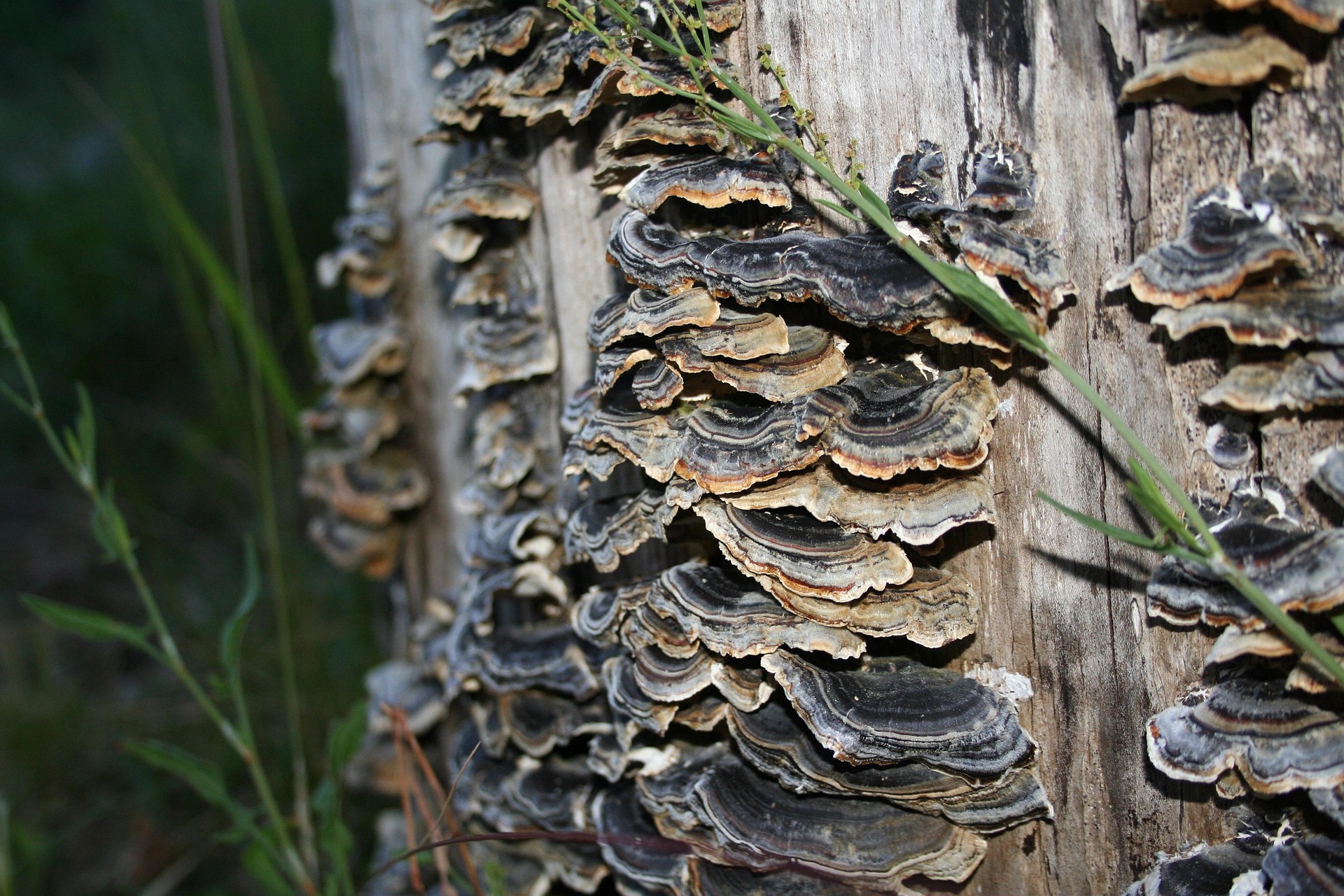
Turkey tail is probably the most clinically researched medicinal mushroom in existence. It does not get the same attention as lion’s mane or cordyceps but in terms of actual scientific evidence, it stands apart from almost everything else in this category.
Its key compounds, PSK and PSP, are approved pharmaceutical adjuncts in cancer treatment in Japan and China. That is not a marketing claim. It is a regulatory fact based on decades of clinical trials.
Here is what turkey tail does, what the research actually shows, and what to look for when buying it.
What turkey tail is
Turkey tail (Trametes versicolor) is a polypore mushroom, meaning it has pores on its underside rather than gills. It grows on dead and dying hardwood trees and is one of the most common wild mushrooms you can find in North America, Europe, and Asia. The concentric rings of brown, tan, rust, and cream do genuinely look like a turkey’s fanned tail.
Its active compounds are two polysaccharopeptides: Polysaccharide-K (PSK, also called krestin) and Polysaccharide Peptide (PSP). Both are extensively studied immune modulators. Turkey tail also contains phenolic antioxidants, flavonoids, and beta-glucans that contribute to its broader effects.

What the research shows
Immune support
PSK and PSP are among the most well-studied natural immune modulators ever identified. They activate natural killer cells, T-cells, macrophages, and dendritic cells, which are the main components of the adaptive and innate immune response.
A clinical study published in Global Advances in Health and Medicine, funded in part by the National Institutes of Health, found that breast cancer patients consuming turkey tail extract showed dose-dependent increases in natural killer cell activity and CD8+ T-cell counts. Those are direct, measurable improvements in immune function, not just marker shifts.
For everyday immune support, turkey tail’s beta-glucans train the immune system to respond appropriately to threats without tipping into chronic overactivation. It is less about stimulating the immune system and more about calibrating it, which is a meaningful distinction for anyone with inflammatory or autoimmune tendencies.
Gut health and the microbiome
Turkey tail functions as a prebiotic. Its polysaccharides selectively feed beneficial gut bacteria including Lactobacillus and Bifidobacterium while inhibiting less desirable strains like Clostridium and Staphylococcus.
A human clinical trial published in Gut Microbes found that PSP from turkey tail significantly altered gut microbiome composition in healthy adults within eight weeks, specifically increasing populations of Bifidobacterium and Lactobacillus. A healthy gut microbiome is foundational to immune function, mental health, and metabolic health. Given that around 70 percent of immune function is gut-associated, the combination of direct immune modulation and prebiotic activity makes turkey tail unusually well-positioned.
For anyone recovering from antibiotic use, dealing with digestive imbalance, or just trying to maintain a healthy gut ecosystem, this is probably the most overlooked benefit in the medicinal mushroom space.
Antioxidant activity
A 2017 analysis in the Journal of Applied Microbiology identified over 35 distinct phenolic compounds in turkey tail extract with documented anti-inflammatory and immune-enhancing properties. Among them is quercetin, one of the most studied natural antioxidants, associated with reduced inflammation and improved cardiovascular health.
The breadth of antioxidant compounds in turkey tail means it addresses oxidative stress through multiple pathways simultaneously, rather than a single targeted mechanism.
The cancer research
PSK has been approved as an adjunct cancer therapy in Japan since the 1980s. Multiple clinical trials have demonstrated improved survival rates and immune function in patients with gastric, colorectal, and breast cancers when PSK was used alongside conventional treatment.
Turkey tail does not treat cancer and should not be framed that way. But the volume and quality of evidence supporting its role as a complementary immune-supportive therapy is unlike any other mushroom. Integrative oncology programmes around the world are paying attention to it for that reason. If you or someone close to you is dealing with cancer and wants to explore this area, the conversation is worth having with an oncologist.
How to take it
Timing is less critical with turkey tail than with cordyceps or reishi. Take it whenever fits your routine.
- Tea: simmer dried turkey tail pieces in water for 20 to 40 minutes. It is earthy and mild, considerably more drinkable than reishi. Ginger and honey work well with it.
- Powder: add to smoothies, soups, or coffee. Look for hot-water extracted powder that preserves the PSK and PSP content.
- Capsules: the most straightforward option for consistent daily use. Aim for 1,000 to 3,000mg of a fruiting body extract. Make sure it specifies fruiting body, not mycelium on grain.
- Foraged and dried: turkey tail is one of the easier medicinal mushrooms to correctly identify and forage. It is extremely common on dead hardwood logs, fruits year-round in many climates, and has few dangerous lookalikes. The main one to be aware of is false turkey tail (Stereum ostrea), which lacks the pores on the underside. Flip it over to check.
Frequently asked questions
Can you eat turkey tail?
Technically yes but it is tough, leathery, and woody with no real culinary appeal. It is a medicinal mushroom consumed as a tea, extract, or powder rather than as food. Simmering it in broths is a practical way to get the benefit while adding depth to soups.
How quickly does it work?
For immune modulation and gut microbiome changes, most research shows meaningful effects within four to eight weeks of consistent daily use. Turkey tail works cumulatively rather than acutely. It is building a stronger foundation over time rather than producing an immediate effect.
Is it safe for everyone?
Turkey tail has a strong safety profile and has been consumed safely in traditional medicine for centuries and used in clinical settings for decades. People with mushroom allergies, autoimmune conditions, or who are immunocompromised should check with their healthcare provider before using it. Its immune-modulating properties may not be appropriate in all situations.
Can you forage it yourself?
Yes, and it is a reasonable starting point for beginner foragers. It is common, distinctive, and has few dangerous lookalikes. The main confusion point is false turkey tail, which looks similar from the top but lacks the tiny pores on the underside. The pore check is reliable. If there are pores, it is real turkey tail.
Does turkey tail need dual extraction?
PSK and PSP are polysaccharides and therefore water-soluble. A high-quality hot water extraction from fruiting body is appropriate and consistent with the clinical research. Dual extraction is less critical for turkey tail than it is for reishi. The more important factors are fruiting body versus mycelium, and third-party testing showing actual PSK content.
Is turkey tail worth taking
For immune support specifically, it is probably the most evidence-backed natural option available. The clinical research is deeper than anything else in the medicinal mushroom category. The gut health benefits are a meaningful bonus that most people do not know about when they start taking it.
It does not have an immediate or noticeable effect in the way cordyceps might. The benefits build over weeks and are cumulative rather than acute. That makes it harder to attribute subjectively but the research behind it is more robust precisely because it has been studied in longer clinical trials than most supplements ever are.
If you are building a medicinal mushroom routine and immune health is a priority, turkey tail is the logical anchor. For a comparison with other mushrooms and which specific products are worth buying, the ranked list covers that.