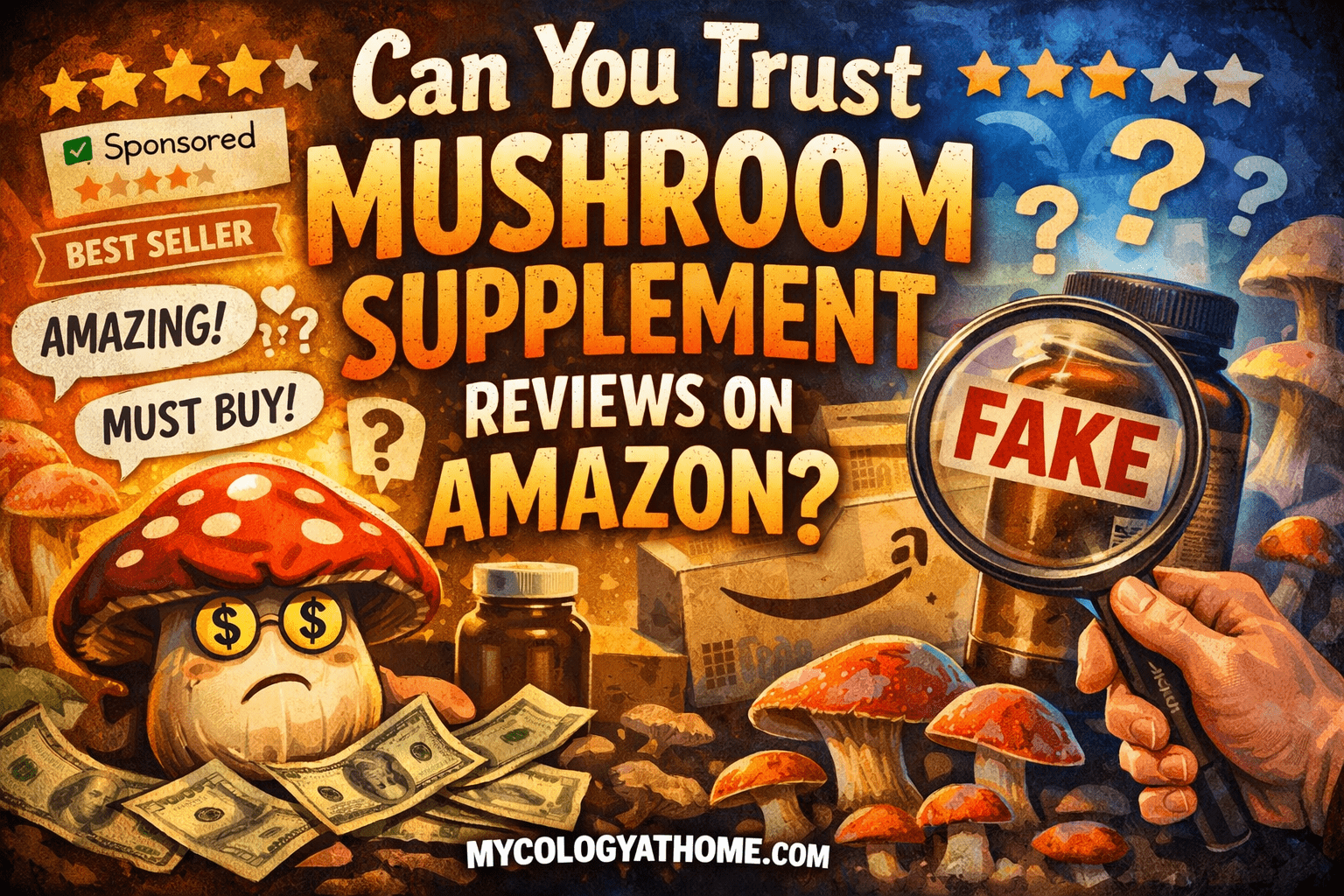
Can You Trust Mushroom Supplement Reviews on Amazon?
A product with 4.8 stars and 30,000 reviews looks safe. It feels validated. You would be making a reasonable decision to buy it.
Except you would not. Not with supplements.
Amazon reviews work well for books, electronics, and kitchen gadgets. For mushroom supplements, the review model breaks down in ways that are worth understanding before you spend money based on star ratings.
This is not a knock on Amazon. It is a structural problem with how reviews interact with a product category where quality is invisible to the consumer.
Why the review system fails for supplements
🎁 Incentivized Reviews ▼
🤖 Fake & Coordinated Reviews ▼
⏰ Review Timing Mismatch ▼
🗑️ Filtering & Suppression ▼
Why mushroom supplements are particularly affected
Most consumer products can be evaluated quickly. Does the jacket fit. Does the blender work.
Supplements are different.
The effects of medicinal mushrooms are gradual, cumulative, and subjective. A customer taking lion’s mane for focus will have a hard time attributing any change to the supplement versus sleep, diet, caffeine, or placebo [1]. That subjectivity makes honest reviewing genuinely difficult, even for someone trying to be accurate.
More importantly: no reviewer without lab equipment can tell you whether their 1000mg lion’s mane capsule contained 30% beta-glucans from a fruiting body extract or 2% from grain-diluted mycelium powder [2]. Those products feel identical going down. The difference only shows up in whether anything actually happens over weeks, and even then attribution is difficult.
A product can receive consistently positive reviews while delivering essentially no active compounds. Customers who feel generally well and attribute it to their supplement are not lying. They just cannot verify what is inside the capsule.
What reviews can vs cannot tell you
The review timeline problem
written here
real effects
changes [1][3]
result window [3]
Most genuine mushroom supplement benefits take two to eight weeks of consistent use to become noticeable [1][3]. The Mori 2009 lion’s mane trial measured results at weeks 8, 12, and 16 [3]. Many Amazon reviews are written within days of receiving the product.
Those reviews can tell you about the packaging, the capsule size, and whether it arrived intact. They cannot tell you whether it works. And they are weighted equally in the star rating alongside reviews from long-term users.
What to use instead of star ratings
The information that actually matters is not on the review page.
A quick decision framework
The fake review problem is real, but it is not the main problem
Review manipulation in the supplement category is well-documented [4][5]. Incentivized reviews, coordinated purchase-and-review schemes, and selective removal of negative reviews all exist at scale.
But here is the thing most articles about Amazon reviews miss: the bigger problem is not fake reviews. It is genuine reviews from people who cannot verify what was in the product.
A real customer who took a mycelium-on-grain supplement for two weeks, felt “a little more energy” (which may be placebo, caffeine, or better sleep that week), and left a five-star review is not being dishonest. They are just answering a question that has nothing to do with whether the product contains meaningful active compounds.
The review system asks “did you like this product?” It does not ask “did this product contain what the label claimed?” Those are different questions. Only the second one matters for supplements.
Five criteria. Every product. Every time. The star rating becomes the least interesting thing on the page.
Frequently asked questions
Sometimes. Clusters posted within a short window, generic language, no usage detail, and thin reviewer profiles are signals. Tools like Fakespot and ReviewMeta analyze authenticity [5]. But for supplements, genuine-but-uninformed reviews are a bigger problem than outright fakes.
Yes. Some quality brands sell through Amazon. The star rating is not how you find them. The label, the CoA, and the brand’s transparency are how you find them. Amazon is the storefront. The vetting is yours.
No. Review count correlates with sales volume and marketing budget, not product quality. Some of the most widely reviewed supplements have been independently tested and found to contain a fraction of the compounds on the label [2].
Not necessarily. But use Amazon as a purchasing platform, not a quality evaluation tool. Evaluate the product using the five-step framework before looking at the reviews. If it passes the framework, buy it wherever is most convenient.
Check whether the brand publishes a certificate of analysis from a third-party lab. If they do, verify that beta-glucan content matches the label. If they do not, the star rating is the only data point you have, and it is not a useful one.
References
[1] Hrobjartsson A, Gotzsche PC. Is the placebo powerless? An analysis of clinical trials comparing placebo with no treatment. New England Journal of Medicine. 2001;344(21):1594-1602. PubMed: 11372012
[2] McCleary BV, Draga A. Measurement of beta-glucan in mushrooms and mycelial products. Journal of AOAC International. 2016;99(2):364-373. DOI: 10.5740/jaoacint.15-0289
[3] Mori K, Inatomi S, Ouchi K, Azumi Y, Tuchida T. Improving effects of the mushroom Yamabushitake (Hericium erinaceus) on mild cognitive impairment. Phytotherapy Research. 2009;23(3):367-372. PubMed: 18844328
[4] He S, Hollenbeck B, Proserpio D. The Market for Fake Reviews. Marketing Science. 2022;41(6):1174-1194. DOI: 10.1287/mksc.2022.1353
[5] Fakespot. Analysis methodology for detecting inauthentic reviews across e-commerce platforms. fakespot.com
[6] U.S. Federal Trade Commission. FTC enforcement against fake reviews. Multiple enforcement actions against incentivized and fabricated review schemes. ftc.gov