Mushrooms and Celiac Disease: Are They Safe?
I have celiac disease. I also grow mushrooms at home and have taken mushroom supplements.
Celiac Risk Assessor
Select your scenario below to see the specific risk pathway and my personal safety protocol.
When I first started growing, I was not diagnosed with celiac disease. I did not think twice about grabbing a bag of rye berries for grain spawn. It is the default grain in mushroom cultivation. Every guide uses it. Every supplier stocks it.
Then it hit me. I was standing at my kitchen counter, hands covered in simmered rye, loading jars that would sit in my kitchen for weeks. Rye. In my kitchen. The place where I eat.
I went looking for answers. I checked Google. I checked Reddit. I checked the celiac forums. What I found was a mess. Contradictory opinions. Almost no scientific sources. A lot of “I think it should be fine” and an equal amount of “I got sick from mushrooms and I don’t know why.”
Nobody had written a thorough, referenced answer. So I did.
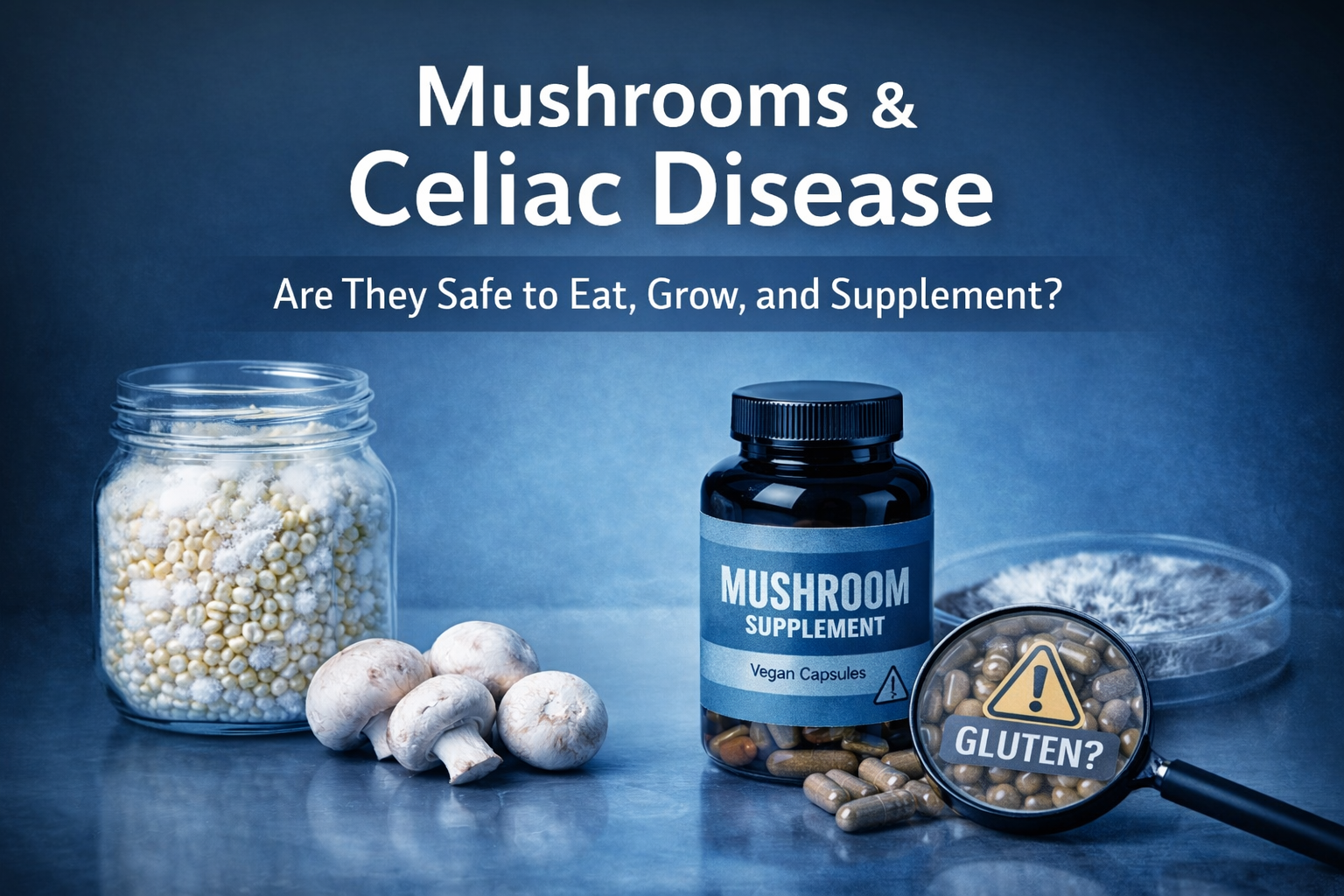
This post covers everything. Whether store-bought mushrooms are safe for people with celiac. Whether growing mushrooms on gluten-containing grains puts you at risk. Whether mushroom supplements contain gluten. And what to do about all of it, practically, if you have celiac disease and want mushrooms in your life.
Table of contents
- Before we get into it
- The short version (for people who want the answer first)
- How fungi actually eat (and why this matters for gluten)
- The enzyme research (what it does and does not tell us)
- Where risk actually enters the system
- Why some people with celiac react to mushrooms
- What regulation does and does not tell us
- The decision framework: what I actually do and how I think about risk
- Gluten-free alternatives for celiac growers
- The evidence picture: what we know, what we interpret, and what is missing
- So what should I actually do?
- Frequently asked questions
- References
- Related reading
Before we get into it
I want to be upfront about what this article is and what it is not.
This is my interpretation of the available evidence as someone with celiac disease who grows mushrooms, eats them, and supplements with them. I found useful biology, patient guidance from celiac organizations, relevant FDA rules, FODMAP research, and a small amount of direct testing. I also found anecdotal reports from forums and communities that pointed in interesting directions.
What I did not find is the kind of direct, large-scale testing I would ideally want. Nobody has published comprehensive ELISA testing of gluten levels in edible mushroom fruiting bodies across multiple species, substrate types, and growing conditions. That study does not exist as far as I can tell.
So what I have done here is taken the best evidence available, organized it honestly, and drawn a conclusion. That conclusion could change if better data comes along. But it is the most informed conclusion I know how to make right now.
I am not a doctor. I am not a food scientist. I am a celiac patient who wanted a real answer and did not find one, so I built one from the research that exists.
The short version (for people who want the answer first)
After going through all of this, I do not think mushrooms themselves are the problem. I think the real variables are handling, processing, and supplements.
The biology of how fungi digest their substrate makes it unlikely that intact gluten proteins end up in the mushroom you eat. The limited direct testing that exists supports this. The National Celiac Association supports this. But “unlikely” is not “impossible,” and the direct data is thinner than I would like.
The real risks, in my assessment, come from the environment around the mushroom. Grain dust in your kitchen if you grow with rye. Surface contamination from handling at a farm. And mycelium-on-grain supplements where you are literally eating the grain.
That is the summary. But “probably low risk” is not the same as “definitely safe,” and if you have celiac, that gap matters. Here is how I closed it for myself.
How fungi actually eat (and why this matters for gluten)
This is the part most articles skip. It is also the part that gives us the strongest biological reason to think mushroom fruiting bodies are low risk.
Fungi do not eat the way animals do. They do not ingest food. They do not have a digestive tract.
Instead, fungi digest externally.
Mycelium, the root-like network of the fungus, secretes enzymes out into the substrate ahead of its growing tips. Those enzymes break down complex molecules in the surrounding material, including cellulose, lignin, starches, and proteins, into simpler compounds. Sugars. Amino acids. Small molecules the fungus can absorb across its cell walls.
This is called extracellular digestion. It means that substrate proteins, including gluten, are broken down outside the organism before anything gets absorbed.
The fruiting body (the mushroom you eat) is then built by the fungus from those absorbed simple compounds. It is synthesized tissue, assembled from building blocks the mycelium already processed. It is not built from undigested substrate that got transported upward.
Think of it this way. A tree absorbs water and minerals from soil. You do not find soil in an apple. The apple is built by the tree from what the tree absorbed and processed. The same principle applies to fungi.
resistant to human digestion
attack
proline bonds [1][2]
fragment
and amino acids
by hyphae
cell walls
as tissue
no intact gluten
The enzyme research (what it does and does not tell us)
There is peer-reviewed research showing that fungal species produce enzymes capable of degrading gluten proteins. This is real science, published in real journals. But it needs framing.
A study on Fusarium graminearum identified at least seven serine endopeptidases that degrade gluten proteins[1]. Separate research on Aspergillus niger demonstrated that a fungal enzyme called AN-PEP reduced gliadin content in wheat flour by 90 to 95 percent[2]. A randomized clinical trial published in Scientific Reports confirmed AN-PEP effectively degrades gluten in a complex meal setting in human subjects[3].
This matters. It tells us that gluten degradation by fungi is not theoretical. It is documented, measurable, and significant.
But here is what it does not tell us.
These studies were conducted on specific fungal species (Fusarium, Aspergillus) that are not the species most people grow at home or buy at the store (Pleurotus, Hericium, Lentinula, Agaricus). The principle of extracellular digestion applies broadly across fungi, but the specific degree of gluten degradation in a home-grown oyster mushroom block has not been directly measured and published.
The enzyme research supports biological plausibility. It makes the case that gluten transfer to the fruiting body is unlikely. It does not make the case that it is impossible, and it does not substitute for direct testing on the species and substrates we actually use.
I want to be clear about this distinction because a lot of articles (and a lot of forum posts) treat “fungi can degrade gluten” as proof that mushrooms are safe. That is a jump. A reasonable jump, but a jump.
Where risk actually enters the system
Not all risks are equal. When I mapped out the full chain from biology to your plate, the risk profile looks like a ladder. The organism itself is at the bottom (lowest risk). The things humans do to it are at the top (highest variability).
Tier 1: Mushroom biology. Mushrooms are fungi. They are not grains. They do not produce gluten proteins. As organisms, they are naturally gluten-free. This is the one part of this question that is not ambiguous.
Tier 2: Substrate digestion. Fungal enzymes break down substrate proteins externally before absorption. Published research demonstrates this across multiple fungal species[1][2][3]. Gluten degradation during colonization is biologically plausible and consistent with how all fungi process their food source.
Tier 3: Fruiting body formation. The fruiting body is synthesized from absorbed nutrients, not assembled from undigested substrate. There is no well-established mechanism by which intact gluten proteins would pass through the mycelial network into the fruiting body. Jim Angelucci of Phillips Mushroom Farm has confirmed publicly that the spawn carrier does not come into contact with the actual fruiting body[9]. Limited testing (GlutenTox Home Kits) on commercially grown mushrooms found them below detectable gluten levels[8].
Tier 4: Harvest, handling, and environment. This is where risk starts to become real and practical. Grain dust in your workspace if you grow with rye or wheat. Surface contamination from handling at commercial farms. Dust settling on mushrooms during harvest and packing. An anecdotal report (forum, not peer-reviewed) described reactions from mushrooms fruited directly on rye berries with grain particles physically stuck to the base[12]. When the same grower used a gluten-free bulk substrate instead, no reactions were reported.
The risk is the environment.
Tier 5: Supplements. Highest variability. Mycelium-on-grain products literally contain the grain substrate. Labeling does not always specify whether the grain is certified gluten-free. Manufacturing cross-contact is possible. The regulatory framework (more on this below) does not require pre-market testing.
The pattern is clear. The further you get from the biology and the closer you get to human handling and processing, the more the risk increases.
The risk is not the mushroom, the risk is the environment.
Why some people with celiac react to mushrooms
This is a real thing. People on the celiac forums report it. I have seen it discussed on Reddit, Facebook groups, and in comments on gluten-free blogs. Some celiacs eat mushrooms and feel like they have been glutened.
I want to be clear about the evidence hierarchy here. Individual forum reports and at-home test results are anecdotal. They are worth taking seriously as signals, but they are not controlled scientific data. With that framing, here are the most discussed explanations.
FODMAP sensitivity
This one gets overlooked, and it may explain what a significant number of people with celiac experience when they eat mushrooms.
Mushrooms are high in FODMAPs. Specifically, they contain mannitol, a polyol that many people with IBS and damaged intestinal lining struggle to absorb. Monash University, the leading FODMAP research institution, classifies most mushroom varieties as high-FODMAP[10].
Celiacs frequently develop concurrent FODMAP sensitivity because of intestinal damage from the disease itself. The symptoms of FODMAP intolerance, including bloating, gas, abdominal pain, and diarrhea, overlap significantly with the symptoms of a gluten exposure.
It is easy to eat mushrooms, feel terrible, and conclude you were glutened. The cause might not be gluten at all.
I cannot say this is the most common explanation because that has not been formally studied. But given how high mushrooms are in mannitol and how common FODMAP sensitivity is among celiacs, it is a strong possibility worth investigating. A low-FODMAP trial under guidance from a dietitian who understands celiac could help clarify what is happening.
Surface contamination from handling
Store-bought mushrooms are handled in facilities that may also process gluten-containing materials. Button mushrooms grow on composted substrate that often contains wheat straw. Dust from the operation could settle on mushroom surfaces during harvesting and packing.
Jennifer Fugo, a certified integrative nutritionist, tested mushrooms from Phillips Mushroom Farm (which uses gluten-containing substrates) using GlutenTox Home Kits. The mushrooms tested negative for gluten[8]. The Mushroom Council also affirmed that mushrooms are gluten-free[11].
On the other hand, at least one celiac patient reported on a forum getting a positive result using a Nima tester on store-bought mushrooms. This is an anecdotal report, not a controlled test, but it is worth noting.
Physical grain contact (home growers)
An experienced grower on the Shroomery forums described (anecdotally) that people who ate mushrooms harvested directly from colonized rye berries got sick[12]. Grain particles were physically stuck to the base of the mushrooms.
When the same grower spawned the rye to a gluten-free bulk substrate and fruited from that, no reactions were reported.
If accurate, this points to physical contamination, not biological transfer. It also highlights why using a bulk substrate step matters for celiac growers rather than fruiting straight from grain.
Individual sensitivity below the regulatory threshold
The FDA defines gluten-free as less than 20 parts per million[13]. Some celiacs report reacting at levels below that threshold. The research on sub-threshold sensitivity is still developing, and the lower limits vary between individuals.
Even if a mushroom tests below 20 ppm, it might not be below your personal reaction threshold. This applies to any food with any level of gluten cross-contact, not just mushrooms.
What regulation does and does not tell us
This section matters more than most people realize.
The FDA’s gluten-free labeling rule (21 CFR 101.91) defines gluten-free as less than 20 ppm[13]. But there are several things this rule does not do that are relevant here.
Gluten-free labeling is voluntary. A food can be free of gluten and not carry the label. Mushrooms are sold without a gluten-free claim, which tells you nothing about whether they contain gluten or not. Absence of a label is not evidence of risk.
The FDA does not require gluten testing before a food goes to market. Companies self-certify. There is no pre-market approval process that verifies gluten levels.
For supplements specifically, the situation is even looser. Supplements are regulated under DSHEA (1994), which does not require FDA pre-approval before sale. GMP (Good Manufacturing Practice) compliance is required, but GMP is about manufacturing consistency, not gluten testing. A supplement can be GMP-certified and still contain gluten. These are different things.
That assumption is stronger than the reality.
Third-party certifications like GFCO (Gluten-Free Certification Organization) do involve actual testing. But they are optional, and most mushroom supplement brands do not carry them.
The bottom line: the regulatory framework does not give you a definitive answer on mushrooms and gluten. It was not designed to. If you want certainty, you need to look at the biology, the limited direct testing, and the organizational guidance, not the labeling rules.
I cover the broader supplement regulatory landscape in my FDA and mushroom supplements post.
The decision framework: what I actually do and how I think about risk
This is the section I consider most important. Everything above is evidence. This is where the evidence becomes practical.
I break the question into three scenarios because the risk profile is different for each one.
Scenario 1: Growing mushrooms at home
What the science suggests. Fungal extracellular digestion breaks down substrate proteins before absorption. The fruiting body is synthesized tissue. Based on current evidence, intact gluten transfer from substrate to fruiting body appears biologically unlikely. The National Celiac Association states that mushroom growing substrates do not make the fruiting bodies contain gluten[7].
Where uncertainty exists. No one has directly measured gluten levels in fruiting bodies across species and substrate types with quantitative methods like ELISA. The biological reasoning is strong, but the direct data is limited.
Where the real risk comes from. Your workspace. If you use rye or wheat for grain spawn, you are handling a gluten-containing ingredient in your kitchen. Soaking it, simmering it, draining it, loading jars. Grain dust lands on counters, towels, and nearby surfaces. This is the same cross-contamination risk you manage with any gluten-containing ingredient.
What I personally do. I use popcorn for all grain spawn. I use hardwood sawdust and rice bran for substrates. No rye, no wheat, no wheat bran anywhere in my process. I do all mushroom work on a dedicated surface away from food prep.
I do not avoid rye because I think it contaminates the mushroom, I avoid it because I do not want gluten in my kitchen at all.
The takeaway. The mushroom is probably fine. Your workspace might not be. Use gluten-free grain and the entire question disappears.
Scenario 2: Store-bought mushrooms
What the science suggests. Commercially grown mushrooms fruit on substrates physically separated from grain spawn (peat casing for button mushrooms, bag surfaces for oysters and lion’s mane). The limited testing available found them below detectable gluten levels[8]. The Mushroom Council and the National Celiac Association consider them safe[7][11].
Where uncertainty exists. Testing has been small-scale and conducted with home-use kits, not quantitative ELISA. Different farms use different substrates and handling practices. At least one anecdotal report of a positive Nima test on store-bought mushrooms exists, though this has not been replicated in controlled conditions.
Where the real risk comes from. Handling and environment. Dust from gluten-containing substrates in the growing facility could settle on mushroom surfaces during harvest and packing. This is trace-level and likely below detection thresholds, but it is a theoretical pathway.
Also worth considering: symptoms after eating mushrooms may be FODMAP-related rather than gluten-related. Mushrooms are classified as high-FODMAP by Monash University[10], and the symptom overlap with a gluten reaction is significant.
What I personally do. I eat store-bought mushrooms. I wash them. I have never had a reaction I could attribute to mushrooms specifically. But I react at the moderate end of the celiac sensitivity spectrum.
I eat store-bought mushrooms, but I understand why someone who is highly sensitive might choose to control the source more tightly. Growing your own with a fully gluten-free process is one way to do that.
The takeaway. Low risk based on available evidence. But low risk is not the same as zero risk. If you react to mushrooms, investigate FODMAPs before concluding it is gluten.
Scenario 3: Mushroom supplements
If there is anywhere in this entire topic where I would genuinely be cautious, it is supplements.
What the science suggests. Fruiting body extract supplements should not contain grain material because the fruiting body is harvested, dried, and extracted separately from the substrate. Mycelium-on-grain supplements, by contrast, literally contain the grain the mycelium was grown on. You are eating the grain.
Where uncertainty exists. “Should not contain grain” is different from “verified to not contain gluten.” Manufacturing cross-contact is always possible. Most mushroom supplement brands do not carry third-party gluten-free certification. Labels say “myceliated brown rice” or “myceliated oats” without specifying whether the grain source is certified gluten-free. And oats, while naturally gluten-free, are commonly cross-contaminated with wheat, barley, or rye during processing unless certified[14].
Where the real risk comes from. The supplement regulatory framework. The FDA does not pre-approve supplements. GMP compliance does not mean gluten testing. Companies self-police. If a mycelium-on-grain product uses oats that were processed in a facility that also handles wheat, there is a plausible pathway for gluten contamination, and nobody is required to test for it before selling to you.
What I personally do. I take fruiting body extract supplements only. No mycelium-on-grain products. This is both a quality decision (beta-glucan content, which I cover extensively elsewhere on this site) and a celiac decision.
If I were going to use a mycelium-on-grain product, I would contact the manufacturer and ask two specific questions: what grain substrate do you use, and is it certified gluten-free? If they cannot answer clearly, I would not take the product.
The takeaway. Fruiting body supplements are lower risk. Mycelium-on-grain supplements carry real uncertainty. Verify before you trust.
Gluten-free alternatives for celiac growers
If you decide to grow, switching to gluten-free inputs is simple and costs nothing in performance.
Grain spawn. Popcorn kernels, millet, or sorghum. All colonize well. All are cheap and widely available. My Instant Pot grain spawn guide uses popcorn for this reason. There is no performance penalty compared to rye.
Substrates. Hardwood sawdust is gluten-free and works for lion’s mane, shiitake, and reishi. Soy hulls are gluten-free and used in Master’s Mix for commercial-quality results. Coffee grounds are gluten-free. For oyster mushrooms, straw works (wheat straw is the stem, not the grain, and contains very little gluten protein, though handling produces dust). Hardwood sawdust also works for oysters with slightly lower yields.
Bran supplementation. Replace wheat bran with rice bran, millet, nutritional yeast, or soybean meal. All function as nitrogen supplements without introducing gluten.
Workspace. Keep mushroom work spatially separated from food prep. This is good practice regardless of which grain you use. Clean surfaces after handling any substrate or spawn material.
The evidence picture: what we know, what we interpret, and what is missing
I have organized the evidence in this article into three tiers because a lot of the confusion around this topic comes from people treating all information as equally reliable.
The visual above captures the full picture. What I want to add here is what is missing from it.
The ideal study would be straightforward. Take multiple mushroom species (Pleurotus ostreatus, Hericium erinaceus, Lentinula edodes, Agaricus bisporus). Grow each on a range of substrates including rye, wheat, and gluten-free alternatives. Harvest the fruiting bodies under controlled conditions. Test them with quantitative ELISA or mass spectrometry for gliadin, secalin, and hordein at detection limits well below 20 ppm.
This study would cost relatively little. It would settle the question definitively. And as far as I can tell, it has not been done.
What we have instead is biological reasoning (strong), organizational guidance (supportive), small-scale home-kit testing (supportive but limited), and a lot of anecdotal reports pointing in various directions.
I am comfortable with my conclusions based on what exists. But I would feel a lot better with direct quantitative data, and I suspect most celiacs reading this feel the same way.
So what should I actually do?
If you have read all of this and still feel uncertain, here is a practical protocol that eliminates every variable I have identified.
Use gluten-free grain for spawn: popcorn, millet, or sorghum. Use hardwood sawdust or soy hulls for substrate. Replace wheat bran with rice bran. Keep mushroom work away from food prep surfaces. If buying store-bought, wash mushrooms and consider species grown on hardwood (shiitake, lion’s mane) over species grown on composted wheat (button, cremini). For supplements, use fruiting body extracts only. Avoid mycelium-on-grain unless the manufacturer confirms the grain is certified gluten-free. And if you react to mushrooms, investigate FODMAPs before assuming it is gluten.
This protocol removes every risk pathway I have identified in this article. It is what I personally follow, and it has worked for me.
After going through all of this, here is where I land.
Eat mushrooms. Grow them if you want to. Supplement with fruiting body extracts. Use gluten-free grain and substrates if you grow. The biology says the mushroom is probably fine. The handling and processing are where the real questions live. Control those, and the risk drops to as close to zero as you are going to get with any food.
Frequently asked questions
Mushrooms as organisms are naturally gluten-free. The concern is not the mushroom itself but the substrate it was grown on and how it was handled. Based on current evidence, fungal digestion breaks down substrate proteins, and there is no well-established mechanism for intact gluten to transfer to the fruiting body. The National Celiac Association considers mushrooms safe [7]. Large-scale quantitative testing has not been published.
One strong possibility is FODMAP sensitivity. Mushrooms are classified as high-FODMAP by Monash University due to their mannitol content [10]. Many celiacs have concurrent FODMAP sensitivity from intestinal damage. A low-FODMAP trial with dietitian guidance could help clarify whether your symptoms are gluten-related or FODMAP-related.
It depends on the product. Fruiting body extract supplements are lower risk because they contain no grain material. Mycelium-on-grain supplements contain the grain substrate and may or may not be gluten-free depending on the grain used, its certification status, and the manufacturing facility. Always verify with the manufacturer.
Yes, on a small scale. Jennifer Fugo tested mushrooms from a farm using gluten-containing substrates with GlutenTox Home Kits and found them negative [8]. The Mushroom Council affirmed mushrooms are gluten-free [11]. Large-scale ELISA testing across species and substrates has not been published.
References
[1] Eggert K, Rawel HM, Berghofer E. Gluten-Degrading Proteases in Wheat Infected by Fusarium graminearum. Journal of Agricultural and Food Chemistry. 2019;67(41):11429-11439. doi: 10.1021/acs.jafc.9b03869
[2] Targeted degradation of gluten proteins in wheat flour by prolyl endoprotease (AN-PEP). Research on Aspergillus niger AN-PEP reducing gliadin content by 90-95%. ScienceDirect
[3] Salden BN, Monserrat V, Troost FJ, et al. Randomised clinical trial: effective gluten degradation by Aspergillus niger-derived enzyme in a complex meal setting. Scientific Reports. 2017;7:13532. doi: 10.1038/s41598-017-13587-7
[4] Kocadag Kocazorbaz E, Zihnioglu F. Gluten-degrading bacteria: availability and applications. Applied Microbiology and Biotechnology. 2021;105:3907-3918. doi: 10.1007/s00253-021-11263-5
[5] Scherf KA, Wieser H, Koehler P. Effective degradation of gluten by proline-specific peptidases. International Journal of Molecular Sciences. 2020;21(21):7801. PMC
[6] Scherf KA, Koehler P, Wieser H. Novel approaches for enzymatic gluten degradation to create high-quality gluten-free products. Food Research International. 2016;110:62-72. ScienceDirect
[7] National Celiac Association. Gluten in animal feed, mushrooms grown in wheat. nationalceliac.org
[8] Fugo J. Mushrooms Test Negative for Gluten. jenniferfugo.com. 2013. Link
[9] Phillips Mushroom Farm. Jim Angelucci, General Manager: “If the spawn uses rye or wheat as the carrier, it does not come in contact with the actual fruiting body.” jenniferfugo.com
[10] Monash University FODMAP Diet. Mushrooms classified as high-FODMAP due to mannitol content. monashfodmap.com
[11] The Mushroom Council. Position that mushrooms are gluten-free. mushroomcouncil.com
[12] Shroomery.org forum discussion. Anecdotal report regarding reactions from mushrooms fruited directly on rye grain. Community forum, not peer-reviewed. shroomery.org
[13] U.S. Food and Drug Administration. Gluten-Free Labeling of Foods. fda.gov
[14] Celiac Disease Foundation. Sources of Gluten. Oats are naturally gluten-free but commonly cross-contaminated. celiac.org
Related reading
- How to Grow Mushrooms at Home: Complete Guide
- How to Sterilize Grain Spawn in an Instant Pot
- Mycelium on Grain Explained for Supplement Users
- Mushroom Supplements: What Works, What’s Misleading, and How to Buy Safely
- Real Mushrooms vs Host Defense vs Oriveda
- What Are Beta-Glucans?
- How to Grow Oyster Mushrooms
- How to Grow Lion’s Mane Mushrooms
- Mushroom Contamination: How to Prevent It