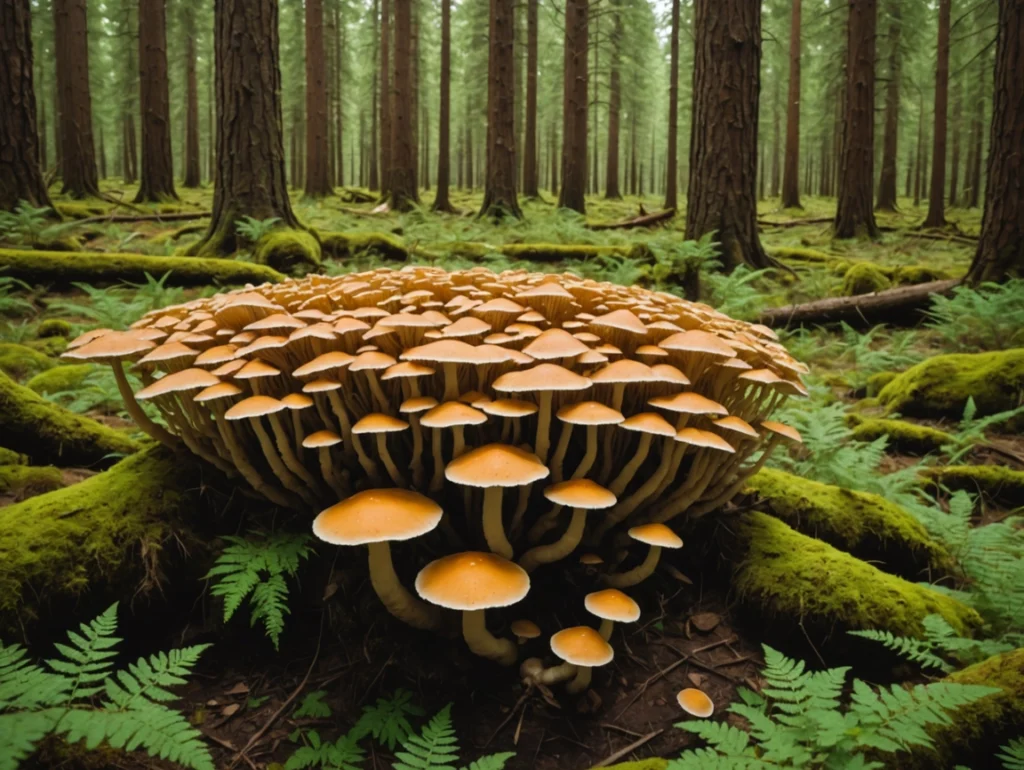
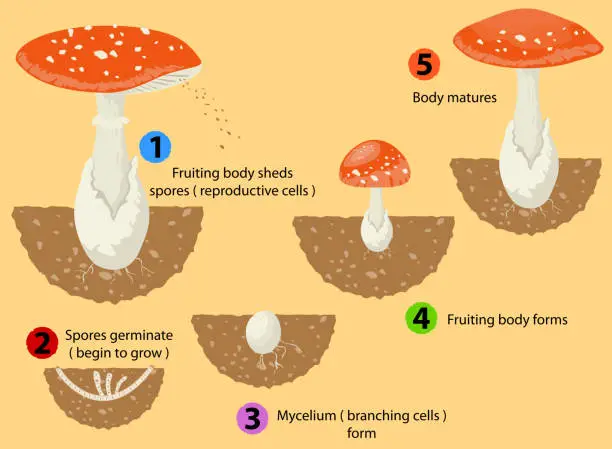
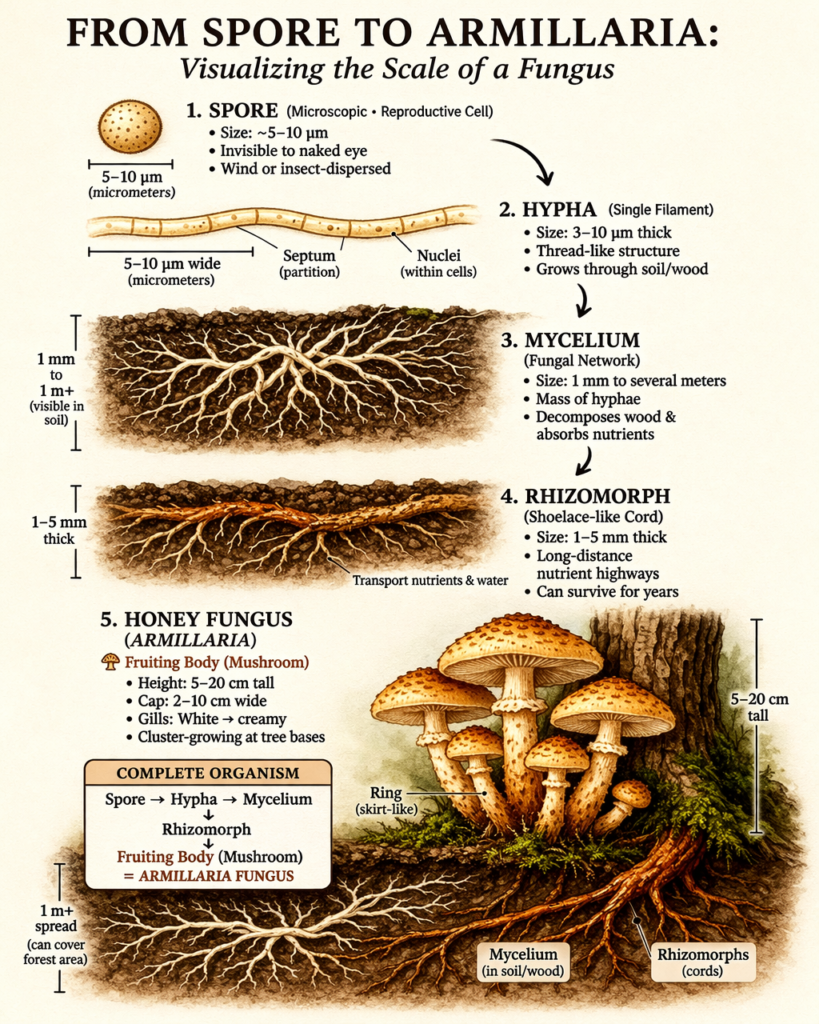
The mushroom you see above ground is not really the organism. It is more like an apple on a tree, a temporary fruiting structure produced by something much larger and longer-lived living beneath the surface. The actual organism is the mycelium, a vast network of thread-like filaments that can spread through soil, wood, and organic matter across areas measured in hectares. The mushroom is just the part the mycelium produces when it is ready to reproduce.
Understanding how a mushroom actually grows, from the moment a spore lands on a suitable surface to the moment a fully formed cap appears above ground, changes how you see the process entirely. It is not simple growth in the way a plant grows upward from a seed. It is a complete ecological drama played out over weeks or months underground before the visible part appears, often in a matter of hours.
This post covers the full journey in sequence, from spore to mycelium to fruiting body, with the biology behind each stage explained clearly.
The Mushroom Is Not the Organism
This distinction is worth dwelling on because it reframes everything else. When you pull a mushroom from the ground or harvest one from a growing block, you are not removing the fungus. You are removing its fruiting body, the reproductive structure it built to disperse spores. The fungus itself remains, the mycelium continues to grow, and the same network will produce more fruiting bodies when conditions are right.
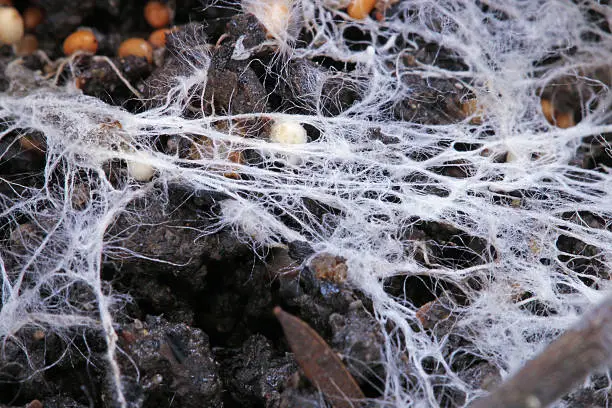
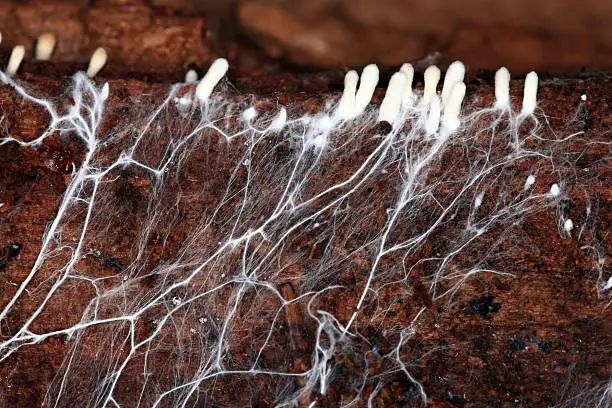
Mycelium is the vegetative body of the fungus, the feeding, growing, colonising part of the organism. It consists of hyphae, microscopic thread-like filaments about two to ten micrometres in diameter. A single hypha is invisible to the naked eye, but a network of them, woven together into the white fuzzy growth you see on a colonising substrate or between wood fibres, is mycelium. The word comes from the Greek mykes, meaning fungus, and helos, meaning nail.
The relationship between mycelium and mushroom is analogous to a tree and its fruit. The tree produces apples to distribute seeds. The mycelium produces mushrooms to distribute spores. The apple is not the tree, and the mushroom is not the fungus.
Stage 1: The Spore
Everything begins with a spore. Fungal spores are single cells, typically between two and 100 micrometres in size, that contain a complete set of genetic information and enough stored energy reserves to survive until conditions are right for germination. They are produced in extraordinary quantities. A single oyster mushroom cap can release up to a billion spores over a few days. A mature giant puffball can produce several trillion.
Spores are released into the air from the gills, pores, or teeth of the fruiting body and carried by air currents, water, insects, and animals. Their durability is remarkable. Many fungal spores can remain viable for years, surviving desiccation, extreme temperatures, and UV radiation that would kill most living cells. Some have been successfully germinated after decades of storage.
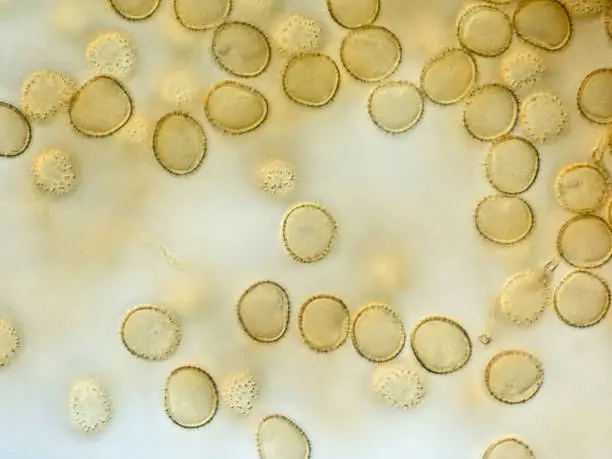
The vast majority of spores never germinate. They land on unsuitable surfaces, dry out, get eaten, or simply fail to encounter the right conditions. The few that land on suitable substrate in suitable conditions begin the process that eventually produces a new mushroom.
What a spore needs to germinate
- Moisture: The spore wall needs to absorb water to trigger metabolic activity. Dry conditions prevent germination entirely.
- Suitable temperature: Different species have different temperature ranges for germination. Most wood-rotting species germinate between 15 and 30C.
- Suitable substrate: The spore needs to land on a material it can colonise. A wood-rotting species landing on bare rock will not germinate productively.
- Absence of inhibitory compounds: Some plants and materials produce antifungal compounds that prevent germination. This is why softwoods are unsuitable substrates for most cultivated species.
Stage 2: Germination and Hyphal Growth
When conditions are right, the spore begins to germinate. The outer wall softens and a tiny tube called a germ tube extends outward into the substrate. This germ tube is the beginning of the first hypha. It grows by extending at its tip, a process called apical growth, pushing into the substrate ahead of it as the cell wall extends and new cell material is deposited.
As the hypha extends, it branches repeatedly, sending new filaments in multiple directions. Each branch also branches, and those branches branch again. Within days, what started as a single spore becomes a three-dimensional network of hyphae spreading through the substrate in all directions. This network is the beginning of the mycelium.
The rate of hyphal growth varies considerably between species and conditions. Under optimal conditions, oyster mushroom hyphae can extend several millimetres per day. The mycelium of some forest fungi grows much more slowly but spreads across larger distances over longer timeframes.
How hyphae feed
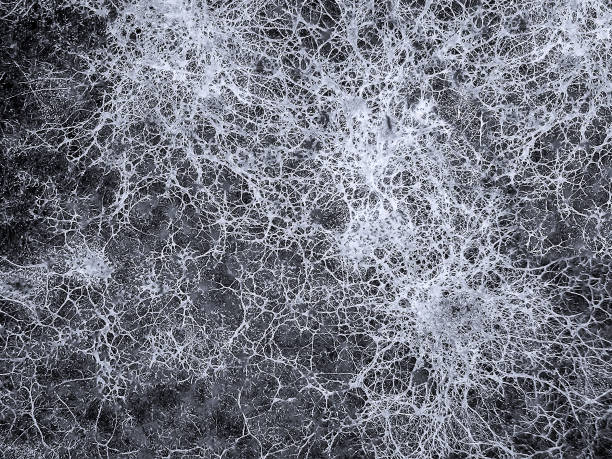
As hyphae grow through substrate, they secrete digestive enzymes ahead of their tips. These enzymes break down complex molecules in the substrate, primarily lignin, cellulose, and hemicellulose in wood and straw, into simpler sugars and amino acids that the hyphae can absorb across their cell walls. This external digestion and absorption is the fundamental feeding mechanism of all fungi.
The efficiency of this process is extraordinary. White rot fungi, which include oyster mushrooms, reishi, and many other common species, can break down both lignin and cellulose. Brown rot fungi can only break down cellulose, leaving behind the reddish-brown lignin residue that gives brown rot its distinctive appearance in decaying wood. The ability of white rot fungi to digest lignin makes them among the most powerful biological recycling systems on earth.
Stage 3: Colonisation
Colonisation is the period when mycelium spreads through and takes over a substrate. In home cultivation, this is the stage when your inoculated grow bag turns progressively white as mycelium spreads from the spawn points outward through the substrate. In nature, it is when fungal mycelium establishes itself in a fallen log or a patch of forest soil.
During colonisation, the mycelium is doing two things simultaneously. It is extending into new territory, breaking down substrate ahead of it and absorbing nutrients. And it is consolidating territory already covered, building a denser, more connected network behind the leading edge. The consolidation phase produces thicker hyphal cords and eventually rhizomorphs, rope-like structures of bundled hyphae that can transport water and nutrients over long distances within the network.
Full colonisation of a substrate can take anywhere from a week to several months depending on the species, the substrate, and the environmental conditions. The mycelium is not visible inside the substrate during most of this process. What you see on the surface, the white coating developing on a grow bag, is just the mycelium that has reached the outer edge of the substrate. Far more is happening inside.
What the mycelium is sensing
Mycelium is not passive during colonisation. Research has shown that fungal networks exhibit a form of environmental sensing and decision-making, adjusting growth direction in response to chemical gradients, moisture availability, and the presence of other organisms. When mycelium encounters a food source it cannot yet fully colonise, it concentrates growth toward that source. When it encounters competing organisms, it can produce antifungal compounds to inhibit them.
There is also evidence that mycelium networks can transmit electrical signals, action potentials very similar in structure to nerve impulses in animals, through their hyphal networks at speeds that suggest coordinated responses to stimuli across the network. The biological significance of these signals is still being researched, but it has generated significant scientific interest in whether fungal networks exhibit something analogous to information processing.
Stage 4: The Fruiting Trigger
A fully colonised substrate does not automatically produce mushrooms. Something has to signal the mycelium that it is time to shift from vegetative growth to reproduction. In nature, these triggers are environmental cues. In home cultivation, replicating them is what initiates fruiting.
The most common natural fruiting triggers are:
- Temperature drop: A drop in temperature signals the approach of autumn or the arrival of a cool, wet period, both of which are historically productive mushroom seasons. Many species require a significant temperature differential between colonisation and fruiting temperatures.
- Moisture increase: Rain after dry conditions is one of the most reliable mushroom triggers in nature. The sudden increase in moisture availability signals that fruiting conditions have arrived.
- Fresh air: Increased airflow and reduced CO2 concentration signal that the mycelium has access to the surface and sufficient gas exchange for a fruiting body to develop.
- Light: While mushrooms do not photosynthesise, light acts as a directional cue and in some species appears to be part of the fruiting trigger, possibly signalling that the mycelium has reached the surface.
- Nutrient depletion: When the mycelium has extracted most of the available nutrients from a substrate, reproduction becomes the priority. Significantly decomposed substrates often produce the greatest abundance of mushrooms.
Stage 5: Primordia Formation
Once the fruiting signal is received, the mycelium begins aggregating into dense knots of hyphal tissue at specific points. These aggregations are called primordia, or pins in cultivation terminology. They are the earliest visible stage of mushroom development, typically appearing as tiny white or cream-coloured bumps on the substrate surface.
The formation of primordia is a significant biological transition. The hyphae in a primordium differentiate into specific tissue types, a process that has similarities to cell differentiation in animal embryos. Different groups of hyphae will become the stipe (stem), the pileus (cap), the gills or pores, and the veil if the species produces one. The blueprint for the entire fruiting body is encoded in the genetics of the mycelium and executed during primordial development.
Primordia are fragile. A drop in humidity, a temperature spike, a change in CO2 levels, or physical disturbance can cause them to abort, drying out and dying before they develop further. This is why maintaining stable fruiting conditions is critical in cultivation and why mushrooms in nature tend to appear in clusters during stable weather windows rather than scattered randomly across seasons.
Stage 6: Fruiting Body Development
Once primordia are established and conditions remain stable, development into the full fruiting body proceeds rapidly. The speed of mushroom growth at this stage is genuinely remarkable. Oyster mushrooms can double in size every 24 hours under good conditions. Some species of Coprinus (ink caps) complete their entire development from pin to mature cap to self-digestion within 48 hours.
The rapid expansion of the fruiting body is driven primarily by water uptake rather than cell division. The hyphal cells that form the developing mushroom absorb water and expand, building the structure outward and upward. This is why mushrooms appear to almost inflate as they develop, and why freshly emerged mushrooms have such high water content, typically 85 to 95 percent water by weight.
The stipe elongates first, pushing the developing cap up through the substrate or into the air. As the cap expands, the gills or pores beneath it develop and mature into the spore-bearing surfaces. In species with a partial veil, the thin membrane connecting the cap edge to the stem tears as the cap expands, sometimes leaving a ring called an annulus on the stem.
The growth stages of a gilled mushroom
| Stage | Common name | What is happening |
| 1 | Egg or button | Cap and stem fully formed but enclosed in outer veil. Gills not yet exposed. |
| 2 | Pin or young mushroom | Outer veil has torn or dissolved. Cap still hemispherical, curving downward. Gills beginning to develop. |
| 3 | Mature cap | Cap has flattened or still convex. Gills fully developed. Partial veil tearing if present. Spore production beginning. |
| 4 | Peak harvest window | Cap edges just beginning to flatten outward. Spore production at or near peak. Best flavour and texture. |
| 5 | Overripe | Cap edges turned fully upward. Heavy spore drop. Texture deteriorating. Bitter or unpleasant flavour developing. |
Stage 7: Spore Release and Dispersal
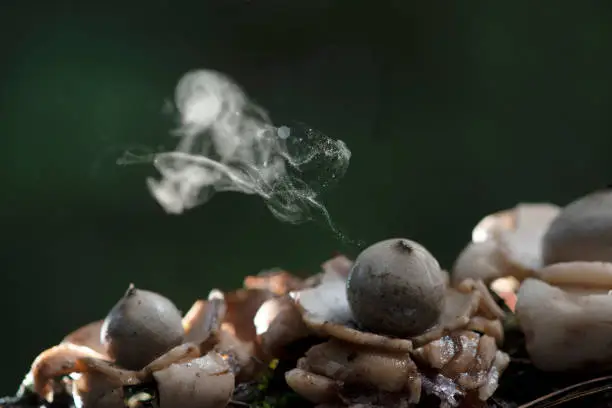
The mature fruiting body exists for one purpose: spore dispersal. Once the cap reaches maturity, spore production and release begins in earnest. In gilled mushrooms, spores are produced on the surface of each gill and dropped into the air space between gills, where they fall by gravity and are caught by air currents.
The mechanism of spore discharge in Basidiomycota fungi is elegantly precise. A basidium cell produces each spore on a tiny stalk called a sterigma.. When the spore is mature, a droplet of water forms at its base and the surface tension energy of that droplet, combined with the spore’s geometry, catapults the spore a fraction of a millimetre into the air space between gills with extraordinary precision. Mycologist Arthur Henry Reginald Buller described this mechanism in the 1920s, and it is now called the Buller’s drop mechanism..
Once airborne, spore dispersal depends on airflow. This is why mushroom gills are oriented vertically, to ensure spores fall into the air column rather than landing back on the gill surface. It is also why many mushrooms orient their caps horizontally regardless of the angle of the substrate they are growing on, a behaviour called negative geotropism guided by the gravitational sensing of the developing fruiting body.
After spore release, the fruiting body degrades rapidly. Some species self-digest through a process called autodigestion or deliquescence, the cap dissolving into a dark, inky liquid that carries spores and is spread by insects. Others simply dry out, collapse, and decompose. The mycelium below continues to live, ready to produce another flush when conditions are right.
What Affects How Fast Mushrooms Grow?
Mushroom growth speed varies enormously between species and conditions. The factors that most influence growth rate at each stage are worth understanding, both for appreciating what happens in nature and for optimising home cultivation.
- Temperature: Enzyme activity, and therefore metabolic rate, increases with temperature up to the species’ optimum. Below the minimum germination temperature, growth stalls. Above the maximum, proteins denature and the mycelium dies.
- Moisture: Water is required for enzyme secretion, nutrient transport through the mycelium, and the rapid cell expansion that drives fruiting body development. Moisture stress slows or halts growth at every stage.
- Nutrient density of substrate: Richer substrates support faster colonisation and larger fruiting bodies, which is why supplemented substrates produce higher yields in cultivation.
- CO2 levels: High CO2 suppresses fruiting body development and causes elongated growth toward fresh air. This is the mechanism behind the leggy stems seen when ventilation is inadequate.
- Competition: The presence of competing organisms, bacteria, other moulds, or other fungal species, diverts resources and can slow or halt mycelium growth. This is the biological basis of contamination in home cultivation.
Frequently Asked Questions
How fast do mushrooms grow?
It depends heavily on the species and conditions. Oyster mushrooms are among the fastest, capable of doubling in size daily during rapid development, with a complete flush from pin to harvest-ready in five to seven days. Shiitake takes ten to fourteen days from pinning to harvest. Reishi caps develop over several weeks. In nature, some species like certain ink caps complete their entire visible life cycle in under 48 hours, while bracket fungi can take months to years to reach maturity.
Do mushrooms grow at night?
Mushrooms grow continuously regardless of light and dark, but growth is often more vigorous during cool, moist periods, which in many climates tends to coincide with night and early morning. Peoples perception that mushrooms appear overnight is partly accurate but more a reflection of the rapid development phase: a primordium that was barely visible at sunset can be a fully formed mushroom by dawn under good conditions. The actual growth is continuous, not nocturnal.
Why do mushrooms appear after rain?
Rain provides two of the most important fruiting triggers simultaneously: increased moisture and a temperature drop. The mycelium, which may have been in a vegetative state during dry conditions, receives the signal that favourable fruiting conditions have arrived. The increased moisture also directly fuels the rapid cell expansion that drives fruiting body development. This is why mushroom foragers check the weather forecast and head out one to five days after significant rainfall in temperate regions.
How deep underground does mushroom mycelium go?
It depends on the species and the substrate. Saprotrophic fungi (decomposers) like oyster mushrooms tend to stay close to their substrate surface. They rarely penetrate more than a few centimeters into dense wood. Mycorrhizal fungi associated with tree roots can extend their hyphae to whatever depth the roots reach, sometimes several meters down. Some soil fungi spread through the upper topsoil where organic matter and moisture are most abundant.
The Tip of a Very Large Iceberg
The mushroom on your kitchen counter or growing on a log in the forest is the combination of a biological process that began with a microscopic spore and played out mostly out of sight. Most of what a fungus is and does is invisible until the brief moment when conditions align and the fruiting body emerges.
That invisibility is part of what makes fungi so consistently underestimated. The mycelium network underlying a single mature mushroom can weigh far more than the visible fruiting body and extend over an area that would astonish most people. Understanding the full growth process makes that network visible, at least in the mind.
Explore how mushrooms reproduce and what happens to their spores after release, what mycelium actually is and how its networks function, and the remarkable mycorrhizal systems that connect entire forests through fungal threads.