QUICK ANSWER
Shiitake grows on sterilized hardwood sawdust (first harvest 6-12 weeks) or inoculated hardwood logs (first harvest 6-12 months, then produces for years).
It needs a cold water soak to trigger fruiting — the key difference from oyster and lion’s mane. Pressure cooker required for sawdust method only.
Shiitake is a step up from oyster mushrooms in patience but not in difficulty. It colonizes slower, needs a deliberate fruiting trigger, and can be particular about temperature and humidity. None of that is hard to manage once you understand why each step matters. The reward is a mushroom with genuine culinary depth and a health profile that is hard to match.
There are two ways to grow shiitake at home: sawdust blocks (faster, indoor, more control) and logs (slower, outdoor, produces for years). This guide covers both. Choose your method based on your timeline and space.
For general growing concepts like sterilization, spawn types, and colonization, the complete beginner guide covers those in full.
📖 New to mushroom growing? Start with: How to Grow Mushrooms at Home: The Complete Beginner Guide
Choose your method
🧱 Sawdust Block Method
Timeline: 6-12 weeks to first harvest
Location: Indoor, any space
Equipment: Pressure cooker required
Flushes: 3-5 per block
Best for: Faster results, indoor growers, more control over conditions
🪵 Log Method
Timeline: 6-12 months to first harvest
Location: Outdoor, shaded area
Equipment: Drill, plug spawn, wax. No pressure cooker.
Produces: 3-5 years from one log
Best for: Long-term supply, outdoor space, minimal ongoing effort
For most home growers starting indoors, the sawdust block method is the right choice. If you have outdoor space and patience, set up a log at the same time — it runs in the background and will be producing mushrooms long after your blocks are spent.
Choose your strain
Shiitake strains vary significantly in their fruiting temperature. This matters more with shiitake than with oyster or lion’s mane. A cool weather strain in a warm room will colonize slowly and fruit reluctantly.
For most home growers, a wide range strain is the safest starting point. Check the temperature specifications on your spawn before buying and match to the conditions you can actually provide.
The sawdust block method
What you need
✅ Sawdust Block Supplies
Shiitake spawn — sawdust or grain, from reputable supplier
Hardwood sawdust — oak, beech, alder, or hardwood pellets. No softwood.
Wheat bran — 20% by weight. Shiitake responds well to supplementation.
Pressure cooker — 15 PSI, 2.5-3 hours
Autoclave bags — filter patch polypropylene
Spray bottle — for misting during fruiting
Prepare and sterilize
Mix 80% hardwood sawdust with 20% wheat bran. If using hardwood pellets, add water first and let them break down before mixing in bran. Adjust moisture to field capacity (squeeze test: few drops, not a stream). Fill autoclave bags loosely to two-thirds full.
Sterilize at 15 PSI for 2.5 to 3 hours. Shiitake on supplemented substrate benefits from the full three hours. Cool completely, 12 to 24 hours, before inoculating.
For the detailed sterilization process, see the complete beginner guide.
Inoculate
Clean workspace, gloves, alcohol on surfaces. Add spawn at 15 to 20% of substrate weight. Distribute throughout, mix lightly, seal, label with date and strain.
Colonization
Move to a warm location (21 to 26C). Shiitake colonizes at a similar pace to lion’s mane — slower than oyster. Be patient.
What to Expect
Colonization Timeline — Shiitake
|
Weeks 1–2 |
White mycelium spreading from spawn points. Slower than oyster. Normal. |
|
Weeks 2–4 |
Progressive spread through substrate. Block firming up. Do not disturb. |
|
Weeks 4–8 |
Full colonization. Block turns white and firm. Brown crust (primordia skin) forming on outside. |
|
Ready |
Brown primordia skin visible. Block is consolidated. Time for the cold water soak fruiting trigger. |
The brown crust is NOT contamination. It is a positive sign the block is ready to fruit.
The brown crust that forms on fully colonized shiitake blocks is called the primordia skin. It is a sign the block is consolidating and getting ready to fruit. Do not mistake it for contamination. This is one of the most commonly misidentified “problems” in shiitake growing.
The fruiting trigger: the step most people miss
This is what makes shiitake different from oyster and lion’s mane. Shiitake often will not fruit without a deliberate stress trigger. In nature, this is a rain event or temperature drop. At home, you replicate it with a cold water soak.
The Step Most People Miss
Shiitake needs a cold water soak to trigger fruiting.
1. Remove block from bag once fully colonized
2. Submerge in cold water (10-15°C) for 12-24 hours
3. Drain and move to fruiting environment
4. Expect pins in 5-10 days. Repeat soak between each flush.
If your block is not fruiting, this is almost always why. Unlike oyster and lion’s mane, shiitake rarely fruits without a deliberate trigger.
If your fully colonized block is sitting in fruiting conditions but producing no pins after two weeks, the cold water soak is almost always the fix. This is the single most common reason shiitake blocks fail to fruit.
Fruiting environment
Shiitake Conditions
Fruiting Environment Quick Reference
Humidity
80–90%
Slightly lower than oyster/lion’s mane. Still needs regular misting.
Temperature
15–25°C
Match to your strain. Check spawn label.
Fresh Air
2–4x daily
Less sensitive than lion’s mane but still needs regular FAE.
Light
Indirect
12hr on/off. Natural light or simple LED.
Shiitake tolerates slightly drier conditions than oyster or lion’s mane, but still needs regular misting. Match temperature to your strain.
The log method
Log-grown shiitake is slower to set up and takes six to twelve months before the first harvest. The payoff is significant: a single inoculated log produces mushrooms for three to five years with minimal maintenance. Log-grown shiitake also has a thicker cap, denser texture, and more intense flavour than block-grown.
Source fresh hardwood logs. Oak is ideal. Cut within the last six weeks, 10 to 15cm diameter, 90 to 120cm length. Avoid diseased trees.
Drill holes in a diamond pattern. 8.5mm drill bit. Space holes 5 to 8cm apart in offset rows along the length. Typically 30 to 50 holes per log.
Insert plug spawn. Tap a plug into each hole with a rubber mallet, flush with or just below the bark surface.
Seal with wax. Melt cheese wax or beeswax and brush over each plug to seal in moisture and block contaminants.
Store in shade. Stack logs off the ground somewhere shaded and reasonably humid. Avoid direct sun and wind. Water during dry spells — if no rain for two weeks, soak thoroughly with a hose.
Trigger after 6 to 12 months. Once colonized, soak logs in cold water for 24 to 48 hours. Pins should appear within one to two weeks. Repeat the soak for each subsequent flush.
Harvest
✅ Ready to Harvest
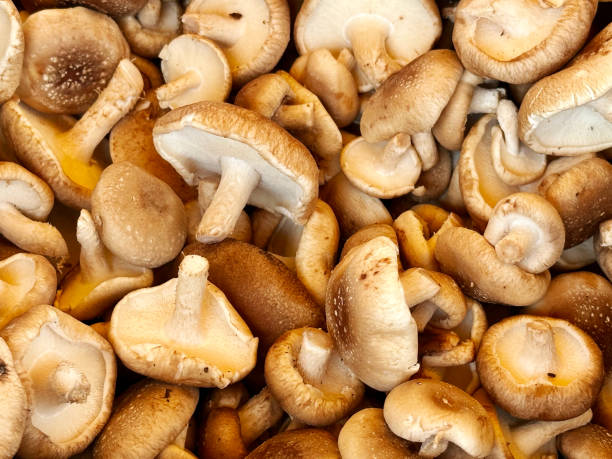
Cap fully formed, medium to dark brown
Veil underneath still partially intact or just beginning to tear
Firm texture, colour at its peak
⚠️ Too Late
Cap edges curling upward, gills fully visible
Spores beginning to drop (white powder on surfaces)
Still edible but past peak flavour and texture
Grip the stem near the base and twist while pulling. Remove any stub. For sawdust blocks, rest for seven to fourteen days between flushes, then repeat the cold water soak to trigger the next flush. For logs, repeat the soak as needed.
Most sawdust blocks produce three to five flushes. Logs produce seasonally for three to five years.
🧊
Fresh
Paper bag in fridge. 7-10 days. Keeps longer than oyster or lion’s mane.
☀️
Dried ⭐
Best storage method for shiitake. Intense concentrated flavour. Rehydrates perfectly. Lasts months.
❄️
Frozen
Saute first. Holds up well in cooked dishes.
Shiitake dries exceptionally well. Dried shiitake has an intense, concentrated flavour and rehydrates with minimal quality loss. If you only store your harvest one way, drying is the best choice for shiitake.
Common mistakes
Avoid These
Common Shiitake Mistakes
| 💧 |
Skipping the cold water soak The #1 reason shiitake blocks don’t fruit. Do the soak. It works. |
| 🌡️ |
Wrong strain for your temperature A cool weather strain in a warm room colonizes slowly and fruits reluctantly. Match the strain to your space. |
| 🔥 |
Inoculating warm substrate Same rule as every species. Wait the full 12-24 hours after sterilization. |
| ⏰ |
Expecting oyster mushroom speed Shiitake is slower at every stage. Colonization takes 4-8 weeks. Be patient. |
| 🪵 |
Logs too green or too old Very fresh logs have antifungal compounds. Old logs have competing fungi. Use logs cut 2-6 weeks ago. |
| 🔄 |
Forgetting to resoak between flushes The cold water soak is not just for the first flush. Repeat it for each subsequent flush. |
Frequently asked questions
Sawdust block method: six to twelve weeks from inoculation to first harvest. Colonization takes four to eight weeks, fruiting takes one to three weeks after the trigger soak. Log method: six to twelve months before first harvest, then years of production.
Almost always because it needs the cold water soak fruiting trigger. Remove from the bag, soak in cold water for 12 to 24 hours, drain, and place in your fruiting environment. If it has been triggered and still nothing after ten days, check temperature and humidity are in range.
Sawdust blocks typically produce three to five flushes. First and second are the most productive. Each requires a cold water soak and seven to fourteen days of rest between harvests. Logs produce seasonally for three to five years.
The log method does not need one — plug spawn, a drill, and wax is the entire setup. The sawdust block method requires sterilization and a pressure cooker is essentially necessary. If you do not have a pressure cooker, start with logs.
That is the primordia layer — a consolidation crust that forms on fully colonized shiitake blocks. It is a positive sign that the block is ready for the fruiting trigger. It is not contamination.
Log-grown shiitake generally has thicker caps, denser texture, and more intense flavor. It also produces for years from a single inoculation. Block-grown is faster and more controllable but the mushrooms are slightly less robust. Many growers run both methods simultaneously.
The Core Trio
Oyster, Lion’s Mane, and Shiitake
These three species cover beginner through intermediate growing. Together they give you fast harvests, cognitive health, and years of culinary mushrooms.
Next steps
If shiitake is your first species, you may want to try oyster mushrooms alongside it for a faster win while the shiitake colonizes. If you already have oyster and lion’s mane under your belt, shiitake completes the core trio of home-grown medicinal and culinary mushrooms.