
 By
Mycelium isn’t the problem. The grain is, and so are the missing numbers. Of the lion’s mane trials on my dose table that state their form, two used fruiting-body powder and one used liquid-grown mycelium.
Mycelium and grain in the lab#
- In Windsor et al. 2025, a paper by mostly Nammex authors that declares Nammex’s financial interest in selling chaga supplements, four chaga “mycelia fermented grain” products measured 33-68% alpha-glucan, against 46-74% for the plain grains and under 2% for wild chaga [16].
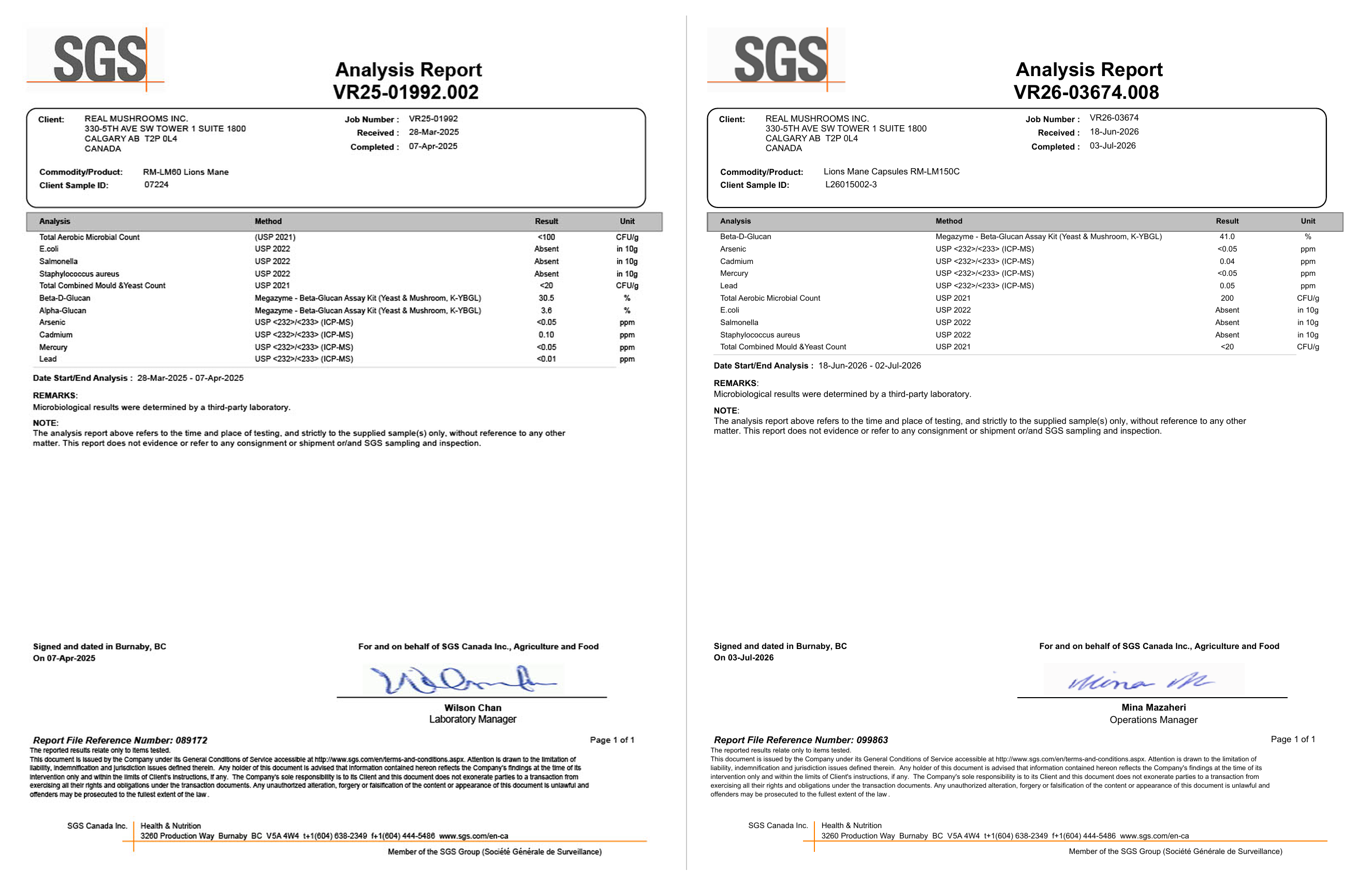
- Real Mushrooms, Nootropics Depot and Mushroom Revival print alpha-glucan figures of 3.6%, 3.1% and 2.4% on test sheets for their fruiting-body lion’s mane, and none of the 3 grain-grown lion’s mane products on my Scorecard publishes one [1][2][6][7].
- An independent Italian study, Corana et al. 2019, measured erinacine A at 105 µg/g in lion’s mane mycelium, while in a wild and a cultivated lion’s mane fruiting body it detected none [20].
Figures as of 22 Nov 2026.Free to quote with a link.How to cite
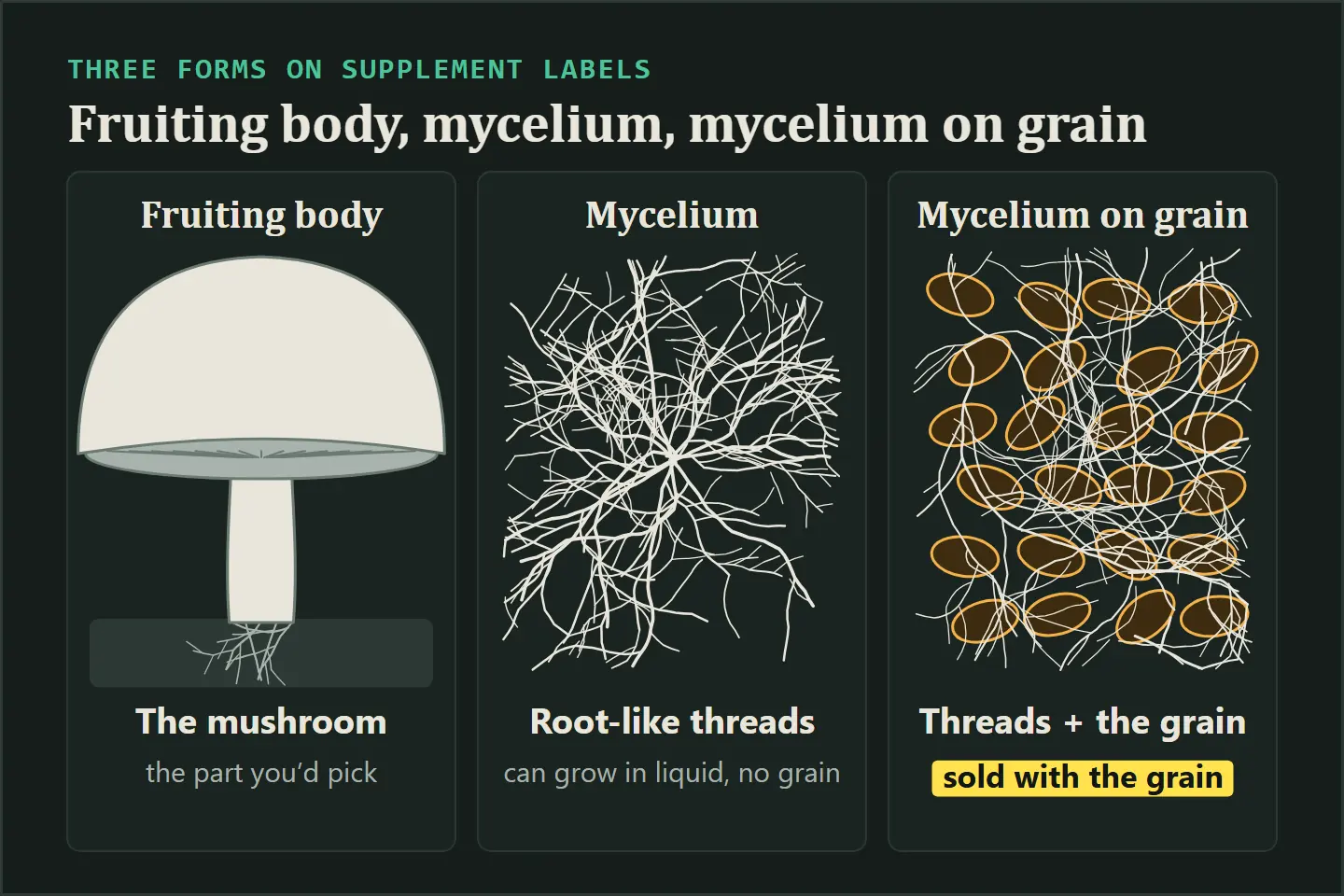
What’s the difference between the fruiting body and the mycelium?
A fungus spends most of its life as mycelium: a mass of thin threads that grows through its food, whether that’s a log, sawdust or a jar of grain. When conditions are right, the mycelium builds a fruiting body: the mushroom, whose job is to make spores. Same organism, two stages (how a mushroom grows from its mycelium). For a buyer, the question is which one is in the capsule, and what came in with it.
What does “mycelium on grain” mean on a supplement label?
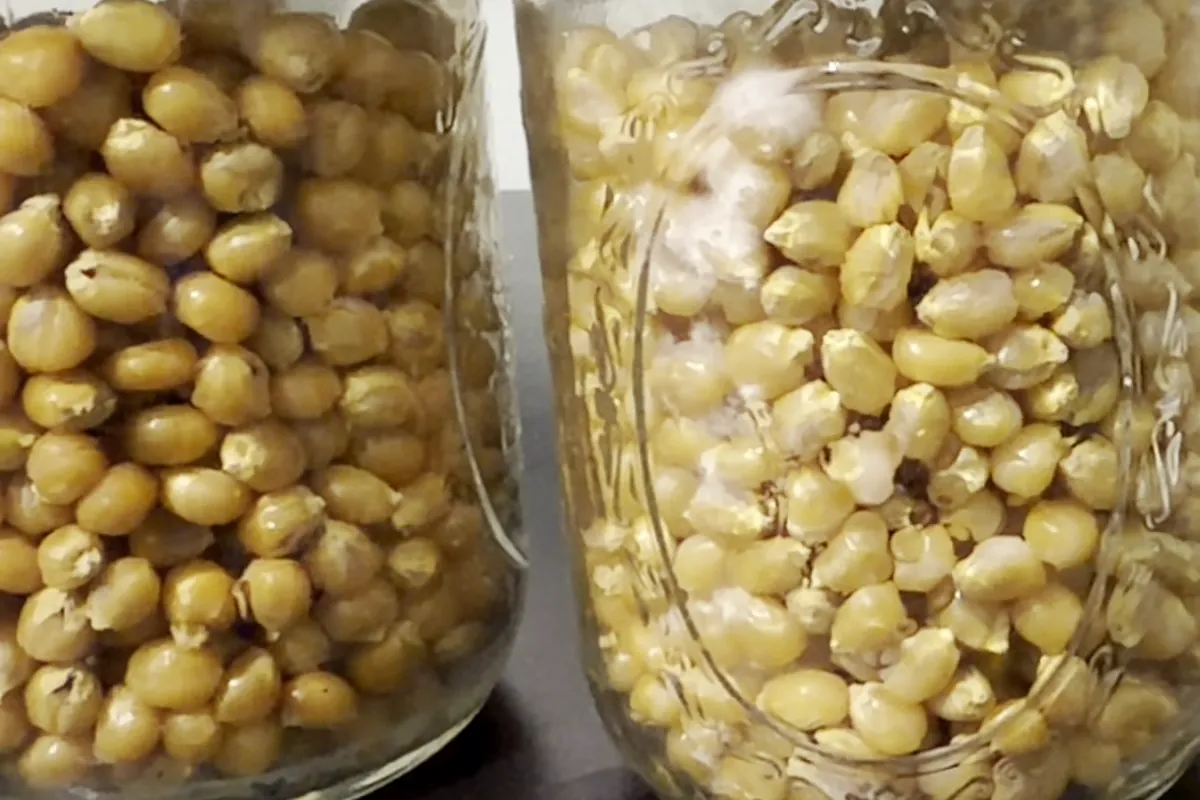
Mycelium can grow in a liquid broth with no grain at all, or on cooked grain such as rice, oats or sorghum. On grain, it grows through the kernels and feeds on them. Growers call this grain spawn.
When I grew mushrooms at home, I made my own grain spawn from popcorn in jars, pressure-cooked in an Instant Pot (how grain spawn is made). For a grower, a colonized jar is a middle step. It’s mixed into a bulk substrate, and the mushrooms come later.
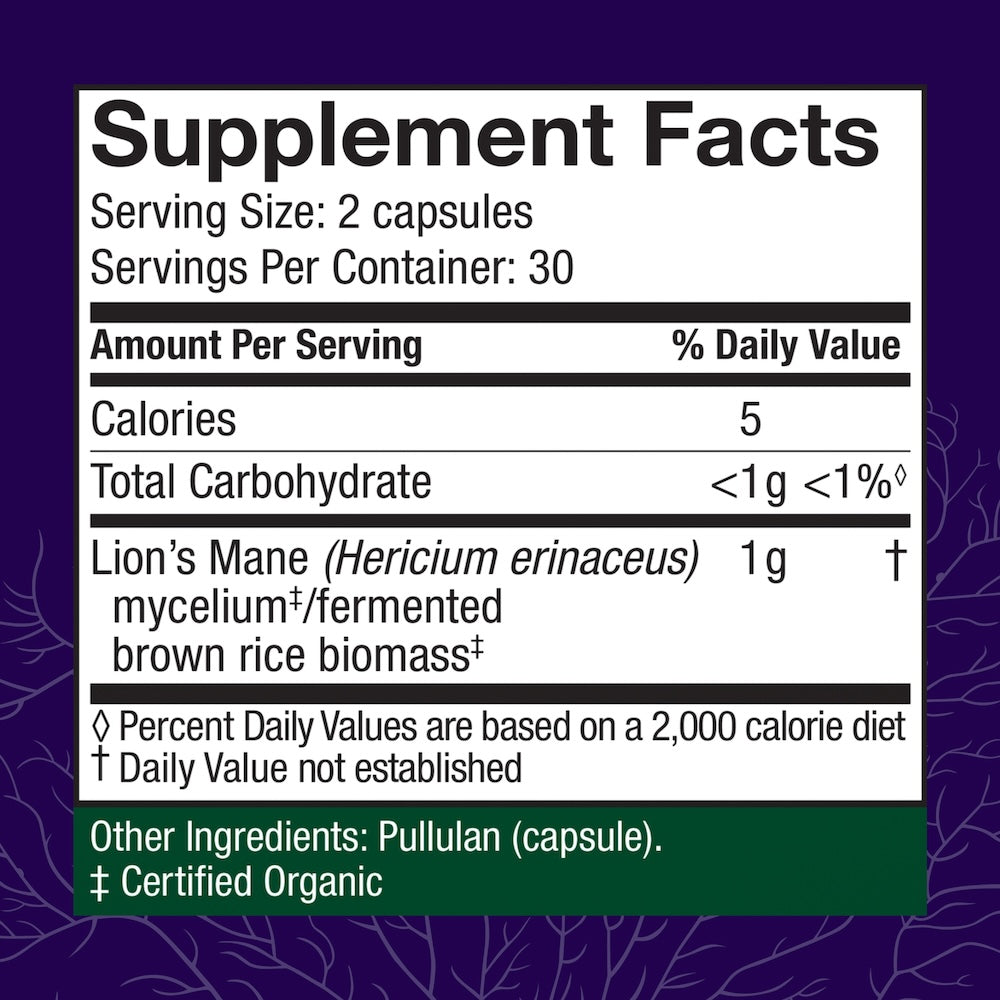
A mycelium-on-grain supplement stops at the jar. The mycelium and the grain are dried and sold together. Host Defense says so on its product page: its lion’s mane contains “both the mushroom mycelium and the fermented rice substrate”. Om says its mycelium feeds on oats and is harvested “once it has worked through them”. How much grain remains? None of the three grain-grown lion’s mane brands I’ve scored says.
“Myceliated grain”, “biomass”, “mycelium”: what do the label words mean?
- “Mycelium/fermented brown rice biomass” (Host Defense): mycelium plus the rice it grew on.
- “Mycelial biomass & fruit body; cultured on organic whole oats” (Om) and “[Mycelium and Fruiting Body] on Oats” (Genius): mycelium and some fruiting body, grown on oats. Neither states the split.
- “Myceliated grain”, “mycelium biomass”: Host Defense’s own terms for the mix.
- “Mycelium” with no grain named: could be either. Ask the brand.
- “Liquid-grown”, “deep layer”, “without a grain substrate”: no grain to carry.
If the label names a grain, I assume it’s in the powder unless the brand says it was removed.
What does “full spectrum” mean?
On its own, nothing you can check. Oriveda calls its fruiting-body extract “full spectrum lossless 1:1”, meaning nothing was filtered out. RYZE’s label says “2,000MG full spectrum mushroom” and never says fruiting body or mycelium. The Scorecard ignores the phrase and scores what the label says underneath it.
Is fruiting body better than mycelium? What can be measured
No human trial I’ve read compares the two, and this site doesn’t rate what either does in a body. On paper, though, they differ a lot.
Beta-glucans: what do the certificates show?
| Product | What's in it | Check 1 | Beta-glucans | Method | Certificate |
|---|---|---|---|---|---|
 Real MushroomsOrganic Lion's Mane Extract Capsules (120 caps)Scorecard rating | Fruiting-body extract | 2 of 2 | 41.0% † | Megazyme K-YBGL (SGS report VR26-03674.008) | SGS report VR26-03674.008, Jul 2026 |
 FreshCapOrganic Lion's Mane Capsules (60 caps)Scorecard rating | 100% fruiting body | 2 of 2 | 31% | label claim only; method not stated | Not published |
 OrivedaLion's Mane 1:1 Fruiting Body (180 caps)Scorecard rating | 1:1 fruiting-body extract | 2 of 2 | 36.3% | Megazyme K-YBGL (Eurofins report 5533050-0; lot 2026-27B) | Eurofins report 5533050-0, Sep 2026 |
 Mushroom RevivalFocus Lion's Mane Capsules (60 caps)Scorecard rating | 100% fruiting body | 2 of 2 | 37.1% | counts as a label claim (clarification 8): brand-issued CoA, no lab na… | Brand-issued CoA, no lab named, Nov 2021 |
 Nootropics DepotLion's Mane Mushroom 8:1 Dual Extract Capsules (60 caps)Scorecard rating | Fruiting-body extract | 2 of 2 | 23.1% | Fluorescence (LAB TM-078), not an enzymatic/Megazyme method; Omnient L… | Omnient Labs CoA ND-26-1133, Sep 2026 |
 Host DefenseLion's Mane Capsules (30 caps)Scorecard rating | Mycelium on brown rice | 0 of 2 | Unknown | polysaccharides only (counts starch) | Not published |
 Om Mushroom SuperfoodLion's Mane Mushroom Capsules ("Focus Lion's Mane", 90 caps)Scorecard rating | Mycelium + fruit body, oats | 0 of 2 | Unknown | not published / not found | Not published |
 Genius MushroomsGenius Lion's Mane (120 caps)Scorecard rating | Mycelium + fruiting body, oats | 0 of 2 | Unknown | not published / not found | Not published |
Prices: each brand's own one-time price for the size its page shows by default, checked 23 Nov 2026. "Unknown" means the brand doesn't publish the number; it scores 0.
Sources for every cell: the Scorecard data (CSV).
Only two of the five fruiting-body figures come from the enzymatic test on a named lab’s certificate, Real Mushrooms’ and Oriveda’s, and Real Mushrooms’ carries the cellulose caveat.
No beta-glucan figure doesn’t mean no beta-glucans, though. It means nobody outside the company can tell.
Starch and alpha-glucan: what does the grain add?
Starch is an alpha-glucan. The enzymatic test measures alpha-glucan on the way (beta-glucan is total glucan minus alpha-glucan), so the alpha-glucan line is where grain starch would show up.
The closest thing to a direct measurement is Windsor et al. 2025. It tested four chaga “mycelia fermented grain” products bought online (on oats, rice, sorghum and one unnamed grain) against wild chaga and the plain grains:
- The grain products held 33-68% alpha-glucan; the plain grains 46-74%; wild chaga under 2%.
- Beta-glucan in the rice- and oat-based products was about the same as in the grain alone: roughly 1% for rice, 5% for oats.
- An iodine starch test was positive for the grain products. Chaga mycelium grown in liquid, with no grain, gave no starch reaction. So the starch came from the grain.
Five of the six authors work for Nammex, which the paper says “has a financial interest” in selling chaga supplements, and the sixth for a lab Nammex uses. It’s chaga only, and four products. Still, I think a declared conflict with published numbers beats no numbers.
A reishi study, Wu et al. 2017, found starch-like polysaccharides in 13 of 19 supplements and none in an authenticated fruiting body; the authors note such starches are often added as fillers and don’t put it down to grain.
What do lion’s mane certificates show for alpha-glucan?
Three lion’s mane certificates print an alpha-glucan line, all for fruiting-body products: Real Mushrooms 3.6% (SGS, April 2025), Nootropics Depot 3.1% (Omnient) and Mushroom Revival 2.4% (its own document). Fungi make some alpha-glucan of their own (Windsor’s liquid-grown chaga mycelium held 15.2%, with no starch reaction), so a low figure on a certificate’s alpha-glucan line isn’t a sign of grain. No grain-grown lion’s mane product I’ve scored publishes an alpha-glucan figure.
What does the mycelium side say?
Host Defense keeps the rice on purpose. In its own words:
- The rice is the mycelium’s food. As its enzymes break down the rice bran, “arabinoxylanes form from simple sugars and starch”, so “it’s important to include the cultured substrate in the final product”.
- The fermented rice is “a completely new, uniquely active ingredient”, not filler; the brand likens it to tempeh.
- Its stated goal is to keep “the mushroom’s natural chemical architecture intact”, so it doesn’t isolate or concentrate compounds.
- Fungi Perfecti, the company behind Host Defense, argued in November 2026 that mycelium makes compounds fruiting bodies don’t, and that a beta-glucan percentage doesn’t capture a mushroom’s value. The article cites no study.
Fungi Perfecti’s January 2026 study of its lion’s mane mycelium is a test-tube study on human immune cells, using an extract of Host Defense powder. All four authors work for Fungi Perfecti; the comparison was one unnamed fruiting-body extract, in two of the tests. No person took anything.
Does mycelium have anything fruiting bodies don’t?
There is a real point in here. An independent Italian study that measured erinacine A, a compound researched in lion’s mane, found it in the mycelium (105 µg/g) and didn’t detect it in a wild or a cultivated fruiting body (Corana et al. 2019). It didn’t test a grain-grown supplement, and I haven’t found a study that did. Two brands that sell fruiting-body extracts also sell lion’s mane mycelium with a stated erinacine A content: Real Mushrooms’ Real Mycelium (5 mg per serving) and Oriveda’s Lion’s Mane NGF (over 4 mg per serving). Both are grown in liquid, with no grain. So “mycelium” and “mycelium on grain” aren’t the same thing, and the Scorecard doesn’t score them the same.
Host Defense argues its case well. But it doesn’t publish a beta-glucan, alpha-glucan or starch figure that would let a buyer check it. I score Host Defense’s mycelium on rice check by check.
Which form of lion’s mane did the human studies use?
Mostly fruiting body, where the paper says. Two lion’s mane trials on my dose table that state the part used dried fruiting-body powder, and a third used dried powder without saying which part:
- Nagano 2010: 2.0 g a day of fruiting body, baked into cookies, 4 weeks.
- Mori 2009: about 2.9 g of powder a day, in tablets, 16 weeks (part not stated in the abstract).
- Saitsu 2019: 3.2 g a day of fruiting body, 12 weeks.
A fourth, Docherty 2023, used 1.8 g a day of a blend whose form isn’t stated. Li 2020 gave 1.05 g a day of mycelium grown in liquid culture rather than on grain. The only trial I’ve found with grain-grown mycelium, Ornish 2024, gave Host Defense lion’s mane at 2 g a day as one of eight supplements, plus diet, exercise and stress management, against usual care with no placebo. So the mushroom’s part can’t be separated, and the trial gives no dose for any form.
So what are the disadvantages of mycelium?
- The grain comes along, and no brand I’ve scored says how much.
- None of the three grain-grown lion’s mane products I’ve scored publishes a beta-glucan or alpha-glucan figure.
- No trial on my dose table tested grain-grown lion’s mane mycelium on its own.
None of that makes mycelium useless. It means you’re buying it on trust.
Do mycelium supplements contain gluten?
It depends on the grain. I have celiac disease, so for me the grain is the first question on a mycelium label. Under FDA’s rule, the gluten grains are wheat, rye, barley and their crossbreeds; rice and oats aren’t on the list. A “gluten-free” claim means no gluten grain as an ingredient and any unavoidable gluten below 20 ppm (parts per million), and the rule covers dietary supplements. The claim is voluntary.
| Brand | Grown on | Gluten claim | Gluten test result published? |
|---|---|---|---|
| Host Defense | organic brown rice | “Gluten Free” on the front label; the FAQ says all its products are gluten-free | none found |
| Om | organic whole oats | gluten-free; says every lot is tested for gluten at 10 ppm | none found |
| Genius | oats | gluten-free; made in a facility that also handles common allergens | none found |
Can rice and oats pick up gluten?
Two FDA points matter here:
- Naturally gluten-free grain can pick up wheat, rye or barley through shared fields, harvesting, transport and plants. Oats labeled gluten-free must contain less than 20 ppm.
- FDA doesn’t consider fermentation a process that removes gluten. For fermented products, FDA judges compliance from the maker’s records, because tests may not measure gluten accurately. Host Defense calls its rice “fermented brown rice biomass”.
So all three claim gluten-free, and none publishes a test result I could check.
When I made grain spawn, I started on rye berries, a gluten grain, and later switched to popcorn, which isn’t one.
If you avoid gluten:
- Find the grain. Rice, oats and sorghum aren’t on FDA’s gluten-grain list; wheat, rye and barley are.
- A “gluten-free” claim is what the 20 ppm rule backs. No claim means unknown, not gluten.
- Want more than a claim? Ask the brand for your lot’s gluten result.
- Fruiting-body products carry no grain substrate, but read the other ingredients.
- If you grow: use gluten-free grain. Popcorn works.
Health questions: this site rates what’s in the bottle and how well it’s documented. It doesn’t say what any product does for you, and it isn’t medical advice. Whether a supplement suits you, or is safe with your medicines or a health condition, is a question for your doctor or pharmacist. Read the medical disclaimer. For background: Memorial Sloan Kettering’s About Herbs entry on lion’s mane, the NIH’s LiverTox entry on lion’s mane and the NIH Office of Dietary Supplements’ Dietary Supplements: What You Need to Know.
Fruiting body or mycelium: species by species
Check 1 works the same for every species. From the labels and papers I’ve read:
| Species | What I’ve seen sold | Scorecard note |
|---|---|---|
| Lion’s mane | Fruiting-body extracts (5 of 8 scored lion’s mane capsules); mycelium on rice or oats (3); liquid-grown mycelium (2) | Dose table: fruiting-body powder, 2.0 g a day; Li 2020’s liquid-grown, erinacine A-enriched mycelium, 1.05 g a day (lion’s mane trial amounts) |
| Reishi | Fruiting-body extracts (5 of 8 scored reishi capsules); mycelium on rice or oats (2) | Dose table: fruiting-body extract, 1.44 g a day; spores, 3.0 g (reishi trial amounts) |
| Cordyceps | Militaris fruiting-body extracts (4 of 8 scored cordyceps capsules); liquid-grown “CS-4” mycelium (Oriveda); militaris on rice or oats (2) | Dose table: Cs-4 mycelium, about 3.0 g a day; dried fruiting body or its extract: no daily trial found (cordyceps trial amounts) |
| Turkey tail | Mycelium extract, COV-1 strain (Oriveda); fruiting body (Four Sigmatic’s blend) | No dose entry |
| Chaga | Wild chaga: a sterile canker on birch (Windsor 2025), not a fruiting body (Lee 2008); Oriveda sells it as “wild-harvested sclerotia”. Also chaga mycelium on grain (Windsor’s four products) | No dose entry |
Does mushroom coffee use fruiting body or mycelium?
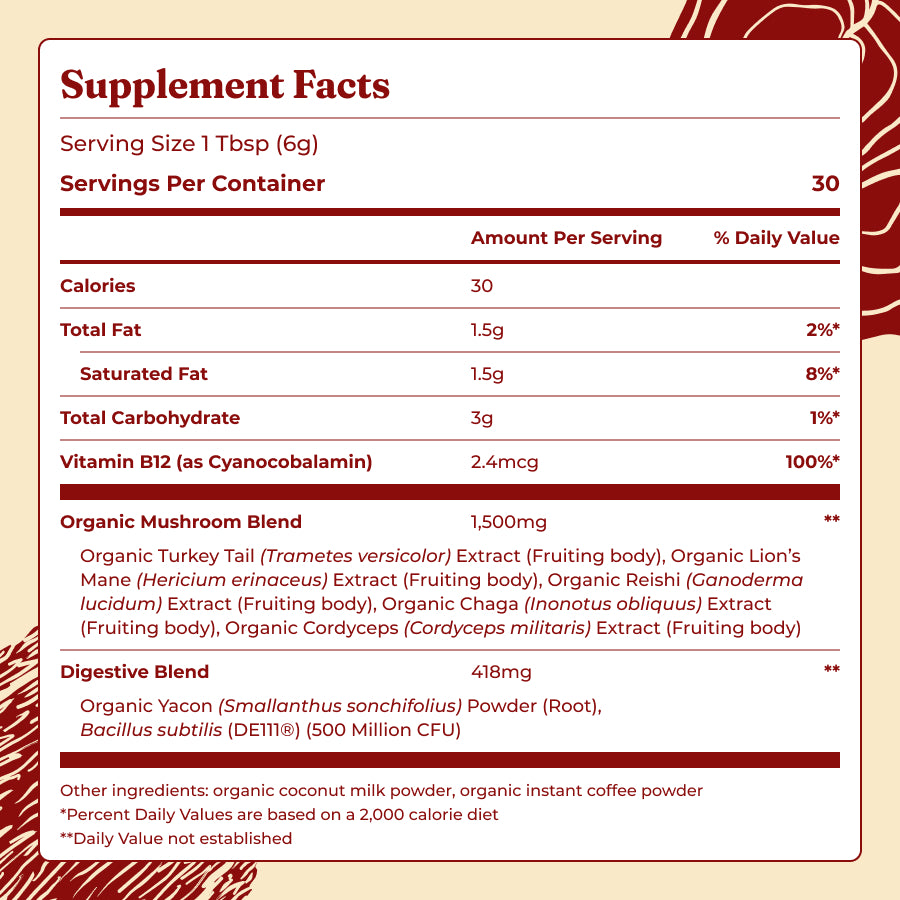
It depends on the brand. Of the seven mushroom coffees I’ve scored, three state fruiting body for every mushroom (Four Sigmatic, Everyday Dose, Cuppa). Two use mycelium grown on oats or sorghum (Om; MUD\WTR, a coffee alternative). Two don’t say for every mushroom: RYZE, whose label says “2,000MG full spectrum mushroom” across six species, and Laird, whose fruiting-body statement covers only its extracts.
How does the Scorecard score fruiting body vs mycelium?
It’s check 1 of the five label checks:
| Score | Rule |
|---|---|
| 2 | 100% fruiting body, stated on the label or product page |
| 1 | A blend of fruiting body and mycelium with the split stated; or mycelium grown on a non-grain medium (such as liquid culture), stated |
| 0 | Mycelium grown on grain (“myceliated grain”, “full spectrum” with grain), or the source isn’t stated |
Unknown scores 0. In lion’s mane, five of the eight products score 2, and the three grown on grain score 0.
Part of How to choose a mushroom supplement Check 1 of the five label checks.
Three quick questions about mycelium
Is mycelium bad?
No. Some brands grow it in liquid, without grain, and state its erinacine A content. What the Scorecard marks down is mycelium sold with its grain and no lab numbers.
Which use fruiting bodies: Real Mushrooms, Host Defense or Oriveda?
The lion’s mane capsules I scored from Real Mushrooms and Oriveda are fruiting-body extracts. Both brands also sell liquid-grown lion’s mane mycelium, with no grain. Host Defense’s lion’s mane label says “mycelium/fermented brown rice biomass”, and the three-brand comparison sets all three side by side.
Can I tell fruiting body from mycelium by looking at the powder?
Not by any method I can source. The studies above used lab tests, so check the label and a certificate with alpha- and beta-glucan lines.
Sources
- Mycology at Home Scorecard data (CSV): every product row, score, label statement and certificate link on this page. /mushroom-supplement-scorecard/ (CSV linked there). checked 22 Nov 2026
- Real Mushrooms, SGS Canada reports VR26-03674.008 (Jul 2026, 41.0%) and VR25-01992.002 (Apr 2025, alpha-glucan 3.6%), one image. realmushrooms.com checked 22 Nov 2026
- Real Mushrooms, Lion’s Mane capsules page, US label (microcrystalline cellulose) and Real Mycelium page. realmushrooms.com · cdn.shopify.com · realmushrooms.com checked 22-23 Nov 2026
- Oriveda, Eurofins certificate 5533050-0, lot 2026-27B (Sep 2026). oriveda.com checked 22 Nov 2026
- Oriveda, US page, certificates page and FAQ. us.oriveda.com · oriveda.com · oriveda.com checked 22 Nov 2026
- Nootropics Depot, Omnient Labs certificate ND-26-1133 (Sep 2026). cdn11.bigcommerce.com checked 22 Nov 2026
- Mushroom Revival, brand-issued certificate (2021) and label. cdn.shopify.com · mushroomrevival.com checked 22 Nov 2026
- FreshCap, product page and label. freshcap.com checked 22 Nov 2026
- Host Defense, product page and label images. hostdefense.com · hostdefense.com · hostdefense.com checked 22 Nov 2026
- Host Defense, FAQ (rice, polysaccharides, gluten). hostdefense.com checked 22 Nov 2026
- Fungi Perfecti, “Myceliated Grain vs Filler” (5 Jan 2023). fungi.com checked 22 Nov 2026
- Fungi Perfecti, “Beyond Beta-Glucans” (5 Nov 2026). fungi.com checked 22 Nov 2026
- Doar E, et al. Immuno 2026;6(1):2. doi.org/10.3390/immuno6010002 checked 22 Nov 2026
- Om, Lion’s Mane capsules product page and label. ommushrooms.com checked 22 Nov 2026
- Genius, Lion’s Mane product page and label. thegeniusbrand.com checked 22 Nov 2026
- Windsor C, et al. Int J Mol Sci 2025;26(7):2970. doi.org/10.3390/ijms26072970 checked 22 Nov 2026
- Wu DT, et al. Sci Rep 2017;7:7792. doi.org/10.1038/s41598-017-06336-3 checked 22 Nov 2026
- McCleary BV, Draga A. J AOAC Int 2016;99(2):364-373 (abstract). doi.org/10.5740/jaoacint.15-0289 checked 22 Nov 2026
- Megazyme (Neogen), K-YBGL instructions (09/25: “NOT applicable” in the presence of other beta-glucans such as cellulose) and validation report (09/25: “over-recovery of β-glucan if sample contains cellulose”). www-docs.megazyme.com · www-docs.megazyme.com checked 23 Nov 2026
- Corana F, et al. Molecules 2019;24(19):3511. doi.org/10.3390/molecules24193511 checked 22 Nov 2026
- Lee MW, et al. Mycobiology 2008;36(4):199-202. doi.org/10.4489/myco.2008.36.4.199 checked 22 Nov 2026
- Nagano M, et al. Biomed Res 2010;31(4):231-237. doi.org/10.2220/biomedres.31.231 checked 22 Nov 2026
- Mori K, et al. Phytother Res 2009. PMID 18844328. pubmed.ncbi.nlm.nih.gov/18844328 checked 22 Nov 2026
- Saitsu Y, et al. Biomed Res 2019;40(4):125-131. PMID 31413233. pubmed.ncbi.nlm.nih.gov/31413233 checked 22 Nov 2026
- Docherty S, et al. Nutrients 2023;15(22):4842. PMID 38004235. pubmed.ncbi.nlm.nih.gov/38004235 checked 22 Nov 2026
- Ornish D, et al. Alzheimer’s Res Ther 2024;16(1):122. doi.org/10.1186/s13195-024-01482-z checked 22 Nov 2026
- 21 CFR 101.91, gluten-free labeling of foods. ecfr.gov checked 22 Nov 2026
- FDA, Questions and Answers: Gluten-Free Food Labeling Final Rule. fda.gov checked 22 Nov 2026
- RYZE, label image. cdn.shopify.com checked 22 Nov 2026
- Four Sigmatic, Original Mushroom Coffee label. us.foursigmatic.com checked 22 Nov 2026
- Coffee rows (Four Sigmatic Focus, Everyday Dose, Om, Laird, Cuppa, MUD\WTR): the label and product links in the Scorecard CSV (source 1). checked 22 Nov 2026
- Chu TT, et al. Br J Nutr 2012;107(7):1017-1027. PMID 21801467 (reishi extract, 1.44 g a day). doi.org/10.1017/S0007114511003795 checked 23-24 Nov 2026
- Zhao H, et al. Evid Based Complement Alternat Med 2012;2012:809614. PMID 22203880 (reishi spore powder, 3.0 g a day). doi.org/10.1155/2012/809614 checked 23-24 Nov 2026
- Chen S, et al. J Altern Complement Med 2010;16(5):585-590. PMID 20804368 (Cs-4, about 3 g a day). pmc.ncbi.nlm.nih.gov checked 23-24 Nov 2026
- Farzan, Koushkie Jahromi. PLoS One 2026;21(7):e0351725. PMID 42455764 (the only controlled trial found naming dried cordyceps fruiting body or its extract: one 1 g dose, not daily). doi.org/10.1371/journal.pone.0351725 checked 23-24 Nov 2026
- Li IC, et al. Front Aging Neurosci 2020;12:155. PMID 32581767 (liquid-grown lion’s mane mycelium, 1.05 g a day, 49 weeks). doi.org/10.3389/fnagi.2020.00155 checked 27 Nov 2026




Cite this page
Quoting with a link is always fine. The Scorecard data and my own charts are free to reuse under CC BY 4.0: add "CC BY 4.0" to the citation. Photos and the page text aren't covered.
Citation
Rowan Hale, "Fruiting Body vs Mycelium: What's Really in the Capsule", Mycology at Home, https://mycologyathome.com/fruiting-body-vs-mycelium/. Data checked 22 Nov 2026. Retrieved [the date you read it].
Tap the citation to select it.
- Key findings
- Sources on this page
- Scorecard data (CSV)
- CC BY 4.0Data and my charts only