
 By
Lion’s mane trials in grams and weeks#
- In Nagano 2010, 30 women ate cookies with 2.0 g of lion’s mane fruiting-body powder a day, or placebo cookies, for 4 weeks and filled in four questionnaires [1].
- Saitsu 2019 compared 3.2 g a day of powdered lion’s mane fruiting body with a placebo in 34 healthy people over 50 for 12 weeks, testing them at 0, 6 and 12 weeks [3].
- Docherty 2023 split 43 healthy adults aged 18 to 45 between a placebo and 1.8 g a day of a lion’s mane blend whose part the paper doesn’t name, for 28 days [4].
Figures as of 23 Nov 2026.Free to quote with a link.How to cite
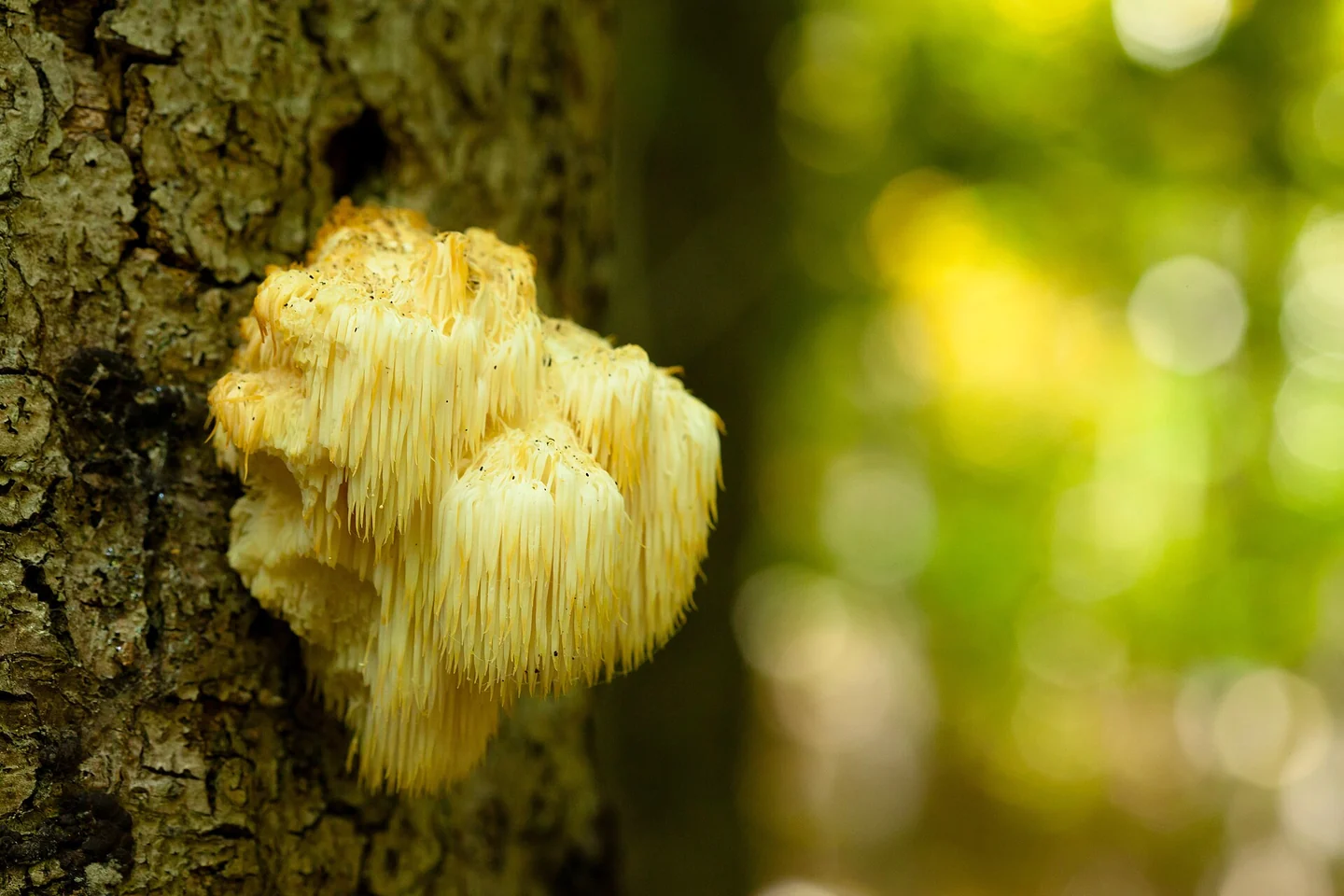
How much lion’s mane per day did the studies use?
| Study | Daily amount | Form | How long | Paper |
|---|---|---|---|---|
| Li 2020 | 1.05 g (3 capsules of 350 mg) | mycelium grown in liquid culture, freeze-dried and enriched with erinacine A (5 mg/g); not an extract, not grown on grain | 49 weeks | PMID 32581767 |
| Docherty 2023 | 1.8 g (3 capsules of 600 mg) | “proprietary blend of organic H. erinaceus mushroom complex”; fruiting body or mycelium not stated | 28 days | PMID 38004235 |
| Smith 2026 | 1.8 g (3 capsules of 600 mg) | the same blend as Docherty 2023 (SO-DSX1); the abstract calls it “powdered”; fruiting body or mycelium not stated | 28 days | PMID 42978868 |
| Nagano 2010 | 2.0 g (4 cookies, 0.5 g each) | powdered fruiting body, baked into cookies | 4 weeks | PMID 20834180 |
| Mori 2009 | 3.0 g of tablets (12 × 250 mg), about 2.9 g of powder | tablets of 96% dried lion’s mane powder; part not stated in the abstract | 16 weeks | PMID 18844328 |
| Saitsu 2019 | 3.2 g (4 × 0.8 g) | powdered fruiting body | 12 weeks | PMID 31413233 |
Which form of lion’s mane did the trials use?
Two of the six trials state powdered lion’s mane fruiting body, 2.0 g and 3.2 g a day. Mori 2009’s tablets were 96% dried lion’s mane powder, but its abstract doesn’t say which part of the mushroom. None of those three used an extract. Docherty 2023 and Smith 2026 gave the same blend, and neither paper names the part.
Li 2020’s mycelium was grown in a liquid medium in fermenters, then freeze-dried and put into capsules, with 5 mg of erinacine A per gram. That’s not an extract. It’s also a different form from mycelium grown on grain.
The 2.0 g in Nagano 2010 is the low end the Scorecard’s dose check uses for fruiting body, as the study-dose table sets out. Docherty’s and Smith’s 1.8 g isn’t, because neither paper says which part it was. Li’s 1.05 g counts only for a label that states Li’s form, and nothing I’ve scored does.
Which lion’s mane trials are left out?
Ornish et al. 2024 isn’t in my table. Its intervention group took “Lion’s Mane, Stamets Host Defense, 2 grams/day” as one of eight supplements, alongside diet, exercise and stress management; the control group got usual care, not a placebo. The mushroom’s own part can’t be separated, so the trial can’t set a dose for any form.
Three trials of lion’s mane alone against a placebo aren’t in the table either. Surendran 2025 gave one 3 g dose of a fruiting-body extract, and La Monica 2023 one 1 g dose of fruiting body. Each tested people within two hours, and one dose can’t set a daily amount. Grozier 2022 gave 10 g a day, as a 1:1 extract baked into two muffins, for 4 weeks. But it was single-blind, the paper doesn’t say the groups were randomized, and it doesn’t name the part of the mushroom.
Who took part in each lion’s mane trial, and what did it test?
Six small trials, six different groups of people. The results are in the papers, linked in the sources.
Nagano 2010: 2.0 g a day for 4 weeks
- Who: 30 women, average age 41, “with a variety of indefinite complaints and no specified diseases”. 26 were analyzed (12 lion’s mane, 14 placebo).
- Measured: four questionnaires, before and after: the Kupperman Menopausal Index, the CES-D depression scale, the Pittsburgh Sleep Quality Index and an Indefinite Complaints Index.
- Who supplied it: the cookies came from Aso Biotech, a Japanese company that two of the seven authors give as their affiliation. The paper has no funding or conflict-of-interest statement.
Mori 2009: 3.0 g of tablets a day for 16 weeks (abstract only)
- Who: Japanese men and women aged 50 to 80 “diagnosed with mild cognitive impairment”. 30 randomized, 15 per group. How many were analyzed isn’t in the abstract.
- Measured: “a cognitive function scale based on the Revised Hasegawa Dementia Scale”, at weeks 8, 12 and 16 and four weeks after stopping, plus “laboratory tests” the abstract doesn’t name.
- Who supplied it: the abstract doesn’t say who supplied the tablets. The first author works at a mushroom company’s laboratory.
Saitsu 2019: 3.2 g a day for 12 weeks
- Who: people “over 50 years old, healthy”, with a long exclusion list (other supplements, shift work, ongoing medical treatment and pregnancy, among others). 34 took part and 31 were analyzed (16 lion’s mane, 15 placebo), average age about 61.
- Measured: three tests at the start, 6 weeks and 12 weeks: the Mini Mental State Examination, the Benton visual retention test and a verbal paired-associate learning test.
- Who supplied it: the paper doesn’t say who supplied the product and has no funding or conflict-of-interest statement. The authors are at three universities and the Radiation Effects Association; two of them also wrote Nagano 2010.
Docherty 2023: 1.8 g a day for 28 days
- Who: healthy adults aged 18 to 45 (average 26) at Northumbria University. The paper calls it a pilot study. 43 were randomized (22 lion’s mane, 21 placebo) and 41 completed the 28 days.
- Measured: a computer battery of word recall, working memory, reaction time and other tasks (COMPASS), plus mood and stress scales, including the 10-item Perceived Stress Scale. The researchers tested people before and 60 minutes after their first dose, then again on day 29.
- Who supplied it: Sempera Organics provided the capsules (its “SO-DSX1”). The paper says the company had no role in the design, analysis or publication, and reports no other outside funding.
Smith 2026: the same 1.8 g a day for 28 days
- Who: 84 women aged 18 to 26 (average about 22) with self-reported anxiety or stress and no psychiatric diagnosis, split between lion’s mane (29), a lion’s mane and reishi blend (27), and a placebo (28).
- Measured: the GAD-7 as the main measure, plus the HADS anxiety subscale, the Perceived Stress Scale, stress rating scales, the Chalder Fatigue Scale and the Rosenberg Self-Esteem Scale. Some were repeated at home on days 7, 14, 21 and 42, and people answered open questions on days 28 and 42.
- Who supplied it: the same company as Docherty 2023 sent the products in bulk, and the researchers filled the capsules. The paper says the company had no role in the design, analysis or publication. The university funded the study, and the authors declare no conflicts.
Li 2020: 1.05 g a day for 49 weeks
- Who: people over 50 with mild Alzheimer’s disease, “probable AD” by two sets of diagnostic criteria (DSM-IV and NINCDS-ADRDA). 68 were recruited, 49 randomized and 41 analyzed (20 lion’s mane, 21 placebo), with average ages of about 74 and 77 in the two groups.
- Measured: four scales at weeks 0, 13, 25 and 49: the Neuropsychiatric Inventory, the Cognitive Abilities Screening Instrument, the Mini Mental State Examination and the Instrumental Activities of Daily Living scale. Also eyesight (visual acuity and contrast sensitivity), blood markers including amyloid-β and BDNF, and diffusion tensor MRI.
- Who supplied it: a company supplied research materials and paid five of the authors’ salaries. The paper says it “did not have any additional role”.
How long does lion’s mane take to work?
The trials only tell you when each one looked, and how people took it. All six gave lion’s mane every day for the whole trial:
- Docherty 2023: 28 days, all three capsules together “every morning after having breakfast”. Tested 60 minutes after the first dose and on day 29.
- Smith 2026: 28 days, all three capsules “in the morning, with breakfast”. Questionnaires every week, and a follow-up on day 42.
- Nagano 2010: 4 weeks, four cookies “at any time of a day”. Tested before and after.
- Saitsu 2019: 12 weeks, with no timing given. Tested at 6 and 12 weeks.
- Mori 2009: 16 weeks, four tablets three times a day, with no mention of meals in the abstract. Tested at 8, 12 and 16 weeks, and 4 weeks after stopping.
- Li 2020: 49 weeks, three capsules a day, taken “with meals”. Tested at weeks 0, 13, 25 and 49.
None of them compared morning with night, and only Li 2020 ran past 16 weeks. Those are the lengths the researchers chose. They say nothing about when, or whether, you’d notice anything.
How do labels compare? Capsules, powders and extract ratios
Labels and trials use different units. The trials gave grams of dried mushroom. A capsule label gives milligrams of extract, sometimes with a ratio. So the Scorecard puts them on one scale:
- Grams of mushroom a day = grams of extract a day × the stated ratio. 0.5 g of an 8:1 extract counts as 4.0 g.
- No ratio on the label? It counts as 1:1. 1.0 g of extract counts as 1.0 g.
- Mycelium grown on grain has nothing to compare with. No controlled trial I could find says it tested this form on its own, so there’s no studied amount to hold it against.
Counting an extract at its ratio doesn’t make it the same thing as a pile of powder, though.
How many scored lion’s mane capsules reach 2.0 g a day?
Of the 8 lion’s mane capsules I’ve scored, 3 reach 2.0 g of mushroom a day at the label serving, 2 give 0.9 to 1.0 g, and 3 use mycelium grown on rice or oats.
| Form on the label | Products | Mushroom a day at the label serving |
|---|---|---|
| Fruiting-body extract, ratio 3:1 or higher (3:1, 8:1, 14:1) | 3 | 3.0 to 14 g by the stated ratio: all above 2.0 g |
| Fruiting-body extract, 1:1 or no ratio stated | 2 | 0.9 g and 1.0 g: about half of 2.0 g |
| Mycelium grown on brown rice | 1 | 1.0 g: no controlled trial to compare with |
| Mycelium and fruiting body grown on oats, split not stated | 2 | 1.2 g and 2.0 g: no controlled trial to compare with |
Has anyone studied oat-grown lion’s mane?
One uncontrolled study has used an oat-grown form. In Evans et al. 2026, 10 healthy adults took lion’s mane “mycelial biomass and fruiting body cultured on organic whole oats”, supplied by M2 Ingredients, at 2 g a day for 28 days, in one group with no placebo or comparison arm. A study with no comparison group can’t set a dose bar.
Your own label against 2.0 g: Find the extract ratio on the label and multiply. No ratio? Count it as 1:1. Mycelium grown on rice or oats? There’s no trial amount to compare it with. That’s the dose check, one of the five label checks, done by hand.
Can you take too much lion’s mane? Side effects
The most in my table is 3.2 g a day of powdered fruiting body, for 12 weeks (Saitsu 2019). The longest run of powder is Mori 2009, about 2.9 g a day for 16 weeks. Li 2020 ran longer, 49 weeks, but at 1.05 g a day of its liquid-grown mycelium.
What did the trials report about side effects?
The papers say little about it:
- Neither Nagano 2010 nor Saitsu 2019 has a section on adverse events.
- Mori 2009’s abstract mentions “laboratory tests” without naming them.
- Docherty 2023’s flow chart lists one withdrawal for an “adverse event” in each group, lion’s mane and placebo, but the paper doesn’t describe either one.
- In Li 2020, three people taking lion’s mane dropped out over side effects (abdominal discomfort, nausea and a skin rash), and one taking the placebo (nausea).
For side effects and interactions, start with Memorial Sloan Kettering’s About Herbs page on lion’s mane, which lists reported side effects, and NIH’s LiverTox record. The box below links both. Whether a capsule holds lead is a separate question, and lab reports, not trials, answer it.
Health questions: this site rates what’s in the bottle and how well it’s documented. It doesn’t say what any product does for you, and it isn’t medical advice. Whether a supplement suits you, or is safe with your medicines or a health condition, is a question for your doctor or pharmacist. Read the medical disclaimer. For background: Memorial Sloan Kettering’s About Herbs entry on lion’s mane, the NIH’s LiverTox entry on lion’s mane and the NIH Office of Dietary Supplements’ Dietary Supplements: What You Need to Know.
Does lion’s mane work? Where these trials fall short
That’s the question behind “does lion’s mane clear brain fog” and “is lion’s mane good for anxiety”. I don’t answer it here, and six small trials are a thin base for anyone who does:
- Small, and mostly short: 30 to 84 people each at the start, followed for 28 days to 16 weeks, apart from Li 2020’s 49 weeks.
- Specific groups: each trial enrolled one group (above), so none tells you about people outside it.
- Company ties: in four trials a company supplied the product or research materials, and two of those used the same company’s blend. Two of Nagano’s authors list its supplier as their affiliation, and Li’s supplier paid five authors’ salaries. Mori’s first author also lists a mushroom company. One paper doesn’t name its supplier, and one abstract doesn’t say.
- Not today’s bottles: not one of the six papers (Mori’s abstract only) names a capsule I’ve scored.
Lion’s mane beta-glucans, coffee and growing your own
Does lion’s mane have beta-glucans? Yes, and a named lab’s certificate can show how much. Of the eight lion’s mane capsules I’ve scored, two publish an enzymatic beta-glucan figure on one, and three publish no figure at all.
Lion’s mane coffee. Lion’s mane is in all seven mushroom coffees I score, but just two say how much a serving holds.
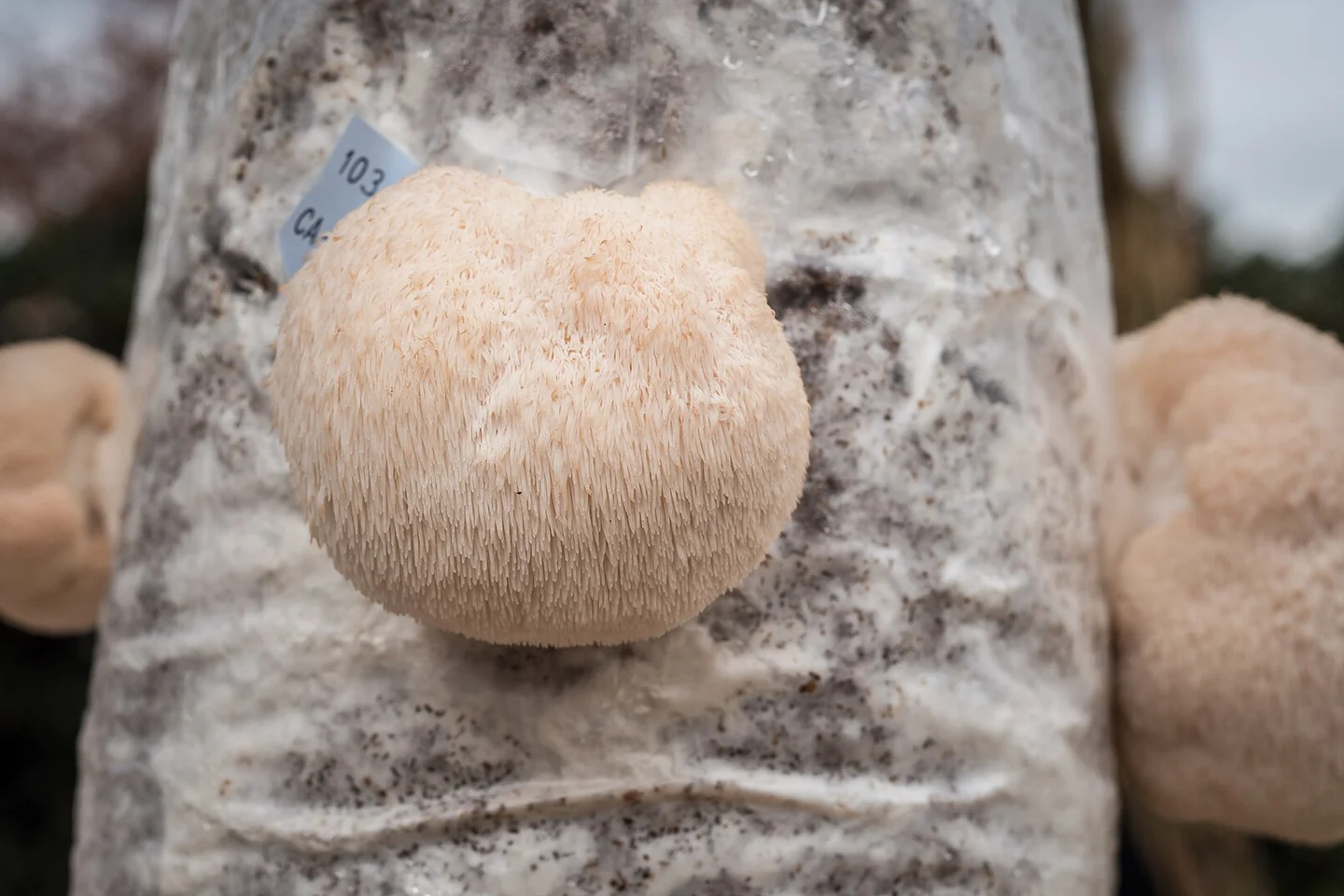
Growing your own. A plate of lion’s mane you grew at home and cooked doesn’t count as a dose here.
Ranked by Scorecard total: the eight capsules, each with its dose check, in best lion’s mane supplement.
- How to read a mushroom supplement label
- How to read a certificate of analysis
- Fruiting body vs mycelium
- Beta-glucans and price per gram
- Lion's mane products ranked
- The Scorecard
- Mushroom coffee
- Reishi dosage
- Cordyceps dosage
Part of How to choose a mushroom supplement The dose check, for lion's mane.
Lion’s mane capsule sizes, medicines, pregnancy and drug tests
What’s the lion’s mane dosage for adults?
All six trials in my table were in adults, from 18 up, three of them in people aged 50 or older. Three gave dried lion’s mane powder, from 2.0 to 3.2 g a day. Two of those papers state fruiting body, and Mori 2009’s abstract doesn’t say which part. Two more gave 1.8 g of the same blend, part not stated, and Li 2020 gave 1.05 g of mycelium grown in liquid culture.
Is a 500 mg capsule of lion’s mane enough?
Next to the trials, it depends on the ratio. At 1:1 or no ratio stated, one 500 mg capsule counts as 0.5 g of mushroom, a quarter of the 2.0 g low end. At 4:1 it counts as 2.0 g, and at 8:1, 4.0 g. I can’t set mycelium on grain against anything, because no controlled trial I could find says it tested that form on its own.
Does fresh lion’s mane count toward the study amount?
Not in a way I can measure. Most of the trials gave dried powder or freeze-dried mycelium, weighed in grams, and a fresh weight doesn’t compare with dried grams.
Can you take lion’s mane with antidepressants?
Ask your doctor or pharmacist, with the bottle in hand. Memorial Sloan Kettering’s lion’s mane page says to talk with your healthcare providers before taking lion’s mane supplements, and NIH’s Office of Dietary Supplements says supplements “can also interact with some medicines”.
Is lion’s mane safe during pregnancy?
Ask your doctor. Saitsu 2019 listed pregnancy among its exclusions. NIH’s Office of Dietary Supplements also says many supplements “have not been well tested for safety” in women who are pregnant or nursing.
Can lion’s mane get you high, or show up on a drug test?
NIH’s LiverTox describes lion’s mane as “an edible mushroom” that has been used widely as a food. Britannica’s entry on psilocybin mushrooms lists Psilocybe and ten other genera with psilocybin-containing species. Lion’s mane’s genus, Hericium, isn’t among them. If a drug test matters to you, ask the lab that runs it what it screens for, and show them the label.
Sources
- Nagano M, Shimizu K, Kondo R, et al. Biomedical Research 2010;31(4):231-237. PMID 20834180. doi.org/10.2220/biomedres.31.231 (full text) checked 22-23 Nov 2026
- Mori K, Inatomi S, Ouchi K, et al. Phytotherapy Research 2009;23(3):367-372. PMID 18844328. doi.org/10.1002/ptr.2634 (abstract and first author’s affiliation through Europe PMC; full text paywalled) checked 23 Nov 2026
- Saitsu Y, Nishide A, Kikushima K, Shimizu K, Ohnuki K. Biomedical Research 2019;40(4):125-131. PMID 31413233. doi.org/10.2220/biomedres.40.125 (full text) checked 23 Nov 2026
- Docherty S, Doughty FL, Smith EF. Nutrients 2023;15(22):4842. PMID 38004235, PMC10675414. doi.org/10.3390/nu15224842 (full text and Figure 1) checked 23 Nov 2026
- Ornish D, et al. Alzheimer’s Research & Therapy 2024;16:122. PMID 38849944. doi.org/10.1186/s13195-024-01482-z (full text) checked 23 Nov 2026
- Evans C, et al. Nutrients 2026;18(19):3177 (10 people, one group, no placebo, 28 days). PMC13666732. doi.org/10.3390/nu18193177 checked 23 Nov 2026
- Mycology at Home Scorecard data (CSV): forms, servings and ratios of the eight lion’s mane capsules; the seven coffees’ lion’s mane listings. /mushroom-supplement-scorecard/ checked 22-23 Nov 2026
- Memorial Sloan Kettering Cancer Center, About Herbs: Lion’s Mane Mushroom (last updated 19 Nov 2025). mskcc.org checked 23 Nov 2026
- NIH LiverTox, “Lion’s Mane” (last update 5 Jan 2024; PMID 38289992). ncbi.nlm.nih.gov checked 23 Nov 2026
- NIH Office of Dietary Supplements, Dietary Supplements: What You Need to Know (updated 4 Jan 2023). ods.od.nih.gov checked 23 Nov 2026
- Encyclopaedia Britannica, “Psilocybin mushroom” (genera with psilocybin-containing species). britannica.com checked 23 Nov 2026
- Li IC, Chang HH, Lin CH, et al. Frontiers in Aging Neuroscience 2020;12:155. PMID 32581767, PMC7283924. doi.org/10.3389/fnagi.2020.00155 (full text) checked 27 Nov 2026
- Smith EF, Docherty S. Frontiers in Nutrition 2026;13:1887408. PMID 42978868, PMC13727649. doi.org/10.3389/fnut.2026.1887408 (full text) checked 27 Nov 2026
- Grozier CD, Alves VA, Killen LG, et al. International Journal of Exercise Science 2022;15(2):1366-1380. PMID 36582308, PMC9762243. doi.org/10.70252/xzko8571 (full text) checked 27 Nov 2026
- Surendran G, Saye J, Binti Mohd Jalil S, et al. Frontiers in Nutrition 2025;12:1405796. PMID 40276537, PMC12018234. doi.org/10.3389/fnut.2025.1405796 (full text) checked 27 Nov 2026
- La Monica MB, Raub B, Ziegenfuss EJ, et al. Nutrients 2023;15(24):5018. PMID 38140277, PMC10745489. doi.org/10.3390/nu15245018 (full text) checked 27 Nov 2026
Image credits
- “Lion’s mane mushroom (25639633041)” by Melissa McMasters, via Wikimedia Commons, CC BY 2.0.
- “2013 Harvest Festival and Farmer’s Market Outdoors Season Closure (20131122-NRCS-LSC-0045)” by Lance Cheung, USDA, via Wikimedia Commons, public domain (US government work, USDA), cropped.


Cite this page
Quoting with a link is always fine. The Scorecard data and my own charts are free to reuse under CC BY 4.0: add "CC BY 4.0" to the citation. Photos and the page text aren't covered.
Citation
Rowan Hale, "Lion's Mane Dosage: How Many Grams a Day the Human Trials Gave, and in What Form", Mycology at Home, https://mycologyathome.com/lions-mane/. Data checked 27 Nov 2026. Retrieved [the date you read it].
Tap the citation to select it.
- Key findings
- Sources on this page
- CC BY 4.0Data and my charts only