What I check, in one line each
- What’s in it: 100% fruiting body, a stated blend, or mycelium grown on grain?
- Measured actives: a beta-glucan % on a named lab’s certificate, measured by an enzymatic method.
- Dose: the daily serving against the lowest daily amount controlled human trials used for the same species and form.
- Safety testing: published third-party results for heavy metals and microbes.
- Value: price per gram of beta-glucans against the median for its species (coffee has its own).
- 9-10 Excellent
- 7-8 Good
- 5-6 Fair
- 0-4 Poor
- 2 1 0 points per check; unknown scores 0
What are the five checks?
Two of them lean on beta-glucans, a type of fiber in a mushroom’s cell walls and the number a lab measures. To run the same checks on a bottle in your hand, start with the five label checks.
1. What’s in it: fruiting body or mycelium on grain?
| Score | Rule |
|---|---|
| 2 | 100% fruiting body, stated on the label or product page |
| 1 | A blend of fruiting body and mycelium, with the split stated; or mycelium grown on something other than grain (such as liquid culture), stated |
| 0 | Mycelium grown on grain (“myceliated grain”, “full spectrum” with grain), or the source isn’t stated |
Why: mycelium grown on grain comes with the grain it grew on, so much of the powder can be grain starch rather than mushroom.
2. Measured actives: is there a lab beta-glucan number?
| Score | Rule |
|---|---|
| 2 | Beta-glucan % published on a lab certificate, measured with an enzymatic beta-glucan method (for example Megazyme’s mushroom and yeast beta-glucan kit), ideally for each batch |
| 1 | Beta-glucan % claimed on the label or website without a certificate, or only “polysaccharides” reported (that test also counts starch) |
| 0 | No beta-glucan figure anywhere |
Not scored, but noted: if a certificate also shows alpha-glucans (starch), a high number is a sign of grain filler, and I say so.
Why: a published enzymatic test can measure beta-glucans, and labs print the result on a certificate you can read yourself, so it’s a number you can compare across brands.
3. Dose: does a daily serving reach what the studies used?
| Score | Rule |
|---|---|
| 2 | The recommended daily serving reaches at least the low end of the daily amount used in human studies, for that species and form (extract or whole powder) |
| 1 | It reaches at least half of that amount |
| 0 | Less than half, or the amount per serving isn’t stated (for example, hidden in a “proprietary blend”) |
I compare grams of mushroom material per day. Extracts count at their stated ratio, so 0.5 g of an 8:1 extract counts as 4.0 g. For lion’s mane fruiting body, the bar is 2.0 g a day (the dose table is below).
Why: an amount only means something next to what researchers tested in people, so I judge a serving against what controlled human trials gave.
4. Safety testing: are heavy-metal and microbe results published?
| Score | Rule |
|---|---|
| 2 | Third-party lab results published for heavy metals (lead, arsenic, cadmium, mercury) and microbes, recent or per batch |
| 1 | Some results published (metals only, for example), or “third-party tested” stated with no results shown |
| 0 | Nothing |
I note pesticide results as a plus. They don’t change the score, because few brands publish them and scoring them would mark down nearly everyone equally.
Why: you can check a published result. You can’t check “tested for purity” on its own.
5. Value: what does a gram of beta-glucans cost?
Price per gram of beta-glucans = price ÷ (servings × grams per serving × beta-glucan %)
| Score | Rule |
|---|---|
| 2 | At or below the median of the products I’ve scored in the same group: each capsule species has its own, and so does coffee |
| 1 | Above the median, up to twice it |
| 0 | More than twice the median, or it can’t be calculated (no beta-glucan figure) |
The median moves as I score more products, so I show it live. For lion’s mane capsules it’s currently $2.58 per gram of beta-glucans.
Why: two bottles at the same price can hold very different amounts of what the lab measures. Price per gram puts them on one scale, and you can run it yourself with the price-per-gram calculator.
What if two products have the same total?
When two products have the same total, I rank them in a fixed order: by the safety testing check, then the measured actives check (higher score first on both), then by price per gram of beta-glucans (lower first, unknown last), then by price per serving (lower first). Only products equal on all four share a rank, shown as “5=”. Safety goes first because I think published safety results matter most to a buyer.
Why does unknown score 0?
Because I can only give credit for what a buyer can see. If a label doesn’t say whether the powder is fruiting body or mycelium, I can’t assume the better answer. If there’s no beta-glucan figure, there’s nothing to score, and no way to work out value. And if a blend hides the amount per serving, I can’t compare the dose with anything.
A 0 for an unknown isn’t a finding that the product is bad. It means you can’t know, from what the brand shows.
A brand can fix that by publishing the missing piece (the fruiting-body statement, the certificate, the amount per serving) and sending it to me. Once it’s public and checks out, I rescore.
Which study doses does the Dose check use?
The bar for each species comes from controlled human trials of that mushroom on its own, each checked against the original paper, not a review. The lion’s mane trials are below. Reishi and cordyceps have bars of their own, with their trials on the reishi page and the cordyceps page.
| Study | Who, and for how long | Daily amount | Form |
|---|---|---|---|
| Nagano et al. 2010 | 30 women, mean age about 41 (26 analyzed); placebo-controlled; 4 weeks | 4 cookies × 0.5 g = 2.0 g | powdered fruiting body (not an extract) |
| Mori et al. 2009 | 30 adults aged 50-80; 16 weeks | 12 × 250 mg tablets = 3.0 g tablets ≈ 2.9 g powder | 96% dried lion’s mane (“Yamabushitake”) powder; the abstract doesn’t say which part of the mushroom (full text paywalled) |
| Saitsu et al. 2019 | 34 adults aged 50 and over; 12 weeks | 4 × 0.8 g = 3.2 g | powdered fruiting body |
| Docherty et al. 2023 | 43 healthy adults aged 18-45 randomised (41 analysed); 28 days | 3 × 600 mg = 1.8 g | “proprietary blend of organic H. erinaceus mushroom complex” (SO-DSX1, Sempera Organics); form not stated |
Where the lion’s mane bars come from
The bar for lion’s mane fruiting body (powder or 1:1 extract) is 2.0 g a day, from Nagano 2010. I don’t use Docherty’s 1.8 g as the bar, because the paper doesn’t state the form. Aso Biotech, the company two of Nagano’s authors list as their affiliation, supplied the cookies.
The bar for lion’s mane mycelium grown in a liquid culture, enriched with erinacine A to 5 mg per gram and freeze-dried, is 1.05 g a day, from Li 2020 [15]. Only a label that states that form is matched to it.
Lion’s mane doses from the original papers covers who took part in each trial and what the researchers measured.
The fine print, in plain words
Which trials can set a dose bar
- Only single-mushroom trials set a dose. A trial counts only if it tested the mushroom on its own against a control. One 2024 trial gave lion’s mane at 2 g a day as one of eight supplements, alongside diet, exercise and stress management, against usual care [11]. No one can separate the mushroom’s own part, so that trial can’t set a dose for any form. A study with one group and no placebo or comparison doesn’t set a dose either.
- A dose bar needs daily dosing for at least two weeks. A trial that gave one dose is reported on the page, but it can’t set a bar for a daily serving.
- Every organism and form gets its own bar. A trial of Cordyceps militaris never sets the bar for Cs-4, a fermented mycelium of a different fungus. A label that names no strain or growing medium can’t be matched to a trial, so it scores 0 for dose, and 0 for what’s in it.
- A form no controlled human trial has tested on its own scores 0. Mycelium grown on rice, for example: there’s no controlled trial of it on its own to match the amount to.
How I count a label’s amount
- No ratio on the label? It counts as 1:1. An extract with no stated ratio counts gram for gram.
- I score blends on the species that best matches its study amount. The page names the other mushrooms and their amounts, or says the brand doesn’t state them. A species with no dose table can’t lift the score.
- An amount with no stated source scores 0 for dose, because I can’t match the form to a trial.
What’s in it
- A fruiting-body statement that covers only some of a blend’s mushrooms counts as “source not stated” for the rest, so What’s in it scores 0.
Lab certificates
- A certificate must name the lab that ran the test. A document the brand issued itself, with no lab named, counts as a label claim: 1 for actives, and “claimed, with no third-party results” for safety.
- Subcontracted tests count, said plainly. A certificate issued and signed by a named independent lab still counts when that lab reports one of its tests as subcontracted. The page says so when a test went to an unnamed lab.
- Enzymatic or not. Actives scores 2 only for an enzymatic beta-glucan method. A certificate that uses another method (fluorescence, for example) scores 1, like a label claim.
- If a certificate finds no beta-glucans, actives scores 0, whatever the label or website says. The page reports both the claim and the result.
- Other markers aren’t scored. Cordycepin, adenosine and triterpenes are reported for information. Actives means beta-glucans for every species, which keeps scores comparable across the Scorecard.
- “Accredited lab” isn’t “accredited for this test.” Accreditation covers the tests listed in a lab’s scope, not everything the lab does. I call a result accredited only when the lab’s published scope lists that method. Example: SGS Canada’s Standards Council of Canada scope lists its heavy-metals method and no beta-glucan method [4].
Certificate dates, and figures that may read high
- I show every certificate’s date. For actives, a certificate’s age doesn’t change the score; for safety it can (see Safety testing below). Dates also matter because the main test changed: Megazyme updated its mushroom and yeast beta-glucan kit (K-YBGL) effective October 1, 2025, and says the new version often gives higher results for mushrooms [1]. In the maker’s own comparison, one pure chaga sample went from 12.69% to 16.83% [3]. So I don’t compare a certificate from before the change with one from after as if they came from the same test.
- Cellulose can make the beta-glucan figure read high. Megazyme’s instructions call the kit “NOT applicable” when other beta-glucans such as cellulose are present [2], and its validation report lists cellulose as causing over-recovery of beta-glucan [3]. So when a label lists cellulose (for example microcrystalline cellulose, used as a flow agent), I say so next to the beta-glucan figure: it may read high, by an unknown amount. The score doesn’t change, because the rule as written gives a published enzymatic result a 2. On 23 November 2026 I checked every scored label: Real Mushrooms is the only product that lists cellulose inside the capsule and has a Megazyme figure.
Safety testing
- For safety, only a recent certificate counts: one dated within the last 24 months, or one for the current lot.
- A factory certification isn’t a product test. GMP certification or an NSF facility registration describes the factory, not what’s in this bottle. If that’s all there is, safety scores 0.
- I put legal limits next to lab results. For heavy metals I show the EU’s legal maximums for food supplements: lead 3.0, cadmium 1.0 and mercury 0.10 mg/kg, with no EU supplement limit for arsenic [5]. For microbes I show Australia’s legal standard for complementary medicines taken by mouth that contain natural raw materials (TGO 100, Schedule 1): total aerobic count ≤10⁴ CFU/g, yeast and mold ≤10² CFU/g, Salmonella absent in 10 g, E. coli and S. aureus absent in 1 g [6]. Neither is US law, and I don’t use either to call a product safe or unsafe.
Price
- The regular price, not a sale. I use the brand’s own one-time price for the size its product page shows by default. I note a sale running on the check date but don’t use it. An advertised “was” price counts as the regular price; I note “today only” and Black Friday prices but don’t use them.
- Subscriptions: no subscription discounts. For a subscription-only brand, I use the list price before any discount.
- No US shop of its own? Then the brand’s official US reseller: the one the brand’s own site links to.
- An archived copy counts when the live page won’t load for a check. The price then comes from the Internet Archive’s copy of the brand’s page, with the archive’s date, and the next quarterly rescore checks it live.
- Format and pack count aren’t size. When a product page opens on single-serve packets or a multi-pack, I score the standard multi-serving format at its single-unit price, and pages that quote the price say which format it is.
- I don’t use Amazon prices. Some pages show Amazon’s price in a product box. It never goes into a score or into the Scorecard’s prices.
Value
- Which beta-glucan figure: the latest lab certificate if there is one, otherwise the label.
- Grain can affect a label figure too. Oats have beta-glucans of their own [13], so a figure for mushroom grown on oats may count them. I say so next to the figure, and the score rule doesn’t change.
- Value is provisional until at least 5 products in its group have a figure (for coffee, until I’ve scored 5 of them). A median of two products doesn’t mean much. I mark provisional value scores as provisional, with a note.
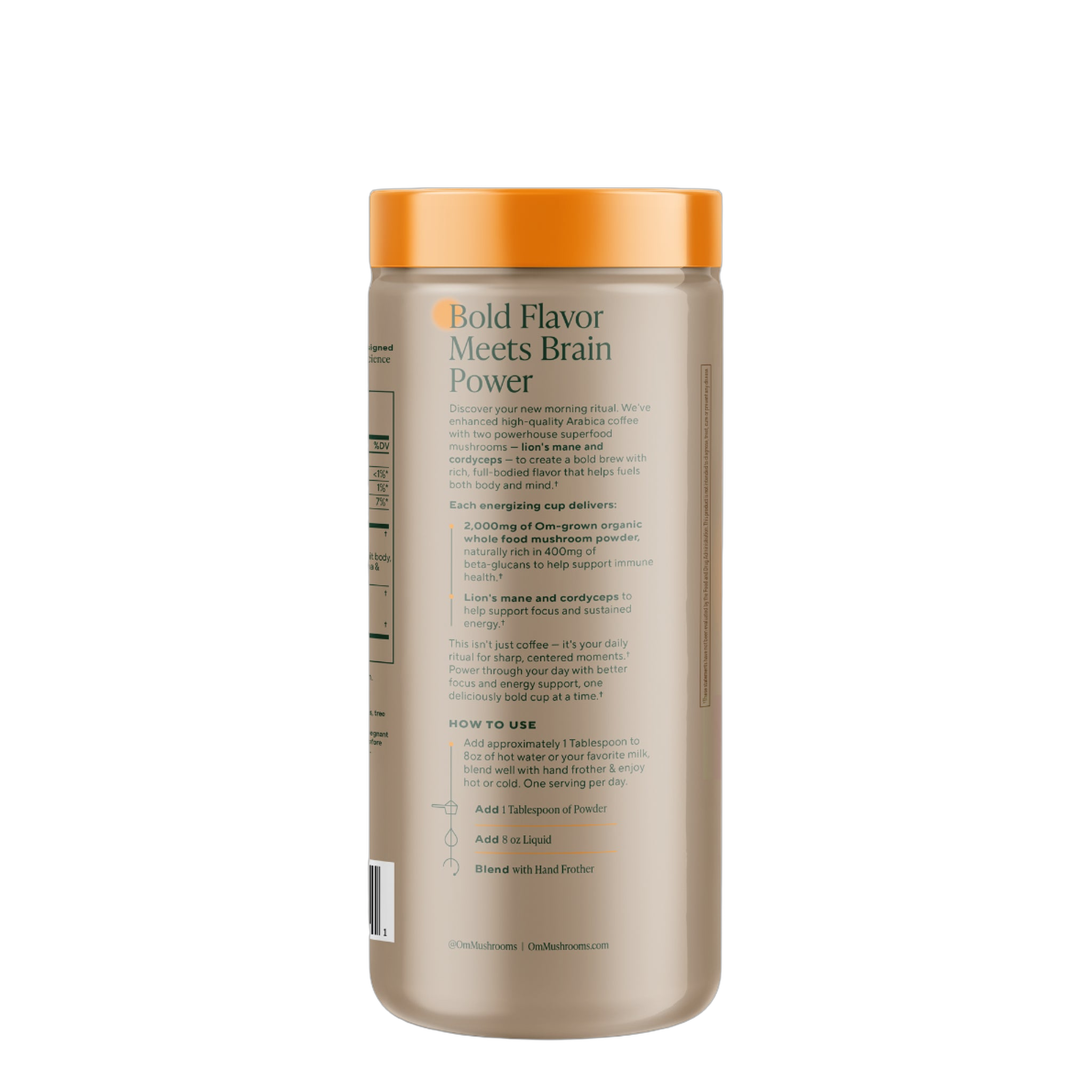
- Fewer than 3 products in a group with a figure? Then I use the lion’s mane capsule median, the largest set I can price. With one product, the “median” would be its own price, and it would always score 2. The score is marked provisional. By 25 November 2026 it covered one product: Om’s coffee, the only coffee with a beta-glucan figure [14].
- Coffee pages also show price per serving, for information. I don’t score it, because Value needs a beta-glucan figure. It only settles ties, as the last step of the order above.
- MUD\WTR stays in the coffee category, labeled “coffee alternative (no coffee)”.
Scorecard rating or hands-on review?
Every scored page carries one of two labels:
- Scorecard rating: scored from the published label, certificates and price. I haven’t bought the product for the page.
- Hands-on review: I bought it with my own money, photographed it and used it.
Hands-on adds photos of the real bottle and label, and what using it was like: taste, routine, cost. It doesn’t add points.
The count today: Scorecard ratings, 30; hands-on reviews, 1.
What can’t this method tell you?
- I don’t run my own lab tests. The lab figures behind every score come from certificates brands published, linked next to the score.
- A certificate describes the sample the lab tested. It may not be the lot in your hands. That’s why I prefer per-batch results and show every certificate’s date.
- I score label statements as written. I can’t confirm “100% fruiting body” beyond what a certificate shows.
- A score rates what the brand documents, not what the product does in your body. A high score means the label, the lab numbers, the serving and the price per gram are clear and checkable. Nothing here is medical advice, as the medical disclaimer explains.
How is money kept out of the scores?
Affiliate links don’t change scores, and commission never breaks a tie. How this site makes money says where the money comes from.
When are scores updated, and how do I report a mistake?
- Dates: every score in the Scorecard shows the date I checked it, and every price carries its own “price checked” date.
- Rescoring: I rescore every product at least once a quarter, and whenever a brand changes the product.
- Corrections: if you think a score is wrong, email hello@mycologyathome.com with the evidence: a label photo, a certificate, a price page. If it checks out, the score changes, and the page that shows it carries a dated note saying what changed and why. Brands are welcome to do the same. Send me a correction.
Can I download the data?
Yes. Download the Scorecard data as a CSV file. It has one row per published product: the label facts, the price and the date I checked it, the beta-glucan figure and its method, the study dose I compared it with, the safety tests, the five check scores, the total, the grade, the label type and the price per gram of beta-glucans, with source links for the label, the certificate and the price.
The data is licensed CC BY 4.0 [12]: you can share and adapt it for any purpose, including commercially, as long as you credit “Mycology at Home (mycologyathome.com)”, link to the license and say if you changed it. To cite it: Mycology at Home Scorecard, [date downloaded], mycologyathome.com.
Does this site use AI?
Research, drafting and fact-checking on this site use AI tools, and every claim is checked against its original source in a separate fact-check pass before a page is published.
Sources
- Megazyme (Neogen), β-Glucan Assay Kit (Yeast & Mushroom), K-YBGL, product page (“a major update to the kit effective October 1, 2025”; “often yielding higher β-glucan results in mushroom samples”). megazyme.com. checked 23 Nov 2026
- Megazyme, K-YBGL product instructions, version 09/25 (“NOT applicable” in the presence of other β-glucans such as cellulose). www-docs.megazyme.com. checked 23 Nov 2026
- Megazyme, K-YBGL validation report, version 09/25 (cellulose “over-recovery of β-glucan”; “Method comparison”, chaga 12.69% → 16.83%). www-docs.megazyme.com. checked 23 Nov 2026
- Standards Council of Canada, scope of accreditation, SGS Canada Inc. (file 15346), ISO/IEC 17025. English scope v13 (accredited 2025-02-08): scc-ccn.ca. Current scope v14 (accredited 2025-08-05; published in French only): scc-ccn.ca. Both list the ICP-MS trace-elements method and no glucan method. checked 23 Nov 2026
- Commission Regulation (EU) 2023/915, maximum levels for food supplements (lead 3.0, cadmium 1.0, mercury 0.10 mg/kg; arsenic limits don’t cover supplements). Consolidated text of 19 Aug 2026: eur-lex.europa.eu. checked 23 Nov 2026
- Therapeutic Goods (Microbiological Standards for Medicines) (TGO 100) Order 2018, Schedule 1 (compilation F2022C00360, in force), Federal Register of Legislation (Australia). legislation.gov.au. checked 23 Nov 2026
- Nagano M, et al. Biomedical Research 2010;31(4):231-237 (full text). PMID 20834180. doi.org/10.2220/biomedres.31.231. checked 22-23 Nov 2026
- Mori K, et al. Phytotherapy Research 2009;23(3):367-372 (abstract). PMID 18844328. pubmed.ncbi.nlm.nih.gov/18844328. checked 23 Nov 2026
- Saitsu Y, et al. Biomedical Research 2019;40(4):125-131 (full text). PMID 31413233. doi.org/10.2220/biomedres.40.125. checked 23 Nov 2026
- Docherty S, et al. Nutrients 2023;15(22):4842 (full text). PMID 38004235. doi.org/10.3390/nu15224842. checked 23 Nov 2026
- Ornish D, et al. Alzheimer’s Research & Therapy 2024;16:122 (full text). PMID 38849944. doi.org/10.1186/s13195-024-01482-z. checked 23 Nov 2026
- Creative Commons, Attribution 4.0 International (CC BY 4.0), legal code: creativecommons.org (plain-language summary: creativecommons.org). checked 23 Nov 2026
- Windsor C, et al. International Journal of Molecular Sciences 2025;26(7):2970 (full text; chaga grown on oats or rice: beta-glucan “comparable to their cereal substrates”). doi.org/10.3390/ijms26072970. checked 22 Nov 2026
- Om, Mushroom Coffee Blend canister side panel (a beta-glucan figure per cup; no method, lab or certificate named). ommushrooms.com. checked 25 Nov 2026
- Li IC, et al. Frontiers in Aging Neuroscience 2020;12:155 (full text). PMID 32581767. doi.org/10.3389/fnagi.2020.00155. checked 27 Nov 2026