
 By
US law lets a supplement print one without FDA approval, and without showing its evidence to FDA or to you, as long as it names no disease and the label carries FDA’s disclaimer [1][8]. All 31 products in my claims audit make claims like these on their sales pages [21].
I started this site partly because of RYZE’s ads, which I kept getting. The law allows that kind of wording. I still think a lot of it stretches the truth.
Rules and rulings on supplement claims#
- FDA’s letter of 11 Dec 2025 says it intends to use enforcement discretion on the rule that the supplement disclaimer appear on each label panel with a structure/function claim, and the Federal Register shows no proposed or final rule to change it [11][12].
- HHS’s Office of Inspector General reported in 2012 that, in a sample of 127 weight-loss and immune-support supplements, none of the 557 human studies the makers sent in met all four of FDA’s recommended elements, and “only 2 percent” were of the actual products [13].
- In NAD case #7563 (16 Sep 2026), a study on “the same dose of saffron” as Alice Mushrooms’ chocolate supported a narrower saffron claim, but the National Advertising Division found its evidence for L-theanine and kanna “was not a good fit” [18].
Figures as of 25 Nov 2026.Free to quote with a link.How to cite
What is a structure/function claim?
It’s a statement that “describes the role of a nutrient or dietary ingredient intended to affect the structure or function in humans”. The Dietary Supplement Health and Education Act (DSHEA) wrote that into law in 1994 [1]. FDA’s own example is “calcium builds strong bones” [5].
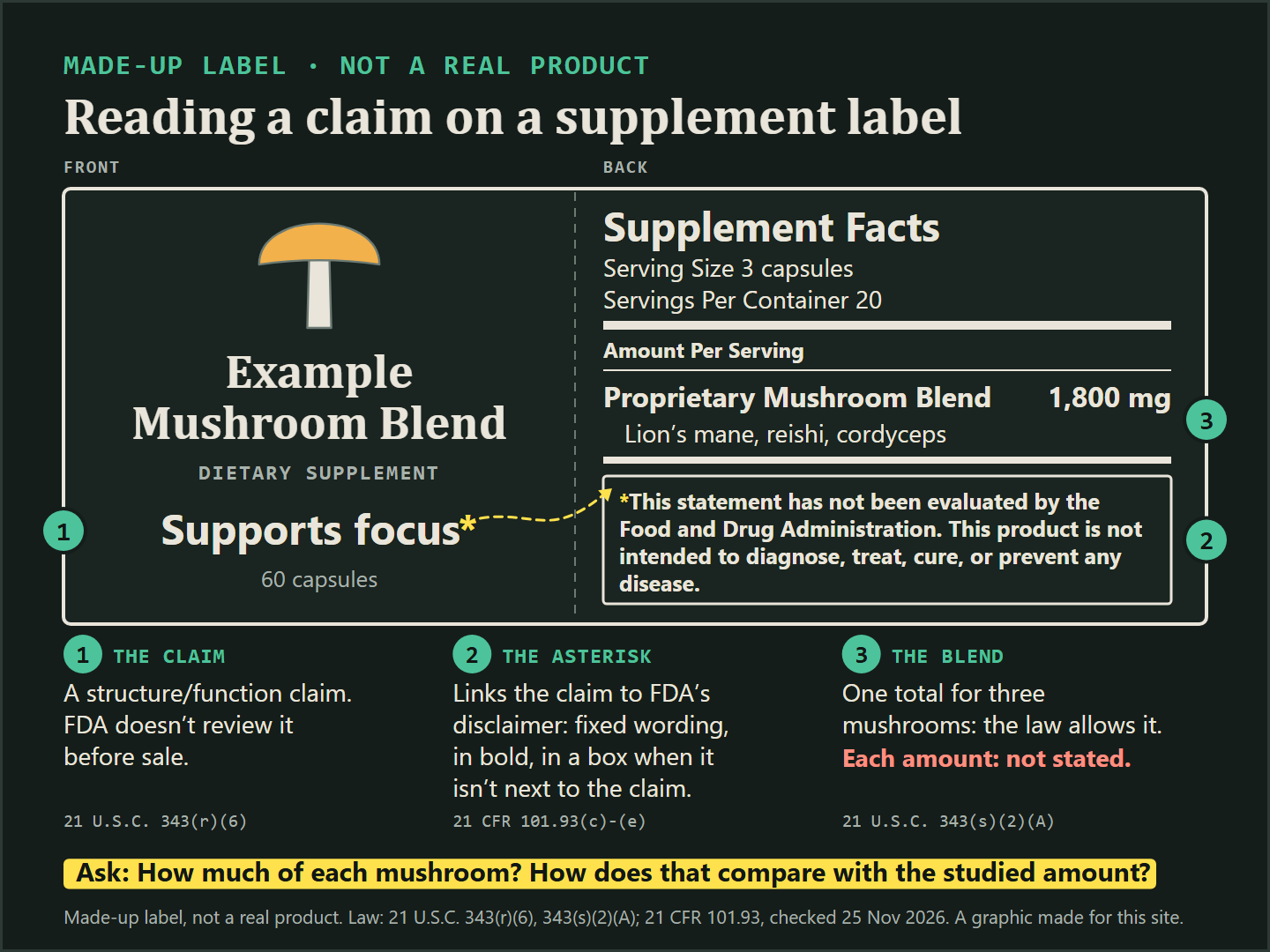
The law sets three conditions. The company must have substantiation that the claim is “truthful and not misleading”. The label must carry FDA’s disclaimer, in bold. And FDA must hear about the claim “no later than 30 days after the first marketing”. The claim also may not say the product can “diagnose, mitigate, treat, cure, or prevent a specific disease” [1].
Nobody approves anything in that list. The evidence stays with the company, and FDA hears about the claim after the product is on sale.
Structure/function claim vs health claim
A health claim ties a substance to a disease or a health-related condition, and FDA reviews it before use [4]. A structure/function claim needs nobody’s sign-off.
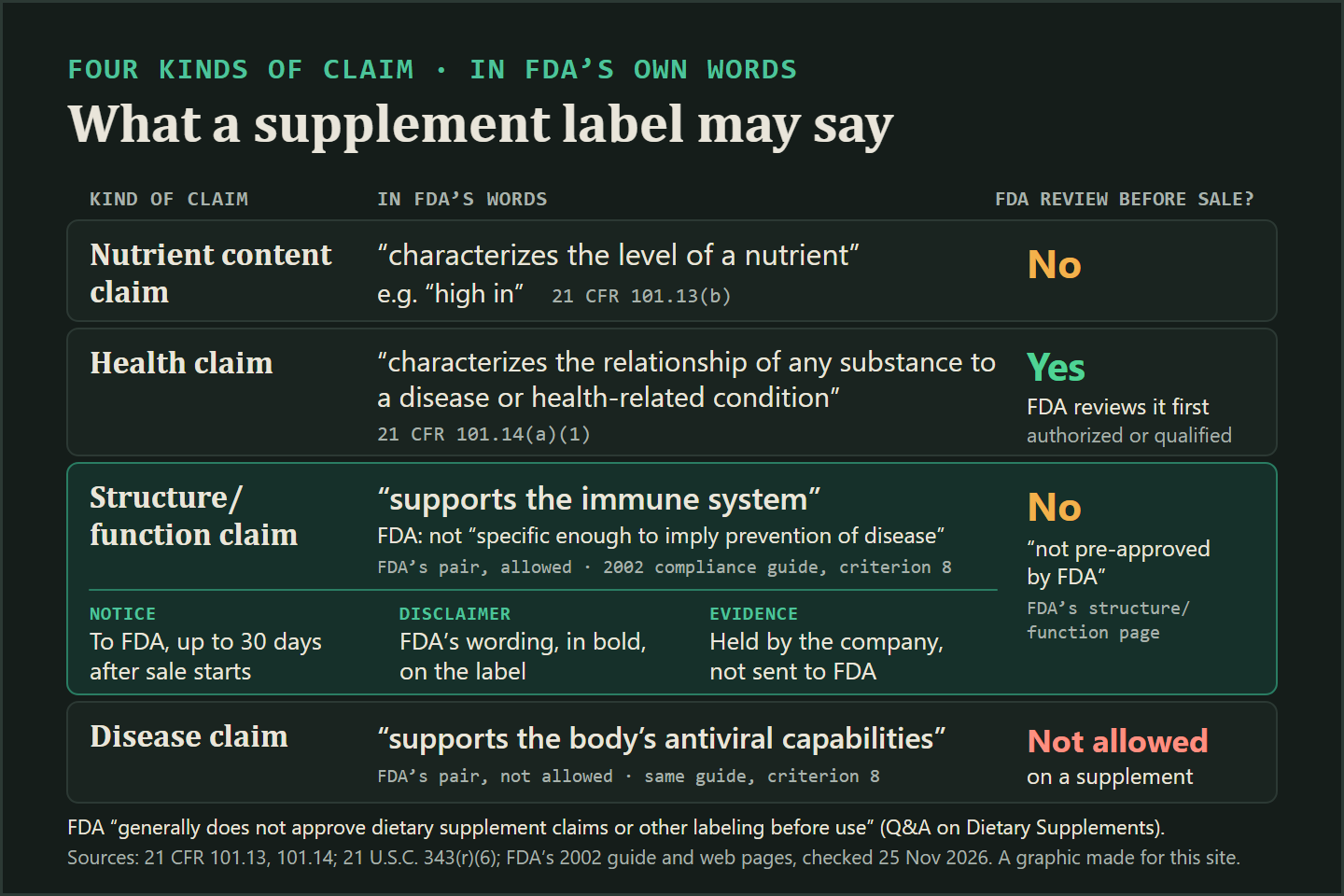
| Kind of claim | Example | Reviewed by FDA before use? | On a supplement? |
|---|---|---|---|
| Nutrient content | “high in” a nutrient [4] | No [8] | Yes |
| Health claim | A substance linked to a disease or health-related condition [4] | Yes [4] | Yes, as FDA allows |
| Structure/function | “calcium builds strong bones” [5] | No [1] | Yes, with the disclaimer |
| Disease claim | “supports the body’s ability to resist infection” [6] | No route | No. It can make the product a drug [2] |
What does “supports focus” or “immune support” actually promise?
Less than it sounds like. The verbs are soft: supports, promotes, maintains, helps. Of the 31 in my audit, 21 make an immune claim and 18 a focus or brain claim [21].
FDA’s test is normal function versus disease. A claim about keeping a healthy body working is allowed. A claim about a disease, named or implied, isn’t. One of FDA’s 10 criteria covers any claim that “otherwise suggests an effect on a disease” [3].
Where does FDA draw the line?
FDA’s own examples, from its 2000 rule and its guide, sit close to mushroom marketing [6][7].
| Topic | Allowed | A disease claim, says FDA |
|---|---|---|
| Immune | “supports the immune system” | “supports the body’s antiviral capabilities” |
| Cold and flu | (no example) | “promotes general well-being during the cold and flu season”, which implies the product “will prevent colds and flu” |
FDA admits the line is fuzzy. It “may not be possible always to draw a bright line”, its guide says, and even “support” or “promote” “might create an implied disease claim”, depending on the context [6].
None of these words tell you how much is inside, which part of the mushroom it is, or how good the evidence is. “Supports focus” reads the same on a capsule that reaches a trial’s daily amount and on a scoop that doesn’t. I think that’s where the stretch happens. A claim can be technically allowed and still promise more than the bottle shows.
Do supplement companies have to prove their claims?
They have to have evidence. They don’t have to show it. The notice to FDA carries a signed line saying the firm “has substantiation”, and the evidence itself stays home [3]. FDA’s guidance says the studies should be “similar to the labeling conditions”, serving size included, but nobody has to send them in [10][13].
Whether the bottle holds what it says is a separate question, and no regulator tests that before sale either.
What did the government find when it asked for the evidence?
For a 2012 report, HHS’s Office of Inspector General asked the makers of 127 supplements sold for weight loss or immune support for their substantiation [13].
- 66 of 104 manufacturers sent documents.
- Of the 557 human studies they sent, none met all four elements FDA recommends, and “only 2 percent” studied the actual products.
- The labels couldn’t settle it. With proprietary formulas, they “did not always list the form, dose, or potency”.
- One in five products carried prohibited disease claims.
OIG asked FDA to seek the power to review that evidence. The recommendation was closed, unimplemented, in May 2017 [13].
Same bottle, two countries
Real Mushrooms’ lion’s mane capsules (9/10, tied for my top score) show what the law changes [22]. The US product page says they “may help to support healthy memory and mood”, and no regulator looked at that before it went up [24].
Canada calls these natural health products (NHPs), and “All NHPs sold in Canada require a product licence before being marketed.” The application covers the dose and the “recommended uses”, and claims “must be supported by appropriate evidence” [23]. Real Mushrooms’ Canadian label lists the lion’s mane under “Medicinal Ingredients”, as a 1:1 fruiting-body extract [24].
Same mushroom, same company, different rules.
What does “These statements have not been evaluated by the FDA” mean?
It means FDA hasn’t checked whether the claim is true. It doesn’t mean the product is unsafe, or that anything was approved. The wording is fixed by law [1][3]:
“This statement has not been evaluated by the Food and Drug Administration. This product is not intended to diagnose, treat, cure, or prevent any disease.”
With more than one claim, it opens “These statements…”. It must be in bold, next to the claim or linked to it by a symbol such as an asterisk [3].
If FDA objects to a notice, it usually sends a “courtesy letter”, which the company is “not required to respond” to. If it doesn’t object, it “generally” sends nothing [9].
Foods play by other rules. FDA requires no notice and no disclaimer for structure/function claims on conventional foods [5]. Several mushroom coffees, RYZE among them, carry Nutrition Facts, the food panel [20][21]. The back of my RYZE bag has no disclaimer, and as a food it needs none [20].
What changed in December 2025?
On 11 December 2025, FDA said it would use “enforcement discretion” on one part of the rule, the disclaimer appearing “on each panel” with a claim. The disclaimer still has to be on the label, linked to each claim, and FDA said it was “likely to propose a rule” [11].
By 25 November 2026 it hadn’t, and the Federal Register shows no proposed or final rule [12]. CRN, the Council for Responsible Nutrition, petitioned FDA on 6 May 2026 to confirm that one boxed disclaimer is enough. FDA posted an interim response on 2 November 2026 and hasn’t ruled [12].
What do mushroom brands claim, and can you check it on the label?
They all claim something. Checking it is harder. Of the 31 labels, 24 state an amount for each mushroom, yet 18 of those 24 don’t reach the low end of what human trials used [22]. All 15 products with lion’s mane make a focus or brain claim, and 3 of them reach the lowest daily amount in its fruiting-body trials [21][22]. The form has to match a trial too. Mycelium grown on grain scores 0 for dose at any amount, since I found no controlled trial that tested it alone.
Which labels let you check the claim?
| Product | Claim on the brand’s page | Amount of each mushroom on the label? | Dose score |
|---|---|---|---|
| Nootropics Depot Lion’s Mane 8:1 | “Supports Cognitive Function” | Yes: 500 mg of 8:1 extract a capsule | 2 |
| Real Mushrooms Lion’s Mane | “may help to support healthy memory and mood” | Yes: 1,000 mg of extract per 2 capsules | 1 |
| Genius Lion’s Mane | “Supports memory, focus, and cognitive function” | Yes: 1,200 mg, grown on oats | 0 |
| RYZE Mushroom Coffee | Lion’s mane “Supports focus, mental clarity, and cognitive function” | No: one 2,000 mg total for six mushrooms | 0 |
| Four Sigmatic Focus coffee | “boost focus and mental clarity in every sip” | No amount anywhere | 0 |
| MUD\WTR Original | “natural energy, focus, and immune support” | No: a 2,240 mg total (560 mg each on its site) | 0 |
A claim doesn’t move a score. The dose check reads the facts panel, and every product I’ve scored is listed with its sources.
RYZE’s claims in 2025 and now
In September 2025, RYZE said it had permanently dropped the coffee claims NAD challenged. NAD didn’t judge them on the merits, and for compliance it handles them as though it had recommended dropping them [17].
| Topic | What NAD quoted (Sep 2025) | RYZE’s home page (25 Nov 2026) |
|---|---|---|
| Energy | “all-day energy” | “Support calm sustained energy & focus.” |
| Focus | “sharper focus” | Lion’s mane: “Supports focus, mental clarity, and cognitive function” |
| Digestion | “healthier digestion” | Turkey tail: “Supports digestive health and a healthy gut microbiome.” |
| Immune | “better immune support” | Shiitake: “supports the immune system” |
| Sleep | “better sleep” | Reishi: “Supports relaxation and a sense of calm.” |
In the Internet Archive’s copies, the home page’s line for each mushroom was rewritten between August and October 2026, most of them to start with “Supports” [20]. NAD’s summary doesn’t say which ads it reviewed, and the full decision is behind a paywall, so I can’t tie any of these lines to the case.
I think it’s the same promise in softer words.
Who polices supplement claims?
Nobody before sale. After it, the FTC handles ads, NAD is the ad industry’s own referee, and FDA steps in over disease claims.
FTC: the ads
The FTC covers “all forms of advertising”, including packaging, websites and social media. Its standard is “competent and reliable scientific evidence”. For health benefits, “as a general matter”, that means “randomized, controlled human clinical testing” [14].
Its 2022 guidance then asks whether the evidence fits the product, and the first question is about dose. “How do the dosage and formulation of the advertised product compare to the product used in the study?” In its Example 38, trials had tested a botanical extract “for supporting the immune system”, but the advertiser’s was “made using a different extraction method” and had “a significantly different chemical profile”, so it “shouldn’t rely on these clinical trials alone” [14].
That’s the question my dose check asks of a label. “Supports focus” next to a 2,000 mg blend with no split leaves no way to compare the product with any study. That doesn’t make the claim false. You just can’t check it from the label.
The FTC adds that “the DSHEA disclaimer or similar statements won’t cure an otherwise deceptive ad”, though its guide “doesn’t have the force or effect of law” [14]. In April 2023 it warned almost 700 companies, supplement marketers among them, that they could face civil penalties, now up to $53,088 per violation. Being on that list “does not in any way suggest” wrongdoing, the FTC said [15].
NAD: the industry checking itself
The advertising industry set up the National Advertising Division in 1971. It’s part of BBB National Programs, a non-profit and “not a government entity”. Any company, consumer or non-profit group can file a challenge, and NAD opens about 20-25% of its cases itself. NAD refers an advertiser that won’t take part or comply to a regulator, usually the FTC [16]. RYZE is the only Scorecard brand I found in NAD’s published case summaries [16].
In a September 2026 decision, NAD looked at Alice Mushrooms, a mushroom chocolate brand whose energy, sleep and calm claims rested on studies of single ingredients. It found the L-theanine and kanna evidence “was not a good fit”, while a study using “the same dose of saffron as in Alice Mushrooms” supported a narrower saffron claim [18]. The study that counted matched the product’s dose.
FDA warning letters: when a claim names a disease
A product “intended for use in the diagnosis, cure, mitigation, treatment, or prevention of disease” is a drug under the law [2]. When claims cross that line, FDA’s warning letters call the products unapproved new drugs [19].
Searching FDA’s warning letters from January 2023 to 25 November 2026, I found 13 about products for people that contain lion’s mane, reishi, chaga, cordyceps or turkey tail. Ten of them involve disease claims [19]. None went to a mushroom coffee brand or a brand I score. Mushroom Revival, which I score, got one in 2020 over other products.
How to read past a supplement claim
Start with the claim, then make the label do the work, the way the five label checks do for the rest of the bottle.
- Name the claim and the mushroom behind it. On a blend, find which mushroom the brand says carries it.
- Find that mushroom’s amount on the facts panel. With one total for a blend, you can’t check the claim from the label.
- Compare it with the studies. Look up what the lion’s mane trials used per day, in the same form.
- Check the part, and what the mushroom grew on.
- Ask about “clinically studied”. Which study? What amount? The same form, or the same product?
Health questions: this site rates what’s in the bottle and how well it’s documented. It doesn’t say what any product does for you, and it isn’t medical advice. Whether a supplement suits you, or is safe with your medicines or a health condition, is a question for your doctor or pharmacist. Read the medical disclaimer. For background: Memorial Sloan Kettering’s About Herbs entry on lion’s mane, the NIH’s LiverTox entry on lion’s mane and the NIH Office of Dietary Supplements’ Dietary Supplements: What You Need to Know.
Part of How to choose
“Clinically studied”, health claims and reporting an ad
What does “clinically studied” mean on a supplement?
It can mean an ingredient was studied, not the product. The FTC says a “clinically tested ingredient” claim tells buyers the product will provide the benefit, so the product may need its own test [14]. Everyday Dose’s ingredients page says “EVERY INGREDIENT. EVERY CLAIM. STUDIED.” I found none of its four company studies on ClinicalTrials.gov or in Europe PMC [25].
Why aren’t supplements regulated like drugs?
Under DSHEA, the 1994 law behind these rules, FDA can’t approve a supplement before it goes on sale. After that, in FDA’s words, it’s “limited to postmarket enforcement” in general [8].
Is “immune support” a health claim?
No. It’s a structure/function claim. FDA says “supports the immune system” isn’t “specific enough to imply prevention of disease” [6]. Health claims are the kind FDA reviews before use [4].
How do I report a misleading supplement ad?
To the FTC, which handles advertising [8]. Its reporting site, ReportFraud.ftc.gov, takes reports on “bad business practices” as well as fraud [26]. NAD also takes challenges from consumers, and it can refer a case to the FTC [16]. A bad reaction to a product is FDA’s area [8].
Sources
- 21 U.S.C. 343, misbranded food: (r)(6), statements for dietary supplements, with the statutory notes (Pub. L. 103-417, DSHEA, 25 Oct 1994). US Code, 2024 edition, GovInfo. govinfo.gov checked 25 Nov 2026
- 21 U.S.C. 321(g)(1), definition of “drug” (US Code, 2024 edition, GovInfo). govinfo.gov checked 25 Nov 2026
- 21 CFR 101.93, notification, disclaimer and disease-claim rules for dietary supplements (eCFR, version current as of 20 Nov 2026; last amended 24 Mar 2023). ecfr.gov checked 25 Nov 2026
- 21 CFR 101.13 (nutrient content claims) and 101.14 (health claims), eCFR; FDA, “Qualified Health Claims” (content current as of 03/28/2024). ecfr.gov · ecfr.gov · fda.gov checked 25 Nov 2026
- FDA, “Structure/Function Claims” (content current as of 03/28/2024). fda.gov checked 25 Nov 2026
- FDA, “Small Entity Compliance Guide on Structure/Function Claims” (January 2002; content current as of 11/10/2017). fda.gov checked 25 Nov 2026
- FDA, “Regulations on Statements Made for Dietary Supplements Concerning the Effect of the Product on the Structure or Function of the Body”, final rule, 65 FR 1000-1050 (6 Jan 2000), GovInfo. govinfo.gov checked 25 Nov 2026
- FDA, “Questions and Answers on Dietary Supplements” (content current as of 08/27/2026). fda.gov checked 25 Nov 2026
- FDA, “Notifications for Structure/Function and Related Claims in Dietary Supplement Labeling” (content current as of 02/09/2023). fda.gov checked 25 Nov 2026
- FDA, “Guidance for Industry: Substantiation for Dietary Supplement Claims Made Under Section 403(r)(6) of the Federal Food, Drug, and Cosmetic Act” (December 2008; content current as of 09/20/2018). fda.gov checked 25 Nov 2026
- FDA, “Letter to the Dietary Supplement Industry on the DSHEA Disclaimer” (11 Dec 2025; content current as of 12/11/2025). fda.gov checked 25 Nov 2026
- Federal Register API, FDA documents since 1 Dec 2025, searched for “101.93”, “dietary supplement disclaimer”, “structure/function claims” and “DSHEA”: no proposed or final rule on 101.93(d) federalregister.gov · regulations.gov docket FDA-2026-P-4993 (CRN’s petition and FDA’s acknowledgement posted 7 May 2026; “180 Day Interim Response Letter” posted 2 Nov 2026) regulations.gov · CRN press release, 6 May 2026 crnusa.org checked 25 Nov 2026
- HHS Office of Inspector General, “Dietary Supplements: Structure/Function Claims Fail To Meet Federal Requirements”, OEI-01-11-00210 (2 Oct 2012): summary page, with the recommendations’ status, and full report. oig.hhs.gov · oig.hhs.gov checked 25 Nov 2026
- FTC, “Health Products Compliance Guidance” (December 2022), sections I, II.A-C, III.A.3, III.B.1, III.B.5 (Examples 18 and 38) and III.C.3; FTC press release, 20 Dec 2022. ftc.gov · ftc.gov checked 25 Nov 2026
- FTC, “FTC Warns Almost 700 Marketing Companies That They Could Face Civil Penalties if They Can’t Back Up Their Product Claims” (13 Apr 2023), and its list of recipients (updated 11 May 2023); 16 CFR 1.98(d) (eCFR) and FTC notice 2026-18853 (Federal Register, 15 Sep 2026: amounts unchanged for 2026). ftc.gov · ftc.gov · ecfr.gov checked 25 Nov 2026
- BBB National Programs, “National Advertising Division” (program page and FAQ); its site map’s 2,259 decision summaries, searched for every Scorecard brand and parent company and for mushroom terms (a case whose address names neither would be missed). bbbprograms.org · bbbprograms.org checked 25 Nov 2026
- BBB National Programs, “Ryze Superfoods Voluntarily Discontinues Health Claims for RYZE Mushroom Coffee and Matcha Following National Advertising Division Inquiry”, NAD case #7492 (11 Sep 2025). bbbprograms.org checked 25 Nov 2026
- BBB National Programs, Alice Mushrooms, LLC, NAD case #7563 (16 Sep 2026). bbbprograms.org checked 25 Nov 2026
- FDA warning letters, full-text index searched for chaga, reishi, ganoderma, cordyceps, lion’s mane, hericium, turkey tail, trametes, coriolus, lingzhi and mushroom terms; letters issued 1 Jan 2023 or later for products for people: 13, the newest to New Green Nutrition Inc. (26 Oct 2026) · FDA warning letter to Mushroom Revival, Inc., 1 Dec 2020 (CMS 610361). fda.gov · fda.gov checked 25 Nov 2026
- RYZE: home page (per-mushroom lines) ryzesuperfoods.com · Internet Archive copies of the home page of 8 Aug 2026 (old lines) and 3 Oct 2026 (rewritten) web.archive.org · web.archive.org · the back of my own bag (photo on my RYZE review). checked 25 Nov 2026
- Mycology at Home claims audit: claim wording, disclaimer and “clinical” wording on all 31 Scorecard product pages (or, for Oriveda, its US reseller’s page), from the live page or the newest Internet Archive copy (copies dated July 2025 to 12 Nov 2026). Pages quoted in the table: Nootropics Depot (live page) nootropicsdepot.com · Real Mushrooms (copy of 14 Oct 2026) web.archive.org · Genius (copy of 15 May 2026) web.archive.org · RYZE (home page, live) ryzesuperfoods.com · Four Sigmatic (live page) us.foursigmatic.com · MUD\WTR (copy of 19 Jul 2026) web.archive.org checked 25 Nov 2026
- Mycology at Home Scorecard data (CSV), 31 products: forms, label amounts and dose scores (counts as of 25 Nov 2026). mycologyathome.com checked 22-24 Nov 2026
- Health Canada, “Information Kit – Regulation of Natural Health Products” (page dated 31 Mar 2009). canada.ca checked 25 Nov 2026
- Real Mushrooms, Organic Lion’s Mane Extract Capsules: US product page (Internet Archive copy, 14 Oct 2026); US back label; Canadian back label. web.archive.org · cdn.shopify.com · cdn.shopify.com checked 25 Nov 2026
- Everyday Dose, ingredients page everydaydose.com · ClinicalTrials.gov API v2, sponsor “Everyday Dose” (0 studies) clinicaltrials.gov · Europe PMC search “Everyday Dose” (no matching paper) europepmc.org checked 23-25 Nov 2026
- FTC, “FTC Announces New Fraud Reporting Platform for Consumers: ReportFraud.ftc.gov” (22 Oct 2020) ftc.gov · ReportFraud.ftc.gov reportfraud.ftc.gov checked 25 Nov 2026


Cite this page
Quoting with a link is always fine. The Scorecard data and my own charts are free to reuse under CC BY 4.0: add "CC BY 4.0" to the citation. Photos and the page text aren't covered.
Citation
Rowan Hale, "Structure/Function Claims: What 'Supports Focus' Means, and Why No Regulator Reviews It First", Mycology at Home, https://mycologyathome.com/structure-function-claims/. Data checked 22 Nov 2026. Retrieved [the date you read it].
Tap the citation to select it.
- Key findings
- Sources on this page
- Scorecard data (CSV)
- CC BY 4.0Data and my charts only