
 By
Beta-glucans are fibers in a mushroom’s cell walls. Labs can measure them with one published enzyme test that works the same way for every brand, so the Scorecard counts them twice, once for what’s measured and once for value.
Megazyme’s own figures for its test#
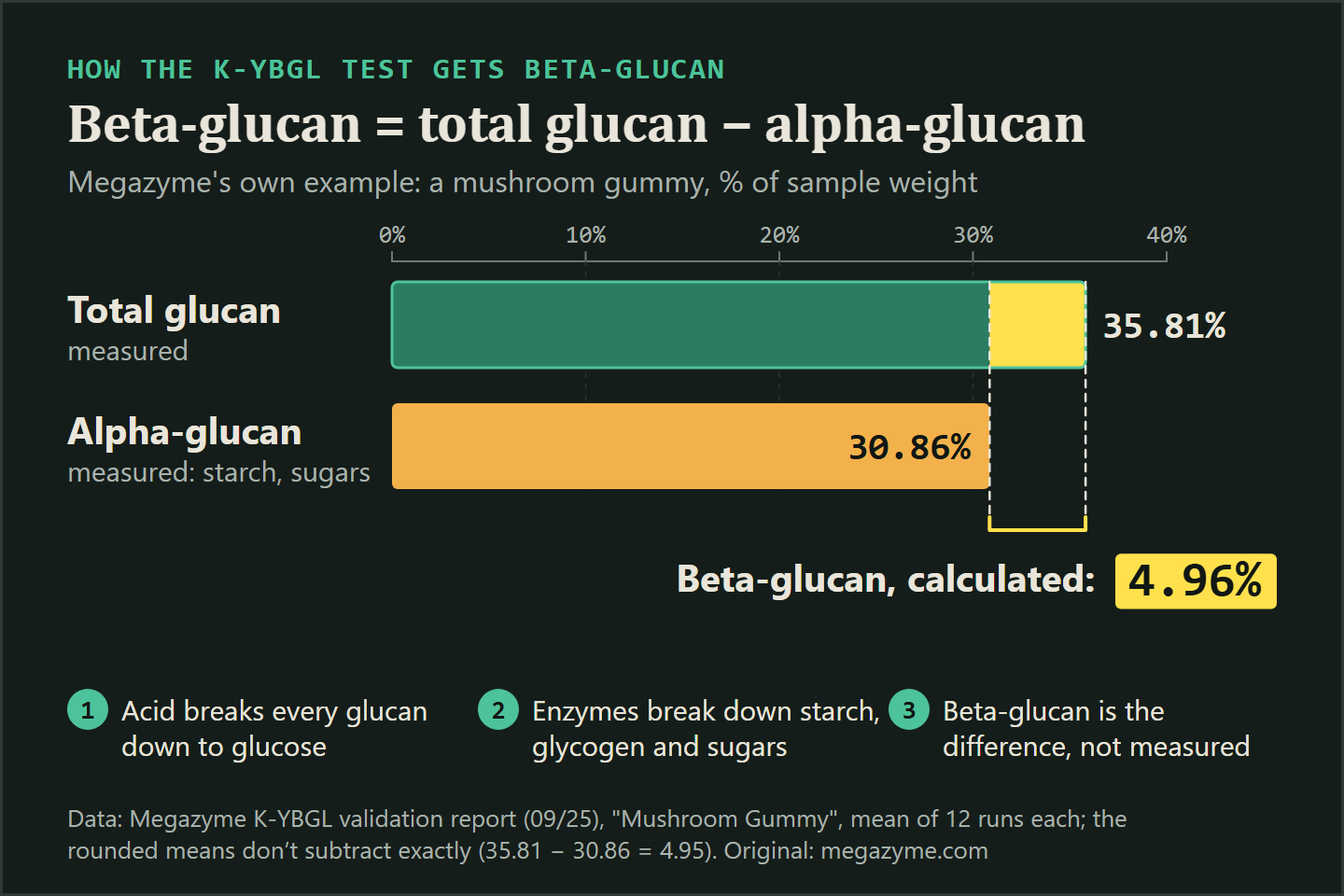
- In Megazyme’s September 2025 validation report for its K-YBGL beta-glucan kit, a mushroom gummy measured 35.81% total glucan but 4.96% beta-glucan once its 30.86% alpha-glucan was subtracted [13].
- Megazyme’s validation report found that the October 2025 version of K-YBGL reads higher on most samples, its pure reishi sample going from 46.81% to 50.74% beta-glucans and its pure turkey tail sample from 52.40% to 57.53% [13].
- Megazyme’s validation report gives K-YBGL a quantitation limit of 1.5% of sample weight and a 1.1% coefficient of variation over 12 runs on its mushroom capsule, but no figure for how much results differ between labs [13].
Figures as of 23 Nov 2026.Free to quote with a link.How to cite
→ Jump to the price-per-gram calculator.
Beta-glucan % by brand: what do the lab reports show?
| Product | What's in it | Beta-glucans | Method | Certificate | $ per g beta-glucans | Price checked |
|---|---|---|---|---|---|---|
 OrivedaLion's Mane 1:1 Fruiting Body (180 caps)Scorecard rating | 1:1 fruiting-body extract | 36.3% | Megazyme K-YBGL (Eurofins report 5533050-0; lot 2026-27B) | Eurofins report 5533050-0, Sep 2026 | $1.02 | 22 Nov 2026 |
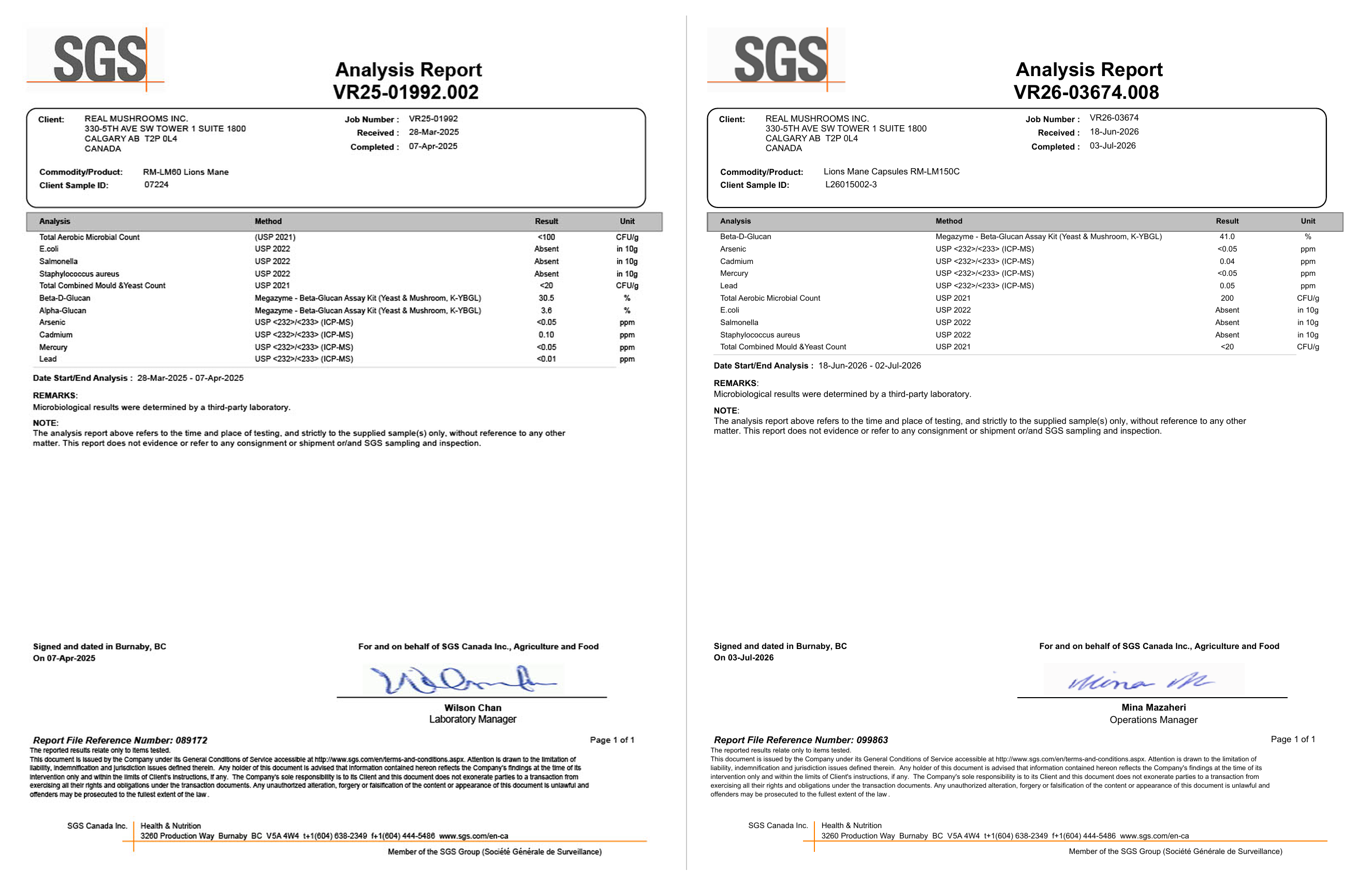
 Real MushroomsOrganic Lion's Mane Extract Capsules (120 caps)Scorecard rating | Fruiting-body extract | 41.0% † | Megazyme K-YBGL (SGS report VR26-03674.008) | SGS report VR26-03674.008, Jul 2026 | $1.42 | 22 Nov 2026 |
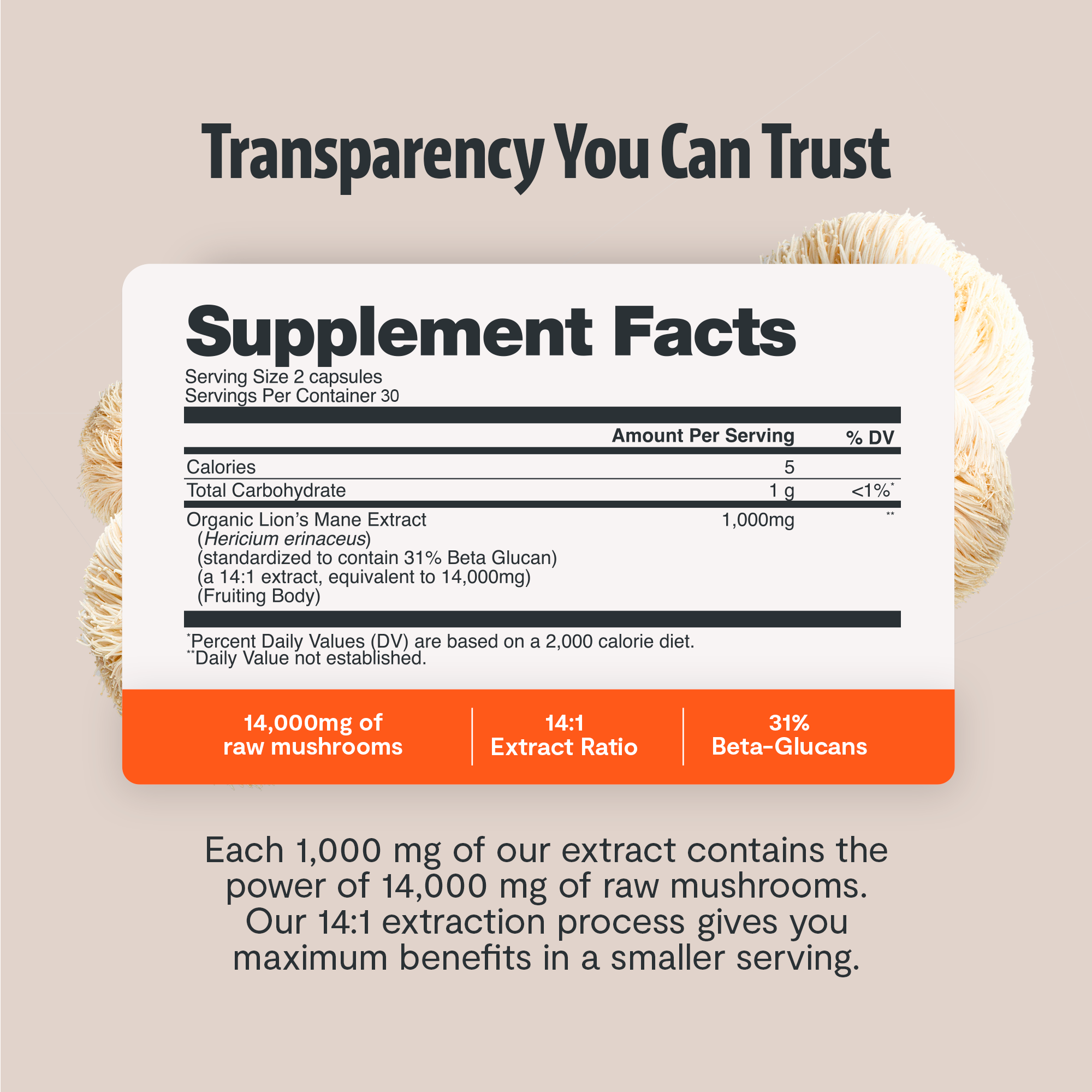
 FreshCapOrganic Lion's Mane Capsules (60 caps)Scorecard rating | 100% fruiting body | 31% | label claim only; method not stated | Not published | $2.58 | 22 Nov 2026 |
 Mushroom RevivalFocus Lion's Mane Capsules (60 caps)Scorecard rating | 100% fruiting body | 37.1% | counts as a label claim (clarification 8): brand-issued CoA, no lab na… | Brand-issued CoA, no lab named, Nov 2021 | $3.41 | 22 Nov 2026 |
 Nootropics DepotLion's Mane Mushroom 8:1 Dual Extract Capsules (60 caps)Scorecard rating | Fruiting-body extract | 23.1% | Fluorescence (LAB TM-078), not an enzymatic/Megazyme method; Omnient L… | Omnient Labs CoA ND-26-1133, Sep 2026 | $4.33 | 22 Nov 2026 |
 Host DefenseLion's Mane Capsules (30 caps)Scorecard rating | Mycelium on brown rice | Unknown | polysaccharides only (counts starch) | Not published | Unknown | 22 Nov 2026 |
 Om Mushroom SuperfoodLion's Mane Mushroom Capsules ("Focus Lion's Mane", 90 caps)Scorecard rating | Mycelium + fruit body, oats | Unknown | not published / not found | Not published | Unknown | 22 Nov 2026 |
 Genius MushroomsGenius Lion's Mane (120 caps)Scorecard rating | Mycelium + fruiting body, oats | Unknown | not published / not found | Not published | Unknown | 22 Nov 2026 |
Prices: each brand's own one-time price for the size its page shows by default, checked 23 Nov 2026. "Unknown" means the brand doesn't publish the number; it scores 0.
Sources for every cell: the Scorecard data (CSV).
Real Mushrooms’ SGS report shows 41.0% beta-glucans, the highest lab figure in the table (see the † note).
Oriveda comes out cheapest per gram, at $1.02, because 60 servings cost $19.95.
Read the method column before the number. Only Real Mushrooms’ and Oriveda’s figures come from the enzymatic test on a named lab’s certificate. Nootropics Depot’s comes from a fluorescence method, at a lab its CEO says he created. Mushroom Revival’s is on the brand’s own 2021 document, with no lab named. FreshCap’s is a label claim. The three products grown on grain, including Host Defense’s, publish none.
How do you work out price per gram of beta-glucans?
A bottle’s price tells you little on its own. Two bottles at the same price can hold very different amounts of beta-glucans. Price per gram puts them on one scale.
- Beta-glucans per serving
- Price per gram of beta-glucans
- Price per day (one serving a day)
The formula: price ÷ (servings × grams per serving × beta-glucan %)
Example (Real Mushrooms): $34.95 ÷ (60 × 1.0 g × 41.0%) = $1.42 per gram of beta-glucans.
Worked example: Real Mushrooms, checked 22 November 2026
- Price $34.95 · 60 servings · 1.0 g per serving (two capsules, 1,000 mg of extract) · 41.0% beta-glucans (SGS, July 2026; see the cellulose note below).
- Beta-glucans per serving: 1.0 g × 0.41 = 0.41 g
- In the bottle: 60 × 0.41 g = 24.6 g
- Price per gram: $34.95 ÷ 24.6 g = $1.42
- Cost per day, at one serving a day: $34.95 ÷ 60 = $0.58
Where to find each input
- Price: the brand’s regular one-time price, without a subscription or sale. Use that and your number will match mine.
- Servings: “Servings per container” on the Supplement Facts panel.
- Grams per serving: the mushroom amount per serving on the panel, in grams (1,000 mg = 1.0 g). If the panel lists it per capsule, multiply: Oriveda is 3 × 300 mg = 0.9 g.
- Beta-glucan %: from a certificate if the brand publishes one, otherwise the label. If the label gives milligrams, divide: Real Mushrooms’ US label lists 300 mg of beta-glucans in 1,000 mg of extract, which is 30%.
Same bottle, two answers: At the label’s 30%, Real Mushrooms works out at $1.94 per gram, and at the certificate’s figure, $1.42. I use the latest lab certificate when there is one, and the label when there isn’t. Bottle size changes the answer too. Nootropics Depot’s 180-capsule bottle comes to $3.85 per gram, against $4.33 for the 60. I use the size each brand’s page shows by default.
Beta-glucans vs polysaccharides: why does the label word matter?
A polysaccharide is a long chain of sugars. Beta-glucans are one kind. Starch is another. So a “polysaccharides” figure counts every polysaccharide the method picks up, and unless the method removes starch first, starch is in the number.
Wu et al. 2017 had to digest the starch in reishi products with an enzyme before measuring their polysaccharides, because starch “should be excluded”. The Megazyme test measures alpha-glucan (starch and glycogen) separately and subtracts it, for the same reason.
How far apart can total glucan and beta-glucan be?
Two samples from Megazyme’s own validation report:
| Sample (Megazyme validation) | Total glucan | Alpha-glucan | Beta-glucan |
|---|---|---|---|
| Mushroom capsule | 47.75% | 6.01% | 41.74% |
| Mushroom gummy | 35.81% | 30.86% | 4.96% |
A total-glucan number with nothing subtracted would put the gummy at 35.81%. Its beta-glucan is 4.96%.
Host Defense’s FAQ says: “We can guarantee our capsules contain greater than 55% polysaccharides.” That covers its capsules in general, lion’s mane included. The brand doesn’t say how it measured that, so nobody outside the company knows how much of it is starch. It isn’t a beta-glucan figure.
'Polysaccharides' is not a beta-glucan figure: A label that gives polysaccharides and no beta-glucan % scores 1 of 2 for actives on the Scorecard. Its value can’t be calculated, so value scores 0. In the calculator, count its beta-glucan % as unknown.
How do labs measure beta-glucans?
The test named on most certificates I’ve read is Megazyme’s mushroom and yeast beta-glucan kit, K-YBGL, published by McCleary and Draga in 2016. It works in three steps:
- Total glucan. Strong acid breaks every glucan in the sample down to glucose, which is measured.
- Alpha-glucan. Enzymes break down starch, glycogen, maltodextrins and sugars such as sucrose and trehalose. That glucose is measured too.
- Beta-glucan = total minus alpha. It’s calculated, not measured directly. In the paper’s words: “β-Glucan was determined by the difference.”
So the kit gives three numbers. Most certificates print one. Of the three K-YBGL reports from named labs that I’ve read for lion’s mane, only one prints the alpha-glucan line (Real Mushrooms, April 2025: 3.6%).
How precise is the Megazyme test?
Megazyme’s validation report (September 2025) gives a detection limit of 0.5% and a quantitation limit of 1.5% of the sample’s weight, and a coefficient of variation between repeat runs under 5%. Its own mushroom capsule tested at 41.74%, with a coefficient of variation of 1.1% across 12 runs by two analysts on two days. The report doesn’t say how much results differ between labs.
What can’t the Megazyme test do?
- It isn’t specific to mushroom beta-glucans. Megazyme’s instructions say the method is “NOT applicable” when other beta-glucans such as cellulose are present, and its validation report lists cellulose as causing “over-recovery” of beta-glucan: microcrystalline cellulose and hydroxyethyl-cellulose weren’t broken down by its enzymes. Capsule shells made of cellulose could inflate the result, so a fair test uses the contents only. Maltitol, found in gummies, needs an extra enzyme step. Real Mushrooms’ US label lists microcrystalline cellulose as a flow agent inside the capsule. How much it holds isn’t published, so the 41.0% may read high, by an unknown amount.
- It isn’t an AOAC Official Method. Megazyme lists it as a “Novel method”. It’s a published, validated enzymatic method.
- An accredited lab isn’t the same as an accredited test. SGS and Eurofins Madison both hold ISO/IEC 17025 accreditation, and neither lab’s published scope lists K-YBGL.
The method changed in October 2025
Megazyme’s validation report compares the two versions and finds the new one reads higher on most samples. Its single “pure mushroom” samples: lion’s mane 42.60% → 43.57%, reishi 46.81% → 50.74%, chaga 12.69% → 16.83%, turkey tail 52.40% → 57.53%. Certificates from before and after aren’t strictly like for like, so the Scorecard shows every certificate’s date.
Why can a certificate beat the label?
Real Mushrooms’ product page guarantees more than 30% beta-glucans (its US label lists 300 mg in 1,000 mg). Its July 2026 SGS report shows 41.0%. The same image on its product page holds an older SGS report, from April 2025, at 30.5%.
Don’t read that as the product getting better. The older report carries the product code of the brand’s powder, it’s a different lot, and it used the pre-October 2025 version of the test. Cellulose is a further unknown (see the note above). The 30% is the brand’s guarantee. A certificate is one lot’s result.
Are beta-glucans the right thing to measure?
Host Defense says no. Fungi Perfecti, the company behind it, published “Beyond Beta-Glucans” on 5 November 2026. It argues four things.
- One compound doesn’t capture a mushroom’s value. The whole organism matters.
- A hot-water fruiting-body extract “can test very high in beta-glucans” while leaving fat-soluble compounds behind.
- Mycelium makes compounds fruiting bodies don’t.
- “There is no authenticated scientific method for measuring beta-glucans”, and next to what mycelium offers, “measuring beta-glucan content is irrelevant”.
The article cites no study. An older article on the Host Defense blog (posted in 2017, dated 2013, so written before the 2016 method paper) has Paul Stamets, the company’s founder, asking what you’d put on a label if one product’s lab results “ranged from Non Detectable to 40%”. He writes that common assays can only detect soluble beta-glucans, so Host Defense won’t put a figure on the label.
Which parts of that argument hold up?
Some of that is fair. K-YBGL isn’t an AOAC Official Method, and cellulose can make it read high. On the “soluble only” point: the method first dissolves the sample’s glucans in strong sulfuric acid, then measures total glucan and subtracts alpha-glucan. It isn’t limited to soluble beta-glucans (McCleary and Draga 2016; Megazyme’s instructions).
“Irrelevant” is where I disagree. A published enzymatic method exists, a US food-testing lab lists it at $296 a sample, and two brands in my table already publish it on a named lab’s certificate. A beta-glucan figure isn’t everything in a mushroom. It’s the one number a buyer can compare across brands. If a brand thinks something else matters more, it can measure that and publish it too. Until then, unknown scores 0.
Which mushrooms have the most beta-glucans?
There’s no clean ranking. Published figures vary a lot within one species, and the data I could read is thin. These are all on Megazyme’s enzymatic kit, as % of dry weight.
- Reishi fruiting bodies: about 42% to 56% in two studies: 47.5-55.9% in cultivated reishi, depending on the strain and the wood it grew on (Finnish strains on five woods, Cortina-Escribano 2020), and 41.8% in one commercial powder, on the pre-2025 kit (Łysakowska 2025). Wild Australian Ganoderma specimens, relatives not identified as reishi, measured 19.5-43.5% (19 specimens, De Oliveira Campos 2024).
- Lion’s mane: one commercial fruiting-body powder measured 25.1%, on the pre-2025 kit (Łysakowska 2025).
- Chaga: wild chaga measured 5.7-11.9%. Four chaga products grown on grain measured 1.0-6.9%, the rice-based one about the same as plain rice. Chaga mycelium grown in liquid measured 14.4% (Windsor 2025, pre-2025 kit). Five of the study’s six authors work for Nammex, which has a financial interest in selling chaga supplements.
For turkey tail, and for the mycelium of any species except chaga, I found no peer-reviewed figure I could read. So for a buyer, I think what’s in the capsule, and what it grew on, can matter as much as which mushroom it is.
What do extracts, ratios and “dual extract” do to the number?
- A ratio isn’t a beta-glucan %. It says how much dried mushroom went into the extract, by the brand’s own account. FreshCap’s 14:1 label says its 1,000 mg is “equivalent to 14,000mg”. Oriveda says its 1:1 means “1kg mushroom = 1 kg extract”.
- In my table, a bigger ratio didn’t mean a bigger %. 14:1 (FreshCap) 31%; 8:1 (Nootropics Depot) 23.1%; 3:1 (Mushroom Revival) 37.1%; 1:1 (Oriveda) 36.3%. The methods differ, so read it loosely. But nothing in my data says a high ratio means more beta-glucans.
- How the Scorecard uses ratios: for dose only. An extract counts at its stated ratio. An unstated ratio counts as 1:1. Value uses the beta-glucan %, never the ratio.
- “Dual extract” names the solvents, water plus alcohol. Nootropics Depot says “water and ethanol extraction”. For beta-glucans, water pulled out far more than strong (96%) alcohol in a chaga study (Lazić 2024), and I found no paper testing a commercial dual extract against a single one.
Which beta-glucan mushroom supplements publish a lab figure?
Not many. For the eight lion’s mane products I’ve ranked on all five checks, the figure is:
- 2 on a named lab’s enzymatic certificate (Real Mushrooms, Oriveda).
- 1 on a named lab’s certificate using fluorescence (Nootropics Depot).
- 1 on the brand’s own document, with no lab named (Mushroom Revival, 2021).
- 1 only on the label (FreshCap).
- 3 nowhere (Host Defense, Om, Genius, all grown on grain).
Do any mushroom coffees give a beta-glucan figure?
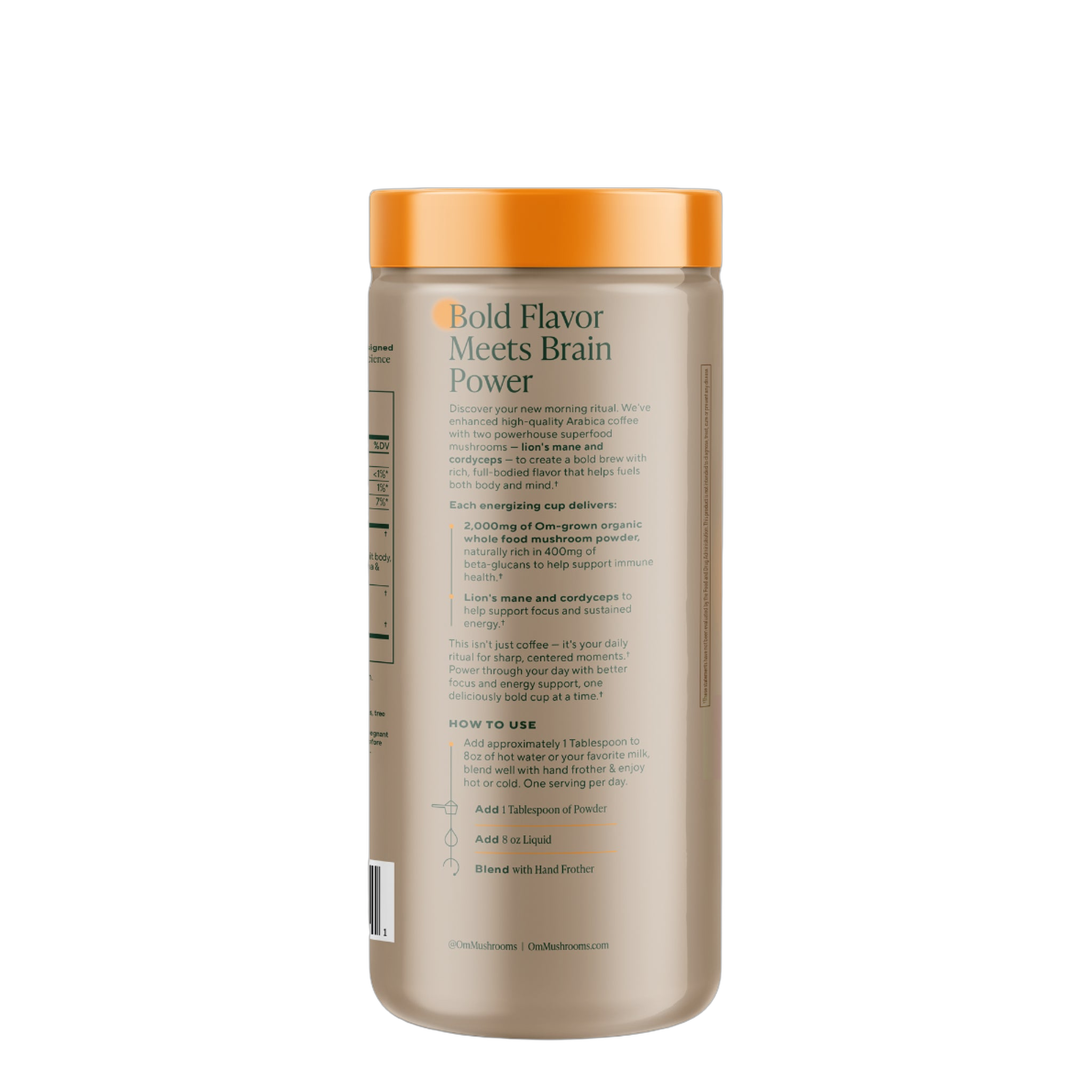
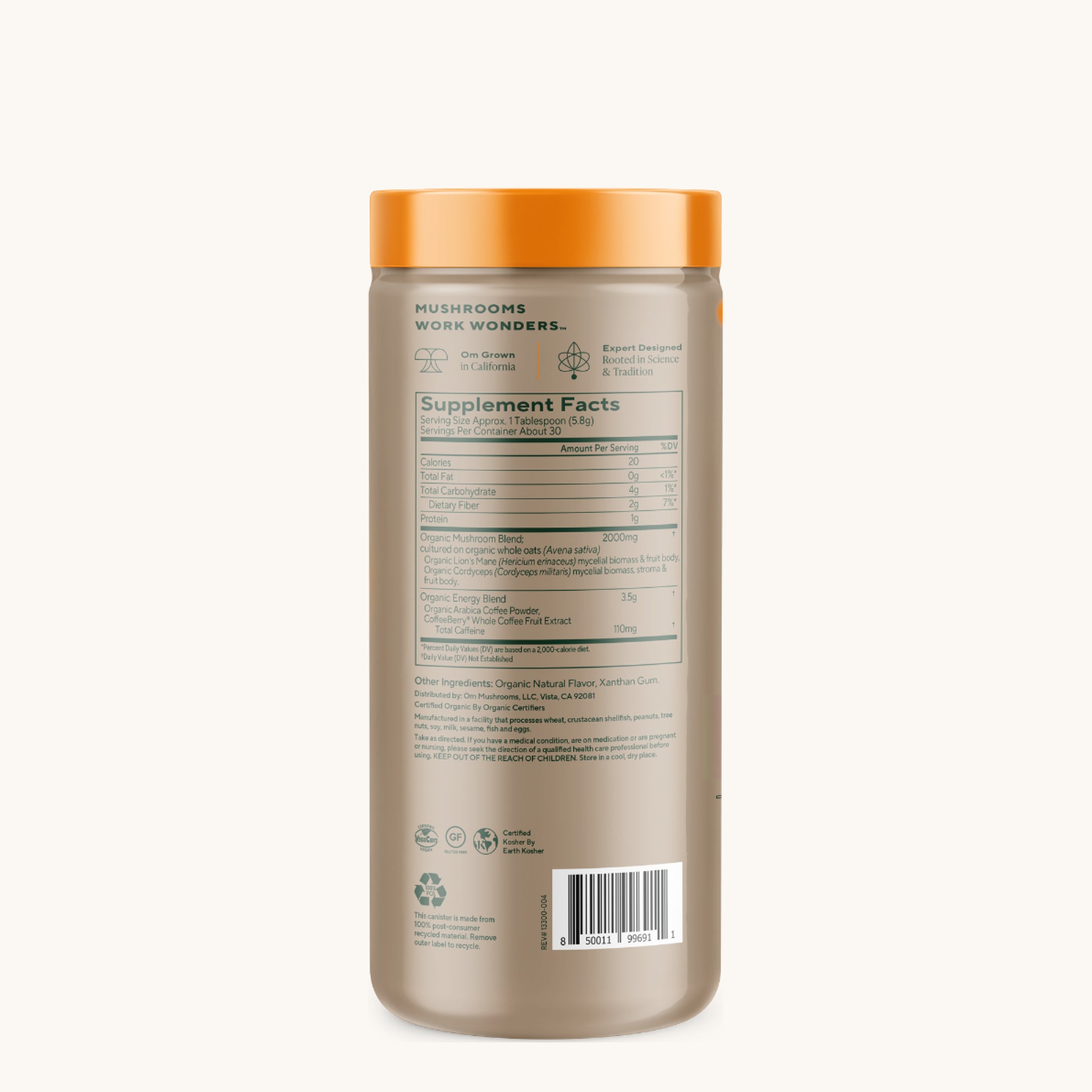
One of the seven I’ve scored does. Om’s canister says each cup’s 2,000 mg of mushroom powder holds 400 mg of beta-glucans, with no method or lab named. Those mushrooms grow on oats, which have beta-glucans of their own, and the label doesn’t say which it counts. Everyday Dose says it tests beta-glucans every batch. Its one published certificate shows none.
If a brand won’t publish it, I can’t credit it, and its price per gram shows as unknown in the Scorecard.
Health questions: this site rates what’s in the bottle and how well it’s documented. It doesn’t say what any product does for you, and it isn’t medical advice. Whether a supplement suits you, or is safe with your medicines or a health condition, is a question for your doctor or pharmacist. Read the medical disclaimer. For background: Memorial Sloan Kettering’s About Herbs entry on lion’s mane, the NIH’s LiverTox entry on lion’s mane and the NIH Office of Dietary Supplements’ Dietary Supplements: What You Need to Know.
Part of How to choose a mushroom supplement Checks 2 and 5 of the five label checks.
Beta-glucan questions: which mushrooms, what %, and oats
Do lion’s mane, reishi, turkey tail and cordyceps have beta-glucans?
Lion’s mane: yes. Two enzymatic certificates from named labs show 36.3% and 41.0% (cellulose note above). Reishi: yes. Fruiting bodies measured about 42-56% in two studies (wild Australian relatives, 19.5-43.5%), and two reishi capsules publish an enzymatic figure from a named lab. Turkey tail: one Megazyme validation sample, 57.53%, the only figure I could read at source. Cordyceps: thin data. One study measured 3.79% in Cordyceps militaris, part not stated (Song 2020), and Megazyme’s validation sample read 11.49%. Two cordyceps capsules publish a named lab’s enzymatic figure.
What beta-glucan % is good?
There’s no universal threshold I can source. Compare like with like, meaning the same method, a recent certificate and a named lab. Price per gram is the more useful number. For lion’s mane capsules, the median so far is $2.58 per gram, the figure the value check scores against.
Where do I find the beta-glucan % on my bottle?
On the Supplement Facts panel, sometimes as milligrams per serving (divide by the serving’s mushroom amount), or on the brand’s certificate. Real Mushrooms posts certificates on its product page and asks buyers to email it for lot certificates.
Are mushroom beta-glucans the same as oat or yeast beta-glucans?
Not quite. Oat and barley beta-glucans are “mixed-linkage” cereal beta-glucans, and labs test them with a different kit (Megazyme K-BGLU, AOAC 995.16). Yeast beta-glucans are tested with the same kit as mushroom ones (K-YBGL is the “yeast and mushroom” kit), but a yeast product isn’t a mushroom product. Check which source a “beta-glucan” label names.
Sources
- Mycology at Home Scorecard data (CSV): every product row, price, servings, beta-glucan figure, method and certificate link on this page. /mushroom-supplement-scorecard/ (CSV linked there). checked 22 Nov 2026
- Real Mushrooms, SGS Canada reports VR26-03674.008 (Jul 2026, 41.0%) and VR25-01992.002 (Apr 2025, 30.5%; alpha-glucan 3.6%), one image. realmushrooms.com checked 22 Nov 2026
- Real Mushrooms, product page ($34.95, 120 caps; “more than 30%”), US label (300 mg in 1,000 mg; microcrystalline cellulose), Canadian label, Prop 65 page (certificates by email). realmushrooms.com · cdn.shopify.com · cdn.shopify.com · realmushrooms.com checked 22-23 Nov 2026
- Oriveda, Eurofins certificate 5533050-0, lot 2026-27B (Sep 2026). oriveda.com checked 22 Nov 2026
- Oriveda, US page ($19.95, “lossless 1:1”), certificates page, and its US reseller’s price page. us.oriveda.com · oriveda.com · modernherbshop.com checked 22 Nov 2026
- FreshCap, product page and label ($23.99, 31%, 14:1). freshcap.com · freshcap.com checked 22 Nov 2026
- Mushroom Revival, product page ($37.95) and brand-issued certificate (2021). mushroomrevival.com · cdn.shopify.com checked 22 Nov 2026
- Nootropics Depot, product page ($29.99 / 60, $79.99 / 180), Omnient Labs certificate ND-26-1133, CEO’s page. nootropicsdepot.com · cdn11.bigcommerce.com · nootropicsdepot.com checked 22 Nov 2026
- Host Defense, product page, FAQ (“greater than 55% polysaccharides”) and “Beta-Glucan Analysis and the Seven Pillars of Immunity” (posted 20 Feb 2017; article dated 2013). hostdefense.com · hostdefense.com · hostdefense.com checked 22 Nov 2026
- Fungi Perfecti, “Beyond Beta-Glucans” (5 Nov 2026). fungi.com checked 22 Nov 2026
- Om and Genius, lion’s mane product pages. ommushrooms.com · thegeniusbrand.com checked 22 Nov 2026
- Everyday Dose, ingredients page and certificate (lot MG237J1, Sep 2025). everydaydose.com · cdn.shopify.com checked 22 Nov 2026
- Megazyme (Neogen), K-YBGL product page; instructions (09/25: “NOT applicable” in the presence of other beta-glucans such as cellulose; the 12 M sulfuric-acid step; the “yeast and mushroom” scope); validation report (09/25: “over-recovery of β-glucan if sample contains cellulose”; repeatability table with C. militaris 11.49%; method comparison, pp. 8-9). megazyme.com · www-docs.megazyme.com · www-docs.megazyme.com checked 22-23 Nov 2026
- McCleary BV, Draga A. J AOAC Int 2016;99(2):364-373 (abstract). doi.org/10.5740/jaoacint.15-0289 checked 22 Nov 2026
- Wu DT, et al. Sci Rep 2017;7:7792. doi.org/10.1038/s41598-017-06336-3 checked 22 Nov 2026
- Windsor C, et al. Int J Mol Sci 2025;26(7):2970. doi.org/10.3390/ijms26072970 checked 22 Nov 2026
- Accreditation scopes: SGS Canada (SCC file 15346) and Eurofins Madison (A2LA 2918.01, which lists K-BGLU / AOAC 995.16 for cereal beta-glucan). scc-ccn.ca · cdnmediaassets.eurofins.com checked 22 Nov 2026
- Medallion Labs, Beta-Glucan (Mushroom & Yeast) test, $296. medallionlabs.com checked 22 Nov 2026
- De Oliveira Campos A, et al. J Fungi 2024;10(10):723 (Australian Ganoderma specimens, not identified as reishi; 19 measured, 19.5-43.5% w/w). doi.org/10.3390/jof10100723 checked 23 Nov 2026
- Cortina-Escribano M, et al. Molecules 2020;25(20):4732 (cultivated reishi, 47.5-55.9%). doi.org/10.3390/molecules25204732 checked 23 Nov 2026
- Łysakowska P, et al. Molecules 2025;30(22):4380 (fruiting-body powders: lion’s mane 25.1%, reishi 41.8%; K-YBGL protocol 08/23). doi.org/10.3390/molecules30224380 checked 23 Nov 2026
- Song HN. Prev Nutr Food Sci 2020;25(2):184-193 (C. militaris, 3.79%). doi.org/10.3746/pnf.2020.25.2.184 checked 23 Nov 2026
- Lazić V, et al. J Fungi 2024;10(3):225 (chaga, water vs ethanol extraction). doi.org/10.3390/jof10030225 checked 23 Nov 2026
- Memorial Sloan Kettering, About Herbs: Lion’s Mane Mushroom (last updated 19 Nov 2025). mskcc.org checked 22 Nov 2026
- NIH LiverTox, Lion’s Mane (PMID 38289992; checked through its Europe PMC copy). ncbi.nlm.nih.gov checked 22 Nov 2026
- NIH Office of Dietary Supplements, Dietary Supplements: What You Need to Know (consumer fact sheet). ods.od.nih.gov checked 22 Nov 2026
- Coffee rows (RYZE, Four Sigmatic, Everyday Dose, Om, Laird, Cuppa, MUD\WTR): Scorecard CSV (source 1). checked 22 Nov 2026
- Om, Mushroom Coffee Blend canister side panel (“Each energizing cup delivers: 2,000mg of Om-grown organic whole food mushroom powder, naturally rich in 400mg of beta-glucans”; no method, lab or certificate named) and Supplement Facts (“cultured on organic whole oats”). ommushrooms.com · ommushrooms.com checked 25 Nov 2026


Cite this page
Quoting with a link is always fine. The Scorecard data and my own charts are free to reuse under CC BY 4.0: add "CC BY 4.0" to the citation. Photos and the page text aren't covered.
Citation
Rowan Hale, "Beta-Glucans in Mushroom Supplements: Lab-Tested % and Price per Gram", Mycology at Home, https://mycologyathome.com/beta-glucans/. Data checked 24 Nov 2026. Retrieved [the date you read it].
Tap the citation to select it.
- Key findings
- Sources on this page
- Scorecard data (CSV)
- CC BY 4.0Data and my charts only