
 By
I earn a commission if you buy through some links on this page, at no extra cost to you. No brand can pay for a score or a place: products I can't earn from are rated exactly the same way. How this site makes money
As an Amazon Associate I earn from qualifying purchases.
Scorecard ratings · checked 24 Nov 2026
Cheapest per gram isn’t best documented
- Score: 9/10Excellent
1. Real Mushrooms
Its SGS report covers beta-glucans, metals and microbes. Its 8:1 ratio is on the Canadian label only.
- Score: 8/10Good
2. Nootropics Depot Red Reishi 8:1
One capsule gives nearly three times the trials’ 1.44 g. Its certificate shows metals, not microbes.
- Score: 8/10Good
3. FreshCap
The highest stated ratio, 14:1. Its 27% beta-glucans comes from the label alone.
- Score: 6/10Fair
4. Oriveda Reishi Primo
The highest enzymatic figure (46.5%, Eurofins). But two capsules give 42% of the studied daily amount.
- Score: 6/10Fair
5. Nootropics Depot Red Reishi 1:1
The lowest price per gram ($1.06), at 35% of the studied daily amount.
Mycelium, no figure: Host Defense, Double Wood and Om score Poor. Each has mycelium on grain, or mycelium with no growing medium stated, and no beta-glucan figure.
| Product | Score | What's in it | Actives | Dose | Safety | Value | $ per g beta-glucans |
|---|---|---|---|---|---|---|---|
 Rank #1Real MushroomsOrganic Reishi Mushroom Capsules (90 caps)Scorecard rating | Score: 9/10Excellent | 2 of 2 | 2 of 2 | 2 of 2 | 2 of 2 | 1 of 2 | $2.53 †$39.95, 45 servings |
 Rank #2Nootropics DepotRed Reishi 8:1 Capsules (60 caps)Scorecard rating | Score: 8/10Good | 2 of 2 | 1 of 2 | 2 of 2 | 1 of 2 | 2 of 2 | $1.55$29.99, 60 servings |
 Rank #3FreshCapOrganic Reishi Mushroom Capsules (120 caps)Scorecard rating | Score: 8/10Good | 2 of 2 | 1 of 2 | 2 of 2 | 1 of 2 | 2 of 2 | $2.47$39.99, 60 servings |
 Rank #4OrivedaReishi Primo (120 caps)Scorecard rating | Score: 6/10Fair | 2 of 2 | 2 of 2 | 0 of 2 | 1 of 2 | 1 of 2 | $4.54$75.95, 60 servings |
 Rank #5Nootropics DepotRed Reishi 1:1 Capsules (60 caps)Scorecard rating | Score: 6/10Fair | 2 of 2 | 1 of 2 | 0 of 2 | 1 of 2 | 2 of 2 | $1.06$19.99, 60 servings |
 Rank #6Host DefenseReishi Capsules (30 caps)Scorecard rating | Score: 2/10Poor | 0 of 2 | 1 of 2 | 0 of 2 | 1 of 2 | 0 of 2 | Unknownno beta-glucan figure · $20.95, 15 servings |
 Rank #7Double Wood SupplementsReishi Mushroom Extract (300 caps)Scorecard rating | Score: 1/10Poor | 0 of 2 | 0 of 2 | 0 of 2 | 1 of 2 | 0 of 2 | Unknownno beta-glucan figure · $19.95, 150 servings |
 Rank #8Om Mushroom SuperfoodReishi Mushroom Capsules (90 caps)Scorecard rating | Score: 1/10Poor | 0 of 2 | 0 of 2 | 0 of 2 | 1 of 2 | 0 of 2 | Unknownno beta-glucan figure · $31.99, 30 servings |
Prices: each brand's own one-time price for the size its page shows by default, checked 23 Nov 2026. "Unknown" means the brand doesn't publish the number; it scores 0.
Sources for every cell: the Scorecard data (CSV).

Which reishi supplements are third-party tested?
Only Real Mushrooms and Oriveda post an enzymatic beta-glucan figure on a named lab’s report. Nootropics Depot’s two show fluorescence figures, which the Scorecard counts like a label claim.
| Product | Lab on the report | What it shows | Date |
|---|---|---|---|
| Real Mushrooms | SGS Canada (microbes by a lab it doesn’t name) | Beta-glucans (enzymatic), metals, microbes | Apr 2026 |
| Oriveda Reishi Primo | Two Eurofins labs | Beta-glucans (enzymatic), metals, pesticides | Sep and Oct 2026 |
| Nootropics Depot 8:1 | Omnient Labs (logo and footer) | Beta-glucans (fluorescence), metals | Jun 2024 |
| Nootropics Depot 1:1 | Omnient Labs (logo and footer) | Beta-glucans (fluorescence), metals | Jul 2025 |
| Double Wood | Colmaric Analyticals | Identity only | Apr 2026 |
| FreshCap, Host Defense, Om | None | A testing claim, no results | None |
Posted results matter. In a 2017 study of 19 reishi supplements bought online in the US in 2015, only 5 held reishi’s own polysaccharides, and 13 held starch-like polysaccharides that an authenticated fruiting body lacked. It named no brands, and the products are over ten years old, so it says nothing about any brand here. To read the reports yourself, see how to check a certificate of analysis.
Reishi capsules, by label, lab sheet and price#
- Three of the 8 reishi capsules on my Scorecard score on dose, each giving 1.44 g or more a day by its label’s ratio, the extract amount in two placebo-controlled trials [1][22][23].
- Oriveda Reishi Primo shows the highest lead of the 4 reishi capsules with named-lab metal results, 1.7 mg/kg (Eurofins ARL, 6 Oct 2026), under the EU’s 3.0 mg/kg food-supplement maximum [16][17].
- Nootropics Depot’s Red Reishi 1:1 has the lowest price per gram of beta-glucans of the 5 scored reishi capsules with a figure, $1.06, and Oriveda Reishi Primo the highest, $4.54, with a median of $2.47 at regular prices [1].
Figures as of 24 Nov 2026.Free to quote with a link.How to citeScorecard data (CSV)
1. Real Mushrooms: the most complete reishi lab report
9/10, Excellent. Beta-glucans, metals and microbes all sit on one named lab’s report, which no other reishi capsule here can show. It isn’t the cheapest per gram.
- What’s in it, 2 of 2: “fruiting bodies only”, with “No added starch, fillers, or mycelium fermented grain”, says the product page.
- Beta-glucans, 2 of 2: 35.1%† by Megazyme’s enzymatic method, on SGS report VR26-01821.002 (April 2026, run on the 200-capsule bottle).
- Dose, 2 of 2: 1.0 g of extract a day, 8:1 by the Canadian label (“500mg (4000 mg dry)” per capsule), so 8.0 g of mushroom. The US label gives no ratio.
- Safety tests, 2 of 2: metals and microbes, both on that report. SGS credits the microbe results to a third-party lab it doesn’t name.
- Value, 1 of 2: $2.53 per gram of beta-glucans ($39.95 for 45 servings). That’s 6 cents over the $2.47 median.
† Microcrystalline cellulose is on the label, and cellulose can make this test read high: how a beta-glucan figure is measured. Under the method as written, it still scores 2.
About $0.89 a day. The brand’s lion’s mane capsule also scores 9/10, in my Real Mushrooms review.

Real Mushrooms
Organic Reishi Mushroom Capsules (90 caps)
Score: 9/10Excellent- What's in it2 of 2
- Actives2 of 2
- Dose2 of 2
- Safety2 of 2
- Value1 of 2
- Per gram of beta-glucans
- $2.53
- Brand-site price
- $39.95 45 servings
As thoroughly documented as anything I've scored, though a few reishi cost less per gram of beta-glucans.
Price checked 23 Nov 2026 on realmushrooms.com (brand site)
2. Nootropics Depot 8:1: cheap per gram, on a 2024 certificate
8/10, Good. A strong daily amount at a low price per gram. But the beta-glucan figure comes from a test the Scorecard doesn’t count as enzymatic, on a certificate over two years old.
- What’s in it, 2 of 2: “Ganoderma lucidum 8:1 Extract (fruiting body)”, on the label.
- Beta-glucans, 1 of 2: 322 mg per 500 mg capsule (64.4%) on certificate ND-24-1354 (June 2024), by fluorescence: about three times the page’s own 20% minimum.
- Dose, 2 of 2: a single 0.5 g capsule of 8:1 extract counts as 4.0 g of mushroom.
- Safety tests, 1 of 2: metals only; no microbe results.
- Value, 2 of 2: $1.55 per gram of beta-glucans ($29.99 for 60 capsules).
The certificates carry Omnient Labs’ logo, and the brand says Omnient “issues the certificate of analysis for each finished lot”, a lab its founder owns, so I don’t call it independent (who runs Omnient). The brand also says this 8:1 mixes “a 16:1 ethanol extract with our 1:1 water extract”.
One capsule a day costs about $0.50. It ranks above FreshCap, also 8/10, on price per gram, $1.55 against $2.47.

Nootropics Depot
Red Reishi 8:1 Capsules (60 caps)
Score: 8/10Good- What's in it2 of 2
- Actives1 of 2
- Dose2 of 2
- Safety1 of 2
- Value2 of 2
- Per gram of beta-glucans
- $1.55
- Brand-site price
- $29.99 60 servings
The newest certificate posted is from June 2024 and shows 64.4% beta-glucans. The page guarantees at least 20%.
Price checked 23 Nov 2026 on nootropicsdepot.com (brand site)
3. FreshCap: 14:1, with no lab report
8/10, Good. The highest stated ratio of the eight. Its only paperwork is the label.
- What’s in it, 2 of 2: worded three ways. The label says “(Fruiting Body and Spore)”, a product image “100% Fruiting Body” and the page’s ingredients “(Fruiting Body)”. Spores aren’t mycelium on grain, so it scores 2. Read as a blend with no split, it would total 7.
- Beta-glucans, 1 of 2: the label’s “standardized to contain 27% Beta Glucan”, with no certificate or method behind it.
- Dose, 2 of 2: 1.0 g of a 14:1 extract, “equivalent to 14,000mg”. That’s nearly ten times 1.44 g, and over the 3.0 g a day the spore trials used.
- Safety tests, 1 of 2: “Third-party tested for purity and strength”, in a product image. No results.
- Value, 2 of 2: $2.47 per gram at the label’s 27% ($39.99 for 60 servings), the median itself.
About $0.67 a day. FreshCap’s lion’s mane capsule, 8/10 in its own review, carries the same kind of label-only figure.

FreshCap
Organic Reishi Mushroom Capsules (120 caps)
Score: 8/10Good- What's in it2 of 2
- Actives1 of 2
- Dose2 of 2
- Safety1 of 2
- Value2 of 2
- Per gram of beta-glucans
- $2.47
- Brand-site price
- $39.99 60 servings
Right in the middle on price per gram of beta-glucans, going by a 27% label claim with no lab report.
Price checked 23 Nov 2026 on freshcap.com (brand site)
4. Oriveda, 5. Nootropics Depot 1:1: low daily amounts
Both score 6/10, Fair, and both give under half the studied amount a day. Oriveda ranks higher because its enzymatic beta-glucan result scores 2, against 1 for Nootropics Depot’s fluorescence figure.
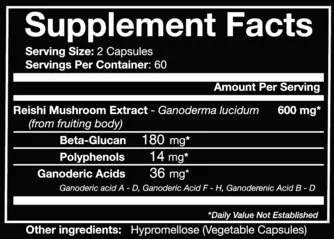
Oriveda Reishi Primo: the highest enzymatic figure, 42% of the studied amount
- What’s in it, 2 of 2: “red Reishi fruiting body extract”, says Oriveda’s US page.
- Beta-glucans, 2 of 2: 46.5% by Megazyme’s method, on Eurofins report 5533057-0 (23 September 2026). The label says 180 mg (30%), and lists no cellulose flow agent.
- Dose, 0 of 2: 0.6 g a day with no ratio stated, so 1:1: 42% of 1.44 g.
- Safety tests, 1 of 2: metals and pesticides (Eurofins ARL, 6 October 2026), but no microbe results. Its lead, 1.7 mg/kg, is the highest of the reishi reports I read. The EU’s food-supplement maximum is 3.0.
- Value, 1 of 2: $4.54 per gram of beta-glucans ($75.95 for 60 servings at Modern Herb Shop), about $1.27 a day.
Of the five with a figure, none costs more per gram. Oriveda’s lion’s mane capsule, which my Oriveda review covers, is the cheapest per gram on the lion’s mane list.
Oriveda
Reishi Primo (120 caps)
Score: 6/10Fair- What's in it2 of 2
- Actives2 of 2
- Dose0 of 2
- Safety1 of 2
- Value1 of 2
- Per gram of beta-glucans
- $4.54
- Reseller price
- $75.95 60 servings
Eurofins measured 46.5% beta-glucans, well over the label's 30%, yet it's the priciest reishi per gram on my Scorecard.
Price checked 23 Nov 2026 at Modern Herb Shop, the US retailer Oriveda's US site links to
Nootropics Depot Red Reishi 1:1: the lowest price per gram, 35% of the studied amount
- What’s in it, 2 of 2: “Ganoderma lucidum Extract (fruiting body)” on the label, and “1:1” on the page only.
- Beta-glucans, 1 of 2: 313.3 mg per 500 mg capsule (62.7%) on certificate ND-25-1286 (July 2025), by fluorescence.
- Dose, 0 of 2: one 0.5 g capsule is 35% of 1.44 g. At two capsules it would reach 69%, a 1.
- Safety tests, 1 of 2: metals only.
- Value, 2 of 2: $1.06 per gram of beta-glucans ($19.99 for 60 capsules), the lowest of the five with a figure. About $0.33 a day at one capsule.

Nootropics Depot
Red Reishi 1:1 Capsules (60 caps)
Score: 6/10Fair- What's in it2 of 2
- Actives1 of 2
- Dose0 of 2
- Safety1 of 2
- Value2 of 2
- Per gram of beta-glucans
- $1.06
- Brand-site price
- $19.99 60 servings
Rock-bottom price per gram of beta-glucans, based on the certificate Nootropics Depot posts.
Price checked 23 Nov 2026 on nootropicsdepot.com (brand site)
Best reishi extract: what 8:1 and 14:1 mean
Real Mushrooms’ 8:1 is the best-documented extract. FreshCap’s 14:1 has the highest stated ratio.
A ratio is the maker’s claim about input. 8:1 says 8 g of dried mushroom went into each 1 g of extract. I use it for one thing, turning the label serving into grams of mushroom. No ratio counts as 1:1.
The bar is 1.44 g a day. Two placebo-controlled trials (Chu 2012, Wachtel-Galor 2004) gave 1.44 g a day of an extract, “equivalent to 13.2 g of the fresh mushroom” in Chu’s words. With no dried ratio given, I count it 1:1, and I read “fresh mushroom” as the fruiting body.
| Product | Stated ratio | Mushroom a day | Share of 1.44 g |
|---|---|---|---|
| Real Mushrooms | 8:1 (Canadian label) | 8.0 g | 556% |
| Nootropics Depot 8:1 | 8:1 | 4.0 g (one capsule) | 278% |
| FreshCap | 14:1 | 14 g | 972% |
| Oriveda Reishi Primo | Not stated | 0.6 g | 42% |
| Nootropics Depot 1:1 | 1:1 (page, not label) | 0.5 g (one capsule) | 35% |
Does a higher ratio mean more beta-glucans?
Not in these five. FreshCap’s 14:1 claims 27% on its label, while Oriveda’s extract, with no ratio stated, shows 46.5% on a lab report. One is a label claim and the other a lab result, so take it as what this data shows, not as a rule. A ratio describes what went into the extract, and the beta-glucan percentage is what someone measured.
Counting a product’s extract at its stated ratio lets me compare it with the trials’ extract. The two still aren’t the same thing (who the reishi trials looked at).
Why Host Defense, Double Wood and Om score Poor
All three include mycelium, by their own labels or pages, and none publishes a beta-glucan figure. All three score 0 for dose, because no controlled trial I could find tested these forms on their own. Fruiting body or mycelium explains why the growing medium matters.
Host Defense: mycelium on brown rice
Host Defense, 2/10. Mycelium grown on brown rice and sold with it, “mycelium/fermented brown rice biomass 1g” by the label. Its only figure is a “greater than 55% polysaccharides” guarantee for all its capsules, a measure that counts starch unless the method removes it. It names testing for “Identity, Composition, Purity and Strength” and posts no results. Its maker argues that beta-glucan content is “not the whole story”, the same case it makes for the lion’s mane capsule in my Host Defense review.
Double Wood: the label and the page disagree
Double Wood, 1/10. The label says “Entire fruiting body”. The product page says “ENTIRE FRUITING BODY AND MYCELIUM INCLUDED” and names no growing medium (both read 24 November 2026). With the mycelium’s source unstated, contents and dose score 0. Counted as fruiting body alone, its 1.0 g of 4:1 would clear the bar. The label carries a “Third-Party Tested” badge, but the page’s test-results link opens an identity test only (Colmaric Analyticals, April 2026). The page does show metal and microbe results for a May 2026 lot, more than Host Defense or Om post, but it names no lab for them.
Om: mycelium on oats
Om, 1/10. The label lists reishi “mycelial biomass & fruit body; cultured on organic whole oats”, with no split and no extract named: 2.0 g a day. The page says every product is tested “by a third-party lab, for heavy metals and other contaminants”, but posts no results, the same gap my Om review finds on Om’s lion’s mane capsules and coffee.
Om and Double Wood tie on total, safety and beta-glucans, and neither has a price per gram. Double Wood ranks higher because it costs less a serving, $0.13 against $1.07.
Also scored:
Host Defense
Reishi Capsules (30 caps)
Score: 2/10, Poor- What's in it0 of 2
- Actives1 of 2
- Dose0 of 2
- Safety1 of 2
- Value0 of 2
Double Wood Supplements
Reishi Mushroom Extract (300 caps)
Score: 1/10, Poor- What's in it0 of 2
- Actives0 of 2
- Dose0 of 2
- Safety1 of 2
- Value0 of 2
Om Mushroom Superfood
Reishi Mushroom Capsules (90 caps)
Score: 1/10, Poor- What's in it0 of 2
- Actives0 of 2
- Dose0 of 2
- Safety1 of 2
- Value0 of 2
Do other reishi lists show lab figures?
The two lists I opened show no lab figures. The Salt Lake Tribune’s “24 best” ran in March 2023 marked “Sponsored”, and none of its picks shows a lab report, a beta-glucan figure or a price per gram. Fitness Volt’s list (updated 31 May 2026) puts an extract powder first, Double Wood 7th and Host Defense 12th, and picks Om’s powder, not its capsules.
Did ConsumerLab test these?
ConsumerLab tested seven reishi supplements for its review of 21 May 2026, including products from FreshCap, Host Defense, Real Mushrooms and Om (Om’s powder). Two weren’t approved, and which two is for members only. Real Mushrooms’ own page says ConsumerLab chose its Reishi 415, a name the page links to the capsule ranked here. That claim dates from ConsumerLab’s 2019 review, not the 2026 one.
What to look for in a reishi supplement
- The part, in writing: fruiting body, spores or mycelium, and what any mycelium grew on.
- A beta-glucan figure from a named lab, method stated. A “polysaccharides” figure is a different measure.
- A daily amount you can check: label grams times the ratio, set against 1.44 g.
- Metal and microbe results with the lab’s name on them, no more than two years old or tied to your lot.
- What a gram of beta-glucans costs, not what the bottle costs: price ÷ (servings × grams per serving × beta-glucan %).
The five label checks work for any mushroom.
What would change these scores?
- The Canadian label: without its 8:1, Real Mushrooms totals 8.
- The brands’ own figures: at its 20% minimum, Nootropics Depot 8:1 would cost $5.00 per gram. At its label’s 30%, Oriveda would cost $7.03.
- Two lower-dose trials (Chiu 2017, and Mitra 2024 in the abstract I could read) don’t say which part of the mushroom they used. If either used the fruiting body, Oriveda and Nootropics Depot 1:1 would rise from 6 to 8.
Health questions: this site rates what’s in the bottle and how well it’s documented. It doesn’t say what any product does for you, and it isn’t medical advice. Whether a supplement suits you, or is safe with your medicines or a health condition, is a question for your doctor or pharmacist. Read the medical disclaimer. For background: Memorial Sloan Kettering’s About Herbs entry on reishi, the NIH’s LiverTox entry on reishi and the NIH Office of Dietary Supplements’ Dietary Supplements: What You Need to Know.
Other reishi questions
Is reishi spore oil worth it?
None of the eight here is a spore oil. The one placebo-controlled trial of spore oil I found gave 3.0 g a day for 12 weeks (Wang 2025).
Are reishi powders, tinctures or gummies any good?
All eight here are capsules. A mushroom gummy in the test maker’s own validation report (Megazyme) measured 4.96% beta-glucan and 30.86% alpha-glucan, the kit’s measure of starch and sugars. One sample, no brand named.
How much reishi did the studies use?
1.44 g a day of an extract in the two trials behind my bar (Chu 2012, 12 weeks; Wachtel-Galor 2004, 4 weeks). The one trial I found that names unextracted fruiting-body powder used 6.0 g a day (Pazzi 2020), and the spore trials 3.0 g.
Is there a downside to reishi?
The Scorecard doesn’t rate effects, good or bad. The health box on this page links two independent references on reishi.
Is organic reishi better?
Organic is a farming claim. It says nothing about which part of the mushroom went in, or how much. Real Mushrooms (9/10) and Om (1/10) both say organic.
Do you score other mushrooms?
Yes. The Scorecard also has eight lion’s mane capsules, eight cordyceps capsules and seven mushroom coffees. The capsules have rankings of their own, lion’s mane products ranked and cordyceps capsules ranked, and no cordyceps capsule scores on dose, for reasons the cordyceps trials show.
Sources
- Mycology at Home Scorecard data (the eight reishi rows: scores, prices, servings, price per gram, checked dates; the $2.47 reishi median). mycologyathome.com. checked 23-24 Nov 2026
- How I score (the five checks, the tie-break and the clarifications). mycologyathome.com. checked 24 Nov 2026
- Real Mushrooms, Organic Reishi Mushroom Capsules, product page and store data (fruiting-body and “No added starch, fillers, or mycelium fermented grain” statements; $39.95 for 90 capsules, no sale). realmushrooms.com. checked 23-24 Nov 2026
- Real Mushrooms labels, 90 capsules. US label (1,000 mg extract a serving, 250 mg beta-glucans; microcrystalline cellulose flow agent; no ratio) cdn.shopify.com · Canadian label (extract 8:1, fruiting body, “500mg (4000 mg dry)” per capsule) cdn.shopify.com. checked 23-24 Nov 2026
- SGS Canada report VR26-01821.002 (completed 16 Apr 2026; sample RM-RX100C, the 200-capsule size; beta-glucans 35.1% by Megazyme K-YBGL; metals; microbes, “determined by a third-party laboratory”), shown under “3rd Party Testing” on the product page. realmushrooms.com. checked 24 Nov 2026
- Megazyme, K-YBGL assay instructions 09/25 (“NOT applicable” when cellulose is present). www-docs.megazyme.com. checked 23 Nov 2026
- Megazyme, K-YBGL validation report 09/25 (“Over-recovery of β-glucan if sample contains cellulose”; the “Mushroom Gummy” sample, run with the kit’s maltitol method: 30.86% alpha-glucan, 4.96% beta-glucan). www-docs.megazyme.com. checked 22-23 Nov 2026
- Nootropics Depot, Red Reishi 8:1 Capsules (fruiting-body statement; 20% minimum; $29.99 for 60; “a 16:1 ethanol extract with our 1:1 water extract”) nootropicsdepot.com · label image (one 500 mg capsule of 8:1 extract, fruiting body; “1-2 Times Daily”) cdn11.bigcommerce.com. checked 23-24 Nov 2026
- Nootropics Depot certificates for the 8:1: ND-24-1354, lot LG8CS1061724, and ND-24-984, lot LG8CS1042524, both 6 Jun 2024 (322 mg beta-glucans per capsule by fluorescence; metals; same raw-material batch) cdn11.bigcommerce.com · cdn11.bigcommerce.com. checked 23-24 Nov 2026
- Nootropics Depot, Red Reishi 1:1 Capsules (“1:1 fruiting body extract”; 35% minimum; $19.99 for 60) nootropicsdepot.com · label image (one 500 mg capsule, fruiting body, no ratio) cdn11.bigcommerce.com. checked 23 Nov 2026
- Nootropics Depot certificates for the 1:1: ND-25-1286, lot LGZCS1071625, 16 Jul 2025, and ND-25-934, lot LGZCS1112524 (313.3 mg beta-glucans per capsule by fluorescence; metals) cdn11.bigcommerce.com · cdn11.bigcommerce.com. checked 23-24 Nov 2026
- Nootropics Depot, Meet Our Third Party Labs (Omnient “issues the certificate of analysis for each finished lot”; read 28 Nov 2026) nootropicsdepot.com · Trust Through Transparency (Omnient and the brand “all owned and overseen by the founder”) nootropicsdepot.com. checked 24 Nov 2026
- FreshCap, Organic Reishi Mushroom Capsules (product data: $39.99 for 120 capsules, no sale; ingredients line “(Fruiting Body)”) freshcap.com · supplement facts image (27% beta-glucan; “a 14:1 extract, equivalent to 14,000mg”; “(Fruiting Body and Spore)”) cdn.shopify.com · product image (“Third-party tested for purity and strength.”) cdn.shopify.com · product image (“100% Fruiting Body”) cdn.shopify.com. checked 23-24 Nov 2026
- Oriveda, US page (Reishi Primo, “a dual extracted and highly concentrated red Reishi fruiting body extract”; link to Modern Herb Shop) us.oriveda.com · label image (600 mg from fruiting body a serving; 180 mg beta-glucan; hypromellose capsules) us.oriveda.com. checked 23 Nov 2026
- Modern Herb Shop, Oriveda Reishi Primo ($75.95; 60 servings, 120 capsules). modernherbshop.com. checked 23-24 Nov 2026
- Oriveda Reishi Primo certificates, lot 2026-27B: Eurofins report 5533057-0 (23 Sep 2026; beta-glucan 0.279 g a serving, Megazyme K-YBGL) and Eurofins ARL report 1410553-S (6 Oct 2026, pages 1-2 of 11; metals, pesticides), in an 11-page file with no microbe results oriveda.com · certificates page oriveda.com. checked 23-24 Nov 2026
- Commission Regulation (EU) 2023/915 (maximum lead level in food supplements, 3.0 mg/kg). eur-lex.europa.eu. checked 22-23 Nov 2026
- Host Defense, Reishi Capsules (product page: “both the mushroom mycelium and the fermented rice substrate”; $20.95 for 30 capsules) hostdefense.com · label (2 capsules = 1 g mycelium/fermented brown rice biomass) cdn.shopify.com · FAQs (“greater than 55% polysaccharides”; testing focused on “Identity, Composition, Purity and Strength”) hostdefense.com. checked 23-24 Nov 2026
- Fungi Perfecti (maker of Host Defense), “Beyond Beta-Glucans”, 5 Nov 2026 (“not the whole story”). fungi.com. checked 22 Nov 2026
- Double Wood, Reishi Mushroom Extract (product page: “ENTIRE FRUITING BODY AND MYCELIUM INCLUDED”; lot 2608406 results with no lab named; “View Third Party Test Results”; $19.95 for one bottle of 300 capsules) doublewoodsupplements.com · label image (“Reishi Mushroom Extract 4:1 1000mg Entire fruiting body”; “Third-Party Tested” badge) cdn.shopify.com · Nutra Solutions USA certificate, lot 2311-348, 24 Jan 2024 (“Entire fruiting body and mycelium”; rice flour) cdn.shopify.com · Colmaric Analyticals identity report (TLC), lot 2516900, 28 Apr 2026 cdn.shopify.com. checked 23-24 Nov 2026
- Om, Reishi Mushroom Capsules (testing statement; $31.99 for 90 capsules) ommushrooms.com · label image (3 capsules = 2 g “mycelial biomass & fruit body; cultured on organic whole oats”) cdn.shopify.com. checked 23-24 Nov 2026
- Chu et al. British Journal of Nutrition 2012;107(7):1017-1027, PMID 21801467 (“1·44 g Lingzhi extract/d … equivalent to 13·2 g of the fresh mushroom”; 12 weeks). doi.org/10.1017/S0007114511003795. Read in full. checked 23-24 Nov 2026
- Wachtel-Galor et al. British Journal of Nutrition 2004;91(2):263-269, PMID 14756912 (1.44 g extract a day, “equivalent to 13.2 g fresh mushroom/d”; 4 weeks). doi.org/10.1079/BJN20041039. Read in full. checked 23-24 Nov 2026
- Spore trials: Zhao et al. Evid Based Complement Alternat Med 2012:809614, PMC3236089 (3.0 g spore powder a day, 4 weeks) pmc.ncbi.nlm.nih.gov · Wang et al. Medicine 2018;97(19):e0636, PMC5959386 (3.0 g spore powder a day, 6 weeks) pmc.ncbi.nlm.nih.gov · Wang et al. Nutrients 2025;17(5):844, PMC11901880 (3.0 g spore oil a day, 12 weeks) pmc.ncbi.nlm.nih.gov. Read in full. checked 23-24 Nov 2026
- Pazzi et al. Healthcare 2020;8(4):520, PMC7712001 (6.0 g a day of micromilled fruiting body). pmc.ncbi.nlm.nih.gov. Read in full. checked 23-24 Nov 2026
- Trials that don’t state the part used: Mitra et al. Int J Med Mushrooms 2024;26(11):51-64, PMID 39241163 (500 mg or 1,000 mg a day; abstract only) pubmed.ncbi.nlm.nih.gov/39241163 · Chiu et al. Pharmaceutical Biology 2017;55(1):1041-1046, PMID 28183232 (225 mg a day of an enriched extract) pubmed.ncbi.nlm.nih.gov/28183232. checked 23-24 Nov 2026
- Wu DT, et al. “Evaluation on quality consistency of Ganoderma lucidum dietary supplements collected in the United States.” Scientific Reports 2017;7:7792, PMC5552695 (19 products bought online in Feb-Mar 2015; G. lucidum polysaccharides in 5, starch-like polysaccharides in 13; brands not named). doi.org/10.1038/s41598-017-06336-3. Read in full. checked 23 Nov 2026
- ConsumerLab, Reishi (Mushroom) Supplements Review, published 21 May 2026 (public summary and the list of seven products tested; results for members only) consumerlab.com · ConsumerLab news release, 22 Aug 2019 (the 2019 review; Real Mushrooms Reishi Extract 415 among its products) consumerlab.com · Real Mushrooms, “How to I.D. the Best Reishi Mushroom Supplement” (the Reishi 415 claim, whose “Reishi 415 product” link goes to the capsule ranked here; modified 19 May 2022) realmushrooms.com. checked 24 Nov 2026
- Fitness Volt, “12 Best Reishi Mushroom Supplements of 2026” (modified 31 May 2026; #1 Anthony’s extract powder, #7 Double Wood capsules, #10 Om powder, #12 Host Defense capsules). fitnessvolt.com. checked 24 Nov 2026
- The Salt Lake Tribune, sponsored content, “24 best reishi mushroom …” (10 Mar 2023, marked “Sponsored”). sltrib.com. checked 24 Nov 2026
- Memorial Sloan Kettering, About Herbs: Reishi Mushroom (last updated 5 May 2026). mskcc.org. checked 24 Nov 2026
- NIH LiverTox: Lingzhi, Reishi, NBK609014 (updated 5 Oct 2024). ncbi.nlm.nih.gov. checked 24 Nov 2026




Cite this page
Quoting with a link is always fine. The Scorecard data and my own charts are free to reuse under CC BY 4.0: add "CC BY 4.0" to the citation. Photos and the page text aren't covered.
Citation
Rowan Hale, "Best Reishi Supplement: Real Mushrooms Leads on Lab Reports, Not on Price", Mycology at Home, https://mycologyathome.com/best-reishi-supplement/. Data checked 24 Nov 2026. Retrieved [the date you read it].
Tap the citation to select it.
- Key findings
- Sources on this page
- Scorecard data (CSV)
- CC BY 4.0Data and my charts only