
 By
What five cordyceps trials gave#
- Farzan 2026 gave 12 young men one 1 g dose of Cordyceps militaris fruiting-body extract and one placebo dose, a week apart, 30 minutes before a cycling test [1].
- Kang 2015, Dubhashi 2023 and Zhou 2021 gave 1.5 to 3 g of C. militaris a day for 15 days to 6 weeks, but none says if it was fruiting body or mycelium (Kang: abstract only) [2][3][4].
- Chen 2010 gave about 3 g a day of Cs-4 fermented mycelium, three 333 mg capsules three times a day, in a 12-week placebo trial of 20 healthy adults aged 50 to 75, though its abstract reads as 1 g [6].
Figures as of 24 Nov 2026.Free to quote with a link.How to cite
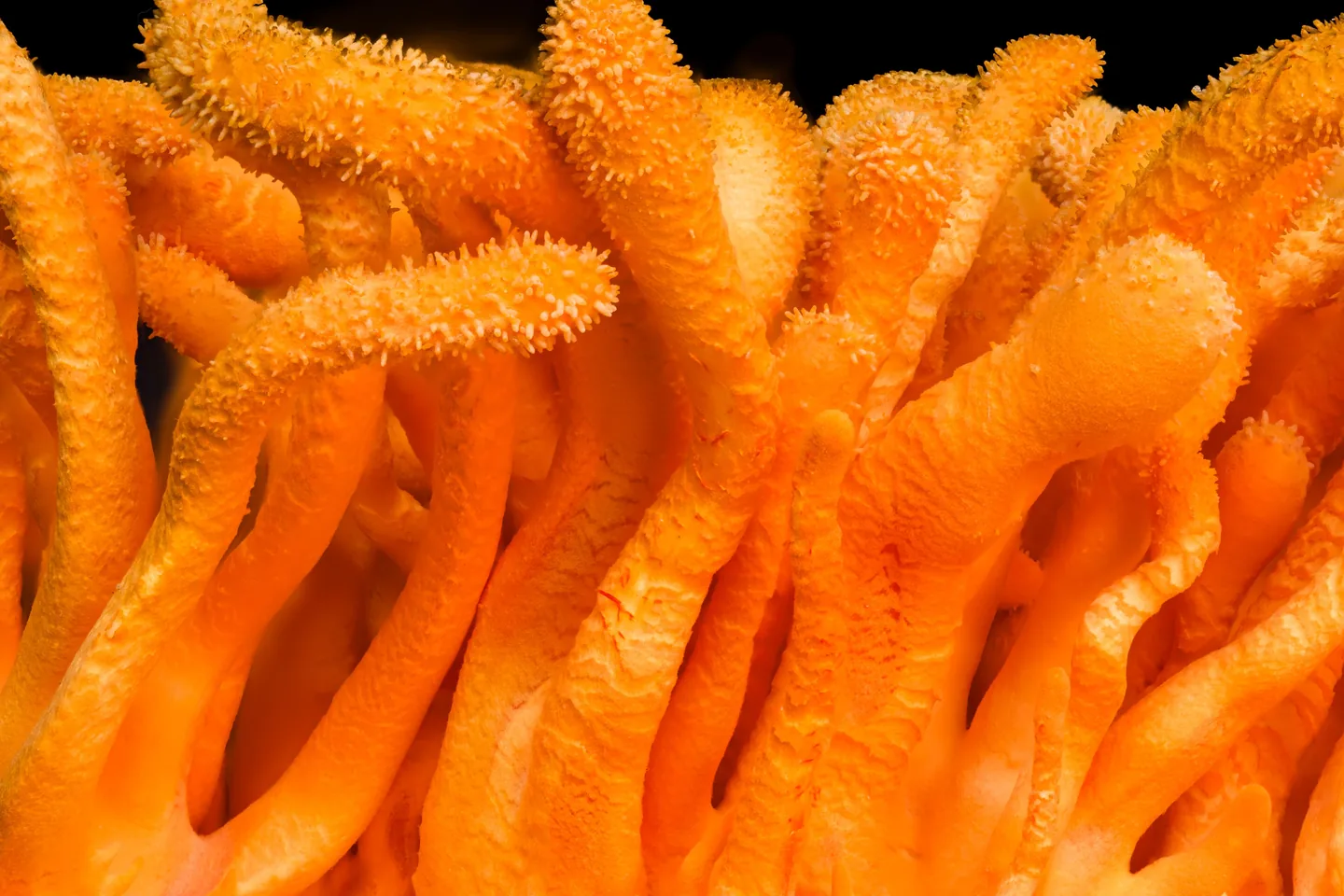
Cordyceps militaris vs Cs-4: which one is in the bottle?
“Cordyceps” on a label can mean four organisms, and a trial of one never sets the amount for another:
- Cordyceps militaris, cultivated and sold as fruiting body or mycelium. Farzan 2026 names the fruiting body and Nakamura 2024 a mycelium extract; Kang 2015, Dubhashi 2023 and Zhou 2021 don’t say which part.
- Cs-4, a fermented mycelium. Its strain, which Chen 2010 names Paecilomyces hepiali, came from wild C. sinensis. Chen 2010 and Parcell 2004 gave it at about 3 g a day. Jung 2019 used another P. hepiali mycelium, as an extract.
- Hirsutella sinensis (Cs-C-Q80), the mycelium in China’s Bailing capsule (Shu 2024). Wang 2016’s Corbrin capsule is likely the same; not confirmed.
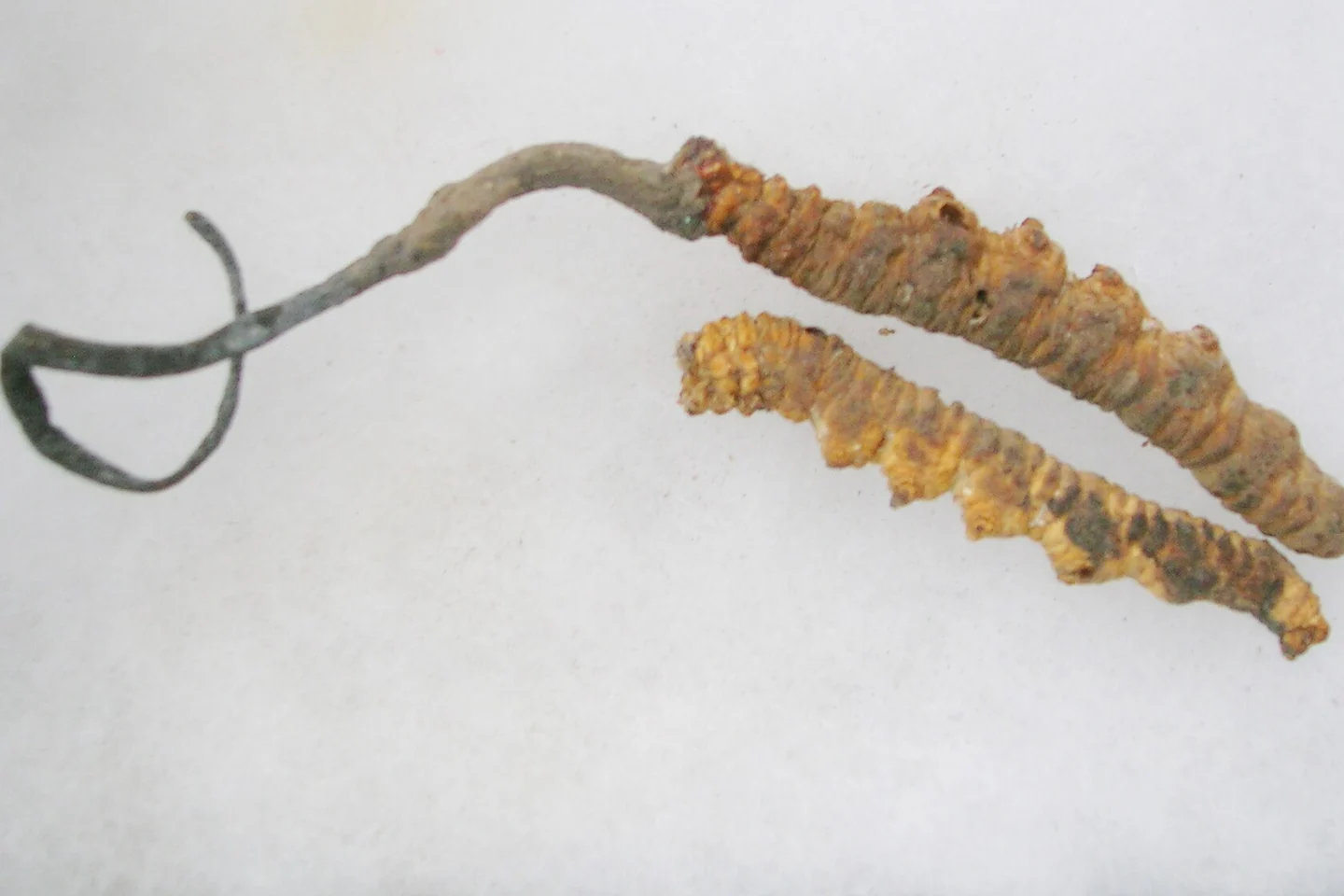
- Wild Ophiocordyceps sinensis, the caterpillar fungus, with no controlled human trial I could find.
Which cordyceps is in the capsules I’ve scored?
Of the 8 cordyceps capsules I’ve scored, 6 hold only C. militaris, 1 blends it with Cs-4, and 1 names neither. Only that blend’s Cs-4 part can be set against a daily trial:
| Form on the label | Capsules | What it can be compared with |
|---|---|---|
| C. militaris fruiting-body extract | 4 | No daily trial of this form |
| Blend: Cs-4 mycelium extract + C. militaris fruiting-body extract | 1 | Cs-4 part: 0.6 g a day, 42% of Jung 2019’s 1.43 g. Militaris part: no daily trial |
| C. militaris mycelium on brown rice; mycelium, stroma and fruit body on oats | 2 | No controlled trial found |
| “Cordyceps sinensis” mycelium, no strain or growing medium named | 1 | Can’t be matched to any trial |
What do some sources and labels get wrong?
- Chen 2010 gave about 3 g a day, not 1 g. Its abstract, and LiverTox’s note on it, read as one 333 mg capsule three times a day; the methods give three, three times a day (756 capsules for 12 weeks).
- Jung 2019’s extract isn’t C. militaris, though Ontawong 2024 cites it as “C. militaris capsules”.
- Labels mix the names. Oriveda’s label calls its CS-4 mycelium extract “Ophiocordyceps sinensis”; NOW’s says “Cordyceps sinensis” and “Mycelium”, with no strain or growing medium.
How much cordyceps per day did the studies use?
It depends on which cordyceps. Each organism and form has its own amount.
| Study | Organism and form | Daily amount | How long | Paper |
|---|---|---|---|---|
| Farzan 2026 | C. militaris fruiting-body extract | 1 g, once (single dose) | one dose | PMID 42455764 |
| Kang 2015 | C. militaris, part not stated | 1.5 g | 4 weeks | PMID 26284906 |
| Dubhashi 2023 | C. militaris, part not stated | 1.5 g (3 × 500 mg) | 15 days | PMID 37727187 |
| Zhou 2021 | C. militaris, part not stated | 3 g (3 tablets) | 6 weeks | PMID 34858228 |
| Nakamura 2024 | C. militaris mycelium extract | 1.8 g (6 × 300 mg) | 16 weeks | PMID 38931190 |
| Chen 2010 | Cs-4, fermented mycelium (P. hepiali) | about 3.0 g (9 × 333 mg) | 12 weeks | PMID 20804368 |
| Parcell 2004 | Cs-4 tablets | 3 g | 5 weeks | PMID 15118196 |
| Jung 2019 | P. hepiali mycelium extract | 1.43 g of extract | 8 weeks | PMID 30925876 |
| Shu 2024 | H. sinensis mycelium (Bailing capsule) | 6.0 g (3 × 2.0 g) | 48 weeks | PMID 39193337 |
| Wang 2016 | Corbrin capsule: likely H. sinensis, not confirmed | 3.6 g (3 × 1.2 g) | 3 months | PMID 28050193 |
Which cordyceps trials are left out?
Ontawong 2024 isn’t in my table because it states no grams. Neither is Pasha 2024, which used fresh fruiting body, or any trial of a blend. The Dose check keeps each organism apart, as it does other species: the same check for lion’s mane and reishi’s trial amounts, form by form.
Who was in each cordyceps trial?
Who took part, what the researchers measured and who paid. The results stay in the papers.
The C. militaris trials
- Farzan 2026: 12 “recreationally active young men”, given one dose of cordyceps and one of placebo, a week apart. Measured: Stroop reaction time and accuracy, oxygen uptake, blood glucose, blood pressure, heart rate. No funding or competing interests declared.
- Kang 2015 (abstract): 79 healthy Korean men, 4 weeks. Measured: natural killer cell activity, lymphocyte proliferation, Th1 cytokines. The abstract names no supplier or funder.
- Dubhashi 2023: 65 adults with mild or moderate COVID-19 (58 evaluable), on top of standard care, 15 days. Measured: time to clinical recovery, RT-PCR, chest X-ray, blood markers. Sponsor: the company that markets the capsules.
- Zhou 2021: 61 outpatients with major depressive disorder and insomnia, all on duloxetine (59 analyzed), 6 weeks. Measured: the Athens Insomnia Scale and the 17-item Hamilton Depression Scale. Publicly funded; maker not named.
- Nakamura 2024: 22 healthy male long-distance runners aged 18 to 24, 16 weeks. Measured: blood markers such as hemoglobin and ferritin, creatine kinase, a 5,000 m time. The powder’s maker funded it.
The Cs-4, P. hepiali and H. sinensis trials
- Chen 2010: 20 healthy adults aged 50 to 75 (15 finished), 12 weeks. Measured: V̇O2 max and the metabolic and ventilatory thresholds. A company supplied the Cs-4; an NIH training grant paid in part.
- Parcell 2004 (abstract): 22 male cyclists, 5 weeks. Measured: V̇O2 peak, ventilatory threshold, a time trial.
- Jung 2019: 80 healthy adults, average age 47.6 (79 finished), 8 weeks. Measured: natural killer cell activity, then cytokines. Government-funded; one author works for the extract’s supplier.
- Shu 2024: 240 adults with chronic bronchitis at eight hospitals in China, randomized 2:1 to capsule or placebo, 48 weeks. Measured: how often acute exacerbations happened, and symptom severity. Hospital-funded; maker not named.
- Wang 2016: 120 adults with moderate-to-severe asthma, 3 months, against usual care (no placebo, no blinding). Measured: an asthma quality-of-life questionnaire, exacerbations, lung function, blood markers of inflammation. No funding statement.
What’s the best way to take cordyceps, and can you take it every day?
No trial compared one way of taking cordyceps with another. What they did:
- Form: mostly capsules; tablets in Parcell and Zhou; a fruit-juice drink in Ontawong.
- Doses a day: three in Chen, Dubhashi, Shu and Wang; two in Jung and Nakamura; one in Zhou and Ontawong. Kang’s and Parcell’s abstracts don’t say.
- Food: Dubhashi, Jung, Zhou and Ontawong tied each dose to a meal, and Chen allowed “water or food”.
- Every day, and for how long: every trial in my table except Farzan 2026 gave cordyceps daily, from 15 days (Dubhashi 2023) to 48 weeks (Shu 2024). The longest for C. militaris was 16 weeks, as a mycelium extract (Nakamura 2024), and for Cs-4, 12 weeks (Chen 2010).
What’s the best time to take cordyceps? Can you take it at night?
No trial compared times of day. Jung gave it after breakfast and dinner, Dubhashi after meals, Nakamura in the morning and evening, Zhou after dinner and Ontawong after breakfast; Chen, Shu and Wang give only the number of doses a day. None gave it at bedtime. Farzan’s single dose came in the morning, 30 minutes before testing and about 2 hours after a set breakfast. These trials can’t tell you whether timing matters.
How do cordyceps labels compare with the trials?
The Scorecard compares labels with trials by three rules:
- Extracts count at their stated ratio; no ratio counts as 1:1 (what an extract ratio means).
- Each organism and form has its own trials. A Cs-4 trial sets nothing for C. militaris.
- No daily trial, nothing to compare: dried C. militaris fruiting body, mycelium grown on grain, and labels that name no strain or growing medium.
By those rules, 7 of the 8 capsules in the label table at the top of this page can’t be matched to a daily trial amount. The eighth is the blend, whose Cs-4 part gives 42% of its trial’s amount.
Why does every cordyceps capsule I’ve scored get 0 for dose?
The dose check needs the lowest amount a controlled trial gave people every day, for at least two weeks, of the same organism and form. For C. militaris fruiting-body extract, the only trial I found gave 12 young men a single 1 g dose of Real Mushrooms’ extract before a cycling test (Farzan 2026). One dose sets no daily bar, so a fruiting-body capsule scores 0, as an unknown does everywhere on the Scorecard.
That 0 says the research is missing. It doesn’t say the capsule holds too little. The blend’s Cs-4 part reaches 42%, under the half that scores 1. If I find a daily trial of the dried fruiting body, I’ll rescore every cordyceps product against it.
What’s cordycepin?
Cordycepin is one of the markers some cordyceps labels and lab reports list, and three of the 8 labels I’ve scored give a figure. The Scorecard reports it but scores only beta-glucans, for every species, so scores stay comparable. Labels and lab reports can disagree. One label says 0.2% cordycepin, while its lab report gives 1.5 mg in a 500 mg capsule, or 0.3%.
Three things on a cordyceps label: On the label, look for the organism (Cordyceps militaris, Cs-4…), the part (fruiting body or mycelium) and, for mycelium, what it grew on. A label that names none of them has no trial to compare with. Dose is the third of the five label checks.
Cordyceps side effects: what the trials, LiverTox and FDA report
What the trials recorded, in their words:
- None recorded: Farzan 2026 (“no dropouts, protocol deviations, or adverse events”), Chen 2010 (“No adverse events occurred.”) and Nakamura 2024 (none “attributable to the test food intake”).
- Nothing serious or severe reported: Jung 2019, Zhou 2021 and Dubhashi 2023. In Dubhashi, 6 patients on cordyceps (20.0%) and 4 on placebo (14.3%) had treatment-emergent adverse events. Kang 2015’s abstract: “There was no statistically significant adverse reaction.”
- Counted in both groups: Shu 2024 found adverse events in 29.6% of patients on the capsule and 30.4% on placebo, with 6 serious events in each group. Wang 2016’s text and its own table give different counts. Parcell 2004’s abstract doesn’t say.
Jung, Zhou and Shu excluded people with liver or kidney failure or abnormal liver or kidney tests.
What does LiverTox say about cordyceps?
LiverTox, NIH’s reference on liver injury from drugs and supplements, gives cordyceps a likelihood score of E: “unlikely cause of clinically apparent liver injury” (last updated 23 July 2026). Its summary: “Cordyceps extracts are generally well tolerated and have not been associated with serum aminotransferase elevations during therapy or with cases of clinically apparent acute liver injury.” It describes “minimal or mild adverse events that can include abdominal discomfort, diarrhea, dry mouth, nausea, poor appetite, and rash.”
It also describes a 2023 case report: an 81-year-old woman on long-term cordyceps developed hepatoportal sclerosis, “an uncommon chronic liver condition of unknown cause”. Her liver blood tests were normal, her symptoms and spleen size “improved once the herbal supplement was discontinued”, and LiverTox calls the link with cordyceps “uncertain”.
Does cordyceps interact with medicines?
Memorial Sloan Kettering’s cordyceps page (last updated 18 January 2023) lists no major reported side effects. It names two kinds of medicine to raise with your provider, diabetes drugs such as insulin and blood thinners such as warfarin. If you take either, show your doctor or pharmacist the bottle.
What has FDA done about cordyceps products?
I searched FDA’s warning letters and recalls from January 2023 to November 2026. On cordyceps:
- April 2026: FDA told Nature’s Elements it had no product specifications “to ensure the identity, purity, strength, and composition” of its Cordyceps supplement, and cited disease claims.
- November 2023: a warning letter to Lone Star Botanicals over disease claims for a powder with cordyceps.
- Recalls: none of a cordyceps supplement for contamination; one of a cordyceps coffee in 2024, for undeclared allergens.
Nothing these firms sell is on my Scorecard. Across FDA’s record on mushroom supplements, the letters are about disease claims and manufacturing failures, and the recalls about labels and packaging.
Health questions: this site rates what’s in the bottle and how well it’s documented. It doesn’t say what any product does for you, and it isn’t medical advice. Whether a supplement suits you, or is safe with your medicines or a health condition, is a question for your doctor or pharmacist. Read the medical disclaimer. For background: Memorial Sloan Kettering’s About Herbs entry on cordyceps, the NIH’s LiverTox entry on cordyceps and the NIH Office of Dietary Supplements’ Dietary Supplements: What You Need to Know.
Does cordyceps work? What the trials can’t tell you
That’s the question behind “cordyceps benefits”, and these trials can’t settle it:
- Size: 12 to 240 people each, for one dose to 48 weeks.
- Groups: young men, runners, cyclists, healthy adults and, in four trials, patients with a specific illness.
- Company ties: three trials had a sponsor, funder or author from the company behind the product; in a fourth, a company supplied it.
- Bottles: only one trial used a product I’ve scored, as a single dose.
Cordyceps beta-glucans, coffee and The Last of Us
Beta-glucans. Of the 8 cordyceps capsules I’ve scored, two publish an enzymatic beta-glucan figure on a named lab’s report, 17.2%† and 41.4%, and three publish none. Published figures for cordyceps itself are scarce too.
† The 17.2% capsule’s label lists microcrystalline cellulose, which the enzymatic test may count as beta-glucan.
Coffee. Cordyceps turns up in five of the seven mushroom coffees on my Scorecard. Only two say how much, on their websites rather than the label: MUD\WTR 560 mg, and Cuppa the “equivalent of 1000mg”.
The Last of Us. Its fungus is fiction, modeled on Ophiocordyceps unilateralis, according to CDC’s journal Emerging Infectious Diseases.
Since dose can’t separate them: the 8 capsules are ranked on the other four checks, with each one’s evidence, in best cordyceps supplement.
- How to read a mushroom supplement label
- How to read a certificate of analysis
- Fruiting body vs mycelium
- Mushroom extract vs powder
- Beta-glucans and price per gram
- Are mushroom supplements safe?
- Cordyceps products ranked
- The Scorecard
- Lion's mane dosage
- Reishi dosage
Part of How to choose a mushroom supplement The dose check, for cordyceps.
Cordyceps on an empty stomach, caffeine, infection and pregnancy
Can you take cordyceps on an empty stomach?
No trial I checked gave it on an empty stomach as a stated condition, or compared it with and without food.
Does cordyceps have caffeine?
None of the 8 cordyceps capsule labels I’ve scored lists caffeine. The five scored mushroom coffees that list cordyceps give 35 to 110 mg of caffeine a serving, from coffee, or from black tea and cacao in MUD\WTR.
Is cordyceps psychedelic?
Britannica’s entry on psilocybin mushrooms names Psilocybe and ten other genera with psilocybin-containing species. Cordyceps and Ophiocordyceps aren’t among them.
Can cordyceps infect humans?
No Cordyceps species is known to infect a vertebrate. LiverTox describes cordyceps as a parasitic fungus that “typically infects insect or arthropod larvae”. An article in Emerging Infectious Diseases (2024) says Cordyceps species “are species-specific” and “No vertebrate Cordyceps hosts exist.”
Is cordyceps safe during pregnancy?
Ask your doctor. Every trial in my table that enrolled women and mentions pregnancy excluded it. Four enrolled only men, and Chen 2010 (ages 50 to 75) doesn’t mention it. So these trials say nothing about pregnancy.
Sources
- Farzan, Koushkie Jahromi. PLoS One 2026;21(7):e0351725. PMID 42455764, PMC13372127. doi.org/10.1371/journal.pone.0351725 (full text: product, single 1 g dose, schedule, adverse events, funding and competing-interest statements) checked 23-24 Nov 2026
- Kang et al. Journal of Medicinal Food 2015;18(10):1164-1172. PMID 26284906. europepmc.org (abstract only; full text paywalled) checked 23-24 Nov 2026
- Dubhashi et al. Cureus 2023;15(8):e43731. PMID 37727187, PMC10505833. europepmc.org (full text; sponsored by Ambrosia Food Farm Co., which markets the capsules) checked 24 Nov 2026
- Zhou et al. Frontiers in Psychiatry 2021;12:754921. PMID 34858228, PMC8632006. europepmc.org (full text) checked 24 Nov 2026
- Nakamura et al. Nutrients 2024;16(12):1835. PMID 38931190, PMC11206946. doi.org/10.3390/nu16121835 (full text; funded by La Vie En Sante Ltd., the powder’s maker) checked 24 Nov 2026
- Chen et al. Journal of Alternative and Complementary Medicine 2010;16(5):585-590. PMID 20804368, PMC3110835. pmc.ncbi.nlm.nih.gov (full text: methods for the 9 capsules a day; Cs-4 supplied by Pharmanex) checked 23-24 Nov 2026
- Parcell et al. International Journal of Sport Nutrition and Exercise Metabolism 2004;14(2):236-242. PMID 15118196. europepmc.org (abstract only) checked 23-24 Nov 2026
- Jung et al. BMC Complementary and Alternative Medicine 2019;19:77. PMID 30925876, PMC6441223. doi.org/10.1186/s12906-019-2483-y (full text; extract from Chebeigen, Inc., which employs one author) checked 24 Nov 2026
- Shu et al. Frontiers in Pharmacology 2024;15:1428216. PMID 39193337, PMC11347402. doi.org/10.3389/fphar.2024.1428216 (full text; funded by China-Japan Friendship Hospital) checked 24 Nov 2026
- Wang et al. Evidence-Based Complementary and Alternative Medicine 2016:6134593. PMID 28050193, PMC5165155. doi.org/10.1155/2016/6134593 (full text: Corbrin capsule, Hangzhou Huadong Pharmaceutical; adverse-event text and Table 5) checked 24 Nov 2026
- Corbrin and Bailing: Evidence-Based Complementary and Alternative Medicine 2016:1360386 (calls Corbrin capsule “CS-C-Q80”), pmc.ncbi.nlm.nih.gov ; Heliyon 2024 (“Corbrin (Bailing) capsule”), pmc.ncbi.nlm.nih.gov checked 24 Nov 2026
- Ontawong et al. Scientific Reports 2024;14:7994. PMID 38580687, PMC10997757. pmc.ncbi.nlm.nih.gov (full text: daily drink, grams not stated; cites Jung 2019 as “C. militaris capsules”) checked 24 Nov 2026
- Pasha et al. Asian Journal of Biological Sciences 2024;17:85-92. doi:10.3923/ajbs.2024.85.92. ajbs.scione.com (fresh fruiting body; not used) checked 23 Nov 2026
- Trials of blends, not used: Hirsch et al. 2017, europepmc.org ; Colson 2005, europepmc.org ; Chen CY 2014, europepmc.org ; Liao 2019, europepmc.org ; Rossi 2014, europepmc.org ; Tsuk 2017 and 2018, europepmc.org , europepmc.org checked 23-24 Nov 2026
- NIH LiverTox, “Cordyceps” (NIDDK; last updated 23 July 2026; PMID 40608959). ncbi.nlm.nih.gov (read from NCBI’s PubMed record and NCBI’s own archive copy of the chapter) checked 24 Nov 2026
- Kaur et al. ACG Case Reports Journal 2023;10:e01206. PMID 38033616. europepmc.org (the case LiverTox describes) checked 24 Nov 2026
- Memorial Sloan Kettering Cancer Center, About Herbs: Cordyceps (last updated 18 Jan 2023). mskcc.org checked 24 Nov 2026
- FDA warning letter to Nature’s Elements, Inc., 7 Apr 2026. fda.gov checked 23 Nov 2026
- FDA warning letter to Lone Star Botanicals Inc., 6 Nov 2023. fda.gov checked 23 Nov 2026
- FDA recalls F-1206-2024 and F-1207-2024 (BF Suma Pharmaceuticals, a reishi coffee and a cordyceps coffee, “Undeclared allergens”), openFDA food enforcement reports, data to 11 Nov 2026. api.fda.gov checked 23 Nov 2026
- Pappas G, Vrioni G. Emerging Infectious Diseases 2024;30(3):595-598. PMC10902526. doi.org/10.3201/eid3003.230684 (full text) checked 24 Nov 2026
- Encyclopaedia Britannica, “Psilocybin mushroom” (genera with psilocybin-containing species). britannica.com checked 23 Nov 2026
- Mycology at Home Scorecard data (CSV): forms, servings, label wording and lab figures of the eight cordyceps capsules, including Oriveda’s label (us.oriveda.com) and NOW’s label as shown in the Internet Archive copy of its page, 12 Nov 2026 (web.archive.org); the seven coffees’ cordyceps listings, amounts and caffeine (MUD\WTR: mudwtr.com ; Cuppa: bettercuppa.com). /mushroom-supplement-scorecard/ checked 22-24 Nov 2026
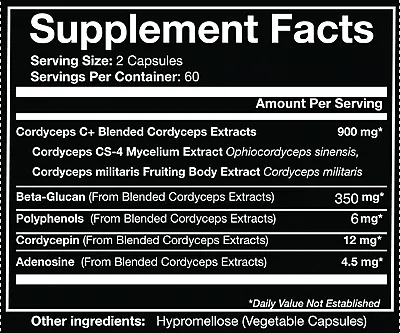
Image credits
- “Cordyceps Militaris” by mushroomclinicaltrials.com (Flickr), via Wikimedia Commons, CC BY 2.0, cropped.
- “CordycepsSinensis” by L. Shyamal, via Wikimedia Commons, CC BY-SA 3.0, cropped. This cropped version is shared under the same licence.


Cite this page
Quoting with a link is always fine. The Scorecard data and my own charts are free to reuse under CC BY 4.0: add "CC BY 4.0" to the citation. Photos and the page text aren't covered.
Citation
Rowan Hale, "Cordyceps Dosage: The Trials Used Different Fungi Sold Under One Name", Mycology at Home, https://mycologyathome.com/cordyceps/. Data checked 24 Nov 2026. Retrieved [the date you read it].
Tap the citation to select it.
- Key findings
- Sources on this page
- CC BY 4.0Data and my charts only