
 By
The ratio on an extract’s label (8:1, 1:1) is the brand’s own account of how much mushroom went into each gram of extract.
Extract ratios and beta-glucans#
- On Nootropics Depot’s own certificates, one brand and one test, its 8:1 lion’s mane shows 115.5 mg of beta-glucans per capsule against 178.5 mg for its 1:1, its 10:1 cordyceps 0 mg, and its reishi pair about the same [14][15][24].
- US label rules (21 CFR 101.36) ask for the weight of a dried extract but don’t require or define a ratio, and in 1998 FDA called the question of how to express dried-extract ratios “beyond the scope” of its review [10][12].
- In See Toh et al. 2023, each of five food mushrooms had a lower beta-glucan percentage as a water extract than as dried mushroom on Megazyme’s kit, oyster mushroom going from 29.8% to 15.9% [7].
Figures as of 28 Nov 2026.Free to quote with a link.How to cite
What’s the difference between mushroom extract and mushroom powder?
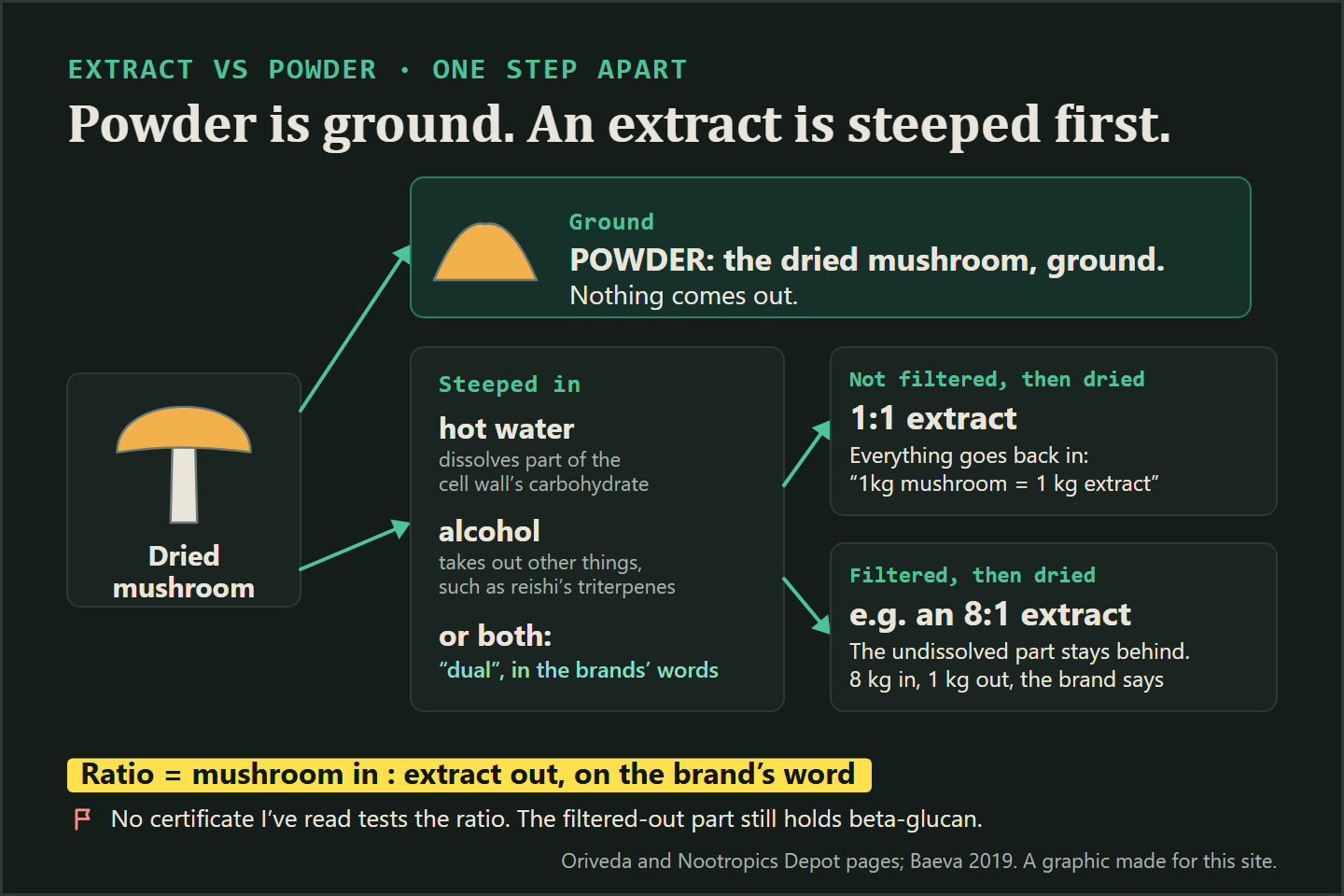
Powder is the simple one. Whatever was in the dried mushroom is in the powder.
An extract adds a soak, and what comes out depends on the liquid:
- The cell wall. A mushroom’s cell walls are mostly carbohydrate: chitin, plus beta-glucans, which make up the bulk (Moore, Robson and Trinci’s fungal biology textbook).
- Hot water dissolves part of that carbohydrate. In a lab extraction of oyster mushrooms, about half of the dried mushroom was still undissolved after hot water and then alkali, and that leftover was chitin bound to beta-glucan (Baeva 2019).
- Alcohol takes out other things. Labs use it to pull triterpenes from reishi, and erinacine A and hericenones from lion’s mane (Wu 2017; Corana 2019).
Then the liquid is dried. If the brand filters it first, the undissolved part stays behind, and that part still holds beta-glucan (Baeva 2019; See Toh 2023). If not, everything goes back in. Oriveda calls that “lossless”.
The same US label rules cover reishi, cordyceps and chaga. My numbers below are for lion’s mane, where my data runs deepest. Reishi’s trials include an extract, at 1.44 g a day, a form none of the lion’s mane trials in my dose table used.
Is mushroom extract better than powder?
Better at what? On the things I can measure, neither form wins by default.
Some extract brands say extracts are more bioavailable. Oriveda says hot water raises bioavailability “± 4 – 10 times”. The study its page links for a similar claim used mouse cells, not people (Coy 2015). Without a human study, I don’t give that any weight.
You’ll also read that people can’t digest chitin, so a mushroom has to be extracted first. That’s stronger than the evidence. A small 2007 study found a chitin-splitting enzyme at work in the stomach juice of 20 of 25 people, tested on lab chitin rather than mushrooms, and its activity varied widely between people (Paoletti 2007). How much mushroom chitin people actually break down hasn’t been measured in any study I found.
For a buyer, I think the real difference is paperwork. An extract lets a brand state a ratio and a beta-glucan figure, and my five top-scoring lion’s mane capsules are all extracts. That’s a reason to read the label, not to pay more.
Lion’s mane extract vs powder: what did the trials use?
Powder. The lion’s mane trials behind my Scorecard’s 2.0 g dose bar used dried powder, not an extract. They’re Nagano 2010 (2.0 g a day of fruiting body) and Saitsu 2019 (3.2 g), plus Mori 2009 (about 2.9 g of powder, part not stated). None of them compared an extract with powder.
What does 8:1 mean on a mushroom label?
A mushroom extract ratio is the brand’s account of mushroom in against extract out, by weight. Nootropics Depot’s help article says its lion’s mane 8:1 takes 8 kg of lion’s mane to make 1 kg of extract. Some labels turn the ratio into a “mushroom equivalent”:
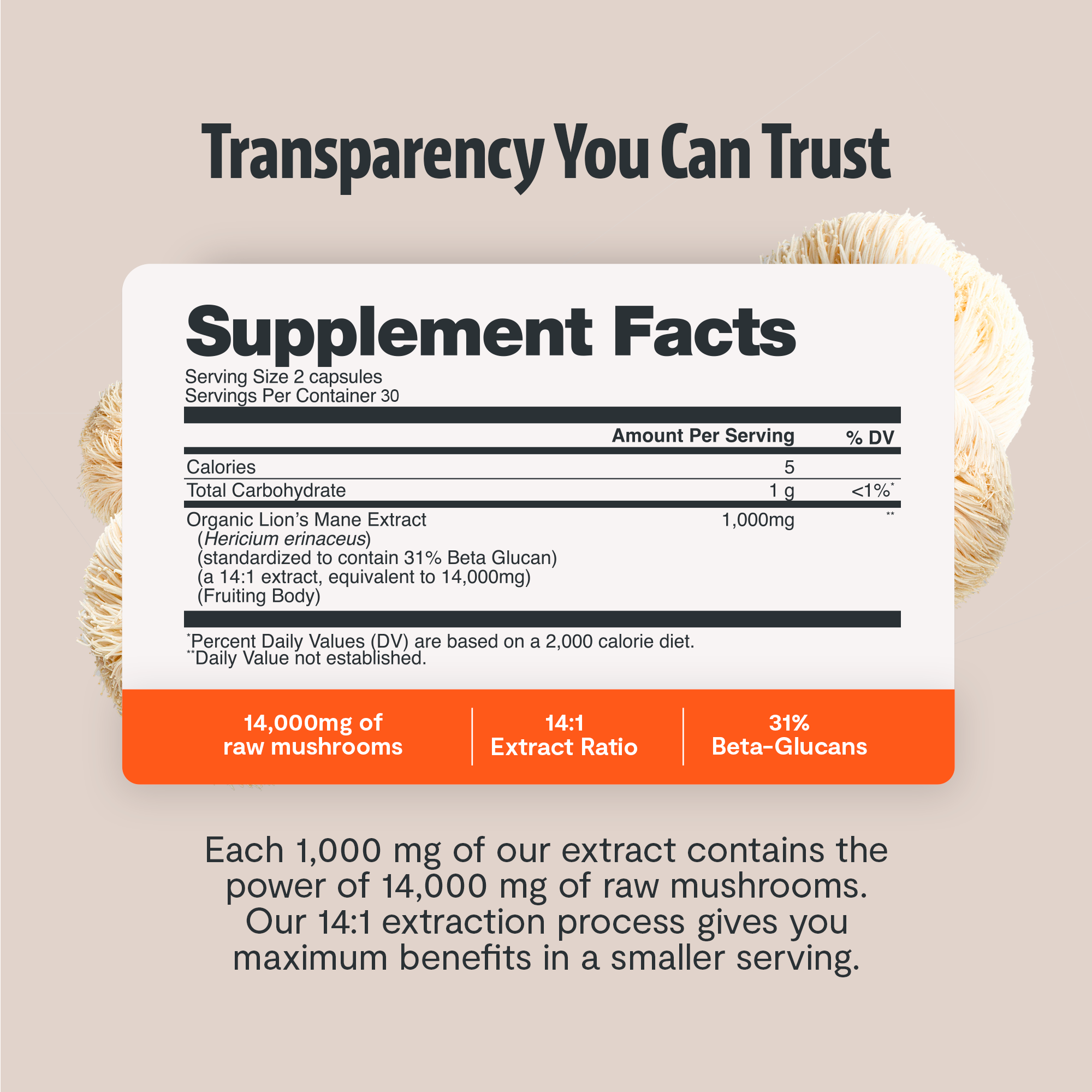
- FreshCap’s label calls its 1,000 mg serving “a 14:1 extract, equivalent to 14,000mg”.
- Mushroom Revival’s label lists 1,000 mg of a 3:1 extract and, in a footnote, “Equivalent to 2,634mg of mushrooms per serving”. At 3:1, the arithmetic gives 3,000 mg. The label doesn’t explain the gap.
Who checks an extract ratio?
Not the rules. For a dried extract, US rules ask the label for “the weight of the dried extract” (21 CFR 101.36). They don’t require a ratio or define one. A 1997 submission to FDA asked for a standard way to express dried-extract ratios, including whether fillers count. In 1998, FDA called those issues “beyond the scope” of its review (63 FR 30615). So an 8:1 is the brand’s own description, held to the general rule that a label mustn’t be false or misleading (21 U.S.C. 343).
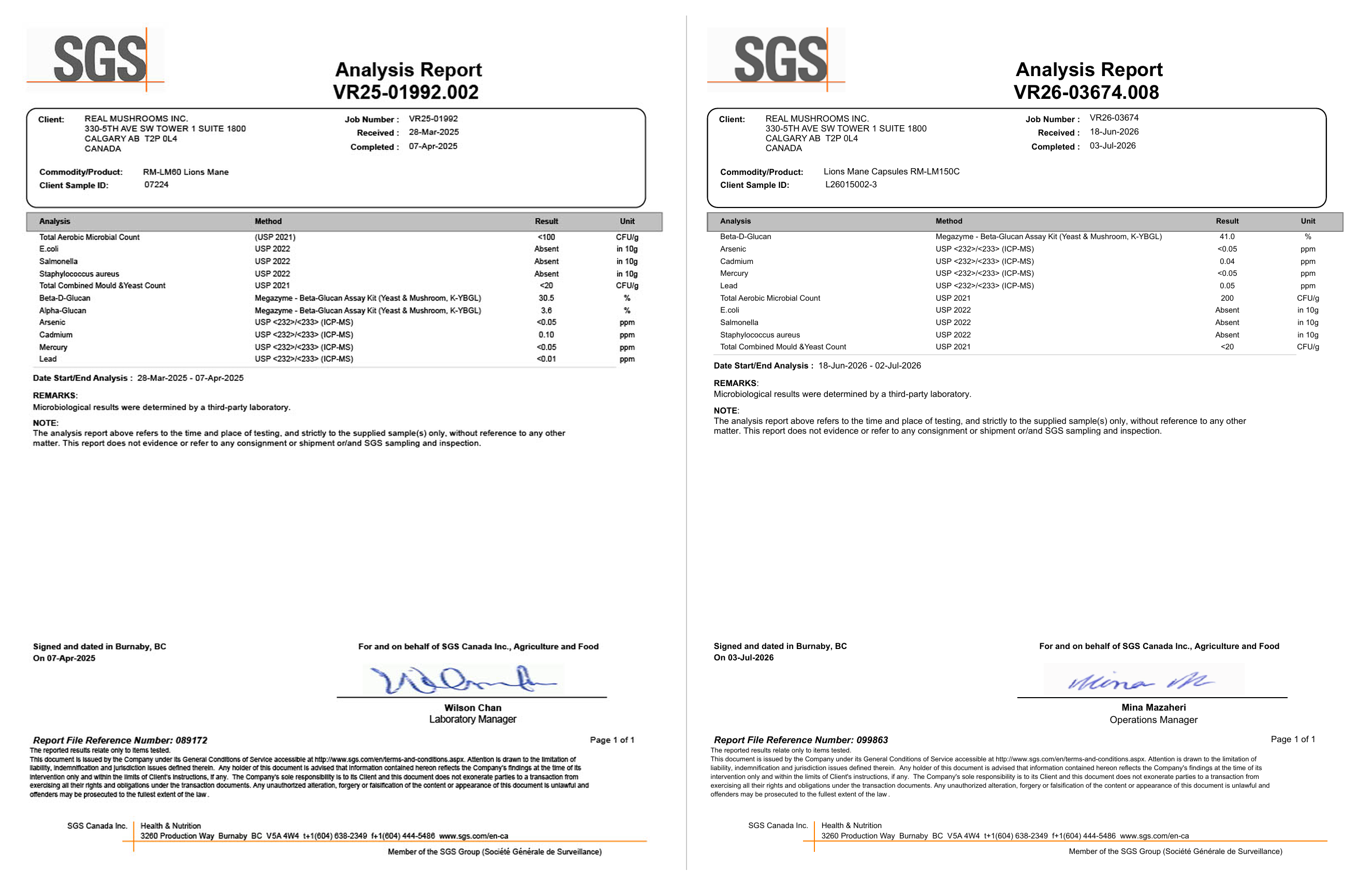
Not the certificates either. None of the four I’ve read for these capsules reports a test of the ratio. Where a ratio appears, it’s part of a product, sample or ingredient name. I found no certificate from FreshCap.
Is an 8:1 extract eight times stronger? Lion’s mane 8:1 vs 1:1
Not necessarily. Nootropics Depot’s own help article says its 8:1 “does not necessarily mean it is 8 times more potent”. By its account, the 8:1 holds more of what dissolves in ethanol and gives up some of what dissolves in water, such as the beta-glucans.
The brand’s certificates let me check that, and not only for lion’s mane. Nootropics Depot sells a 1:1 and a higher-ratio extract of lion’s mane, reishi and Cordyceps militaris, and the newest certificate for each of the six measures beta-glucans the same way, by fluorescence. The higher ratio never came out clearly ahead. It showed fewer beta-glucans than the 1:1 for lion’s mane, none for cordyceps and about the same for reishi.
Same brand, same test: 1:1 against a high ratio
| Extract | Beta-glucans a capsule | Alpha-glucans a capsule | Beta-glucans stated on its product page | Certificate date |
|---|---|---|---|---|
| Lion’s mane 1:1 (hot water) | 178.5 mg (35.7%) | 15.7 mg (3.1%) | Minimum 25% | 28 Sep 2026 |
| Lion’s mane 8:1 (water and ethanol) | 115.5 mg (23.1%) | 15.7 mg (3.1%) | None (minimum 15% in Nootropics Depot’s 2021 article) | 14 Sep 2026 |
| Red reishi 1:1 (hot water) | 313.3 mg (62.7%) | 9.4 mg (1.9%) | Minimum 35% | 16 Jul 2025 |
| Red reishi 8:1 (16:1 ethanol + 1:1 water) | 322 mg (64.4%) | 24 mg (4.8%) | Minimum 20% | 6 Jun 2024 |
| Cordyceps militaris 1:1 (hot water) | 68.2 mg (13.64%) | 73.5 mg (14.7%) | Standardized to 25% | 14 Oct 2026 |
| Cordyceps 10:1 (water and alcohol, 250 mg capsule) | 0 mg (0%) | 90 mg (36.0%) | Standardized to 20% | 19 Aug 2026 |
Does Nootropics Depot claim more for its higher ratios?
No, less. It states a lower beta-glucan figure for the higher ratio of all three species. For lion’s mane and reishi, those minimums are the specs printed on the certificates, and every result clears its spec. The cordyceps certificates set no spec, so the 25% and 20% are product-page claims, and neither capsule’s certificate reaches its figure. The 10:1 shows 0 mg on all eight certificates its page links, all made from one raw batch.
It’s one brand, and the figures have limits. Fluorescence isn’t the enzymatic method behind the Eurofins and SGS results in the next table, so the two sets don’t compare. Each row is a single lot, and the reishi pair were tested about a year apart. Nootropics Depot’s CEO says he created Omnient (who runs it). I wouldn’t stretch six certificates into a rule for other brands.
Ratio math vs lab math: five lion’s mane capsules compared
| Product (Scorecard) | Ratio on the label | Daily serving | Mushroom a day, by the ratio | Beta-glucans (source) | Beta-glucans a day | Cost a day | Price per gram of beta-glucans |
|---|---|---|---|---|---|---|---|
| FreshCap (8/10) | 14:1 | 1.0 g | 14 g | 31% (label claim, no lab report) | 0.31 g | $0.80 | $2.58 |
| Nootropics Depot (7/10) | 8:1 | 0.5 g | 4.0 g | 23.1% (Omnient Labs, fluorescence, 2026) | 0.12 g | $0.50 | $4.33 |
| Mushroom Revival (7/10) | 3:1 | 1.0 g | 3.0 g (2.6 g by its label) | 37.1% (brand-issued sheet, 2021, no lab named) | 0.37 g | $1.27 | $3.41 |
| Real Mushrooms (9/10) | 1:1 (Canadian label; none on the US label) | 1.0 g | 1.0 g | 41.0%† (SGS, enzymatic, 2026) | 0.41 g | $0.58 | $1.42 |
| Oriveda (7/10) | 1:1 | 0.9 g | 0.9 g | 36.3% (Eurofins, enzymatic, 2026) | 0.33 g | $0.33 | $1.02 |
Scorecard data; regular prices checked 22 November 2026 (Oriveda: its official US reseller). The beta-glucan figures come from different methods and sources, so this isn’t a ranking. † With microcrystalline cellulose on Real Mushrooms’ label, this enzymatic figure may run high (the cellulose caveat).
What does the table show?
By the ratio, FreshCap’s daily serving holds 14 times as much mushroom as Real Mushrooms’. By beta-glucans, on FreshCap’s label claim against Real Mushrooms’ lab report, it holds about three quarters as much. Nootropics Depot’s 8:1 counts as 4 g of mushroom a day and shows the least beta-glucan of the five, by a different test.
Nothing in this data says a bigger ratio means more beta-glucans.
Why does value use beta-glucans, not the ratio?
Per gram of mushroom by the ratio, FreshCap looks cheapest, at about $0.06, and Real Mushrooms most expensive, at $0.58. That isn’t a Scorecard measure, because per gram of beta-glucans the order changes. The value check uses price per gram of beta-glucans, never the ratio, and on that Oriveda is cheapest, at $1.02.
Is a 1:1 extract the same as powder?
On paper, yes. By process, no.
Oriveda defines “1:1 lossless” as “1kg mushroom = 1 kg extract”: the mushroom goes through hot water and “nothing was filtered out”. Nootropics Depot’s 2021 article calls its own 1:1 “simply the whole mushroom, which has been treated with hot water.” So by these definitions, a 1:1 isn’t concentrated. It’s the mushroom, processed.
Oriveda’s lossless 1:1 comes with two claims: that it holds “all known bioactives”, and that it cuts “the required dosage” from about 2-3 g a day to 600-900 mg. Its page names no study that tested either, so the Scorecard doesn’t credit them.
Real Mushrooms’ Canadian label calls its lion’s mane “mushroom extract 1:1 (Fruiting body)”, while its US label gives no ratio (Real Mushrooms’ two labels). The Scorecard counts both at the same grams as powder.
What does “dual extract” mean?
On the labels and brand pages I’ve read, it’s water plus alcohol:
- Nootropics Depot’s lion’s mane: “water and ethanol extraction”.
- Mushroom Revival’s label: “Water/Alcohol Extracted”.
- Everyday Dose: “Hot-water + alcohol dual extraction”.
The wording isn’t fixed. FreshCap’s product page said “dual extracted” when I read it on 22 November 2026. Its product images say “Triple Extracted” (24 November).
Nootropics Depot’s red reishi “8:1 Dual Extract” is two extracts mixed, by its own account: “a 16:1 ethanol extract with our 1:1 water extract”, diluted “to an 8:1 specification”. So that 8:1 is an average of two ratios, in proportions the brand doesn’t give, and the red reishi’s dose score still counts it at 8:1.
Is a dual extract better?
None of the papers I’ve read compared a commercial dual extract with a single one. What the lab work shows is that each solvent takes out different things. On chaga, water pulled out far more polysaccharides and beta-glucans than strong (96%) alcohol, while 50% alcohol pulled out the most phenolics (Lazić 2024).
So “dual” tells you which solvents a brand says it used. It doesn’t tell you what ended up in the capsule.
What about mushroom tinctures?
A tincture is a liquid extract made with alcohol and water. In the chaga comparison, 96% alcohol pulled out far fewer polysaccharides and beta-glucans than water (Lazić 2024).
Its ratio is a different kind of number, too. The only ratio format in US label rules is an optional one for liquid extracts: weight of starting material to volume of solvent (21 CFR 101.36). In that format, a 1:5 tincture means 1 g of mushroom to 5 ml of solvent.
Does extraction raise beta-glucans?
My Scorecard can’t set an extract against plain powder. The three lion’s mane capsules I’ve scored that aren’t sold as extracts publish no beta-glucan figure.
What did a same-batch study find?
In the one usable study I found that tested both, the water extracts of five food mushrooms all had a lower beta-glucan percentage than the dried mushrooms they were made from (See Toh 2023; Megazyme’s enzymatic kit for both). Oyster mushroom went from 29.8% to 15.9%. By the study’s yields, the extracts worked out at roughly 5:1 to 8:1 (my arithmetic). The authors suggest that beta-glucan that doesn’t dissolve stays behind in the solids.
It points one way but doesn’t prove it. The study used supermarket mushrooms rather than supplement species, 50 °C water, and an alcohol step that partly purified the extract.
For lion’s mane, reishi, chaga, cordyceps and turkey tail, I found no same-batch figures I could use.
How the Scorecard counts extracts and powders
The dose check counts an extract at its stated ratio, and one with no ratio as 1:1, against the lowest daily amount in a human trial of the same form, which is 2.0 g for lion’s mane fruiting body. The trials behind that bar used powder, so the 4.0 g a day the table gives Nootropics Depot’s 8:1 is my Scorecard’s conversion for the dose check, not a tested equivalence.
How to read extract claims on a label
- The part. US rules count mushrooms as botanicals and ask the label to name the part used (21 CFR 101.4), and fruiting body or mycelium changes what you’re buying.
- The ratio: the brand’s account of mushroom in to extract out. No certificate I’ve read tests it.
- The solvent: hot water, alcohol or both. Read the brand’s words, not just “dual”.
- The amount per serving, in milligrams of extract: the number US rules require.
- A beta-glucan percentage on a certificate with a named lab and method.
- “Standardized to X%” is a claim until a certificate shows it.
If a label gives a ratio and no beta-glucan figure, ask the brand for the certificate for your lot.
Health questions: this site rates what’s in the bottle and how well it’s documented. It doesn’t say what any product does for you, and it isn’t medical advice. Whether a supplement suits you, or is safe with your medicines or a health condition, is a question for your doctor or pharmacist. Read the medical disclaimer. For background: Memorial Sloan Kettering’s About Herbs entry on lion’s mane, the NIH’s LiverTox entry on lion’s mane and the NIH Office of Dietary Supplements’ Dietary Supplements: What You Need to Know.
Part of How to choose a mushroom supplement Check 3 of the five label checks: dose.
Mushroom extract vs powder FAQ
Should I buy an extract or a powder?
Pick on what the label lets you check rather than the word “extract”. That means the part used, the amount per serving, and a beta-glucan figure on a named lab’s certificate.
Is an extract the same as fruiting body?
No. “Fruiting body” is the part of the mushroom. “Extract” is what was done to it. A brand can say both, and all five in my table do. “Full spectrum” on its own tells you neither.
Sources
- Mycology at Home Scorecard data (CSV): the five lion’s mane rows (ratio, serving, beta-glucan figure and method, certificate, regular price, scores). /mushroom-supplement-scorecard/ (CSV linked there). checked 22 Nov 2026
- Moore D, Robson GD, Trinci APJ. 21st Century Guidebook to Fungi, 2nd ed. (Cambridge University Press 2020), the authors’ online edition, chapter 6 (“Structure and synthesis of fungal cell walls”) and §5.15. davidmoore.org.uk · davidmoore.org.uk · davidmoore.org.uk checked 24 Nov 2026
- Baeva E, et al. “Polysaccharides from Basidiocarps of Cultivating Mushroom Pleurotus ostreatus: Isolation and Structural Characterization.” Molecules 2019;24(15):2740 (full text). doi.org/10.3390/molecules24152740 checked 24 Nov 2026
- Wu DT, et al. Sci Rep 2017;7:7792 (reishi supplements; ethanol extract for triterpenes, water extract for polysaccharides). doi.org/10.1038/s41598-017-06336-3 checked 23 Nov 2026
- Corana F, et al. Molecules 2019;24(19):3511 (lion’s mane; erinacine A and hericenones extracted with 70% ethanol). doi.org/10.3390/molecules24193511 checked 23 Nov 2026
- Lazić V, et al. J Fungi 2024;10(3):225 (chaga, water vs 50% and 96% ethanol). doi.org/10.3390/jof10030225 checked 23 Nov 2026
- See Toh CJY, et al. “Is mushroom polysaccharide extract a better fat replacer than dried mushroom powder for food applications?” Front Nutr 2023;10:1111955 (full text; Table 3 and Results). doi.org/10.3389/fnut.2023.1111955 checked 24 Nov 2026
- Paoletti MG, et al. “Human gastric juice contains chitinase that can degrade chitin.” Ann Nutr Metab 2007;51(3):244-251 (abstract; it opens: “Chitin digestion by humans has generally been questioned or denied”). doi.org/10.1159/000104144 · The claim as one brand puts it: Real Mushrooms, “What is a Mushroom Extract?” (“Our bodies typically lack the chitinase enzyme to digest chitin”) realmushrooms.com checked 24 Nov 2026
- Lion’s mane trials: Nagano M, et al. Biomed Res 2010;31(4):231-237, doi.org/10.2220/biomedres.31.231 · Mori K, et al. Phytother Res 2009, PMID 18844328, pubmed.ncbi.nlm.nih.gov/18844328 · Saitsu Y, et al. Biomed Res 2019;40(4):125-131, PMID 31413233, pubmed.ncbi.nlm.nih.gov/31413233. checked 22 Nov 2026
- 21 CFR 101.36(b)(3)(ii)(B) and (C), dietary supplement labels: liquid and dried extracts (eCFR, current to 20 Nov 2026). ecfr.gov checked 24 Nov 2026
- 21 CFR 101.4(h), botanicals “(including fungi and algae)” and the part of the plant (eCFR, current to 20 Nov 2026). ecfr.gov checked 24 Nov 2026
- FDA, final rule on dietary supplement labeling, action on petitions for reconsideration, 63 FR 30615, 5 June 1998 (FR Doc. 98-14915). govinfo.gov checked 24 Nov 2026
- 21 U.S.C. 343(a) (misbranded food: labeling “false or misleading”) and 321(ff) (dietary ingredients include “an herb or other botanical” and its “extract”, (ff)(1)(C) and (F); a dietary supplement is deemed a food), Cornell LII. law.cornell.edu · law.cornell.edu checked 24 Nov 2026
- Nootropics Depot, lion’s mane: 8:1 product page (“water and ethanol extraction”; $29.99 for 60) nootropicsdepot.com · help article “Comparing Lion’s Mane 8:1 Vs. Lion’s Mane 1:1” (last updated 4 Aug 2021; 8 kg to 1 kg; “does not necessarily mean it is 8 times more potent”) support.nootropicsdepot.com · “Hericium erinaceus: Which is the Best Lion’s Mane Mushroom for You?” (31 Aug 2021; “Minimum 15%” and “Minimum 25%”; the 1:1 “simply the whole mushroom”) nootropicsdepot.com (rechecked 28 Nov 2026: both minimums still there; the 8:1 product page itself gives no beta-glucan figure) · 1:1 capsules page (“standardized to 25% beta-glucans”; “a minimum of 25% beta-glucans”; checked 28 Nov 2026) nootropicsdepot.com · Omnient Labs certificate for the 8:1, ND-26-1133, lot HC8CS1091426, 14 Sep 2026 (115.5 mg beta-glucans per capsule, spec ≥ 75 mg; 15.7 mg alpha-glucans; LAB TM-078, fluorescence; the ratio only in the product name; rechecked 28 Nov 2026) cdn11.bigcommerce.com · Omnient Labs certificate for the 1:1, ND-26-1166, lot HCECS1092826, 28 Sep 2026 (178.5 mg beta-glucans per capsule, spec ≥ 125 mg; 15.7 mg alpha-glucans; LAB TM-078, fluorescence; checked 28 Nov 2026) cdn11.bigcommerce.com
- Nootropics Depot, red reishi: 8:1 product page (“a 16:1 ethanol extract with our 1:1 water extract”; “20% Beta-Glucan Content Guaranteed”) nootropicsdepot.com · 1:1 product page (“35% Beta-Glucan Minimum Guaranteed”) nootropicsdepot.com · help article “Comparing Red Reishi 8:1 Vs. Red Reishi 1:1” (last updated 4 Aug 2021; “to an 8:1 specification”) support.nootropicsdepot.com · Omnient Labs certificate for the 1:1, ND-25-1286, lot LGZCS1071625, 16 Jul 2025 (313.3 mg beta-glucans per capsule, spec ≥ 175 mg; 9.4 mg alpha-glucans; fluorescence) cdn11.bigcommerce.com · Omnient Labs certificate for the 8:1, ND-24-1354, lot LG8CS1061724, 6 Jun 2024 (322 mg beta-glucans per capsule, spec ≥ 100 mg; 24 mg alpha-glucans; fluorescence; the 60-count certificate issued the same day, ND-24-984, prints 24.9 mg alpha-glucans) cdn11.bigcommerce.com. Pages and certificates checked 28 Nov 2026.
- FreshCap: label (“a 14:1 extract, equivalent to 14,000mg”; 31%) freshcap.com · product page (“dual extracted”; $23.99) freshcap.com · product image 2 (“Triple Extracted”) cdn.shopify.com checked 22-24 Nov 2026
- Mushroom Revival: label (“Hericium erinaceus 3:1”, “Water/Alcohol Extracted”, “Equivalent to 2,634mg of mushrooms per serving”) cdn.shopify.com · brand-issued certificate, lot 61992 (2021; “3:1” in the ingredient name) cdn.shopify.com · product page ($37.95) mushroomrevival.com checked 24 Nov 2026
- Real Mushrooms: US label (1,000 mg of extract, no ratio; microcrystalline cellulose) cdn.shopify.com · Canadian label (“mushroom extract 1:1 (Fruiting body)”) cdn.shopify.com · SGS reports (no ratio) realmushrooms.com · product page ($34.95) realmushrooms.com checked 22-23 Nov 2026
- Oriveda: US page (“1:1 lossless”; “1kg mushroom = 1 kg extract”; “nothing was filtered out”; “all known bioactives”; “± 4 – 10 times”; “the required dosage drops from ± 2 – 3 grams daily to ± 600 – 900 mg daily”; its “Research” link for an “up to 10 times” claim is source 21) us.oriveda.com · Eurofins certificates, lot 2026-27B (36.3%; “1:1” only in the sample name) oriveda.com · US reseller ($19.95) modernherbshop.com checked 22-24 Nov 2026
- Everyday Dose, ingredients page (“Hot-water + alcohol dual extraction”). everydaydose.com (the live page later refused automated requests, and the Internet Archive copy of 16 Nov 2026 has the same words) checked 22-24 Nov 2026
- Coy C, et al. Int J Med Mushrooms 2015;17(8):713-722 (mushroom products tested on J774.A1 mouse macrophage cells; PMID 26559858, abstract). doi.org/10.1615/IntJMedMushrooms.v17.i8.20 checked 24 Nov 2026
- NIH Office of Dietary Supplements, “Botanical Dietary Supplements: Background Information” (consumer fact sheet, updated 11 Dec 2020): a tincture is a botanical “soaked in a solution of alcohol and water”; an extract “can be evaporated to make a dry extract for use in capsules or tablets”. Read via the Internet Archive copy of 14 Nov 2026 (the live page refused automated requests). ods.od.nih.gov checked 24 Nov 2026
- EMA, “Guideline on declaration of herbal substances and herbal preparations in herbal medicinal products/traditional herbal medicinal products”, EMA/HMPC/CHMP/CVMP/287539/2005 Rev. 1 (in force since 1 Oct 2010): tinctures listed under “Other extracts such as tinctures”; fungi counted as herbal substances. ema.europa.eu checked 24 Nov 2026
- Nootropics Depot, Cordyceps militaris: 1:1 capsules page (FAQ: “standardized to 25% beta-glucans”) nootropicsdepot.com · 10:1 capsules page (FAQ: “standardized to 20% beta-glucans”; 250 mg capsule) nootropicsdepot.com · Omnient Labs certificate for the 1:1, ND-26-1229, lot CMTCS1101426, 14 Oct 2026 (68.2 mg beta-glucans and 73.5 mg alpha-glucans per capsule, both “Report Only”; fluorescence) cdn11.bigcommerce.com · Omnient Labs certificate for the 10:1, ND-26-1267, lot CM1CS1081926A, 19 Aug 2026 (beta-glucans 0 mg per capsule, alpha-glucans 90 mg, both “Report Only”; fluorescence) cdn11.bigcommerce.com. The 10:1 page links eight certificates (ND-25-1718, ND-25-1743, ND-26-065, ND-26-479, ND-26-531, ND-26-1269, ND-26-1268 and ND-26-1267; 20 Oct 2025 to 19 Aug 2026), all from raw-material batch CM10511224 and all showing 0 mg beta-glucans and 90 mg alpha-glucans. Pages and certificates checked 28 Nov 2026.
- Nootropics Depot, “Meet Our Third Party Labs” (Omnient Labs, its “Primary testing lab”, “issues the certificate of analysis for each finished lot”) nootropicsdepot.com · “A Message From Our CEO” (“so I created Omnient Labs”) nootropicsdepot.com. The certificates in sources 14, 15 and 24 carry Omnient Labs’ logo and Tempe address in their header and footer images. checked 28 Nov 2026


Cite this page
Quoting with a link is always fine. The Scorecard data and my own charts are free to reuse under CC BY 4.0: add "CC BY 4.0" to the citation. Photos and the page text aren't covered.
Citation
Rowan Hale, "Mushroom Extract vs Powder: What 8:1, 1:1 and 'Dual Extract' Really Mean", Mycology at Home, https://mycologyathome.com/mushroom-extract-vs-powder/. Data checked 22 Nov 2026. Retrieved [the date you read it].
Tap the citation to select it.
- Key findings
- Sources on this page
- Scorecard data (CSV)
- CC BY 4.0Data and my charts only