
 By
Most of the products I’ve scored publish no named-lab heavy-metal results. The ones that do come from four brands [3].
Mushroom supplements in FDA and NIH records#
- Of the 13 FDA warning letters I found since January 2023 on chaga, cordyceps, lion’s mane, reishi or turkey tail products for people, 8 cite manufacturing failures [22].
- In a warning letter of 17 Mar 2023, FDA wrote that a firm used a lion’s mane powder lot marked “Fail” on its own identity test in a finished product [7].
- NIH’s LiverTox has its own record for 3 of the 7 species I looked up (lion’s mane, reishi and cordyceps), while Memorial Sloan Kettering’s About Herbs covers all 7 [24][25].
Figures as of 23 Nov 2026.Free to quote with a link.How to cite
Health questions: this site rates what’s in the bottle and how well it’s documented. It doesn’t say what any product does for you, and it isn’t medical advice. Whether a supplement suits you, or is safe with your medicines or a health condition, is a question for your doctor or pharmacist. Read the medical disclaimer. For background: Memorial Sloan Kettering’s About Herbs entry on lion’s mane, the NIH’s LiverTox entry on lion’s mane and the NIH Office of Dietary Supplements’ Dietary Supplements: What You Need to Know.
Are mushroom supplements FDA approved?
No. Under US supplement regulation, FDA has no authority to approve a mushroom supplement before it goes on sale, and it doesn’t test one first. In its own words [1]:
“FDA does not have the authority to approve dietary supplements before they are marketed.”
“FDA does not test dietary supplements before they are sold to consumers.”
Under the Dietary Supplement Health and Education Act of 1994 (DSHEA), companies are “responsible for evaluating the safety and labeling of their products before marketing” [2]. After that, “in general, FDA is limited to postmarket enforcement” [1]. Advertising is mostly the Federal Trade Commission’s job [1].
FDA doesn’t approve the claims on the label either. It “generally does not approve dietary supplement claims or other labeling before use” [1]. That’s what the asterisk means next to a claim on the bottle.
Who checks a mushroom supplement before it’s sold?
The maker does. FDA’s manufacturing rules (21 CFR Part 111) require at least one identity test on each dietary ingredient [4], and make the maker set its own “limits on those types of contamination” [5]. They set no number for lead or any other contaminant [5]. And the maker can check a subset of finished batches, picked through “a sound statistical sampling plan”, instead of every batch [4].
FDA “periodically inspects facilities that manufacture supplements” [6]. Sometimes it finds the checks ignored. In a 2023 warning letter, FDA recorded a lion’s mane powder lot that failed the firm’s own identity test, was marked “Fail”, and went into a finished product anyway [7].
What “third-party tested” means
It’s a claim until you see the report. USP Verified and NSF/ANSI 173 certify a product. The certifier checks the label against the contents and screens for contaminants such as heavy metals [8][9]. A factory (GMP) certificate doesn’t, and NSF says GMP registration “doesn’t apply to individual products” [9]. A sentence about testing, with no results, is less than either.
If a “third-party tested” badge sold you a bottle, ask the brand for the report behind it, and check it against what a real certificate should include.
Do mushroom supplements have heavy metals? What the lab reports show
They can. FDA said so in a 2024 warning letter: “Mushroom components, due to their common growing conditions, are at high risk for the accumulation of toxic elements” [10]. FDA was faulting a maker of chaga, maitake and agaricus gummies and capsules for having no toxic-element specifications. The letter is about missing limits, not test results [10].
Across the 31 products I’ve scored, 2 show figures that name no lab, 15 stop at a testing claim, and 2 make no testing claim I could find. The rest publish a named lab’s results [3].
Which brands publish heavy-metal results?
| Product | Heavy metals | Microbes | Safety score |
|---|---|---|---|
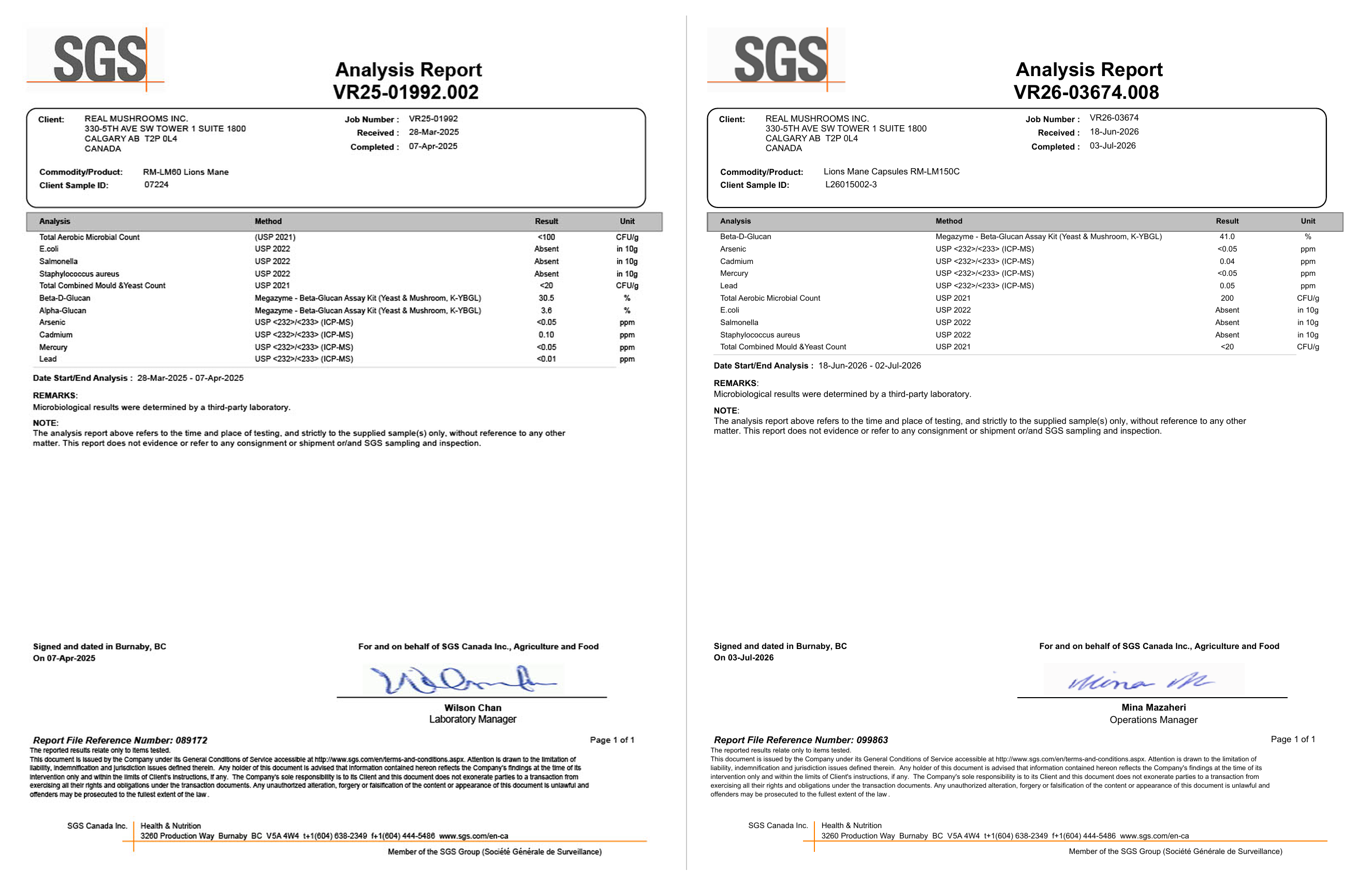
| Real Mushrooms: lion’s mane, reishi and cordyceps | SGS, Apr-Jul 2026; lead 0.05 to 0.11 ppm [11][3] | Yes (sub-lab not named) | 2 each |
| Everyday Dose Coffee+ Mild | ARL, Sep 2025; lead 0.016 ppm [12] | Yes | 2 |
| Oriveda: lion’s mane, reishi and cordyceps | Eurofins, Oct 2026; lead 1.1 and 1.7 mg/kg (cordyceps: lead figure not used) [13][3] | None shown | 1 each |
| Nootropics Depot: lion’s mane, two reishi, two cordyceps | Omnient Labs (affiliated), Jun 2024 to Oct 2026; lead up to 0.17 ppm [14][3] | None shown | 1 each |
| Mushroom Revival Lion’s Mane | Brand’s own 2021 sheet, no lab named | Same sheet | 1 |
| Double Wood Reishi | Figures on its product page for a lot made in May 2026; no lab named | Same, no lab named | 1 |
What do the named-lab reports show?
In the 11 reports whose lead figure I use, lead runs up to 1.7 mg/kg, on Oriveda’s reishi report. Every one is below the EU’s legal maximum for food supplements (3.0 mg/kg) [15][3], and ppm and mg/kg are the same unit. That’s EU law. FDA’s rules set no number [5]. And 5 of the 12 “named lab” reports come from Omnient Labs, a lab Nootropics Depot’s CEO says he created [14].
Only Oriveda shows pesticide results, on the reports for all three of its products. Each has two pesticide panels with nothing above the lab’s reporting limits, though most limits on the reishi report were 20 times those on the cordyceps one. Four Sigmatic, Cuppa and Everyday Dose claim pesticide testing without published results [3].
Each result is one report on one lot. The Scorecard’s top safety score asks for named-lab results for both metals and microbes, and only Real Mushrooms and Everyday Dose show both (how the safety check scores).
Which brands show no test results?
| Product | Heavy metals | Microbes | Safety score |
|---|---|---|---|
| FreshCap: lion’s mane, reishi and cordyceps | Claim only | None shown | 1 each |
| Host Defense: lion’s mane, reishi and cordyceps | “Purity” claim only | None shown | 1 each |
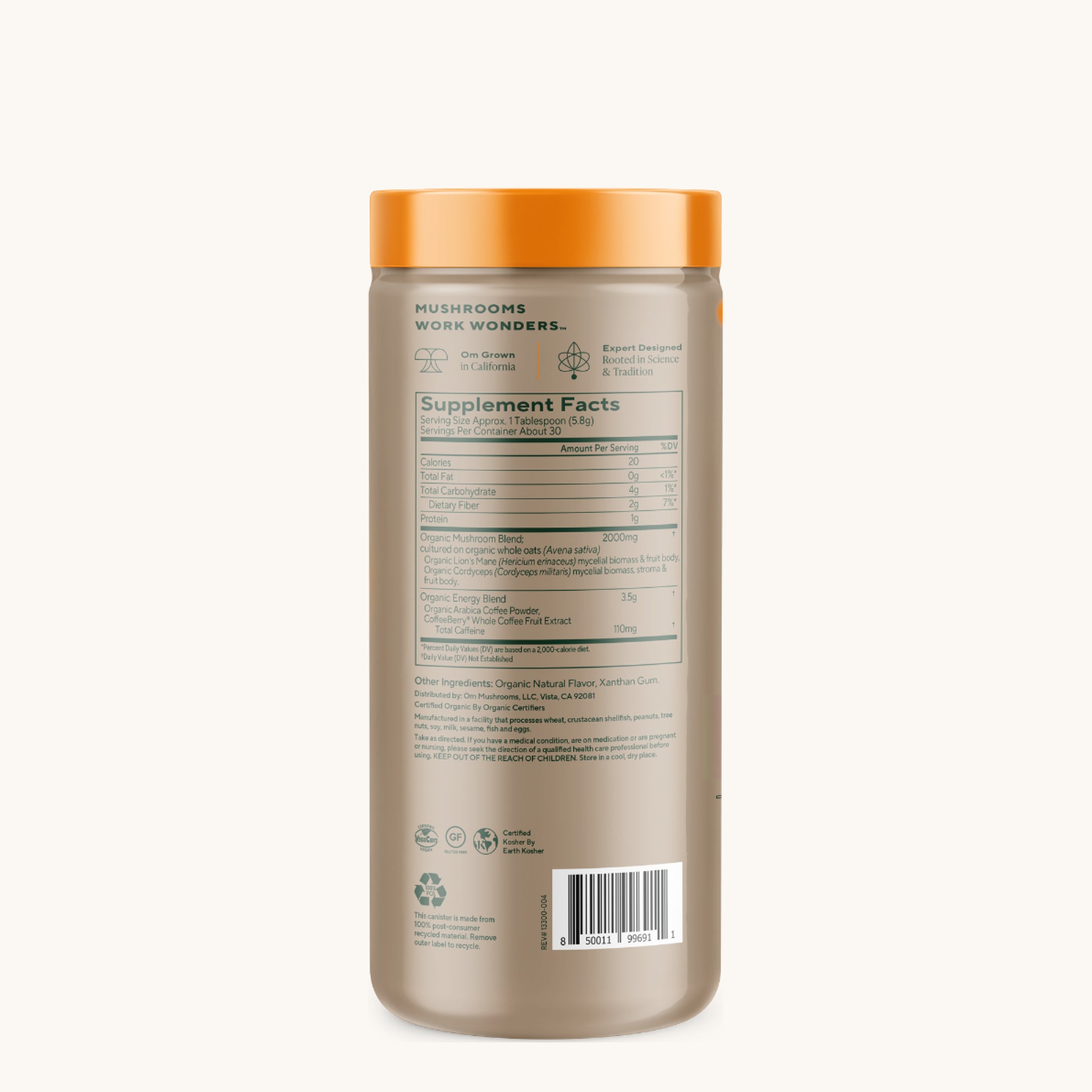
| Om: lion’s mane, reishi and cordyceps capsules; coffee | Claim only | None shown | 1 each |
| NOW Cordyceps | “Quality tested” claim only | None shown | 1 |
| RYZE Mushroom Coffee | Claim only (other ingredients) | None shown | 1 |
| Four Sigmatic Focus coffee | Claim only | Claim only | 1 |
| Cuppa instant coffee | Claim only (the coffee) | Claim only | 1 |
| MUD\WTR Original | Claim only | None shown | 1 |
| Genius Lion’s Mane | No claim (factory certificate only) | None shown | 0 |
| Laird PERFORM coffee | No claim found | None shown | 0 |
Has anyone tested mushroom supplements independently?
Not much in public. I found no independent, peer-reviewed survey of heavy metals in mushroom supplements sold in the US.
The closest is from Italy. A 2023 study tested 19 mushroom supplements from 6 unnamed companies. Lead was above their 0.05 mg/kg reporting limit in 4, and the authors report arsenic, cadmium, mercury and lead all below the EU limits they used. At most 6 of the 19 matched the labeled species by DNA, and one went over the EU limit for aflatoxin [16].
In a 2017 study of reishi supplements sold in the US, researchers tested 19 bought online in 2015. Only 5 matched their labels on what the researchers measured, and 13 held starch-like polysaccharides that an authenticated reishi fruiting body didn’t have [17]. The study didn’t name the brands, and the products are over ten years old. It warns about labels in general.
What happens when something goes wrong with a supplement?
The law puts the first duty on the company. Companies whose name is on the label must send FDA any report they receive of a serious adverse event within 15 business days, and the label must carry a US address or phone number for those reports [18][19]. That covers serious events the company hears about, not every complaint, and the law says a report isn’t an admission that the supplement was responsible [18].
Anyone can report a problem through FDA’s Safety Reporting Portal, as a guest if you like. If you think a supplement gave you or someone you know a serious reaction or illness, FDA’s advice is to “immediately stop using the product and fill out a safety report” [20]. In an emergency, call 911 [21].
Recalls and warning letters for mushroom supplements
On 23 November 2026, I searched FDA’s warning letters and recall reports since January 2023 for lion’s mane, reishi, chaga, cordyceps and turkey tail [22].
- Recalls: none found for contamination (metals, microbes or a wrong species). The ones I found were about labels and packaging, such as undeclared soy lecithin and coconut oil in a reishi coffee and a cordyceps coffee (2024) [22].
- Warning letters: 13 letters about products for people name one of those five mushrooms. 10 involve disease claims, which make a product an unapproved drug in FDA’s eyes; 8 cite manufacturing failures; 5 cite both [22]. The two letters described above are among them [7][10].
None of these firms is on my Scorecard. And a recall search shows what FDA acted on, not what’s in the bottles.
Are mushroom supplements psychedelic?
Lion’s mane, reishi, cordyceps, chaga and turkey tail aren’t in any genus Britannica lists for psilocybin mushrooms. Its entry names Psilocybe and ten other genera with psilocybin-containing species; the five belong to Hericium, Ganoderma, Cordyceps and Ophiocordyceps, Inonotus and Trametes [23][24][25].
The psychedelic “mushroom” products FDA has acted on are different: chocolates and gummies sold for “microdosing”, or as “psychedelic edibles” and “legal psychedelics”.
What was in Diamond Shruumz?
Prophet Premium Blends recalled all flavors of Diamond Shruumz chocolate bars, cones and gummies in June 2024; FDA’s recall page lists them as food, not supplements [26]. FDA’s tests found muscimol, a compound of Amanita muscaria [27], in 9 of 22 chocolate bars, 5 of 10 cones and the raw ingredient. Some samples held psilocin, “a Schedule I-controlled substance”, some pregabalin, “a prescription drug”, and many held compounds from kava [28].
FDA and CDC agree on 180 illnesses in 34 states and 73 hospitalizations [28][29]. On deaths, FDA’s final update (November 2024) counted three potentially associated deaths; CDC’s April 2026 report and its outbreak page (updated August 2026) count two [28][29][30]. CDC doesn’t say why. The 180 include people who ate other brands: 118 reportedly ate a Diamond Shruumz product, and 62 another or an unspecified brand of mushroom chocolate [28].
What has FDA said about Amanita muscaria?
In December 2024, FDA said Amanita muscaria and its compounds muscimol, ibotenic acid and muscarine “are not authorized for use as ingredients in conventional food”, and recommended “that people avoid eating foods with these ingredients” [27]. It has since told two sellers that Amanita muscaria products sold as dietary supplements were adulterated (September 2025 and September 2026) [31].
None of these is lion’s mane, reishi, cordyceps, chaga or turkey tail. If someone sells a “mushroom” product as psychedelic or for microdosing, it isn’t the kind of product this site scores.
Can mushroom supplements hurt your liver? Where to read about side effects
A label can’t tell you. Start with NIH’s LiverTox and Memorial Sloan Kettering’s About Herbs pages. A LiverTox record is NIH’s entry on whether a drug or supplement has been linked to liver injury, with an overview, product information and a list of published reports [24]. LiverTox has records for 3 of the 7 species below.
| Species | NIH LiverTox record | MSKCC page (last updated) |
|---|---|---|
| Lion’s mane (Hericium erinaceus) | Yes: Lion’s Mane, 5 Jan 2024 | Lion’s Mane Mushroom, 19 Nov 2025 |
| Reishi (Ganoderma) | Yes: Lingzhi, Reishi, 5 Oct 2024 | Reishi Mushroom, 5 May 2026 |
| Cordyceps (Cordyceps, Ophiocordyceps) | Yes: Cordyceps, 23 Jul 2026 | Cordyceps, 18 Jan 2023 |
| Chaga (Inonotus obliquus) | None found, as of 23 Nov 2026 | Chaga Mushroom, 3 Dec 2025 |
| Turkey tail (Trametes versicolor) | None found, as of 23 Nov 2026 | Coriolus versicolor, 22 Apr 2026 |
| Shiitake (Lentinula edodes) | None of its own, as of 23 Nov 2026 | Shiitake Mushroom, 23 May 2025 |
| Maitake (Grifola frondosa) | None of its own, as of 23 Nov 2026 | Maitake, 9 Jul 2026 |
“No record” isn’t a sign of safety, and a record isn’t a sign of risk. What each trial recorded about side effects is on the lion’s mane, reishi and cordyceps pages.
What should you tell your doctor or pharmacist?
NIH’s Office of Dietary Supplements gives lines worth taking with you [6]:
- “the term natural doesn’t always mean safe”
- supplements “can also interact with some medicines”
- before “any type of surgical procedure, talk with your health care provider about any supplements you take”
- tell your health care providers “about any dietary supplements you’re taking”
Mycelium on grain: a question if you avoid gluten
I have celiac disease. If you avoid gluten too, and a product is mycelium grown on grain, ask the maker which grain and whether it’s certified gluten-free, and skip it if the answer isn’t clear.
Among the products I’ve scored, Host Defense’s three grow mycelium on brown rice, four from Om (three capsules, one coffee) and Genius on oats, and MUD\WTR on oats and/or sorghum, all sold with the grain they grew on [3]. Host Defense’s FAQ calls all its products gluten-free, and the pages for Om’s lion’s mane capsules and coffee, Genius and MUD\WTR describe the product or its grain that way. None of them publishes a gluten test result I could find. Om says every production lot “is tested for gluten at 10 parts per million” and shows no result. Om’s coffee label also says it’s “Manufactured in a facility that processes wheat” and other allergens [32].
Under FDA’s rule, a food labeled gluten-free must keep any gluten it can’t avoid below 20 ppm, and the rule covers supplements. Wheat, rye and barley are the gluten grains. Oats and rice aren’t [33].
Whether oats or rice suit you is a question for your doctor.
Are mushroom supplements safe? What I’d check before buying
- Find the lab report for your lot. A named lab, the four metals and microbes, dated within the last 24 months or matching the lot on your bottle. No report online? Ask the brand. A line about quality doesn’t count.
- Read the species and the part on the label. The Latin name, and “fruiting body” or “mycelium” plus what it grew on.
- If something goes wrong, stop and report it to FDA’s Safety Reporting Portal (911 in an emergency) and to the maker, through the contact on the label [6][19][20][21].
Step 1 is the one most brands make hard. The Scorecard links every certificate I found.
Part of How to choose
Extracts, daily use, pregnancy and Prop 65
Are mushroom extracts safe?
Same answer as for any mushroom supplement. What’s in a given extract is a lab question, so look for a named lab’s metal and microbe results for your lot.
Are functional mushrooms safe to take every day?
A label gives you a serving, not a verdict on daily use. A daily habit also means many lots, and each lab report covers one, so ask for the report on your lot.
Are mushroom supplements safe during pregnancy or for kids?
Ask your doctor before you start. NIH’s Office of Dietary Supplements says many supplements “have not been well tested for safety in children and in women who are pregnant or nursing”, and advises care with both [6].
Is “third-party tested” a guarantee?
No. 17 of the 31 products I’ve scored stop at the claim or at figures that name no lab [3]. Even a USP or NSF seal isn’t a promise. NIH’s Office of Dietary Supplements says such seals “do not guarantee that a product is safe or effective” [6].
Do mushroom coffees have the same testing gaps?
Mostly, yes, and the coffee labels show it. Of the 7 mushroom coffees I’ve scored, 1 publishes metal and microbe results: Everyday Dose, for one lot from September 2025. Five claim testing and show no results. Laird makes no claim I could find [3].
Does Prop 65 mean a product is unsafe?
No, and it doesn’t mean safe either. A Prop 65 warning means the seller says you’re exposed to a chemical on California’s list above a threshold. California’s Attorney General says that’s “not the same as a regulatory decision that a product is ‘safe’ or ‘unsafe.’” For lead, the threshold is a daily exposure (0.5 micrograms a day), not an amount in the product. For the number, ask the company for its lab report [34].
Sources
- FDA, “Questions and Answers on Dietary Supplements” (content current as of 08/27/2026). fda.gov checked 22 Nov 2026
- FDA, “Dietary Supplements” (content current as of 10/01/2024). fda.gov checked 22 Nov 2026
- Mycology at Home Scorecard data (CSV): the safety, contents and testing columns for all 31 products, with each brand’s testing page and certificate. mycologyathome.com (NOW’s page from an Internet Archive copy of 12 Nov 2026; counts as of 25 Nov 2026) checked 22-24 Nov 2026
- 21 CFR 111.75 (eCFR, Title 21 up to date as of 19 Nov 2026): identity testing, finished-batch sampling. ecfr.gov checked 23 Nov 2026
- 21 CFR 111.70 (eCFR): specifications, including contamination limits. ecfr.gov checked 23 Nov 2026
- NIH Office of Dietary Supplements, “Dietary Supplements: What You Need to Know” (updated 4 Jan 2023). ods.od.nih.gov checked 23 Nov 2026
- FDA warning letter to Brand Packaging Group, Inc., 17 Mar 2023. fda.gov checked 23 Nov 2026
- USP, “USP Verified Mark”. usp.org checked 22 Nov 2026
- NSF, “Supplement and Vitamin Certification” and “Selecting Dietary and Nutritional Supplements”. nsf.org · nsf.org checked 22 Nov 2026
- FDA warning letter to Restorative Botanicals, LLC, 13 Aug 2024 (content current as of 09/24/2024). fda.gov checked 23 Nov 2026
- Real Mushrooms, SGS Canada reports VR26-03674.008 and VR25-01992.002 (one image). realmushrooms.com checked 22 Nov 2026
- Everyday Dose, ARL (Analytical Resource Laboratories, Lehi, Utah) report, Coffee+ Mild, lot MG237J1, released 25 Sep 2025. cdn.shopify.com checked 22 Nov 2026
- Oriveda, Eurofins certificates 1410549-S (Eurofins ARL) and 5533050-0 (Eurofins Madison), lot 2026-27B. oriveda.com checked 22 Nov 2026
- Nootropics Depot, Lion’s Mane 8:1 certificate from Omnient Labs: cdn11.bigcommerce.com · “A Message From Our CEO, Paul” (Omnient Labs line) nootropicsdepot.com checked 22-23 Nov 2026
- Commission Regulation (EU) 2023/915, maximum levels for contaminants in food (original text). eur-lex.europa.eu checked 22 Nov 2026
- Risoli S, Nali C, Sarrocco S, et al. “Mushroom-Based Supplements in Italy: Let’s Open Pandora’s Box.” Nutrients 2023;15(3):776. doi.org/10.3390/nu15030776 checked 23 Nov 2026
- Wu DT, Deng Y, Chen LX, et al. “Evaluation on quality consistency of Ganoderma lucidum dietary supplements collected in the United States.” Scientific Reports 2017;7:7792. doi.org/10.1038/s41598-017-06336-3 checked 23 Nov 2026
- 21 U.S.C. 379aa-1, serious adverse event reporting for dietary supplements (US Code, 2024 edition, GovInfo). govinfo.gov checked 23 Nov 2026
- 21 U.S.C. 343(y), the label’s domestic address or phone number (US Code, 2024 edition, GovInfo). govinfo.gov checked 23 Nov 2026
- FDA, “How to Report a Problem with Dietary Supplements” (content current as of 03/13/2025). fda.gov checked 23 Nov 2026
- FDA, “When and Where to Report Emergencies” (content current as of 01/29/2018). fda.gov checked 23 Nov 2026
- FDA warning letters, searched by full text for lion’s mane, hericium, reishi, ganoderma, chaga, cordyceps, turkey tail, trametes versicolor, coriolus and “mushroom” terms, letters issued 1 Jan 2023 or later; and FDA recall (enforcement) reports through openFDA, searched by the same species names, 2023 onward (recalls H-0344-2026, F-1206-2024, F-1207-2024, H-0014-2025 to H-0016-2025). fda.gov · api.fda.gov checked 23 Nov 2026
- Encyclopaedia Britannica, “Psilocybin mushroom” (genera with psilocybin-containing species). britannica.com checked 23 Nov 2026
- NIH LiverTox (National Institute of Diabetes and Digestive and Kidney Diseases): home ncbi.nlm.nih.gov · Lion’s Mane ncbi.nlm.nih.gov · Lingzhi, Reishi ncbi.nlm.nih.gov · Cordyceps ncbi.nlm.nih.gov. Record dates from PubMed and Europe PMC; LiverTox searched by common and Latin name for chaga, turkey tail, shiitake and maitake, no record of their own found. checked 23 Nov 2026
- Memorial Sloan Kettering, About Herbs pages (“Last Updated” dates as shown in the table): mskcc.org · mskcc.org · mskcc.org · mskcc.org · mskcc.org · mskcc.org · mskcc.org checked 23 Nov 2026
- Prophet Premium Blends, “Prophet Premium Blends Recalls Diamond Shruumz Products Because of Possible Health Risk” (company announcement 27 Jun 2024, posted by FDA 28 Jun 2024). fda.gov checked 23 Nov 2026
- FDA Constituent Update, “FDA Alerts Industry and Consumers about the Use of Amanita Muscaria or its Constituents in Food” (18 Dec 2024). fda.gov checked 23 Nov 2026
- FDA, “Investigation of Illnesses: Diamond Shruumz-Brand Chocolate Bars, Cones, & Gummies (June 2024)” (content current as of 11/15/2024). fda.gov checked 23 Nov 2026
- CDC, “Outbreak Investigation of Illnesses Linked to Diamond Shruumz Products” (published 18 Jun 2024; updated 11 Aug 2026). cdc.gov checked 23 Nov 2026
- Rumph JT, Winquist A, Troeschel AN, et al. “Severe Illness Associated with Eating Mushroom-Containing Chocolate Products, United States, January-October 2024.” MMWR 2026;75(13):179-184 (9 Apr 2026). cdc.gov checked 23 Nov 2026
- FDA warning letters to Blue Forest Farms, LLC (11 Sep 2025) and Psyched Wellness Ltd. (29 Sep 2026). fda.gov · fda.gov checked 23 Nov 2026
- Gluten statements on the brands’ own pages: Host Defense FAQ hostdefense.com · Om Lion’s Mane Capsules ommushrooms.com · Om Mushroom Coffee Blend ommushrooms.com and its canister label (wheat-facility line, “GF” mark) ommushrooms.com · Genius Lion’s Mane thegeniusbrand.com · MUD\WTR Original mudwtr.com checked 22-23 Nov 2026
- FDA gluten-free rule, 21 CFR 101.91, and FDA’s Questions and Answers on the gluten-free rule. ecfr.gov · fda.gov checked 22 Nov 2026
- California Department of Justice, Office of the Attorney General, Proposition 65 “Frequently Asked Questions” (no page date shown). oag.ca.gov checked 23 Nov 2026
Cite this page
Quoting with a link is always fine. The Scorecard data and my own charts are free to reuse under CC BY 4.0: add "CC BY 4.0" to the citation. Photos and the page text aren't covered.
Citation
Rowan Hale, "Are Mushroom Supplements Safe? Who Checks Them and What Lab Reports Show", Mycology at Home, https://mycologyathome.com/are-mushroom-supplements-safe/. Data checked 23 Nov 2026. Retrieved [the date you read it].
Tap the citation to select it.
- Key findings
- Sources on this page
- CC BY 4.0Data and my charts only